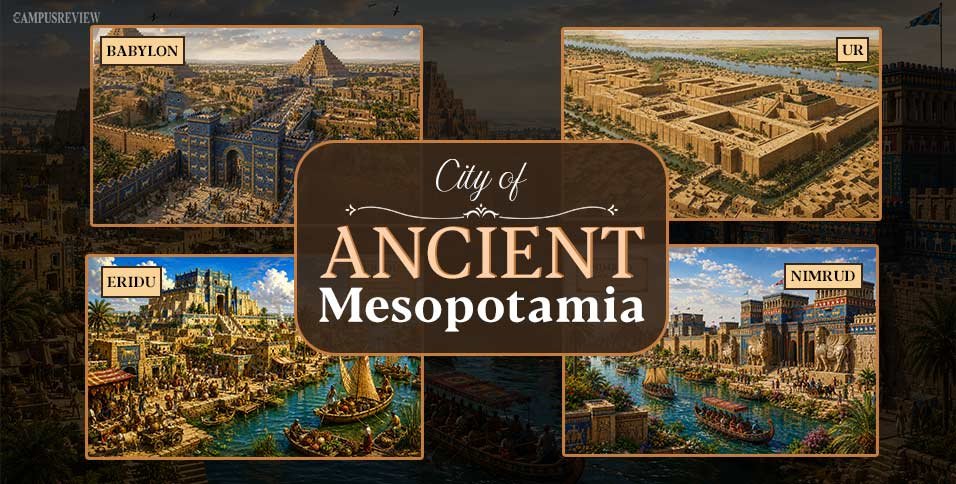
What was the first city in the world? The answer lies in the city of ancient Mesopotamia, the region between the Tigris and Euphrates rivers in modern-day Iraq. This land gave rise to the world’s earliest cities, writing, and laws.
In this guide, you’ll explore 12 famous examples of such cities. You will learn where each city stood, who ruled it, how many people lived there, and what it gave to the world.
What Is Ancient Mesopotamia?
Mesopotamia means “land between two rivers” in Greek. The two rivers are the Tigris and the Euphrates. This area covers modern Iraq and parts of Syria, Turkey, and Iran.
People often call Mesopotamia the cradle of civilization. Here is why:
- People built the first cities here.
- They invented cuneiform writing, the first writing system in the world.
- They built the ziggurat, a huge stepped temple made of mudbrick.
- They wrote the first law codes.
- They split time into hours and minutes, a system we still use today.
The history of Mesopotamia is divided into three main stages. Each stage has its own famous cities.
| Stage | Time Period | Known For |
| Sumerian city-states | 4000 – 2350 BC | First cities, first writing |
| Akkadian Empire | 2350 – 2100 BC | First empire, joining many cities |
| Babylonian and Assyrian Empires | 1900 – 539 BC | Law codes, libraries, huge capitals |
Where Was Mesopotamia Located?
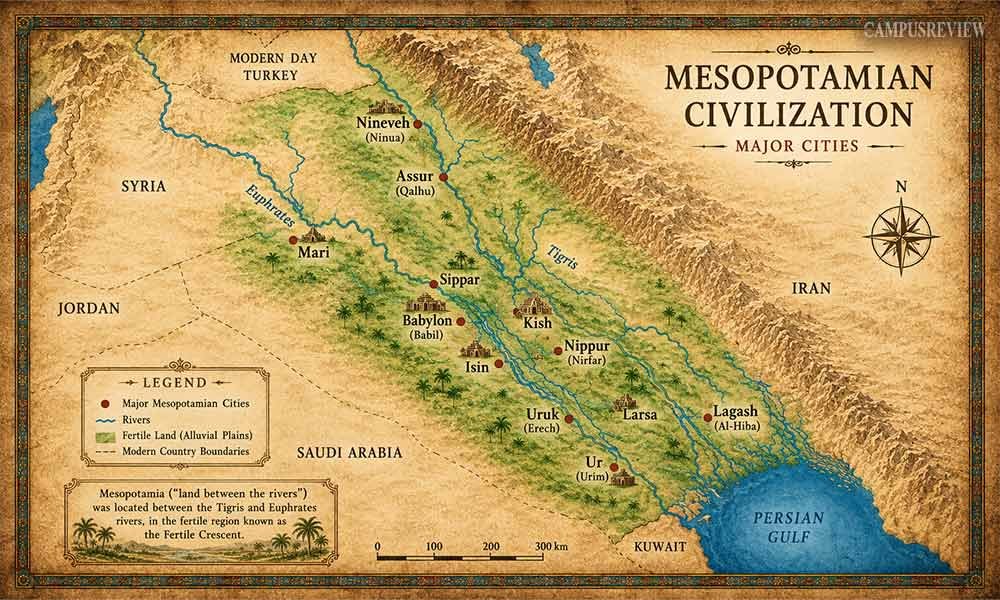
Picture a Mesopotamia map of the Middle East. Mesopotamia sits inside the Fertile Crescent, a curved strip of land good for farming. The Tigris and Euphrates rivers flow through it, from the hills of Turkey down to the Persian Gulf.
Mesopotamia splits into two zones:
- Upper Mesopotamia (north): hills and rain-fed farms. This is where Assyrian capital cities like Nineveh and Assur stood.
- Lower Mesopotamia (south): flat, dry land. Farmers here depended on canals from the rivers. This is where the earliest Sumerian cities grew, like Uruk, Ur, and Eridu.
12 Famous Cities of Ancient Mesopotamia
Now let’s look at each city of ancient Mesopotamia one by one. Each one played a real part in building Mesopotamian civilization as we study it today.
1. Eridu: The Oldest City in the World
| Region | Southern Sumer |
| Peak Years | 5000 – 3500 BC |
| Population | 5,000 – 10,000 |
| Famous For | Oldest city in the world, temple of Enki |
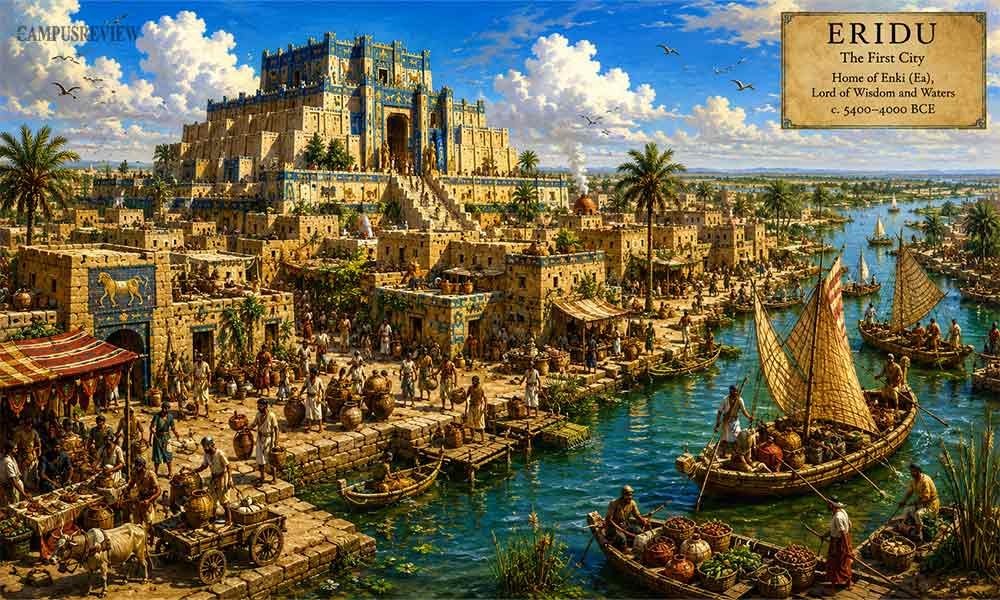
Eridu holds the title of the oldest city in the world, at least in Sumerian myth. Ancient Sumerians believed that kingship itself descended from heaven at Eridu before a great flood.
Eridu sat about 12 km from Ur. It was the home of Enki, the god of fresh water and wisdom.
Archaeologists found 18 temples built one on top of the other at this one spot. Each generation built its temple over the last one. This shows people worshipped here for thousands of years without a break.
Over time, the Euphrates River shifted away from Eridu. The city of ancient Mesopotamia could no longer farm properly. People left, and Eridu became a quiet temple site instead of a busy city.
Quick fact: Eridu is part of the Ahwar of Southern Iraq, a UNESCO World Heritage Site.
2. Uruk: The First True City
| Region | Southern Sumer |
| Peak Years | 4000 – 3100 BC |
| Population | 50,000 – 80,000 |
| Famous For | First writing, King Gilgamesh |
If Eridu was the myth, Uruk was the reality. Most historians call Uruk city the world’s first true urban center.
By 2900 BC, Uruk covered 6 square km. A wall 9 km long circled the city. Uruk city held between 50,000 and 80,000 people at its peak. That made it the biggest city on Earth at the time.
Uruk gave the world its most famous ancient king: Gilgamesh, one of the greatest rulers. He ruled around the 27th century BC and built Uruk’s great walls. His story became the Epic of Gilgamesh, the oldest major work of literature that survives today.
Uruk also produced the earliest examples of cuneiform writing. Temple workers first used it to track grain, animals, and land.
Quick fact: Uruk also gave us the cylinder seal, a stone tool people rolled on wet clay to sign documents. Think of it as the world’s first signature.
3. Ur: Home of Royal Tombs and Wheels
| Region | Southern Sumer |
| Peak Years | 2112 – 2004 BC |
| Population | 20,000 – 50,000 |
| Famous For | Royal Cemetery, Great Ziggurat |
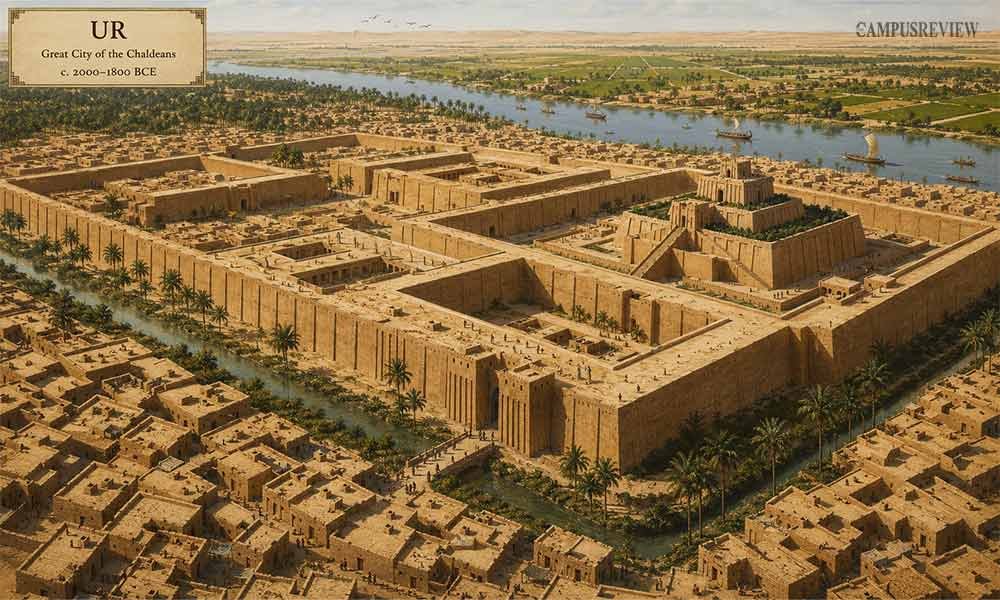
The city of Ur sat near where the Euphrates met the Persian Gulf. This spot made Ur the city of ancient Mesopotamia a top trading port. Ships came from Dilmun (Bahrain), Magan (Oman), and even the Indus Valley.
King Ur-Nammu ruled Ur around 2112 to 2095 BC. He wrote the Code of Ur-Nammu, the oldest known law code in the world. It came centuries before the more famous Code of Hammurabi.
In the 1920s, archaeologist Leonard Woolley dug up Ur’s Royal Cemetery. He found 16 royal tombs packed with gold, silver, and jewels. He also found ancient wagons with wooden wheels and leather tires, among the earliest wheeled vehicles ever found.
Ur also has a huge ziggurat, a three-tier temple built for the moon god Nanna. Many religious traditions name Ur as the hometown of the patriarch Abraham.
Quick fact: Ur, Uruk, and Eridu together form one UNESCO site called the Ahwar of Southern Iraq.
4. Nippur: The Religious Capital
| Region | Central Sumer |
| Peak Years | Throughout the Sumerian era |
| Population | Not fully known |
| Famous For | Temple of Enlil, no king ever ruled here |
Nippur never became a royal capital. Instead, it worked as the religious heart of Sumer. Nippur held the main temple of Enlil, the chief Sumerian god of air and storms.
Sumerian kings from other cities traveled to Nippur to get blessed by Enlil’s priests. A king was not seen as fully legal unless Nippur approved him. This makes Nippur one of the most important Sumerian cities, even without political power.
Archaeologists found thousands of clay tablets at Nippur. These include hymns, school texts, and even ancient math problems. Students today can still read what Sumerian students wrote in school over 4,000 years ago.
Quick fact: Nippur gives us our best look at daily Sumerian school life, called the edubba, or tablet house.
5. Kish: Where Kingship Began After the Flood
| Region | Northern Sumer |
| Peak Years | Early Dynastic Period |
| Population | Not fully known |
| Famous For | First city with kings after the flood, in Sumerian myth |
Sumerian tradition says Kish was the first city to have kings again after a great flood wiped out earlier cities. Because of this, rulers across ancient Mesopotamia often used the title King of Kish to show they held real power, even when they ruled from another city.
Kish sat close to where Babylon would later rise. It fought many wars with Uruk over control of land and water.
Archaeologists found early palace buildings at Kish. These count among the oldest royal palaces ever discovered in Mesopotamia.
Quick fact: Sargon of Akkad started his career as a cupbearer at the court of Kish, before he built his own empire.
6. Lagash: The City With the Oldest Records
| Region | Southern Sumer |
| Peak Years | 2500 – 2350 BC |
| Population | Not fully known |
| Famous For | Detailed records, King Eannatum |
Lagash left behind more written records than almost any other Sumerian city of ancient Mesopotamia. Its rulers documented wars, land deals, temple accounts, and taxes in careful detail.
King Eannatum of Lagash left us the Stele of the Vultures. This stone carving shows the Lagash army marching in formation. It is one of the earliest pictures of organized warfare in human history.
Lagash also fought a long border war with the city of Umma over farmland and canal rights. Clay tablets recording this dispute count among the oldest legal documents on Earth.
Quick fact: Lagash was one of the first cities to record anti-corruption reforms under its ruler Urukagina.
7. Akkad: The Lost Capital of the First Empire
| Region | Central Mesopotamia (exact site unknown) |
| Peak Years | 2334 – 2154 BC |
| Population | Not known |
| Famous For | First empire in world history, King Sargon |
Akkad holds a strange record. It was the capital of the world’s first true empire, yet archaeologists have never found its exact location.
Around 2334 BC, King Sargon of Akkad conquered the Sumerian city-states one by one. He built the Akkadian Empire, joining many cities and languages under one ruler for the first time in history. This makes Akkad the starting point for all later Akkadian Empire cities and the empires that followed it.
Sargon’s grandson, Naram-Sin, expanded the empire further and even called himself a god. But the empire fell within two centuries, due to invasions, drought, and revolt.
Quick fact: Historians believe Akkad may still lie buried somewhere near modern Baghdad, waiting to be found.
8. Babylon: The Most Famous Ancient City
| Region | Central Mesopotamia |
| Peak Years | 1792 – 539 BC |
| Population | 100,000 – 200,000 |
| Famous For | Code of Hammurabi, Ishtar Gate |
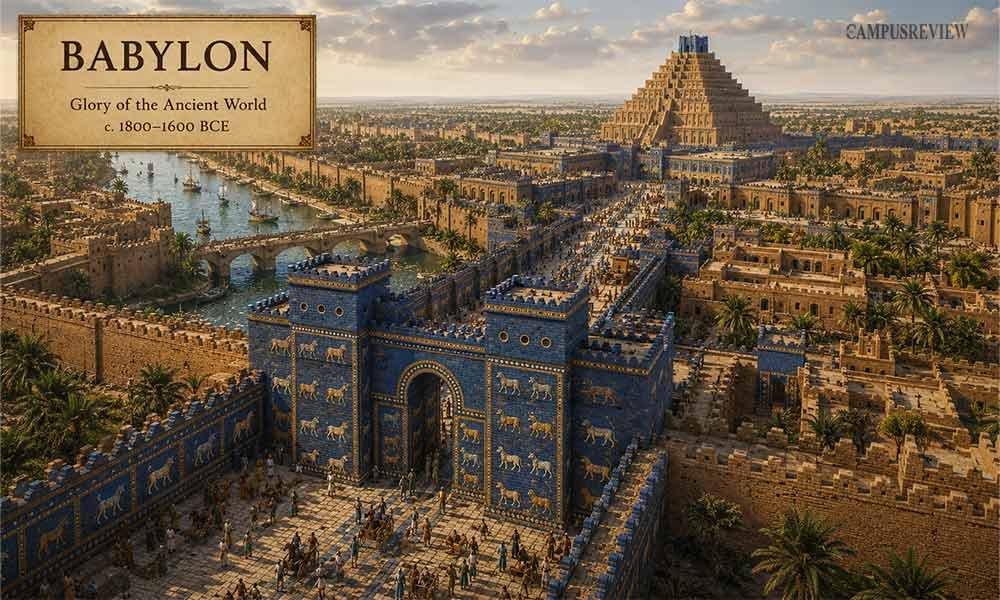
Babylon, the city of ancient Mesopotamia, is probably the most famous name on this list. It sat on the Euphrates, about 85 km south of modern Baghdad.
King Hammurabi ruled Babylon from 1792 to 1749 BC. He built the Code of Hammurabi, a set of 282 laws carved onto a stone pillar. These laws covered trade, property, family life, and crime. This code shaped the entire Babylonian Empire that followed.
Centuries later, King Nebuchadnezzar II rebuilt Babylon into a massive capital. He built the Ishtar Gate, covered in glazed blue bricks and images of dragons and bulls. He also built the Etemenanki ziggurat, a 91-meter tower that likely inspired the biblical Tower of Babel story.
Babylon led the ancient world in math and astronomy. Its scribes used a base-60 number system. This is why we still split an hour into 60 minutes and a circle into 360 degrees.
Quick fact: Babylon became a UNESCO World Heritage Site in 2019.
9. Mari: The Trading City on the Euphrates
| Region | Upper Euphrates, near modern Syria |
| Peak Years | 1900 – 1759 BC |
| Population | Not fully known |
| Famous For | Royal palace, huge letter archive |
Mari sat further up the Euphrates than the other cities on this list, closer to modern Syria. It grew rich as a trade stop between Mesopotamia and the Mediterranean coast.
Mari’s royal palace covered nearly 2.5 hectares and had around 300 rooms. Archaeologists found over 20,000 clay tablets here, many of them letters between kings, spies, and officials.
These letters give historians a rare, personal look at daily politics in the ancient Near East. They talk about marriages, wars, trade deals, and even gossip between royal courts.
Mari’s independence ended when King Hammurabi of Babylon destroyed the city around 1759 BC.
Quick fact: Mari’s letter archive is one of the best sources historians have for understanding how Mesopotamian city-states actually talked to each other.
10. Assur: The Religious Heart of Assyria
| Region | Northern Mesopotamia |
| Peak Years | 2000 – 614 BC |
| Population | 20,000 – 40,000 |
| Famous For | Original Assyrian capital, temple of the god Ashur |
Assur gave the Assyrian people their name and their god. The city sat on the Tigris river in the north, in what historians call Upper Mesopotamia.
Assur worked first as a trading hub. Assyrian merchants ran trade posts as far away as central Turkey, trading textiles and metal.
Later, Assur became the first Assyrian capital, and it stayed the religious center even after kings moved the political capital elsewhere. Every Assyrian king had to be crowned at Assur to be seen as legitimate.
Quick fact: Assur is a UNESCO World Heritage Site, but it is also on the endangered list due to conflict and a planned dam project.
11. Nimrud: A Royal Assyrian Capital
| Region | Northern Mesopotamia |
| Peak Years | 883 – 859 BC (as capital) |
| Population | Not fully known |
| Famous For | King Ashurnasirpal II, ivory carvings |
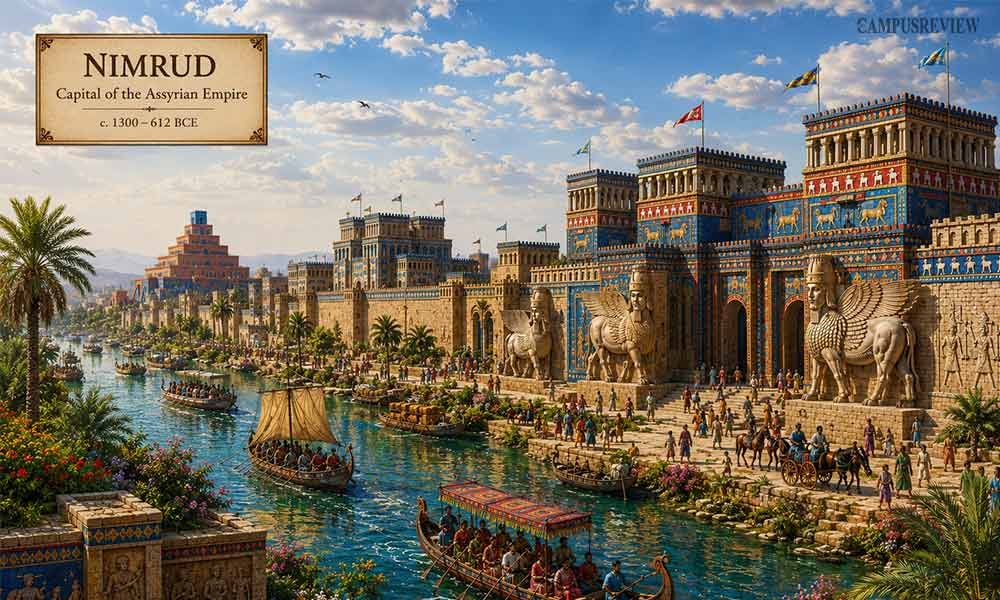
King Ashurnasirpal II made Nimrud his new capital around 879 BC, moving power away from Assur. He threw a famous opening feast said to have fed over 69,000 guests.
Nimrud’s royal palace held detailed stone carvings showing hunts, wars, and winged guardian spirits called lamassu. Archaeologists also found stunning ivory carvings here, some of the finest art from the ancient Near East.
Nimrud remained an important Assyrian capital city of ancient Mesopotamia until the fall of the Assyrian Empire in the late 600s BC.
Quick fact: Parts of Nimrud were destroyed in recent conflict, which makes old photos and records even more valuable to historians today.
12. Nineveh: The Last Great Assyrian Capital
| Region | Northern Mesopotamia |
| Peak Years | 705 – 612 BC |
| Population | Over 100,000 |
| Famous For | Royal Library, Kings Sennacherib and Ashurbanipal |
Nineveh sat across the Tigris River from modern Mosul. King Sennacherib made it his capital in 705 BC and turned it into one of the largest cities on Earth.
Sennacherib built a 12 km wall around the city, with 15 gates. He also built the Palace Without Rival, decorated with carved scenes of battles and lion hunts.
His grandson, Ashurbanipal, built the Royal Library of Ashurbanipal. This held over 30,000 clay tablets. Scholars later found copies of the Epic of Gilgamesh and the Enuma Elish, the Babylonian creation story, inside it.
Nineveh fell in 612 BC when Babylonian and Median armies destroyed it. This defeat ended the Neo-Assyrian Empire and opened the door for the Neo-Babylonian Empire to take over the region.
Quick fact: Without Ashurbanipal’s library, historians might never have recovered the full text of the Epic of Gilgamesh.
Comparison Table: 12 Famous Cities of Ancient Mesopotamia
Use this table for quick revision before your exam.
| City | Region | Peak Era | Best Known For |
| Eridu | Southern Sumer | 5000 – 3500 BC | Oldest city, temple of Enki |
| Uruk | Southern Sumer | 4000 – 3100 BC | First writing, King Gilgamesh |
| Ur | Southern Sumer | 2112 – 2004 BC | Royal Cemetery, ziggurat |
| Nippur | Central Sumer | Sumerian era | Religious capital, temple of Enlil |
| Kish | Northern Sumer | Early Dynastic | Kingship after the flood |
| Lagash | Southern Sumer | 2500 – 2350 BC | Oldest detailed records |
| Akkad | Central Mesopotamia | 2334 – 2154 BC | First empire, King Sargon |
| Babylon | Central Mesopotamia | 1792 – 539 BC | Code of Hammurabi, Ishtar Gate |
| Mari | Upper Euphrates | 1900 – 1759 BC | Royal palace, letter archive |
| Assur | Northern Mesopotamia | 2000 – 614 BC | Original Assyrian capital |
| Nimrud | Northern Mesopotamia | 883 – 859 BC | Ashurnasirpal II, ivory art |
| Nineveh | Northern Mesopotamia | 705 – 612 BC | Royal Library, Gilgamesh tablets |
Conclusion
These 12 cities built the base of world history. Cities of ancient Mesopotamia gave us writing, law, math, and the first empires. Each city of ancient Mesopotamia on this list solved its own problems in its own way, from Eridu’s temples to Nineveh’s library.
Next time you read about the Fertile Crescent cities in class, you will know exactly which city did what. Keep this guide handy for revision, and use the comparison table above for quick recall before exams.
FAQs
1. Where is the city of ancient Mesopotamia located today?
Most sites of a city of ancient Mesopotamia are located in modern-day Iraq, while a few extend into Syria, Turkey, and Iran.
2. What made Uruk different from other Mesopotamian cities?
Uruk stood out because it was one of the first true cities in history. It introduced large-scale urban planning, monumental temples, and the earliest known form of cuneiform writing.
3. Did all cities of ancient Mesopotamia belong to the same empire?
No. Many cities of ancient Mesopotamia began as independent city-states before later becoming part of larger empires such as the Akkadian, Babylonian, and Assyrian Empires.
4. What is a ziggurat?
A ziggurat is a tall, stepped temple tower made of mudbrick. Sumerians and Babylonians built ziggurats to honor their gods. The Great Ziggurat of Ur and the Etemenanki in Babylon are two famous examples.