A figure of speech is language that adds color, emotion, or emphasis to a sentence. Writers use it in poetry, speeches, and everyday conversation. You use figures of speech every day when you say “my heart is racing” or “she has a heart of gold.”
This guide covers 20 common figures of speech with simple definitions and examples. You’ll also learn how to identify them, understand similes and metaphors and use simple tricks to remember them.
What Is a Figure of Speech?
A figure of speech is a word or phrase used in a non-literal way to make language more vivid, emotional, and memorable.
Language has two forms: literal and figurative. Literal language says exactly what it means. Figurative language uses comparison, exaggeration, or wordplay to say more than the plain words suggest.
Look at this simple pair of sentences:
Literal: The child is very fast.
Figurative: The child runs like the wind.
Both sentences describe speed. But the second one paints a picture. It compares the child to wind, so you feel the motion instead of just reading a fact.
People use figures of speech to make ideas easier to picture, add feeling to a message, and make sentences memorable. You will find them in song lyrics, movie dialogue, news headlines, and classroom textbooks alike.
What Are the Different Types of Figures of Speech?
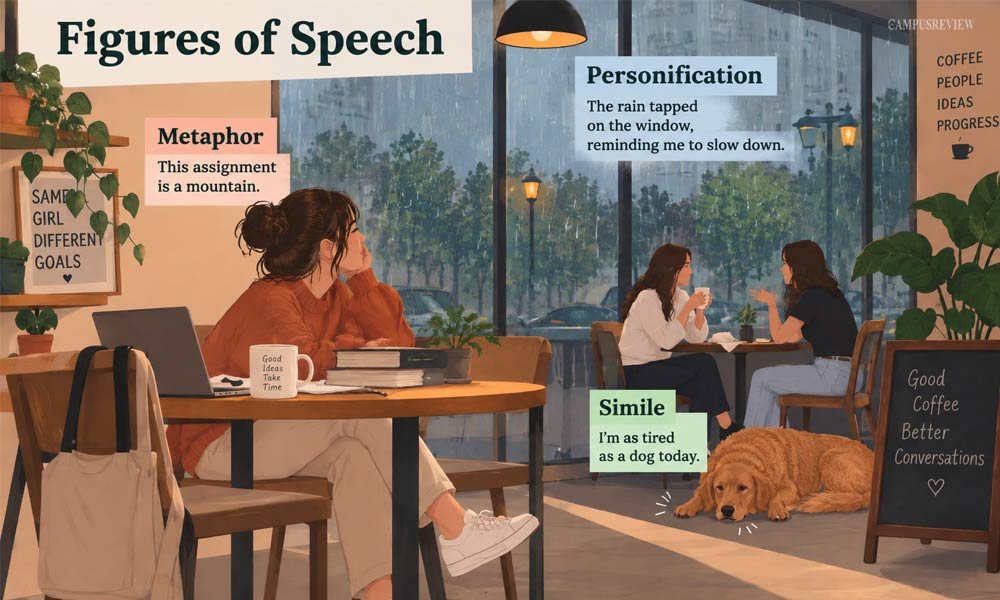
Figures of speech can be grouped into two broad categories: tropes and schemes.
- Tropes change the usual meaning of a word or phrase. They make you understand an idea in a different way. Simile, metaphor, and personification are common examples of tropes.
- Schemes change the way words are arranged or repeated without changing their basic meaning. Alliteration and repetition are examples of schemes because they affect the sound, pattern, or structure of a sentence.
The common types of figures of speech include simile, metaphor, personification, hyperbole, alliteration, onomatopoeia, oxymoron, and irony. Used by some of the greatest authors, helping them make their writing more vivid, expressive, and memorable.
| Figure of Speech | Meaning | Example |
| Simile | Compares two things using “like” or “as” | Her smile was like sunshine. |
| Metaphor | Says one thing is another thing | The classroom was a zoo. |
| Personification | Gives human traits to non-human things | The flowers danced in the breeze. |
| Hyperbole | Uses extreme exaggeration | This bag weighs a ton. |
| Alliteration | Repeats the same starting sound | Silly snakes slither slowly. |
| Onomatopoeia | Uses words that copy real sounds | The bacon sizzled in the pan. |
| Oxymoron | Joins two opposite words | The room was filled with deafening silence. |
| Irony | Says the opposite of what actually happens | A swimming coach forgets how to swim. |
Scholars have identified more than 30 types of figures of speech over the centuries. This guide focuses on the 20 most common ones, so you can learn what matters without getting lost in rare terms.
20 Common Figures of Speech Examples
Each entry below gives you a definition, a real example, and a short note on how it works. Read them in order, or jump straight to the one you need.
1. Simile
A simile compares two different things using the words “like” or “as.” It points out a shared quality between them, such as speed, courage, or beauty, without saying the two things are identical.
Example: My love is like a red, red rose.
How it works: The word “like” keeps the comparison open. You know the speaker means the person shares the rose’s beauty, not that she is literally a flower.
2. Metaphor
A metaphor states that one thing is another thing. It skips comparison words like “like” or “as” and makes a direct claim instead, so the two ideas blend into one strong image.
Example: Time is a thief.
How it works: This sentence does not compare time to a thief. It says time is a thief. The image suggests that time takes things away quietly, just like a thief steals without warning.
3. Personification
Personification gives human actions, feelings, or traits to objects, animals, or ideas that cannot actually think or act. Writers use it to make things like weather, machines, or emotions feel alive and easier to relate to.
Example: The wind whispered through the trees.
How it works: Wind cannot whisper. But describing it this way helps you imagine a soft, gentle breeze instead of just stating that air moved past the leaves.
4. Hyperbole
Hyperbole uses extreme exaggeration to make a point. Nobody expects you to believe the statement literally, since the real goal is to show strong feeling, not to state a fact.
Example: This backpack weighs a ton.
How it works: No school backpack weighs 2,000 pounds. But saying it does gets across just how heavy and tiring it feels to carry.
5. Alliteration
Alliteration repeats the same starting consonant sound in words that sit close together in a sentence. This repeated sound gives the line a catchy rhythm that is easy to say out loud and easy to remember.
Example: Peter Piper picked a peck of pickled peppers.
How it works: The repeated “p” sound gives the sentence rhythm. Writers use alliteration in tongue twisters, poems, and brand names to make lines catchy and memorable.
6. Onomatopoeia
Onomatopoeia uses words that sound like the noise they describe. Saying the word almost feels like hearing the actual sound, which makes writing feel more real and alive.
Example: The bee buzzed around the flower.
How it works: The word “buzzed” mimics the actual sound a bee makes. This figure of speech helps readers hear a scene, not just read about it.
7. Oxymoron
An oxymoron pairs two words that seem to contradict each other, placed side by side. This clash of meaning captures a feeling or idea that a single plain word cannot fully express.
Example: The silence was deafening.
How it works: Silence cannot be loud. But putting “deafening” next to “silence” captures a quiet so intense it feels overwhelming, as if sound is missing entirely.
8. Irony
Irony happens when the real result is the opposite of what you expect. It highlights a gap between what should happen and what actually happens, and that gap often feels surprising or even funny.
Example: A fire station burns down.
How it works: You expect a fire station to stay safe from fires. When it burns down anyway, the situation becomes ironic because reality flips your expectation upside down.
9. Assonance
Assonance repeats the same vowel sound in nearby words, even when the words start and end differently. This repeated sound creates a subtle musical quality inside a line, without needing a rhyme at the end.
Example: The rain in Spain stays mainly in the plain.
How it works: Notice the repeated long “a” sound in “rain,” “Spain,” “mainly,” and “plain.” This creates a musical rhythm without relying on rhyme at the end of each line.
10. Apostrophe
Apostrophe happens when a speaker directly addresses someone absent, an idea, or an object as if it could listen and respond. Writers use it to express strong emotion toward something that cannot actually reply.
Example: O Death, where is thy sting?
How it works: Death cannot hear or answer. But speaking to it directly adds drama and shows how strongly the speaker feels about the subject.
11. Antithesis
Antithesis places two opposite ideas next to each other in a balanced sentence structure. The contrast between the two ideas makes each one stand out more clearly than it would on its own.
Example: We must learn to live together as brothers or perish together as fools.
How it works: The sentence sets two clear choices side by side. This balance makes the contrast sharper and the message easier to remember.
12. Paradox
A paradox is a statement that sounds contradictory at first but reveals a real truth once you think it through. It forces the reader to pause and look past the surface meaning of the words.
Example: The child is the father of the man.
How it works: A child cannot literally father an adult. But the line means that childhood experiences shape who a person becomes later in life.
13. Metonymy
Metonymy replaces a thing with the name of something closely connected to it. Instead of naming the thing directly, the writer uses a related word or object to stand in for the same idea.
Example: The pen is mightier than the sword.
How it works: “Pen” stands for writing and ideas. “Sword” stands for violence and war. The sentence really means that words can influence people more than force can.
14. Synecdoche
Synecdoche uses a part of something to represent the whole thing, or the whole to represent a part. It works as a quick, natural shortcut that people use often without even noticing it.
Example: Check out my new set of wheels.
How it works: “Wheels” stands in for the entire car. This shortcut is common in casual speech and makes sentences feel more natural and less formal.
15. Repetition
Repetition restates a word or phrase on purpose to stress an idea or build emotion. Saying the same words again pushes the point deeper into the reader’s mind and adds weight to the moment.
Example: Horror! Horror! Horror!
How it works: Saying the same word three times in a row, as Shakespeare does in Macbeth, shows shock and panic far better than saying it once.
16. Rhetorical Question
A rhetorical question is asked to make a point, not to get an answer. The speaker already expects the listener to agree, so the question works more like a statement in disguise.
Example: If you prick us, do we not bleed?
How it works: The speaker already knows the answer is yes. Asking it as a question forces the listener to think it through and agree on their own.
17. Anaphora
Anaphora repeats the same word or phrase at the start of several sentences or lines in a row. This pattern builds rhythm and makes the passage feel more powerful, organized, and easy to follow.
Example: With mine own tears I wash away my balm, with mine own hands I give away my crown.
How it works: Repeating “with mine own” at the start of each line adds weight to the loss being described and creates a steady, building rhythm.
18. Idiom
An idiom is a common expression with a meaning that is different from the literal meaning of the words in it. Its meaning comes from how people commonly use the expression, rather than from the individual words themselves.
Example: Bite the bullet.
How it works: This phrase means to face something difficult with courage. It has nothing to do with actual bullets today, but every English speaker understands what it means.
19. Pun
A pun plays with a word that has more than one meaning, or with two words that sound alike. This wordplay usually creates humor by letting one sentence carry two meanings at the same time.
Example: Your argument is sound, all sound.
How it works: “Sound” first means logical, then shifts to mean noise. The double meaning creates a witty twist at the end of the sentence.
20. Euphemism
A euphemism swaps a harsh or blunt word for a softer, gentler one. People use it to talk about sensitive topics, such as death or illness, without sounding too direct or hurtful.
Example: He passed away peacefully in his sleep.
How it works: Saying “passed away” instead of “died” softens a painful topic and makes it easier to talk about during a difficult time.
How to Remember Figures of Speech
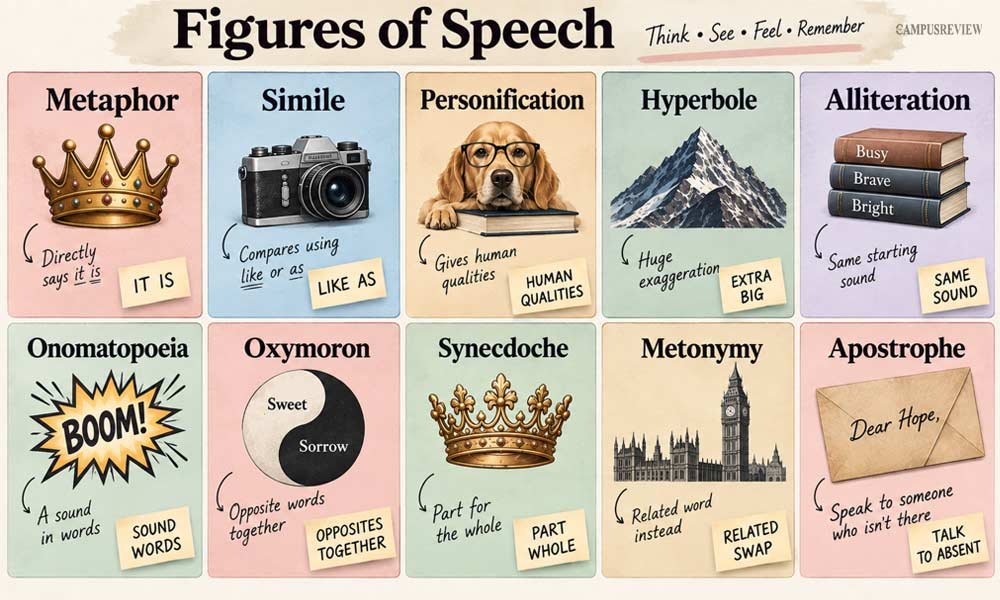
Here are a few easy memory tricks to help you remember the trickiest figures of speech examples:
Simile vs Metaphor
Simile has the word “like” hiding inside it if you say it fast: si-MILE… think “as” and “like” go with simile. Metaphor has no “like,” so remember: “Metaphor makes it, simile compares it.”
Personification
Break the word apart: PERSON-ification. It gives a “person’s” traits to something that is not a person. If a thing acts like a person, it’s personification.
Alliteration Alliteration starts with “AL,” and so do all the repeated sounds in the example. Think: “All the same letter, all at once.”
Onomatopoeia
This one sounds hard to spell, but the trick is in the meaning: the word literally sounds like the noise. Buzz, pop, crash, bang. If saying the word out loud makes the sound it describes, it’s onomatopoeia.
Hyperbole
Say it as “hy-PER-bo-lee” and think “hyper,” like a kid on too much sugar. Hyperbole is language that goes “hyper,” way past the truth.
Oxymoron
Split it: OXY (sharp) + MORON (dull). The word itself is a mini oxymoron, a “sharp-dull” word. That’s the whole trick: two opposite ideas stuck together.
Metonymy vs Synecdoche
Metonymy swaps in something related (“the crown” for a king). Synecdoche swaps in a part of the actual thing (“wheels” for a car). Trick: synecdoche = a slice of the real thing; metonymy = a neighbor of the real thing.
Anaphora
Anaphora repeats words at the start of lines. Think “A for anaphora, A for the front of the sentence.”
Simile vs Metaphor
Simile and metaphor both compare two things, but they work differently. A simile uses “like” or “as” to keep the comparison open. A metaphor drops those words and states a direct equation instead.
| Feature | Simile | Metaphor |
| Comparison word | Uses “like” or “as” | No comparison word |
| Type of link | Suggests similarity | States identity |
| Example 1 | She is as brave as a lion. | She is a lion in battle. |
| Example 2 | He fought like a wild beast. | He was a beast on the field. |
| Example 3 | My love is like a red rose. | My love is a blooming rose. |
A simile leaves you room to draw your own comparison. A metaphor pushes you straight into it. Neither one is “better.” Writers pick whichever one gives the strongest image for the moment.
How to Identify a Figure of Speech
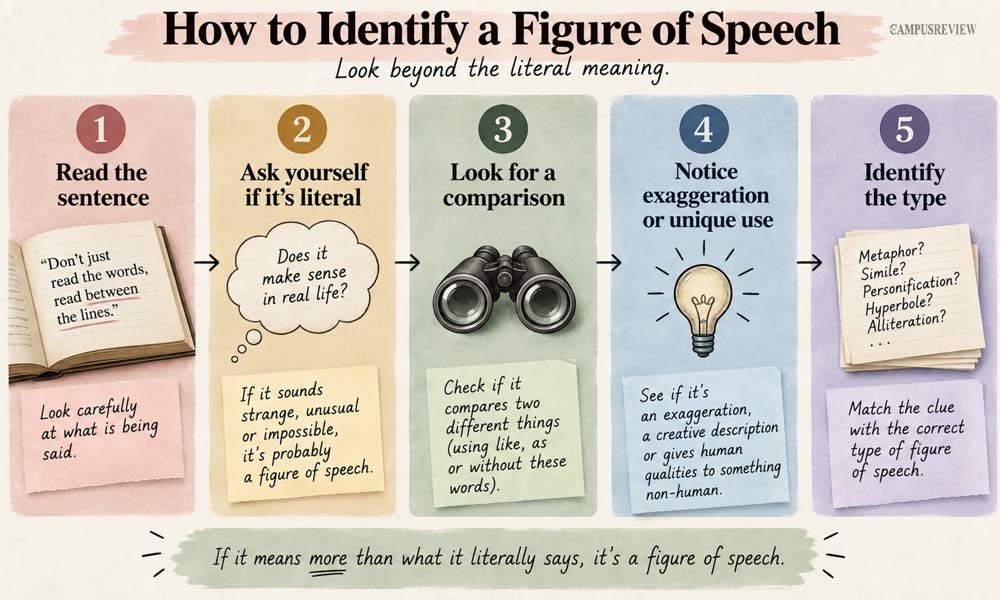
Follow these six steps to spot a figure of speech in any sentence:
● Check if the sentence can be true in real life. If not, it is likely figurative.
● Look for “like” or “as.” These words often signal a simile.
● Look for extreme exaggeration. This points to hyperbole.
● Listen for repeated sounds at the start of words. This points to alliteration.
● Check if a non-human thing acts or feels like a person. This points to personification.
● Read the full context. The real meaning often becomes clear only once you know what the speaker intends.
Try it on this sentence: “The ancient trees whispered secrets to the night sky.” Trees cannot whisper, and this human action is given to nature, so this sentence uses personification.
Common Figures of Speech in Everyday English
You use figures of speech examples without noticing, in everyday conversation. Here are five you probably said this week:
| Phrase | Figure of Speech | What It Really Means |
| I’m drowning in work. | Metaphor | I have too much work to handle. |
| It’s raining cats and dogs. | Hyperbole / Idiom | It is raining very heavily. |
| The wind whispered through the trees. | Personification | The wind made a soft, gentle sound. |
| The baby slept like a log. | Simile | The baby slept very deeply. |
| I’ve told you a million times. | Hyperbole | I have told you many times before. |
Frequently Asked Questions
1. What are the 10 most common figures of speech?
The 10 most common are simile, metaphor, personification, hyperbole, alliteration, onomatopoeia, oxymoron, irony, apostrophe, and antithesis.
2. Why do writers use figures of speech?
Writers use figures of speech to make language more vivid, easier to picture, more emotional, and more memorable.
3. Are figures of speech the same as literary devices?
No. A literary device is a broad category that includes figures of speech along with bigger tools like flashback and foreshadowing. Every figure of speech is a literary device, but not every literary device is a figure of speech.
4. Can one sentence have more than one figure of speech?
Yes, one sentence can contain more than one figure of speech. Writers often combine different figures of speech to make an idea more vivid, emotional, or expressive.