The Campus Review
September 10, 2026
The UC Berkeley Law admissions investigation by the U.S. Department of Justice and the Department of Education alleges that the law school intentionally discriminated against applicants based on race. Federal officials say UC Berkeley favored Black applicants over white and Asian applicants with similar academic qualifications. However, law school Dean Erwin Chemerinsky disputes these findings and says the university follows all state and federal laws.
Federal regulators state that the findings letter marks the conclusion of an investigation into the school’s admissions practices. The development places national attention on how American universities evaluate candidates under changing civil rights enforcement priorities.
Key Claims in the UC Berkeley Law Admissions Investigation
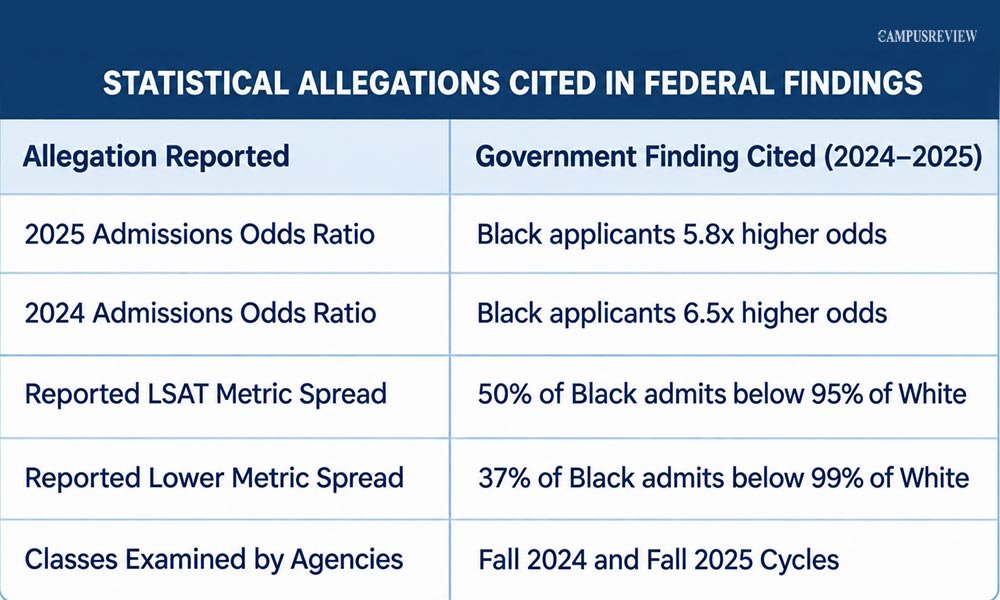
Federal investigators reviewed applicant files, internal scoring systems, and admission logs across the entering classes of 2024 and 2025. The agencies allege that the school’s practices violated Title VI of the Civil Rights Act of 1964.
- Acceptance Odds Ratios: Federal investigators report that Black applicants in 2025 had 5.8 times higher odds of acceptance than white applicants with similar credentials, following a reported 6.5-to-1 ratio in 2024.
- Reported Metric Differences: According to the findings letter, half of all admitted Black applicants in the 2024 and 2025 cycles recorded Law School Admission Test (LSAT) scores below 95% of admitted white candidates.
- Applicant Grouping Claims: The federal letter asserts that reviewers grouped applications using demographic checkboxes during the file evaluation cycle.
- Essay Scrutiny: Investigators allege that certain personal statement prompts were evaluated in ways that served as proxies for racial identity.
Admissions Rules in California and the U.S
The investigation involves both California and federal rules on college admissions. In California, public colleges have been banned from considering race, ethnicity, or sex in admissions since voters approved PropositFlion 209 in 1996.
In 2023, the U.S. Supreme Court ruled in Students for Fair Admissions v. Harvard and the related UNC case that the universities’ race-conscious admissions programs violated the Constitution and federal law. However, the Court said students can still discuss how race affected their lives, as long as colleges evaluate each applicant based on their individual experiences and qualities.
Perspectives from Federal Regulators and Berkeley Law
Both sides have released formal statements outlining their legal positions on the UC Berkeley Law admissions investigation.
“Berkeley Law School’s deliberate efforts to circumvent the Supreme Court’s decision in SFFA demonstrate a complete disregard for the rule of law. The Department will continue to aggressively pursue compliance from schools who attempt to racially manipulate their student bodies in violation of federal law.”
– Harmeet K. Dhillon, Assistant Attorney General for Civil Rights
“University of California, Berkeley School of Law in its admissions decisions scrupulously complies with Proposition 209, federal statutes, and the United States Constitution. Our admissions policy is clear that race is not considered in any way in admissions decisions.”
– Erwin Chemerinsky, Dean of UC Berkeley Law
Assistant Secretary for Civil Rights Kimberly Richey stated that federal civil rights laws protect applicants against racial stereotyping and preferential treatment.
In response, university leadership emphasized that admissions officers conduct holistic evaluations of every applicant, taking into account individual challenges, leadership history, and community service alongside academic records.
Why the Investigation Focuses on Holistic Admissions
The dispute centers on how federal agencies interpret individualized holistic reviews compared to the university’s internal selection policies.
| Area of Disagreement | Federal Agency Position | Law School Position |
| Applicant Evaluation | Cites regression models that identify statistical differences among credential groups | Conducts whole-file reviews evaluating life accomplishments alongside quantitative data |
| Personal Essays | Scrutinizes prompts for potential use as indirect demographic proxies | Uses statements to evaluate individual perseverance, resilience, and personal character |
| Data Disparities | Cites statistical differences as part of its evidence of discriminatory treatment | Considers score spreads a natural byproduct of non-mechanical, individual file review |
The tension between statistical modeling and individualized holistic review remains a central issue in the federal inquiry. The outcome could influence how law schools interpret and document individualized admissions reviews under federal civil rights requirements.
What Happens Next in the Investigation
The federal government has asked the university to work toward a voluntary agreement to address the findings. If they cannot reach an agreement, the Department of Justice may take the case to federal court.
- Possible Federal Lawsuit: If a lawsuit is filed, a federal judge could decide how universities can use personal essays when reviewing applications under the 2023 Supreme Court ruling.
- Other Federal Admissions Reviews: The investigation comes as federal officials also review admissions practices at other schools, including Duke Law School and medical programs at several University of California campuses.
- Evaluation Policy Reviews: Law schools nationwide may re-examine their application rubrics, essay instructions, and scoring documentation to ensure processes withstand federal scrutiny.
The outcome of the UC Berkeley Law admissions investigation could influence how law schools interpret and document individualized admissions reviews under federal civil rights requirements.