The Campus Review
September 28, 2026
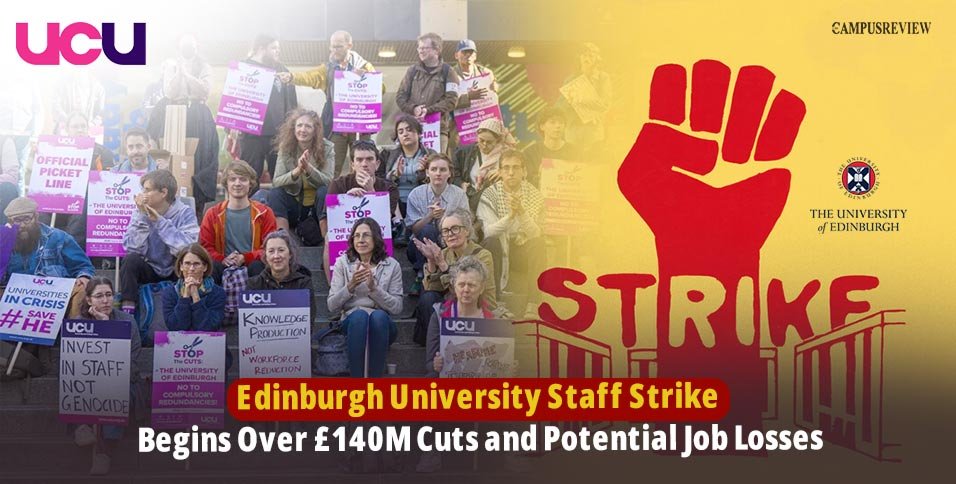
Around 3,000 academic and professional workers walked out this morning as the Edinburgh University staff strike began, according to UCU. Organised by the University and College Union, the five-week industrial action runs from September 28 through October 30, 2026. The dispute centres on the university’s £140 million cost-reduction plans.
UCU says up to 1,800 posts could be affected and around 90 academic programmes face review, restructuring or phased closure. The action coincides with the start of Semester 1 teaching.
Key Facts Behind the Action
The table below breaks down the primary numbers, timelines, and operational details reported across the institution.
| Factor | Detail or Figure | Context and Source Information |
| Strike Period | September 28 to October 30, 2026 | Covers 25 strike days across the first five teaching weeks of Semester 1. |
| Staff Involved | Around 3,000 employees | Estimated by UCU; includes lecturers, researchers, and professional support staff. |
| Target Savings | £140 million | The university’s planned multi-year cost-reduction programme. |
| Potential Posts Affected | Up to 1,800 posts | Estimated by UCU through redundancies, contract non-renewals, and frozen vacancies. |
| Academic Programmes | Around 90 programmes | Number identified by UCU as facing review, restructuring or phased closure. |
| Financial Position | Financial reserves and assets over £3 billion | Reported in university financial accounts; cited by union negotiators regarding job protections. |
Why Is the Edinburgh University Staff Strike Happening in 2026?
The Edinburgh University staff strike follows the introduction of major financial restructuring plans first announced by leadership in February 2025. University executives state that recurring expenditure is rising faster than recurring income, requiring operational adjustments to create a sustainable operating model for the institution.
In contrast, the union argues that the scale of the proposed savings will harm staff working conditions and could reduce the range of programmes available to students.
The primary issues driving the current industrial action include:
- Compulsory Redundancies: UCU has called on the university to provide a firm commitment ruling out compulsory job losses. Management maintains that redundancies must remain an available option if other cost controls fall short.
- Contract and Staffing Changes: Union branches have highlighted changes to fixed-term contracts and reductions for hourly-paid teaching staff, arguing that these measures lower overall departmental staffing capacity.
- Workload Concerns: Union members express concern that shrinking staff numbers will shift heavier teaching and administrative burdens onto remaining colleagues.
- Academic Programme Changes: Around 90 programmes, primarily in arts, languages, and literatures, face review, restructuring, or phased closure under curriculum rationalisation plans, according to UCU.
- Use of Financial Reserves and Assets: UCU questions why the institution does not draw more heavily on its reported financial reserves and assets of over £3 billion to protect frontline jobs during inflationary pressures.
What UCU and the University of Edinburgh Say
Both UCU and the University of Edinburgh have issued statements explaining their positions on the strike and proposed financial changes.
Union Leadership Stance
Trade union organisers argue that senior leadership should prioritise non-staff budgets instead of cutting jobs. UCU Edinburgh Branch Co-President Cecile Menard stated that staff want to welcome students rather than stand on picket lines, urging management to “prioritise cuts to non-staff budgets and stop the redundancies that are decimating our university”.
At the national level, UCU General Secretary Dr. Jo Grady criticised the refusal to rule out compulsory redundancies despite strong financial reserves and assets, calling on government ministers to ensure universities “put staff and students ahead of profits”.
University Executive Position
University leaders maintain that difficult financial decisions are necessary to create a sustainable operating model.
Principal and Vice-Chancellor Professor Sir Peter Mathieson stated that the university was “extremely disappointed” by the five-week walkout, arguing that relying on financial reserves and assets for ongoing operating expenses “is not a reliable or responsible way to solve the underlying problem long-term”.
He added that regular portfolio reviews ensure degree offerings align with student demand and changing employment markets.
Edinburgh University Strike: Key Differences Between UCU and Management
The core disagreements between union representatives and university management centre on financial strategy and employment protections.
| Issue | UCU Position | University Position |
| Compulsory Redundancies | Calls for an explicit ban on compulsory redundancies. | States a commitment to avoiding compulsory job cuts wherever possible, but retains them as a last resort. |
| Financial Reserves and Assets | Argues financial reserves and assets should be utilised to protect jobs and teaching services. | Contends that drawing on reserves to fund day-to-day operating costs is financially unsustainable. |
| Budget Priorities | Recommends focusing cuts on non-staff budgets, estate expenditure, and capital works. | Aims to reduce recurring overheads and realign staffing with student demand. |
| Curriculum Provision | Opposes the closure or reduction of specialist degree offerings. | Seeks to review academic offerings to reflect current enrolment and financial needs. |
How the Strike Could Affect Edinburgh Students
Taking place across weeks two to six of Semester 1, the industrial action could affect day-to-day learning and university services:
- Teaching Sessions: Some lectures, seminars, laboratory tutorials, and office hours could be disrupted on strike days when participating staff are scheduled to teach or provide support.
- Student Support Services: Certain departmental enquiries, IT helpdesks, and administrative services may experience reduced operating capacity.
- Course Restructuring: Students on programmes affected by restructuring may receive information about teach-out arrangements and future module availability from their schools or departments.
- Assessment Guidance: Students should follow university communications for any changes to coursework, assessments, or examination arrangements.
What Happens Next for the Edinburgh University Strike
The current industrial action is scheduled to continue through October 30, 2026. Further discussions between UCU and university leadership could affect the action’s duration and scope. The best universities in Scotland, Edinburgh University staff strike remains focused on redundancy policies, staffing changes, programme restructuring, and the university’s wider cost-reduction plans.