The Campus Review
May 27, 2026
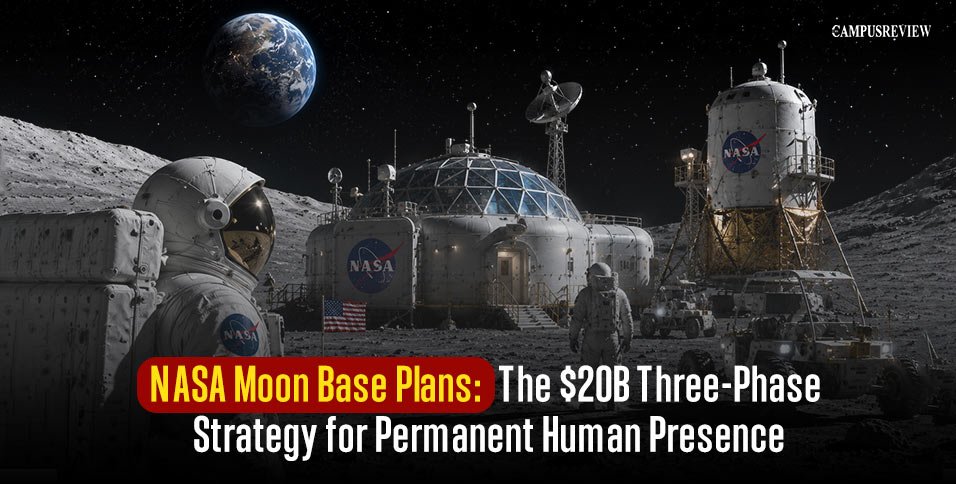
The National Aeronautics and Space Administration has officially unveiled a massive $20 billion initiative to build a permanent base on the Moon. Released in late May 2026, the updated roadmap outlines a strict timeline to transition from temporary missions to a fully operational lunar outpost. According to the official NASA moon base plans, the newly accelerated strategy relies heavily on commercial partnerships and infrastructure near the lunar South Pole.
Federal agencies state that this strategy introduces a fresh approach to deep space exploration. Instead of focusing on space stations that orbit the Moon, the agency is now prioritizing direct-to-surface infrastructure to secure immediate technical results.
This sudden operational shift aligns directly with the directives outlined in the White House executive order on space superiority, which mandates rapid surface infrastructure deployment. Global aerospace firms and international space partners have already secured agreements to support the first wave of automated supply deliveries.
This strict focus marks one of the most aggressive shifts in modern space history. As international competition increases, space organizations are quickly evaluating the long-term logistical challenges of lunar soil operations.
This comprehensive report breaks down the official statistics behind the current plan, explains the legal rules driving these decisions, and outlines exactly how teams will establish long-term housing on the Moon.
What Is the Timeline for the NASA Lunar Base Framework?
To achieve a sustainable presence without going over budget, federal planners have structured the initiative into three strict sequential blocks. The entire project spans from initial scouting runs starting later this year to continuous human occupation over the next decade. Each block has specific hardware requirements and payload delivery targets.
The official schedule for the development of the NASA lunar base framework is organized as follows:
| Development Phase | Operational Timeline | Core Mission Objectives | Infrastructure Cargo Target |
| Phase 1 | 2026 to 2029 | Deliver initial instruments via commercial landers, deploy rovers, and secure direct-to-surface capabilities | 4 Metric Tons |
| Phase 2 | 2029 to 2032 | Build localized power grids, set up specialized human habitats, and scale up heavy machinery | 60 Metric Tons |
| Phase 3 | 2032 and Beyond | Solidify continuous human occupation, activate long-duration survival systems, and initiate routine crew rotations | 150 Metric Tons |
This highly organized progression ensures that robotic landers reduce operational risks before astronauts begin prolonged construction cycles on the surface.
Why Is NASA Accelerating Its Surface Construction Plans?
The acceleration of the lunar roadmap stems from the December 2025 White House executive order on space superiority. This national policy mandates two strict deadlines: a crewed return to the lunar surface by 2028 and an operational surface nuclear reactor by 2030.
To meet these targets, NASA paused the development of orbiting deep-space gateway stations. By halting these orbital concepts, the agency redirected all funding, engineering talent, and near-term logistics directly to surface operations. Engineering teams are now converting the hardware originally designed for orbital power systems into surface-based nuclear energy projects. This surface power infrastructure is critical to keep the base operational during the freezing, 14-day lunar nights.
The Robotic Assets Driving Immediate Cargo Deliveries
The initial push under Phase 1 relies heavily on a specialized dual-rover strategy and advanced robotic scouting assets. Scheduled to launch a series of unmanned missions, these automated vehicles will map hazardous terrain where humans cannot safely step.
The automated exploration framework relies on three distinct robotic elements:
- Heavy Cargo Transporters: A massive, multi-million dollar platform weighing nearly 2,000 pounds, designed specifically for astronaut transport and moving heavy building supplies across long distances.
- Agile Autonomous Scouts: Lighter, highly flexible rovers capable of traveling at speeds exceeding 9 miles per hour. These can be managed via manual control, full autonomy, or direct teleoperation from flight centers on Earth.
- Hopping Scouting Drones: Specialized micro-drones designed to leap directly into permanently shadowed craters to map out frozen water-ice reserves without getting stuck in loose regolith.
The initial test deployments will land directly on the Shackleton Connecting Ridge. These automated units will measure exactly how heavy rocket exhaust gases displace surface soil during touchdown. They will also deploy precise retroreflective laser systems to help future supply ships land within inches of their targets.
Shifting to a Commercial-First Procurement Model
Building an entire base on another celestial body requires a massive departure from traditional bureaucratic procurement methods. Under the recent White House directives, the government has dissolved slow-moving legacy aerospace advisory bodies. Decision-making power has been centralized directly within the White House science office to speed up industrial execution.
As a result, traditional, cost-plus federal contracts are being completely replaced by flexible, milestone-based commercial agreements. By using streamlined Space Act Agreements, private companies are given the creative freedom to design their own landers and delivery buggies. This commercial-first model reduces delivery costs and ensures that private cargo operators compete aggressively, driving rapid technical progress.
International Integration and Long-Term Logistics
While American private commercial landers handle the initial phases, the long-term sustainability of the outpost relies on integrated international partnerships. Building permanent structures requires heavy machinery that exceeds domestic cargo limits.
To resolve these infrastructure gaps, the updated framework weaves together specialized international contributions:
- Extended Human Mobility: The Japan Aerospace Exploration Agency is leading the development of a large pressurized lunar cruiser, allowing astronauts to explore hundreds of miles away from the main camp without wearing heavy spacesuits.
- Advanced Habitation Structures: The Italian Space Agency has cleared critical design reviews for multi-purpose habitable modules that provide enhanced radiation and thermal shielding for permanent living quarters.
- Surface Logistics Management: The Canadian Space Agency is managing utility vehicles and heavy-duty mechanical arms to handle heavy cargo and unload arriving automated supply ships.
End Note
The formal NASA moon base plans represent a highly structured evolution in global space exploration. By moving away from complex orbital space stations and shifting straight to surface nuclear energy and commercial-first procurement, the agency is actively building a practical, functional foundation for human deep-space expansion.
For academic institutions, technical professionals, and global logistics groups, this roadmap establishes a clear path toward transforming the Moon from a brief symbolic destination into a bustling, permanent scientific workspace.
Also Read: US Visa Crackdown: Why the State Department Just Revoked 6,000 Student Visas