
Most students study for hours and still forget everything on exam day. That is not bad luck. It is the wrong method.
Effective exam preparation does not mean reading your notes five times. It means using techniques that your brain actually remembers. Science has tested dozens of study methods.
A few work far better than the rest.
This guide gives you the best exam preparation tips backed by research. You will learn why common habits like highlighting fail you.
You will also learn exam revision strategies, time management for students, and how to handle exam stress. Each tip comes with a simple way to use it today.
Why Do Most Study Methods Fail You?
Re-reading your notes feels productive. It is not. Your brain confuses familiarity with knowledge. This is called the illusion of competence. When you re-read a page, the words look familiar.
Your brain mistakes this familiarity for real understanding. So you stop studying too early, before you actually know the material.
Highlighting causes a similar problem.
It pulls out single facts but does not build connections between ideas. Research shows highlighting can even hurt your performance on questions that need deeper thinking.
The table below shows which habits to drop and which to pick up.
| Low-Value Habit | High-Value Replacement |
| Re-reading notes | Active recall (testing yourself) |
| Highlighting text | Writing summaries in your own words |
| Cramming the night before | Spaced repetition over several days |
| Studying everything equally | Focusing on your weakest topics first |
How Early Should You Start Exam Preparation?
Start at least three to four weeks before your exam. This gives you enough time to use spaced repetition, which needs multiple short reviews instead of one long session.
Good time management for students comes down to three simple rules:
- Study in short blocks. Work for 25 to 50 minutes, then take a short break. This is the Pomodoro method.
- Review, do not just plan. Spend less time making a perfect schedule and more time tracking what you have actually revised.
- Protect your sleep. Your brain locks in memories during deep sleep. Skipping sleep to study more erases the gains from your last session.
7 Science-Backed Exam Preparation Tips
Now that we understand why smart studying matters, let’s look at 7 science-backed exam preparation tips that can help you study more effectively and improve retention
1. Use Active Recall Instead of Re-reading
Re-reading your notes feels productive, but it is one of the weakest ways to study. Your brain confuses familiarity with knowledge, a trap called the illusion of competence.
You recognize the words on the page and assume you know the topic, then you close the book and realize you cannot explain it at all. Active recall fixes this by forcing your brain to pull out the answer instead of just spotting it.
Do It Now
- Open your textbook or notes and pick one short topic.
- Read it carefully two or three times, slowly, without rushing.
- Close the book completely and put it out of sight.
- Write down or say out loud everything you remember about the topic.
- Open the book again and check what you missed. Mark those gaps and revisit them tomorrow.
This trick works best for subjects like history, biology, or literature, where you need to recall facts, dates, and definitions in your own words without feeling burnout.
Pro Tip: Say your answer out loud instead of just thinking it. Speaking forces your brain to organize the answer properly, and it is much harder to fool yourself when you have to say it clearly.
2. Review with Spaced Repetition
Your brain forgets new information fast. Without any review, you lose close to 42% of what you just learned within 20 minutes, and almost 79% of it within a month.
Cramming everything into one long session the night before ignores this completely. Spaced repetition means reviewing the same topic a few times, with a bigger gap each time, so the memory gets stronger with every pass instead of fading away.
Do It Now
- After you first learn a topic, do a quick 5-minute review the same day.
- Review the same topic again the next day, this time without looking at your notes first.
- Review it once more after a week has passed.
- Do one final review about a month later, right before the topic comes up again in revision.
This trick works especially well for math and science formulas, since you need the steps to feel automatic, not just familiar, by the time you sit the exam.
Pro Tip: Keep a tiny notebook or app just for topics due for review. A five-minute check each morning keeps old material fresh without eating into new study time.
3. Build a Timetable That Tracks Progress, Not Just Dates
Most study timetables fail because they are built weeks in advance, around a calendar that has no idea how your week will actually go. One missed day and the whole plan falls apart.
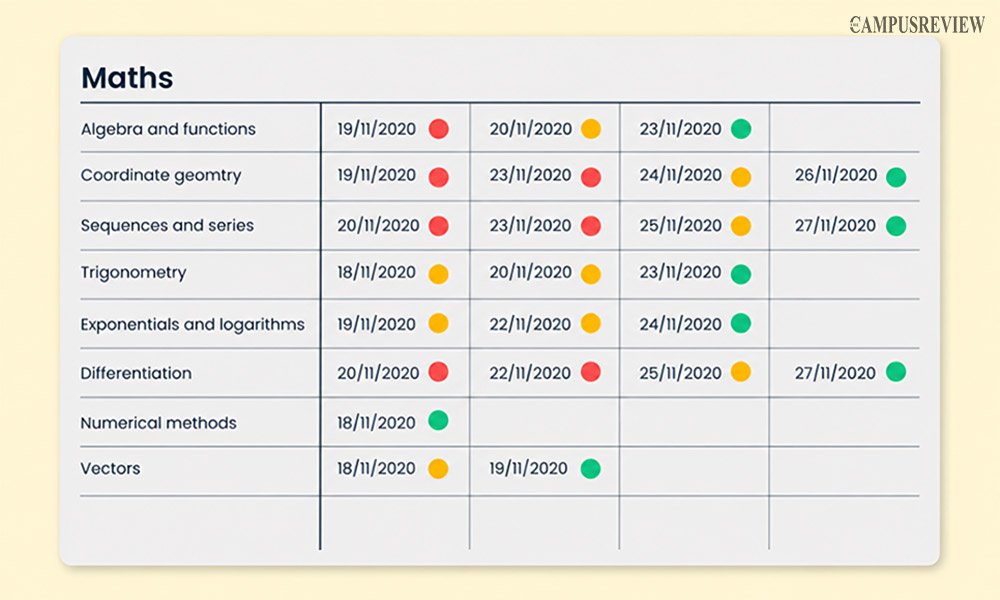
A retrospective timetable works the other way. You log what you have already studied and how well you know it, so the plan adjusts itself based on your real progress instead of a guess made three weeks ago.
Do It Now
- List every exam topic down one side of a page or spreadsheet.
- After you study a topic using active recall, write down today’s date next to it.
- Color it red if you struggled, amber if you were shaky, or green if it felt solid.
- Each day, study your red topics first, then amber, and leave green topics for occasional review.
This trick works best when you have many topics to juggle at once, like board exams or competitive exams with a wide syllabus.
Pro Tip: Re-color a topic the moment your confidence changes, even mid-week. The timetable should always reflect today, not last Monday.
4. Match the Technique to How You Learn Best
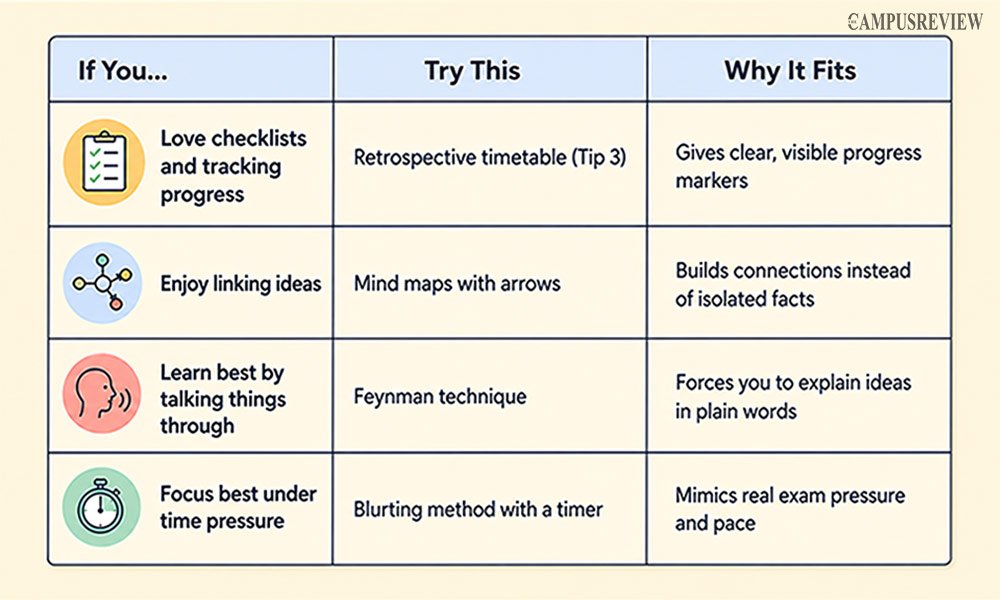
Not every trick suits every student, and forcing yourself into one rigid method usually backfires. Some students think best out loud, some think best in pictures, and some think best under pressure.
Picking a technique that fits your natural style means you stick with it long enough to see real results, instead of giving up after two days.
The Feynman Technique in Four Steps
These study techniques for exams work for any student who gets stuck on confusing topics.
• Write the topic name at the top of a blank page.
• Explain it in plain words, as if you are teaching a child.
• Circle any part that sounds confusing or uses big words.
• Go back to your notes, fix the gap, and explain it again.
The Blurting Method in Five Steps
This technique of blurring method suits students who want fast, honest feedback on what they actually know.
• Read a short section of your notes for 10 minutes. Do not highlight.
• Close the book and wait 10 minutes before testing yourself.
• Set a 5-minute timer and write down everything you remember.
• Check your notes and mark what you missed in a different color.
• Study only the missed parts, then blurt again the next day.
5. Practice With Timed Mock Exams
Knowing a topic and performing well under exam pressure are two different skills
Karpicke and Blunt found that students who practiced through testing themselves showed far greater real, usable understanding than students who used methods like concept mapping alone.
A mock exam trains your brain to retrieve answers fast, under a clock, which is exactly what the real exam will demand.
Do It Now
- Pick a past paper and set a timer for the exact exam duration.
- Sit it like the real thing. No notes, no phone, no pausing the timer.
- Mark it honestly using the official marking scheme, if you have one.
- Spend more time reviewing your wrong answers than your correct ones.
- This trick works best for math and accounting style subjects, where speed and accuracy under pressure decide your final score.
Pro Tip: Always use a fresh paper for each mock attempt. Reusing the same one can mean your brain remembers the answer, not the method behind it.
6. Control Your Study Sound and Environment
Sound affects focus more than most students realize. Songs with lyrics compete with your brain’s own language centers, which makes reading and writing noticeably harder.
Instrumental music avoids this clash entirely and, at the right tempo, can actually help you settle into a focused state faster.
Do It Now
- Switch off any music with lyrics while reading or writing answers.
- Try an instrumental playlist, including game soundtracks built for calm focus.
- Pick slower tracks, around 50 to 80 BPM, for reading and understanding new topics.
- Switch to faster tracks, around 110 BPM, when grinding through repetitive practice questions.
This trick works best for language-heavy subjects like English, history, or law, where every sentence you read or write needs full attention from your brain’s language centers.
Pro Tip: If silence works better for you than any music, that is fine too. The goal is zero distraction, not a specific playlist.
7. Protect Your Sleep Instead of Cutting It
Skipping sleep to study more feels logical in the moment, but it quietly undoes your hard work.
Your brain locks new information into long-term memory during deep sleep, especially during REM cycles that repeat roughly every 90 minutes through the night.
Cut that sleep short, and you cut the process that was about to make today’s studying actually stick.
Do It Now
- Set a fixed sleep time during exam weeks and stick to it, even on busy days.
- Do a light, calm review before bed instead of learning brand-new material.
- Avoid screens and bright light for 30 minutes before sleeping.
- Wake up early enough for a proper breakfast on exam day, instead of rushing out the door.
This trick matters most the night before a big exam, when the temptation to pull an all-nighter is highest and the cost to your memory is also highest.
Pro Tip: If you must choose between one more hour of revision and one more hour of sleep the night before an exam, choose sleep. It protects everything you already studied.
What to Study in the Last 7 Days Before Exams (Quick Cheat Sheet)
Stick it on your wall. Follow it day by day.
| Day | Main Focus | Do This | Tool to Use |
| Day 7 | Sort your topics | List every topic. Mark each red, amber, or green based on confidence. | Retrospective timetable |
| Day 6 | Attack red topics | Read once, close the book, write all you remember. Check gaps. | Active recall |
| Day 5 | Attack red topics | Repeat active recall on yesterday’s weak spots. Explain the hardest topic out loud. | Feynman technique |
| Day 4 | Move to amber topics | Quick recall test on amber topics. Re-review yesterday’s red ones briefly. | Spaced repetition |
| Day 3 | Full mock test | Sit one full past paper under real time limits. Mark it honestly. | Timed mock exam |
| Day 2 | Fix mock mistakes | Review every wrong answer from the mock. Re-test those exact topics. | Active recall |
| Day 1 | Light review only | Skim summary notes or flashcards. No new topics. Sleep on time. | Sleep + light recall |
Your Daily Routine, Every Day This Week
| Step | How to Do It |
| Study in blocks | 25 to 50 minutes of focused work, then a 5 to 10 minute break. |
| Test before you trust | Never mark a topic done just by reading it. Close the book and recall it first. |
| Pick the right sound | No lyrics while reading or writing. Use instrumental tracks if you need background sound. |
| Move your body | A short walk between long sessions resets focus and lowers stress. |
| Protect your sleep | Same sleep time every night this week. No all-nighters. |
Night Before the Exam
- Light review of summary notes or flashcards only.
- Pack your bag. Check exam time and venue details.
- Eat a normal meal. Go easy on caffeine.
- Sleep at your usual time.
Exam Morning
- Eat a proper breakfast.
- Do one light, calm recall of your weakest topic. Nothing new.
- Reach your exam venue early. Rushing raises stress for no reason.
Remember: Test yourself, do not just read. Space your reviews, do not cram. Protect your sleep, do not trade it for one more hour of study.
How Do You Manage Exam Stress?
A little stress sharpens focus. Too much stress blocks memory and clear thinking. Exam stress management is about keeping your nerves in a useful zone, not at zero.
- Control your study sound. Lyrics compete with your brain’s language centers. Instrumental music, including game soundtracks, works better for reading and writing tasks.
- Break big tasks into small ones. A vague goal like “study biology” feels heavy. “Review the cell diagram for 20 minutes” feels doable.
- Move your body daily. A short walk shifts your brain into a relaxed state that often solves problems you were stuck on.
- Talk to someone. Share your worries with a friend, parent, or teacher instead of carrying them alone.
Final Word
Good exam preparation tips are not about working harder. They are about working in a way your brain actually remembers.
Pick one technique from this guide. Test yourself instead of re-reading. Space your reviews instead of cramming. Try a mock exam under real time limits. Small changes like these add up to real results on exam day.
FAQs
1. What is the single best exam preparation tip?
The best exam preparation tip is active recall, testing yourself instead of re-reading notes.
It strengthens memory far more than passive revision methods.
2. How many hours should I study before an exam?
There is no fixed number of hours; effectiveness matters more than duration.
A few hours of focused active recall over days works better than long cramming sessions.
3. Is it bad to study right before an exam?
Studying right before an exam is fine if it’s a quick review of key points.
However, trying to learn new topics at the last minute often increases stress and confusion.
4. Does music help you study?
Instrumental music can improve focus and reduce distractions for some students.
However, music with lyrics often interferes with reading and problem-solving.