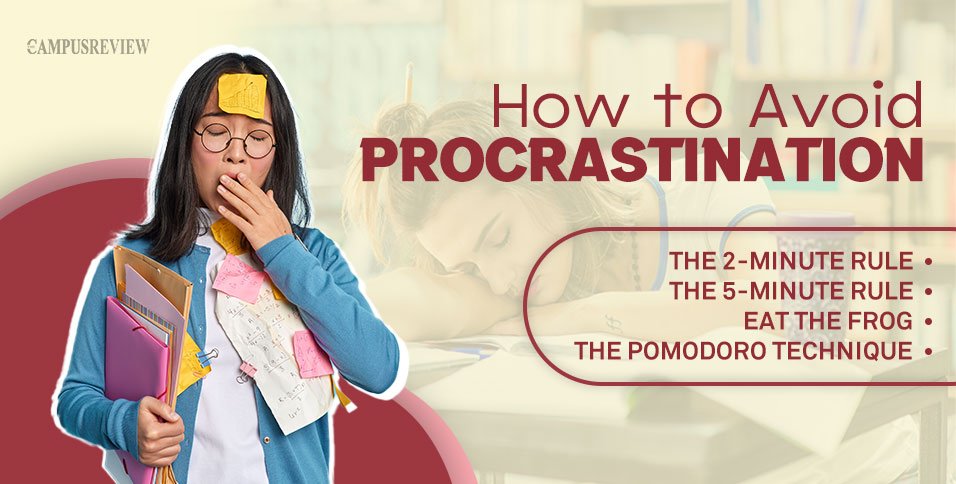
Your brain treats your future self like a stranger. That is the real reason you keep pushing tasks to “later.” Science calls this the temporal disjunction.
You feel zero connection to the person who has to finish the assignment tomorrow, so you hand the work over to them today without guilt. If this sounds familiar, you’re in the majority: research shows that 80% to 95% of college students engage in procrastination
This guide gives you the best tips on how to avoid procrastination and laziness. You will learn why you delay tasks, and you will get 10 clear ways to stop. Each one tells you exactly what to do right now, with a real example, so you never wonder where to start.
Why Do Students Procrastinate?
Students procrastinate because their brains avoid tasks that feel hard, boring, or scary. Researchers often refer to this pattern as academic procrastination when it affects studying, assignments, and exam preparation.
- The limbic system sees a difficult task as a threat, which is why many students struggle with procrastination and lack of motivation.
- The Prefrontal Cortex handles planning. It wants to think about your future. But it gets tired fast.
When you feel stressed or tired, the limbic system wins. You reach for your phone instead of your notes. This is not a weakness. It is biology.
Once you understand this, you can use simple tricks to help your planning brain win more often.
The Monkey, the Planner, and the Panic Monster
Writer Tim Urban describes this brain battle in a simple way. Picture three characters inside your head.
| Character | What It Wants | What It Does |
| The Rational Decision Maker | Long-term success | Plan your study schedule |
| The Instant Gratification Monkey | Fun, right now | Pulls you toward your phone |
| The Panic Monster | Safety from disaster | Wakes up only near the deadline |
The Panic Monster scares the Monkey away at the last minute. That is why you suddenly focus the night before an exam. The tips below help you skip the panic stage and start early instead.
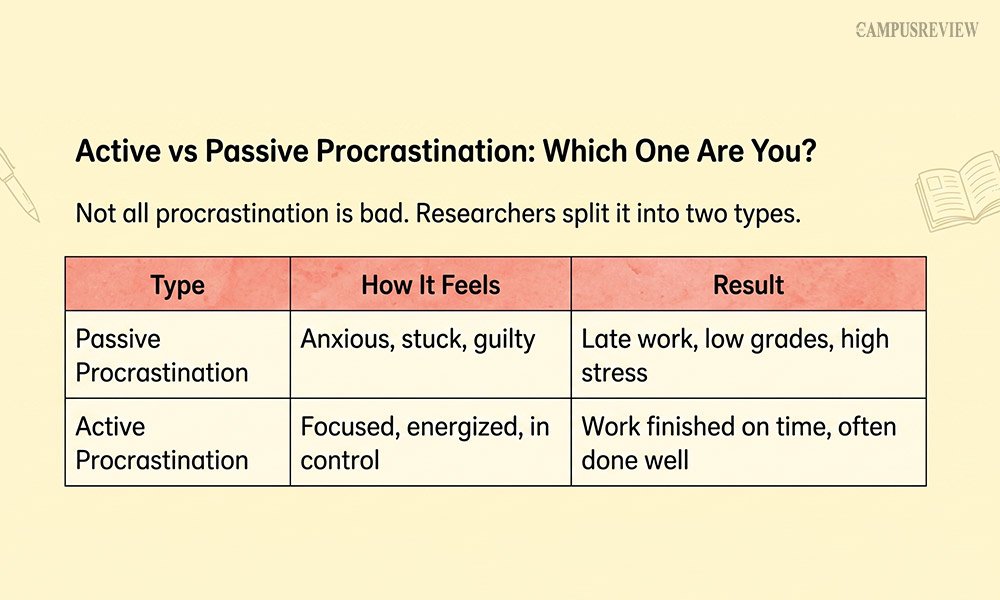
| Type | How It Feels | Result |
| Passive Procrastination | Anxious, stuck, guilty | Late work, low grades, high stress |
| Active Procrastination | Focused, energized, in control | Work finished on time, often done well |
Passive procrastination is when you want to start early, but keep delaying. You feel stressed, guilty, and stuck, and the work usually gets done at the last minute or even late.
Active procrastination, on the other hand, is different. This is when a person chooses to delay work on purpose but still manages time well. For example, some students study only 2–3 days before an exam but still score well.
If you feel frozen and guilty, you fall into the passive group. Data reveals that procrastinators experience up to 300% more daily stress than non-procrastinators. The good news is you can move from passive to active with the right system.
10 Ways to Avoid Procrastination
To help you put this into action, here are 10 effective ways on how to avoid procrastination
1. The 2-Minute Rule
Author James Clear made this rule famous in his book Atomic Habits. He argues that procrastination is not a willpower problem; it is a friction problem.
Your brain resists big, vague tasks but accepts tiny, clear ones without a fight. Clear calls this “mastering the art of showing up.”
Once you show up, momentum carries you forward, helping you build productive habits.
How it works:
- Open the task in front of you (your book, your laptop, your notes).
- Shrink it to a version that takes less than 2 minutes. Not “write the essay.” Just “open a blank document and type the title.”
- Do only that tiny step.
Example: Instead of “study for the chemistry exam,” you just open your notebook to chapter 3. That is the whole task for now. Most students keep going once they start.
2. The 5-Minute Rule
This method is widely used in cognitive behavioral therapy to break task-avoidance cycles. The idea is simple.
Most of your fear builds up before you start a task, not during it. Therapists call this anticipatory anxiety.
Once you begin, the fear usually drops within minutes, and it becomes easier to overcome procrastination.
How it works:
- Set a timer on your phone for 5 minutes.
- Work on the task. Quality does not matter yet.
- When the timer rings, you are free to stop. No guilt.
Example: You keep avoiding your math homework. Tell yourself you only need to do 5 minutes. By the time the timer rings, the fear is usually gone, and you keep working.
3. Eat the Frog
This phrase comes from a quote often credited to Mark Twain: “Eat a live frog first thing in the morning, and nothing worse will happen to you the rest of the day.”
Productivity author Brian Tracy built an entire method around this idea in his book Eat That Frog!.
The principle is direct: your hardest task deserves your freshest energy.
How it works:
- The night before, pick your single hardest task. This is your “frog.”
- The next morning, skip your phone and messages.
- Start your day by working on the frog, even for just 10 minutes.
Example: You hate writing history notes. Instead of saving it for last, you write them first thing in the morning, while your mind is sharp, and easy subjects can wait.
4. If-Then Plans (Implementation Intentions)
Psychologist Peter Gollwitzer studied this technique across 94 separate studies.
He found that people who simply make a standard goal (e.g., “I intend to study”) only succeeds 53% of the time, but adding an “If-Then” plan makes you 2 to 3 times more likely to follow through.
This is a highly effective strategy to stop procrastinating while studying because your brain just reacts to the cue.
How it works:
- Pick one task you need to finish this week.
- Pick an exact time and place.
- Write the sentence: “If it is [time] and I am at [place], then I will [task].”
Example: “If it is 5 PM and I am at my desk, then I will open my chemistry notes and study for 30 minutes.” When 5 PM arrives, you act without needing to decide again.
5. Temptation Bundling
Behavioral economist Katy Milkman researched this idea and found it boosts follow-through on tasks people normally avoid.
The method draws on the old Premack Principle, which says a behavior you enjoy can reinforce one you do not. This helps you create consistency by making the reward depend on doing the work.
How it works:
- Pick the boring task you avoid the most.
- Pick a small treat you genuinely enjoy, like music, a show, or a snack.
- Allow yourself the treat only while doing the task. Not before, not after.
Example: “I am only allowed to listen to my favorite playlist while organizing my notes.” Over weeks, the boring task starts to feel less painful because your brain links it to something pleasant.
6. The Unschedule
Psychologist Neil Fiore created this method in his book The Now Habit. He found that students often procrastinate because their schedule feels like a list of “have-tos” with no room to breathe.
This triggers quiet resentment, which is one of the hidden causes of procrastination. The fix is to plan rest first, not last.
How it works:
- Open your weekly planner.
- Fill it first with rest, meals, and fun plans. Leave work blocks empty.
- Once you finish 30 real minutes of work, write it down afterward, as a reward log rather than a to-do list.
Example: You block out movie night and dinner with friends before anything else. Study time fits around your life instead of swallowing it whole, and you stop feeling trapped.
7. The Pomodoro Technique
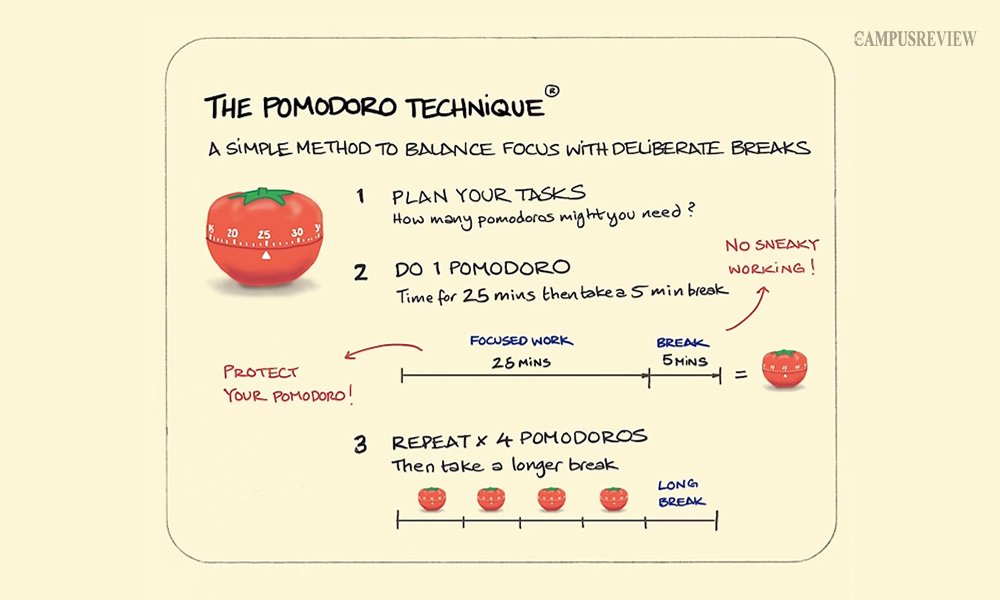
Francesco Cirillo developed this method in the late 1980s and named it after the tomato-shaped kitchen timer he used.
The Pomodoro Technique makes studying feel less overwhelming by breaking work into focused 25-minute sessions followed by short breaks. This helps you start tasks more easily, stay focused, and avoid burnout.
In fact, experimental reports show that students using this method completed 22% more study tasks and cut their concentration breaks by 40%.
How it works:
- Pick one subject or task.
- Set a timer for 25 minutes. Work with zero distractions.
- Take a 5-minute break. Repeat. After 4 rounds, take a longer 15 to 30-minute break.
Example: You study chemistry for 25 minutes, stretch for 5, then repeat. Four rounds later, you have studied for nearly two hours without burning out. An effective method to master time in competitive exams.
8. Remove Triggers From Your Space
Behavioral scientists call this “choice architecture.” The idea is simple: you will lose most fights against willpower, so do not start one.
Instead, redesign your space to figure out how to avoid procrastination naturally by making the distracting choice harder to reach than the productive one.
How it works:
- Put your phone in another room, not just on silent.
- Turn on a website blocker if you study on a laptop.
- Clear your desk of anything not needed for the task in front of you.
Example: If you feel distracted by noise while studying, move to a quieter space such as a library corner or study room. Fewer interruptions make it easier to stay focused for longer periods.
9. Write a Letter to Your Future Self
Social psychologist Hal Hershfield used brain scans to show that people picture their future self almost the same way they picture a complete stranger.
This is why it feels easy to dump hard work on “future you.” Writing to that person rebuilds the emotional connection
How it works:
- Open a blank page or note app.
- Write “Dear Future Me” at the top.
- Write 3 to 4 lines about your goal and how today’s effort gets you there.
Example: “Dear Future Me, I am studying hard today so you can walk into your dream job interview with confidence.”
This small habit makes your future self feel real, not like a stranger you can dump work on.
10. The Paralyzed Servant Technique
Psychiatrist Dr. Alok Kanojia, known online as HealthyGamerGG, created this exercise for students who freeze on open-ended tasks.
The fix is to imagine giving instructions to a servant who can only follow exact, physical commands, which is an excellent way to stop procrastinating while studying.
How it works:
- Imagine your brain is a servant that can only follow literal, physical instructions.
- Write the exact first action, not the end goal.
Example: Do not write “study for the exam.” Write “sit at desk, open textbook to chapter 3, read the first paragraph.” This removes the confusion that causes you to freeze.
How to Stop Procrastinating While Studying
Studying brings extra procrastination triggers, like unclear goals, long reading lists, and phone notifications. Try these quick fixes:
- Break your study session into 25-minute Pomodoro blocks.
- Use the 2-minute rule to open your notes before you decide whether you “feel like” studying.
- Keep your phone in another room or use an app blocker during study time
- Study your hardest subject first, while your focus is fresh.
- Bundle a boring subject with a small reward, like your favorite snack.
Find Your Procrastination Pattern
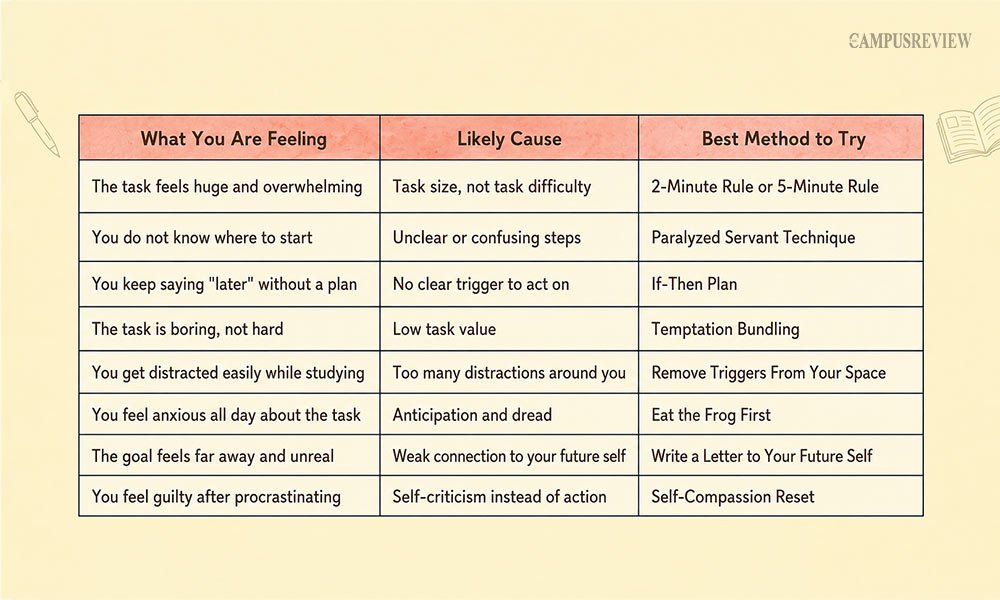
Not every procrastination problem has the same cause, so how to avoid Procrastination type that is triggering you? Simple. Before trying another productivity hack, identify what is actually stopping you.
Use the table below to match your situation with the most effective technique from this guide.
What to Do When You Miss a Day
You will miss a day. Everyone does. This does not ruin your progress.
Research shows habits form over weeks, not days. One missed day does not erase your effort.
Forgive yourself and restart the next day. Self-blame only feeds the avoidance cycle; self-compassion breaks it and teaches you how to avoid procrastination in the long-term.
Conclusion
Procrastination is not a flaw in your character. It is a pattern your brain learned, and you can unlearn it. You do not need to use all 10 methods at once.
Pick just one, like the 2-minute rule or eating your frog first, and try it today. Use the 3-word daily log to notice your own patterns instead of forcing a strict plan.
These tips on how to avoid Procrastination work best when you practice them often, not perfectly. Give yourself grace on hard days, and keep showing up.
Your future self will thank you for the work you start today.
FAQ
1. Why do I keep procrastinating even when I know my tasks are important?
Procrastination often happens due to fear of failure, feeling overwhelmed, or a lack of clarity. Your brain chooses short-term comfort over long-term effort.
2. What is the fastest way to stop procrastinating?
The fastest way to stop procrastinating is to start with a very small step. Even 2–5 minutes of action can break the mental resistance and help you build momentum.
3. How do I stay consistent and avoid procrastination daily?
To stay consistent and avoid procrastination daily, create a simple routine, break tasks into smaller parts, and track your progress instead of focusing only on big goals.
4. Does procrastination mean I am lazy?
No, procrastination does not mean you are lazy. Procrastination is usually linked to stress, poor planning, or emotional resistance, not laziness.
5. How can I stop getting distracted while working?
To stop getting distracted while working, you should remove distractions like phone notifications, set clear time blocks, and work in focused intervals like 25–45 minutes.