The Campus Review,
28 May 2026
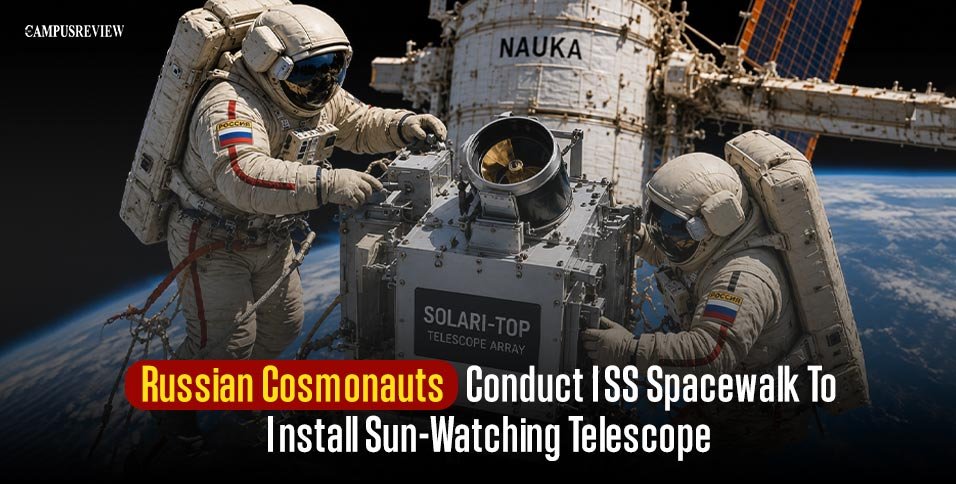
Two Russian cosmonauts have completed a major spacewalk outside the International Space Station to upgrade solar observation hardware. Executed in late May 2026, the mission required over six hours of continuous operations in open space. According to flight control logs, the primary objective was the deployment of an advanced sun-watching telescope on the exterior of the orbital laboratory.
Aerospace teams state that this operation represents the second major Russian spacewalk conducted this year & the 279th spacewalk for space station assembly upgrades. Rather than performing routine maintenance, the team focused on installing high-precision scientific instruments designed to monitor solar flares and space weather anomalies. International space tracking centers confirmed that all hardware systems were successfully activated without operational delays.
This deployment is a major upgrade to the space station’s long-term solar tracking capabilities. As solar activity increases, international scientific organizations are actively gathering real-time data to protect global satellite networks. This technical report details the precise duration of the mission, maps out the newly installed equipment, and outlines the broad scientific outcomes of the operation.
What Were the Core Details of the ISS Spacewalk?
To ensure total hardware alignment without risking astronaut safety, flight controllers structured the extravehicular activity into clear engineering blocks. The entire mission was broadcast live, showcasing the step-by-step installation of scientific gear on the station’s Russian segment.
The official operational metrics of the late May 2026 spacewalk are organized in the following table:
| Operational Parameter | Official Mission Logistics | Technical Component Details |
| Total Duration | Approximately 6 Hours and 11 Minutes | Total time elapsed from hatch opening to structural repressurization. |
| Primary Payload | Solari-Top Telescope Array | An advanced sun-watching scientific instrument for tracking solar flares. |
| Location of Installation | Nauka Multipurpose Laboratory Module | Exterior surface of the primary Russian orbital segment. |
| Cosmonaut Team | Expedition 75 Flight Engineers | Two experienced orbital specialists are assigned to heavy assembly. |
This systematic approach ensured that the heavy telescope array was securely mounted before the orbital station transitioned into its high-velocity thermal shadow cycles.
Why Is the Installation of the Sun-Watching Telescope Critical?
The timeline for deploying this specific telescope stems from the current solar cycle progression. Scientists require precise, unobscured data to map powerful solar wind streams that directly interfere with Earth-bound communication grids.
To secure clean data streams, the technical team executed two main structural changes:
- Direct Exterior Mounting: By placing the scientific sensor array directly on the outer hull of the Nauka module, engineers eliminated any optical distortion caused by the space station’s thick window ports.
- Repurposing Communication Cables: The cosmonauts successfully rerouted existing external power lines to feed the new telescope, saving valuable energy resources and skipping the need to launch heavy external battery packs.
Technical Challenges Faced During Extravehicular Assembly
The mission required intense physical labor and precise tool handling under extreme environmental conditions. Moving large scientific components in zero gravity presents major risks to the station’s outer shielding.
The technical execution relied on three specific operational steps:
- Regolith Layer Inspection: The crew checked the structural seals around the Nauka hatch to ensure that microscopic space debris had not damaged the primary pressure locks.
- High-Velocity Tethering: The 2,000-pound telescope assembly was moved using a manual mechanical crane system, with multiple safety tethers secured to prevent the payload from drifting into low Earth orbit.
- Laser Alignment Verification: The specialists used hand-held digital calibration tools to verify that the telescope sensors were pointed exactly at the solar center within millimeters of accuracy.
End Note
The successful execution of this ISS spacewalk highlights the continuous technical evolution occurring aboard the orbital laboratory. By eliminating structural fluff and focusing straight on advanced solar instrumentation, the mission establishes a practical foundation for better space weather forecasting.
For global communication providers and satellite operators, this upgrade offers a clear path toward protecting critical digital infrastructure from volatile solar disruptions.
Also Read: NASA Moon Base Plans: The $20B Three-Phase Strategy for Permanent Human Presence