The Campus Review
July 29, 2026
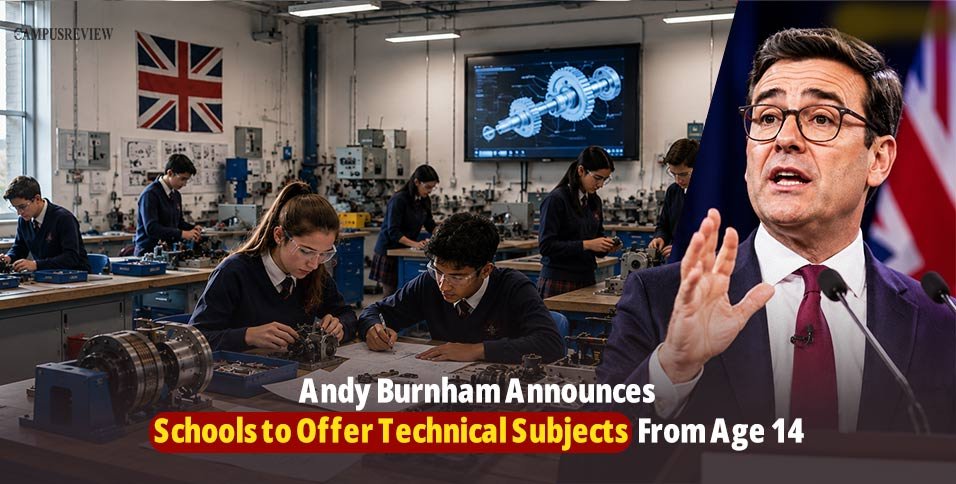
The UK government has announced plans to allow schools to offer technical subjects to pupils in England from age 14 as part of a major overhaul of secondary education, with a nationwide rollout expected from September 2028.
Prime Minister Andy Burnham unveiled the proposal during a speech in Derby, saying the reforms will better connect schools with local labour market needs and help address long-standing skills shortages.
Under the plan, Year 10 students will study core subjects, including English, maths, and science, alongside technical learning.
The government says the reforms aim to reduce youth unemployment and prepare students for careers in high-demand technical fields.
“From today, Britain will value the hard hat as much as the graduation cap.” – Andy Burnham, UK Prime Minister
Speaking directly to young people, Burnham said:
“Whether you choose construction, coding or classics, you’ll get the skills you need and be given the respect you deserve.” – Andy Burnham, UK Prime Minister
Schools to Offer Technical Subjects: Key Changes for Students
| Feature | Details under government education proposal |
| Starting Age | Technical education pathways start at age 14 (Year 10) |
| Core Curriculum | Mandatory academic subjects (English, maths, science) preserved alongside practical learning |
| Employer Role | Employers will help shape regional technical pathways based on local workforce needs |
| School Inspections | Ofsted expected to recognize and assess technical education quality and career readiness |
| Regional Leadership | Strategic authorities and mayors adapt training tracks to regional economic strengths |
Why Ministers Announced the Strategy Today
Ministers launched the policy following warnings from education and labour market analysts about growing disconnects in the British workforce. According to government labour market statistics, over one million young people aged 16 to 24 in the UK are currently not in education, employment, or training (NEET).
An interim report led by former cabinet minister Alan Milburn warned that this trend risks creating a lost generation disconnected from the modern economy.
At the same time, employer associations highlight persistent hiring difficulties. According to the British Chambers of Commerce, 75% of recruiting businesses struggle to find job applicants with relevant technical skills.
By introducing technical pathways alongside GCSEs, the government aims to reduce youth inactivity and address regional skills shortages.
How Technical Education Fits Existing Qualifications
The proposal introduces early practical learning without eliminating academic foundations.
- GCSE Core Preserved: Students will continue taking foundational GCSE courses in English, maths, and science.
- Consultation on Implementation: The government has said the technical pathways will complement existing academic routes, with further implementation details expected during consultation.
- Post-16 Progression: The government said the new pathways are intended to support progression into technical qualifications after age 16, such as T Levels, apprenticeships, and higher vocational diplomas, with further details to be announced.
- Local Model Influence: The strategy draws inspiration from local initiatives such as Greater Manchester’s MBacc framework, adapting regional career pathways for national use.
Industry Support and Delivery Challenges
Business organizations welcomed the decision to expand vocational education in secondary schools. According to recent British Chambers of Commerce research, 46% of small firms value apprenticeships and university degrees equally, while 37% view vocational education as more relevant to their immediate hiring needs.
However, school leaders and teaching unions raised immediate implementation concerns:
- Workshop and Equipment Funding: Headteachers warn that providing specialist facilities requires significant capital investment beyond current budgets.
- Teacher Recruitment: Schools face existing recruitment shortages in engineering, computing, and technical subjects.
- Timetabling Balance: Balancing core GCSE preparation with new technical learning opportunities presents practical scheduling challenges.
- Regional Disparities: Schools in rural areas may find it harder to establish active business partnerships than those in major industrial hubs.
- Cautious Welcome from Leaders: Pepe Di’Iasio, General Secretary of the Association of School and College Leaders (ASCL), welcomed the focus on reducing youth inactivity but urged realistic implementation timelines:
“Bringing local politicians, school and college leaders and employers together is a noble objective, but to do it properly requires time, a national framework to work within, and investment. Right now there is little detail about what this will look like in practice.” – Pepe Di’Iasio, ASCL General Secretary
What Happens Next
The Department for Education, led by Education Secretary Lucy Powell, will begin consultations with teachers, local authorities, and business leaders to refine the technical pathways.
- 2026–2027: Regional leaders will analyze local employment shortages to identify priority technical areas.
- 2027: The government plans to release updated operational guidance and timetabling structures for schools.
- 2027–2028: Ofsted will update its inspection standards to evaluate vocational learning quality.
- September 2028: The government aims for participating schools to offer technical subjects to Year 10 students.
Further details on funding, curriculum design, and implementation are expected over the next two years.