The Campus Review
November 23, 2026
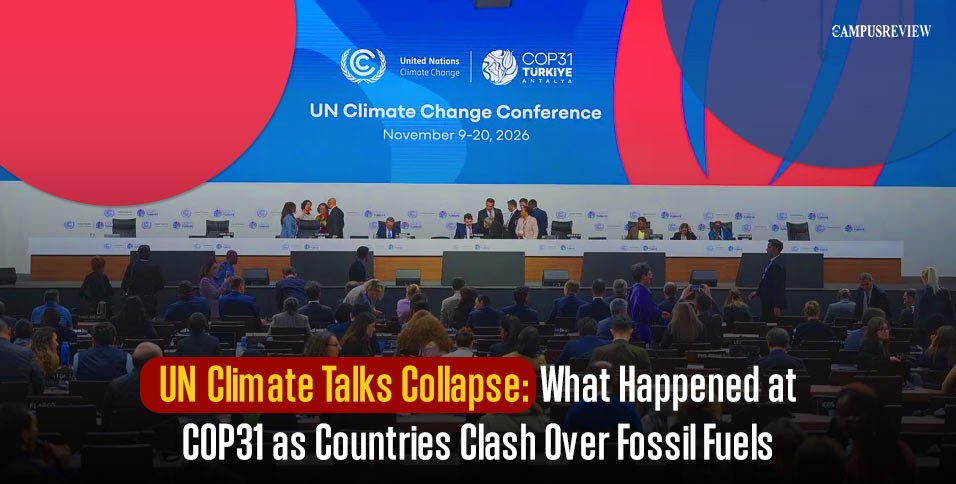
The UN climate talks collapse became official on Sunday, November 22, 2026, when negotiators in Antalya, Türkiye, failed to reach consensus on an overarching political agreement. Two weeks of talks and two days of overtime ended without the proposed Antalya Pact, making it the longest-running United Nations Climate Change Conference on record.
Nearly 200 countries could not agree on how to address oil, gas, and coal or how to fund climate protection for poorer nations. While several smaller climate initiatives moved forward, the failure to adopt a final cover decision left the global climate process deeply divided.
Here is a clear, fact-checked breakdown of what happened in Antalya, where countries clashed, and what comes next.
The Numbers Behind the UN Climate Conference 2026
The verified figures from the summit show the scale of the Antalya negotiations.
| Key Metric | Verified COP31 Fact |
| Conference Dates | November 9 to 22, 2026, in Antalya, Türkiye |
| Participating Nations | Nearly 200 countries (196 parties to the UN climate framework) |
| Record Overtime | Two days past the Friday deadline, making it the longest UN climate summit on record |
| Electrification Pledge | Around 90 countries backed the 35×35 Global Electrification Pledge |
| Annual Adaptation Need | $305 billion per year by 2035 for developing nations, per the 2026 UNEP Adaptation Gap Report |
| Next Climate Summit | COP32 in Addis Ababa, Ethiopia, scheduled for November 2027 |
Why the UN climate talks collapsed
Three major roadblocks stalled the COP31 climate negotiations and prevented a final cover decision.
1. The Battle Over Fossil Fuels: Countries disagreed on whether the final agreement should include a clear plan to reduce the use of coal, oil, and gas. Some nations opposed mentioning fossil fuels and supported carbon capture technology instead.
2. The Climate Funding Gap: Developing countries wanted more financial support to deal with floods, heatwaves, and droughts. A proposed target of $120 billion a year by 2035 appeared in earlier drafts but was not included in the final agreement.
3. The Consensus Rule: UN climate change negotiations require countries to reach a common agreement. Since some countries rejected the final draft, negotiators could not approve the proposed global climate agreement.
Who Stood Where: The Three-Way Divide
The deadlock in Antalya did not split simply into rich versus poor countries. Three distinct groups pulled the talks in different directions.
| Group / Countries | What They Wanted | Their Reaction to the Draft |
| European Union and Vulnerable Nations | Clear plans to reduce fossil fuel use and cut emissions | Rejected the draft because it did not do enough to address fossil fuels |
| Oil-Producing Nations (including Saudi Arabia) | Keep using different energy sources, including oil and gas | Opposed stricter rules to reduce fossil fuel use |
| Developing Countries (including India) | More financial support to deal with climate change and protect vulnerable communities | Criticised the draft for not providing enough support to poorer nations |
What Key Leaders Said in Antalya
Statements from the closing floor show the deep frustration after the failed climate agreement.
- Murat Kurum, COP31 President and Turkish Environment Minister: “There will be no new text from now on. We will not be carrying out work on a new text in an environment where there is no consensus. We will implement existing decisions.”
- António Guterres, UN Secretary-General: Said he was “deeply disappointed that COP31 has ended without consensus on an overarching outcome,” adding, “There may be no consensus in the negotiating room. There is no ambiguity in the science.”
- Chris Bowen, COP31 President of Negotiations and Australian Energy Minister: “Unfortunately, we were unable to reach agreement on a cover decision. And that’s disappointing, very disappointing.”
- European Union Delegation: “We will not endorse a cover decision or an Antalya pact that does not even mention fossil fuels, which is the key driver of climate change.”
- Saudi Arabia Delegation: “We believe that climate change requires all solutions on the table.”
What COP31 Achieved Despite the Failed Climate Deal
The collapse of the overarching political pact does not mean the entire conference produced zero results. It helps to separate what stayed intact, what moved forward, and what stalled.
- Existing Commitments Remain Active: The 2015 Paris Agreement and the 2023 COP28 pledge to transition away from fossil fuels remain legally and politically in force.
- Initiatives That Moved Forward: According to the UK Government’s COP31 outcome briefing, countries still advanced practical action on clean energy, including the 35×35 Global Electrification Pledge. Nations also strengthened partnerships to cut methane emissions, protect forests and coral reefs, and improve early-warning systems for extreme weather. Work also continued on separate tracks covering climate finance and a just transition.
- Proposals That Remained Unresolved: Because countries rejected the overarching Antalya Pact, negotiators did not adopt new fossil fuel transition rules, the proposed $120 billion adaptation finance target, or a unified political response to crossing the 1.5°C warming limit.
What Happens Next for Global Climate Action
The UN climate talks collapse leaves governments with major unfinished business, but the global climate process does not stop. Technical talks and diplomatic negotiations will continue over the next twelve months ahead of COP32 in Addis Ababa, Ethiopia, in November 2027.
That upcoming summit will give countries another opportunity to bridge their divides over fossil fuels and adaptation funding. In the meantime, clean energy and electrification pledges show that many nations are willing to move ahead with practical climate action even when unanimous UN agreements stall.
Pranjal Kharche