The Campus Review
August 12, 2026
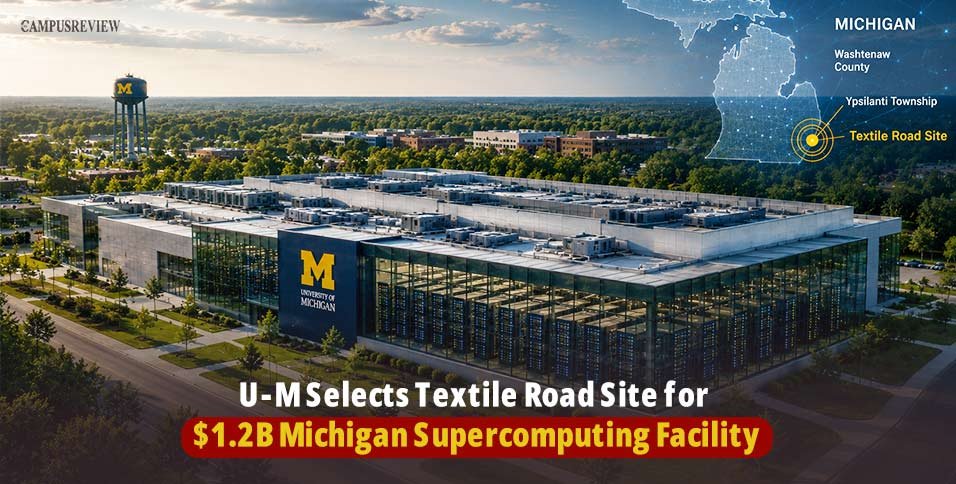
The University of Michigan has selected a 144-acre site on Textile Road in Ypsilanti Township as the preferred site for a planned $1.25 billion Michigan supercomputing facility.
The project, developed in partnership with Los Alamos National Laboratory, will support high-performance computing, artificial intelligence research, and scientific computing.
The facility is expected to support research in public health, clean energy, materials science, and national security.
Key Details of the Project
- Project Scope: The project is widely reported as a $1.2 billion investment, while U-M materials put the total investment at approximately $1.25 billion.
- Footprint: 144 acres off Textile Road and Bridge Road in Ypsilanti Township, combining a parcel purchased from Norfolk Southern Railroad with existing U-M property.
- Key Partners: University of Michigan (U-M) and Los Alamos National Laboratory (LANL).
- Economic Outlook: Early project proposals and state discussions estimated the facility could support up to 200 research and technical positions.
- State Support: Supported by a $100 million Strategic Site Readiness Program grant from the Michigan Strategic Fund.
Why Textile Road Was Selected for the Project
U-M evaluated two potential sites in Ypsilanti Township for the scientific computing facility, including the former Willow Run bomber plant site at the American Center for Mobility.
Comprehensive engineering, environmental, and real estate reviews showed that the Willow Run site presented complex brownfield redevelopment requirements.
The Textile Road site offered several advantages for the planned facility:
| Location Factors | Textile Road Site | Willow Run / ACM Site |
| Zoning Status | Pre-zoned for light industrial use by Ypsilanti Township | Industrial, with extensive brownfield remediation needs |
| Utility Access | Proximity to existing electrical and data infrastructure | Requires major utility and site remediation upgrades |
| Development Buffers | Space to preserve natural areas and separate facility from homes | Constrained layout options due to legacy industrial structures |
In an official statement regarding the site confirmation, U-M Public Affairs noted:
“The Textile Road site gives U-M an opportunity to build a world-class research facility in a location that meets the project’s infrastructure needs while preserving natural features, creating substantial buffers from neighboring homes and parks and supporting responsible long-term development.”
What Will the Michigan Supercomputing Facility Do?
The project is designed primarily for scientific and national security research rather than consumer-facing cloud services. The complex will house an academic center for U-M faculty and students along with a federal research facility operated by Los Alamos National Laboratory.
Core Areas of Research
- Drug Discovery & Healthcare: Researchers will use high-performance computing to simulate molecular interactions and support research in health and drug discovery. The university’s healthcare research also includes the University of Michigan School of Nursing, which focuses on education, research, and healthcare innovation.
- Energy & Climate Sciences: Advanced modeling will test power grid resilience and assist in developing clean energy technologies.
- National Security: LANL will use advanced computing and simulations to support national security research and nuclear stewardship.
- Sustainable AI Computing: Through projects like Zeus led by U-M computer science researchers, open-source tools are being developed to measure and optimize AI model training, with tests showing energy savings of up to 50%.
Community Outreach and Environmental Measures
Township leaders and community members previously raised questions about water usage, energy consumption, and environmental impacts of the supercomputer plan. To address these questions, U-M released factual details about the facility’s design and the scheduled community outreach events.
- Water Management: U-M confirmed that cooling water will be purchased from local municipal utilities and sanitary discharge will be handled through municipal systems, with no direct draw from or discharge to the Huron River.
- Emissions & Infrastructure: Buildings are designed to operate cleanly and quietly using all-electric infrastructure with minimal direct emissions.
- Land Preservation: The university plans to preserve significant natural buffer areas and wetlands on the site.
Addressing concerns over local impacts, State Sen. Jeff Irwin highlighted the difference between the proposed research facility and commercial data centers, noting that the project is intended to expand research infrastructure and workforce opportunities.
“Data centers aren’t drawing private sector employers who want to glean innovation from the research that they’re doing at the data center. Data centers are just warehousing and moving bits and bytes on behalf of Meta or Amazon Web Services or Google.”
- State Sen. Jeff Irwin
Looking Ahead
The selection of the Textile Road site moves the Michigan supercomputing facility project into its next phase of planning and development. U-M plans to hold its next community town hall in Ypsilanti Township on September 9, with the facility targeted for completion in 2030.