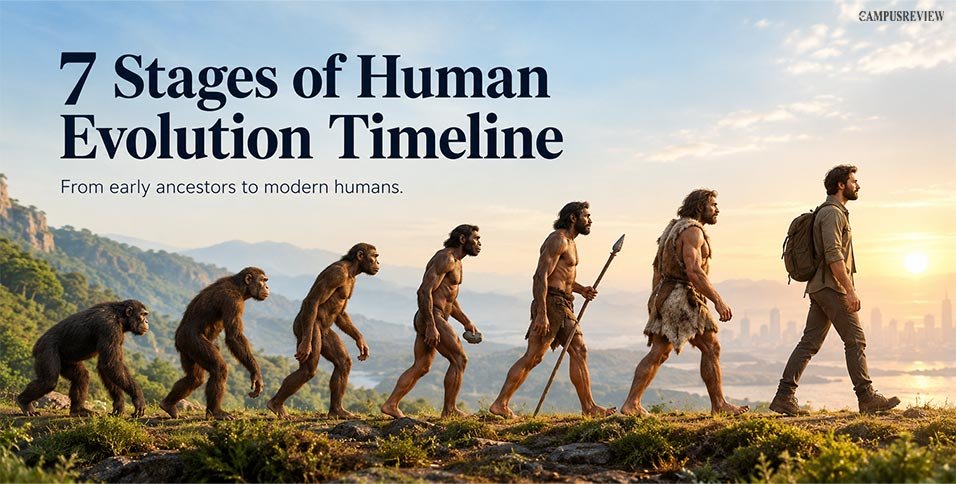
Human evolution is a six-million-year story. It shows how humans developed from ape-like ancestors into modern Homo sapiens. Key milestones include walking on two legs, growing a bigger brain, making tools, using fire, migrating out of Africa, and building language and culture. This process did not happen in one straight line. It moved through many species and stages, each with its own traits and struggles.
This guide covers the 7 stages of human evolution with a clear timeline, key changes, fossil discoveries, tools, and DNA evidence. It explains how scientists use Human Evolution evidence to piece together the story of human evolution.
What Is Human Evolution?
Human evolution is the gradual process through which modern humans developed from earlier ape-like ancestors over about six million years, mainly in Africa.
Humans are primates and share a common ancestor with chimpanzees and bonobos. Humans did not evolve from modern apes. Instead, humans and chimpanzees evolved separately after their shared ancestor lived about 8 to 6 million years ago.
Africa is known as the cradle of humankind because the earliest human fossils, including those older than 2 million years, have been found there. Scientists use fossils, tools, and DNA to trace how humans evolved over time.
Human Evolution Timeline
Use this table as a quick snapshot of the whole journey before you read each stage in detail.
| Stage / Species | Approx. Time Period | What Changed |
| Dryopithecus | 12.5-11.1 million years ago | Tree-dwelling ape, upright posture begins |
| Ramapithecus | 14-9 million years ago | Jaw and teeth adapt; later reclassified |
| Australopithecus | 4-2 million years ago | Full bipedalism, small brain |
| Homo habilis | 2.4-1.4 million years ago | Larger brain, first stone tools |
| Homo erectus | 1.89 million-110,000 years ago | Modern body, migration out of Africa, fire |
| Neanderthals | 400,000-40,000 years ago | Cold adaptation, complex tools, symbolic art |
| Homo sapiens | 300,000 years ago-present | Language, culture, global migration |
7 Stages of Human Evolution
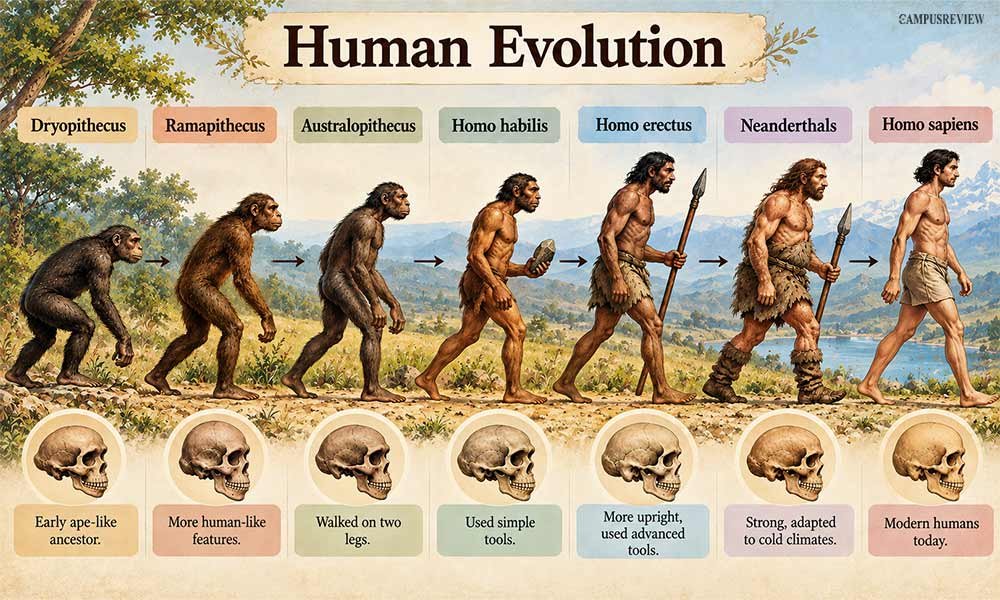
These 7 stages of human evolution include Dryopithecus, Ramapithecus, Australopithecus, Homo habilis, Homo erectus, Neanderthals, and Homo sapiens, offering a simplified map of a complex, branching history.
| Species | Approx. Time Period | Notable Fossil Discovery |
| Dryopithecus | 12.5-11.1 mya | First found in France, 1856 |
| Ramapithecus | 14-9 mya | Siwalik Hills, India, 1932 |
| Australopithecus | 4-2 mya | “Lucy” skeleton, Ethiopia, 1974 |
| Homo habilis | 2.4-1.4 mya | Olduvai Gorge, Tanzania, 1959 |
| Homo erectus | 1.89 mya-110,000 years ago | Java, Indonesia, 1891 |
| Neanderthals | 400,000-40,000 years ago | Neander Valley, Germany, 1856 |
| Homo sapiens | 300,000 years ago-present | Jebel Irhoud, Morocco, ~315,000 years old |
1. Dryopithecus
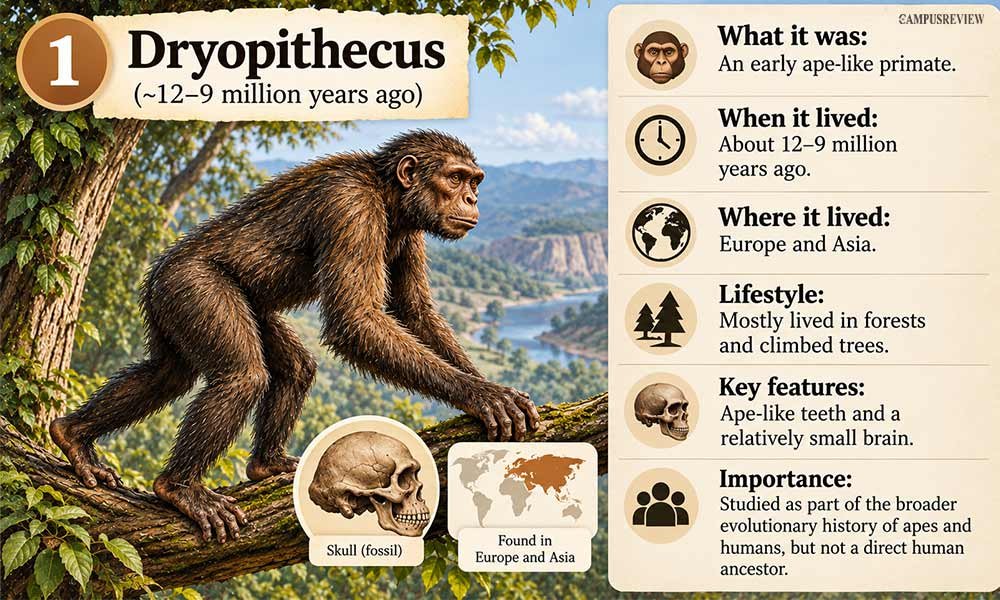
Dryopithecus was among the earliest ape-like primates connected to the human family tree and lived during the middle to late Miocene period, roughly 12.5 to 11.1 million years ago. The name comes from Greek and means “tree ape,” a fitting label for a primate built for life in the forest canopy.
Physical Characteristics
Dryopithecus had a body plan closer to a modern gibbon than to a human. It had long arms suited for swinging between branches, a lighter build, and teeth adapted for a mostly fruit-based diet.
Unlike ground-dwelling hominins that came later, Dryopithecus still relied heavily on trees for food and safety, though its posture shows early signs of the more upright stance that later species would build on.
Habitat
Fossils show Dryopithecus lived across a wide range, from Europe to East Africa and China. The first fossil turned up in France in 1856, making it one of the earliest ape fossils ever studied by scientists. Later finds in China and East Africa showed this genus was more widespread than researchers first assumed.
Why It Matters to the Broader Evolutionary Story
Dryopithecus sits near the base of the family tree that eventually splits into apes and humans. It does not lead directly to modern humans, but studying its bones and teeth helps scientists understand what the common ancestor of humans and great apes might have looked like, long before bipedalism or tool use ever appeared.
2. Ramapithecus
Ramapithecus lived about 14 to 9 million years ago during the Miocene Epoch and was once considered an early human ancestor based on its jaw and tooth fossils.
Jaw and Teeth
The first Ramapithecus fossil, discovered in 1932 by G.E. Lewis in the Siwalik Hills of northern India, consisted of jaw fragments with a curved dental arch and relatively small canine teeth. These features looked human-like at the time, which is exactly why researchers initially classified Ramapithecus as an early hominin.
Environment
Later finds placed Ramapithecus in Saudi Arabia and parts of Africa as well, suggesting a wide range across Miocene forests and woodlands, environments rich in fruit and vegetation that shaped its dental structure.
Scientific Context
More complete fossils recovered decades later told a different story. Ramapithecus turned out to be more closely related to modern orangutans than to humans, and scientists reclassified it accordingly. This case is now a textbook example of how new fossil evidence can overturn an accepted theory.
3. Australopithecus
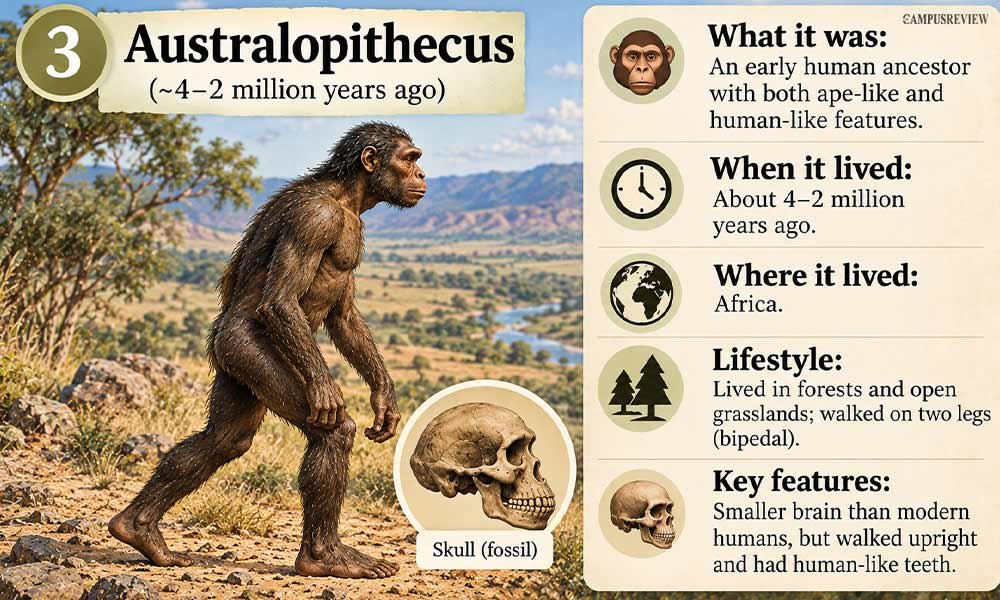
Australopithecus lived in Africa about 4 to 2 million years ago and was an early human relative known for walking upright on two legs, an important step in human evolution.
Walking on two legs, called bipedalism, freed the hands to carry food, tools, and eventually offspring, a change that reshaped the entire trajectory of human evolution.
Brain Size
Despite walking like a human, Australopithecus still thought more like an ape. Its brain measured close to 400 to 500 cubic centimeters, not far off from a modern chimpanzee’s brain size. Big cognitive leaps had not happened yet. What changed first was the body, not the brain.
Teeth
Australopithecus had large, thick-enameled molars suited for chewing tough plants, roots, and seeds. This dental structure hints at a diet shaped by an unpredictable food supply, likely tied to the shifting African climate of the time.
African Fossils
The first Australopithecus fossil was found in 1924 near Taung, South Africa, by quarry workers. The most famous specimen, though, is “Lucy,” an Australopithecus afarensis skeleton found in Ethiopia in 1974.
Lucy’s skeleton is about 40 percent complete, an extraordinary find for a fossil over 3 million years old, and her hip and knee bones offer some of the clearest proof of early bipedalism.
4. Homo habilis
Homo habilis translates to “handy man,” a name chosen because of the species’ clear connection to toolmaking. Homo habilis lived approximately 2.4 to 1.4 million years ago, during the early Pleistocene, and is considered one of the earliest members of our own genus, Homo.
Brain Development
Homo habilis had a noticeably larger brain than Australopithecus, averaging around 600 to 700 cubic centimeters. This jump in brain size lines up with more complex behavior, including a wider and more flexible diet.
Stone Tools
Homo habilis is associated with some of the earliest deliberately shaped stone tools, known as Oldowan tools. These simple flakes and choppers let early humans cut meat and crack bones for marrow, widening the range of food they could access.
Scientists still debate whether Homo habilis was truly the first toolmaker, since some stone tools appear to be slightly older than the earliest confirmed Homo habilis fossils.
Olduvai Gorge
The first Homo habilis fossils were unearthed in 1959 at Olduvai Gorge in Tanzania, by a team led by Louis and Mary Leakey. This site remains one of the most important fossil locations in the study of human evolution, and continues to yield new finds today.
5. Homo erectus
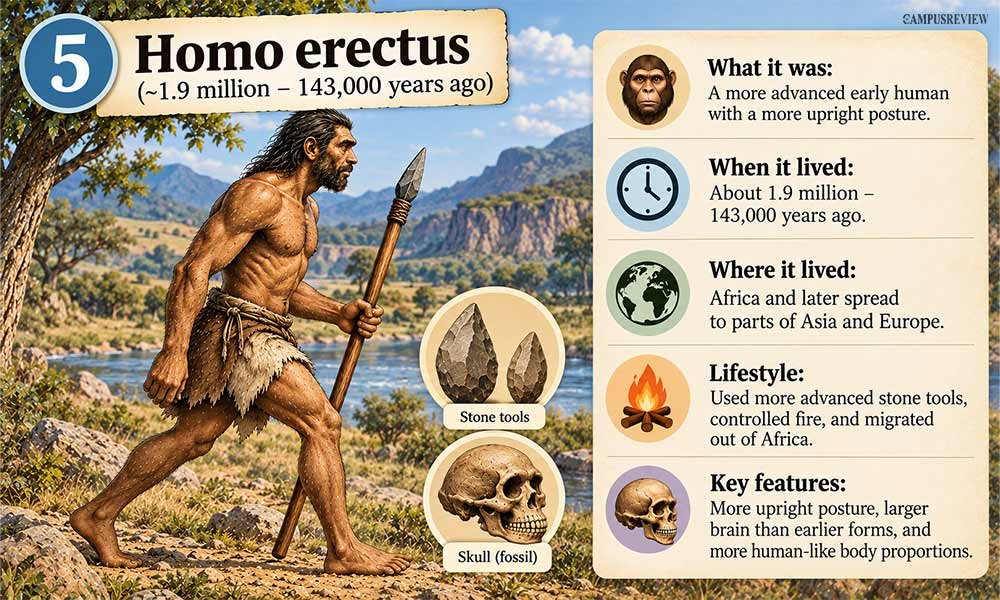
Homo erectus had longer legs, shorter arms, and a narrower pelvis that supported efficient upright walking and running, making it well adapted for long-distance movement across open landscapes.
Migration Beyond Africa
Homo erectus holds a major distinction: it is the first hominin species confirmed to have left Africa. Fossil evidence places Homo erectus in parts of Asia and Europe as early as 1.89 million years ago, with the species persisting in some regions until as recently as 110,000 years ago.
The first fossil, found on the island of Java in Indonesia in 1891 by Dutch doctor Eugène Dubois, proved that early humans had already spread across continents far earlier than scientists once believed.
Stone Tools
Homo erectus is closely linked with the Acheulean tool tradition, known for symmetrical, teardrop-shaped handaxes. These tools were more advanced than the simple Oldowan flakes used earlier and required real planning to shape.
Fire and Hearths
Evidence connects Homo erectus with some of the earliest use of controlled fire. Fire offered warmth, protection from predators, and a way to cook food, and cooked food is generally easier to digest and absorb nutrients from than raw food.
Why It Was Important
Homo erectus represents the first hominin to look, move, and behave in ways that feel recognizably human. Its combination of a modern-looking body, advanced tools, controlled fire, and long-distance migration marks it as a genuine turning point between early hominins and the species that would eventually become us.
6. Neanderthals
Neanderthals (Homo neanderthalensis) had short, powerfully built bodies with wide chests and strong limbs, a build well suited to conserving body heat. They lived across Europe and parts of Asia, roughly 400,000 to 40,000 years ago, and were physically closer to modern humans than any earlier hominin.
Cold-Climate Adaptation
Neanderthals endured harsh ice age conditions for hundreds of thousands of years. Their compact bodies, large nasal cavities for warming cold air, and layered clothing made from animal hides all helped them survive freezing European winters that would challenge any human today.
Tools
Neanderthals crafted the Mousterian toolkit, a more refined and specialized set of stone tools compared to earlier hominins. They used these tools for hunting, hide preparation, and woodworking, showing a level of planning and skill once thought to be unique to modern humans.
Social Behavior
Neanderthals hunted large, dangerous animals in coordinated groups, cared for injured or sick members of their communities, and intentionally buried their dead. These behaviors point to complex social bonds and possibly even early forms of ritual or belief.
Relationship With Modern Humans
Genetic studies confirm that Neanderthals interbred with early Homo sapiens. As a result, most people with non-African ancestry today carry a small percentage of Neanderthal DNA.
Neanderthals eventually went extinct around 40,000 years ago, but recent research suggests this was not because they were less capable. It was more likely a mix of climate pressure, small population size, and competition with expanding Homo sapiens populations.
7. Homo sapiens
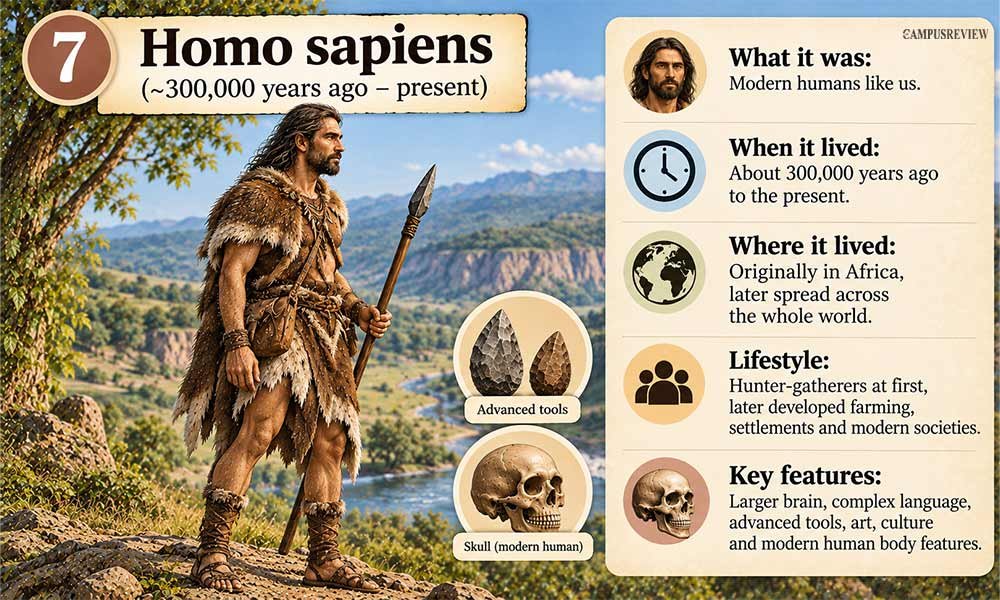
Homo sapiens, the species every person alive today belongs to, first appears in the fossil record roughly 300,000 years ago in Africa. The oldest known Homo sapiens fossils, found at Jebel Irhoud in Morocco, date back approximately 315,000 years, pushing the known origin of our species earlier than scientists once believed.
Brain and Cognition
Homo sapiens developed a brain averaging around 1,350 cubic centimeters, larger and structurally more complex than any earlier hominin’s. This supported advanced problem-solving, long-term planning, and abstract thought, abilities that set modern humans apart from every species before them.
Language
Full, grammar-based language is considered a defining trait of Homo sapiens, though pinpointing exactly when it emerged is difficult since language leaves no direct fossil evidence. Indirect clues, such as symbolic artifacts and complex tool traditions, suggest sophisticated communication was well established by at least 100,000 years ago.
Art and Symbolic Expression
Homo sapiens left behind some of the earliest confirmed art and symbolic objects, including engraved ochre, shell beads, and cave paintings.
A well-known example is the engraved ochre plaque from Blombos Cave in South Africa, dated to around 75,000 years ago, one of the oldest known pieces of deliberate human symbolism.
Culture
Beyond art, Homo sapiens built wide-reaching social and trade networks, exchanging materials and resources across hundreds of kilometers. This capacity for cooperation and cultural exchange likely helped the species adapt faster than any hominin before it.
Global Migration
Homo sapiens eventually spread from Africa to every continent except Antarctica, reaching Australia within the past 60,000 years and the Americas within the past 30,000 years or so. This global spread required adapting to an enormous range of climates, from deserts to arctic tundra, something no earlier hominin species managed to do.
Key Milestones in Human Evolution
Here is the story of human evolution as a quick timeline of milestones.
- 6 million years ago: Human and chimpanzee lineages split apart
- More than 4 million years ago: Bipedalism develops
- 3.3 million years ago: The oldest known stone tools appear
- 2 million years ago: Early humans expand beyond Africa into Asia
- 300,000 years ago: Homo sapiens emerges in Africa
- Past 100,000 years: Complex art, symbols, and culture spread worldwide
How Did Humans Evolve?
Major human traits did not appear all at once. They evolved separately, at different times, over millions of years.
Walking on Two Legs
Bipedalism was one of the earliest human traits to evolve, appearing more than 4 million years ago. Walking upright freed the hands for tasks like carrying food and tools.
Brain Development
Brain size grew slowly at first. Rapid brain growth mostly happened in the last 800,000 years, giving later humans the ability to plan, solve problems, and think abstractly.
Toolmaking
The oldest stone tools date back about 3.3 million years. Tools let early humans cut meat, crack bones for marrow, and process plants they could not eat with teeth alone.
Use of Fire
Fire gave early humans warmth, protection from predators, and a way to cook food. Cooked food is easier to digest, which may have helped support bigger brains.
Migration
Early humans first left Africa around 2 million years ago. Later, Homo sapiens spread across Asia, Europe, Australia, and eventually the Americas, adapting to very different climates along the way.
Language and Communication
Symbolic communication, including the use of pigment and decorated objects, appears in the archaeological record around 250,000 years ago. Language let humans plan together and pass down knowledge.
Culture and Symbolic Thinking
Art, jewelry, and burial rituals became common in the last 100,000 years. These behaviors show that humans could think beyond survival, using symbols to express identity and meaning.
How Do Scientists Know About Human Evolution?
Human evolution is not guesswork. It rests on four main types of evidence.
Fossils
Bones and teeth are the most direct evidence of early humans. Fossil shape and size reveal how ancient hominins moved, chewed, and grew. Skull shape can even show how brain size changed over time.
Archaeological Evidence
Stone tools, footprints, hearths, and butchered animal bones show how early humans behaved, not just what they looked like. A cluster of stone tools next to animal bones, for example, tells researchers that hominins were butchering meat at that spot.
Genetics
Comparing DNA across humans, chimpanzees, and even extinct groups like Neanderthals reveals how closely related different species are. Genetic studies have confirmed that Neanderthal DNA still exists in many people alive today.
Dating Methods
Scientists use techniques like radioactive decay to work out how old fossils and rock layers are. Different elements decay at known, fixed rates, so measuring what remains tells researchers roughly how many years have passed since a layer formed.
End Note
Human evolution is not a straight line from ape to modern human. It is a branching story shaped by climate, geography, and chance, running across six million years. Each stage, from tree-dwelling Dryopithecus to symbol-making Homo sapiens, added a piece to the picture.
Fossils, tools, genetics, and dating methods let scientists piece this story together with real evidence, not guesswork. Understanding the 7 stages of Human Evolution helps us understand what makes us human today: our brains, our tools, our language, and our ability to adapt to almost any environment on Earth.
FAQs
1. When did human evolution begin?
Human evolution began about 6 million years ago, when the lineages leading to humans and chimpanzees split apart.
2. Did humans evolve from monkeys?
No. Humans did not evolve from any living monkey or ape. Humans and modern apes share a common ancestor that no longer exists today.
3. Where did humans first evolve?
Humans first evolved in Africa. Every human fossil older than 2 million years comes from African sites.
4. When did humans start walking on two legs?
Bipedalism, or walking on two legs, developed more than 4 million years ago.
5. When did Homo sapiens appear?
Homo sapiens appeared roughly 300,000 years ago. The oldest known fossil, found in Morocco, is about 315,000 years old.