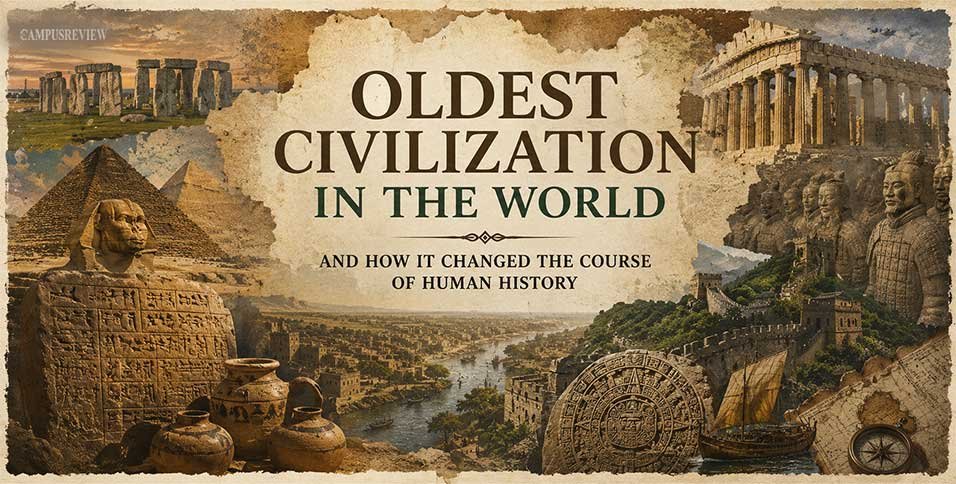
The oldest civilization in the world is generally recognized as the Sumerian civilization of ancient Mesopotamia, which emerged around 4500–4000 BCE in present-day Iraq. Its cities, writing system, and organized government laid the foundation for later civilizations.
However, Sumer was not the only early center of human development. Ancient Egypt, the Indus Valley Civilization, Caral-Supe (Norte Chico), and Ancient China also built advanced societies that shaped history in different ways. Because civilizations developed independently across regions, historians continue to study how and when each one emerged.
This guide explains the oldest civilization in the world, compares the earliest civilizations through a timeline, and explores their achievements, from writing and architecture to trade and governance. Backed by archaeological research, it offers a clear and reliable introduction to humanity’s earliest civilizations.
Oldest Civilizations at a Glance
This table provides a quick overview of the world’s oldest civilizations, making it easy to compare their origins, locations, and key contributions at a glance.
| Civilization | Location | Time Period | Known For |
| Sumer (Mesopotamia) | Modern Iraq | 3500-3100 BCE | First cities, cuneiform writing, law codes |
| Ancient Egypt | Nile Valley | 3100 BCE onward | Pyramids, pharaohs, hieroglyphs |
| Indus Valley | Pakistan & India | 2600-1900 BCE | Planned cities, drainage systems |
| Caral-Supe | Coastal Peru | 3500-1800 BCE | Pyramids, quipu cords |
| Ancient China | Yellow & Yangtze rivers | 1600-1046 BCE (Shang) | Bronze casting, oracle bones |
| Olmec | Gulf Coast, Mexico | 1600-400 BCE | Colossal stone heads, rubber |
The World’s Oldest Civilizations
Each of these six regions built complex society completely on its own. Historians call them the six cradles of civilization. Here is a closer look at each one.
Mesopotamia (Sumer)
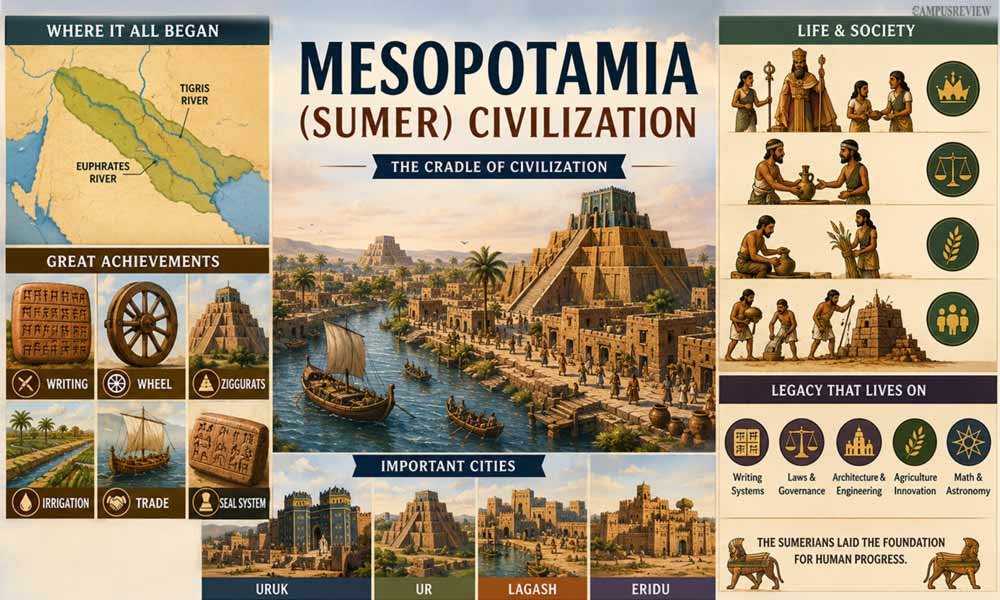
● Location: Between the Tigris and Euphrates rivers, in modern Iraq.
● Time period: About 4000 BCE to 1900 BCE.
Many scholars point to Sumer as the site of the earliest human civilization on record, because of its early cities and writing.
Sumer grew in a dry, flat plain. Farmers dug canals to bring river water to their fields. This turned dry land into rich farmland. Big harvests meant people did not all need to farm. Some became priests, traders, or builders instead.
Cities of Mesopotamia grew fast. Uruk, Ur, and Eridu became major city-states. Each one had its own ruler and its own temple.
Around 3400 BCE, Sumerian scribes invented cuneiform. They pressed wedge-shaped marks into wet clay using a reed pen. This is why many historians call Sumer the first and oldest civilization in the world. Cuneiform recorded trade deals, laws, and stories like the Epic of Gilgamesh.
Sumerians also gave us math ideas we still use today. They split circles into 360 degrees.
They split hours into 60 minutes. They built tall stepped towers called ziggurats for worship and administration.
Sumer matters because later empires copied its playbook. The Akkadians, Babylonians, and Assyrians all built on Sumerian ideas about law, writing, and city government.
Ancient Egypt
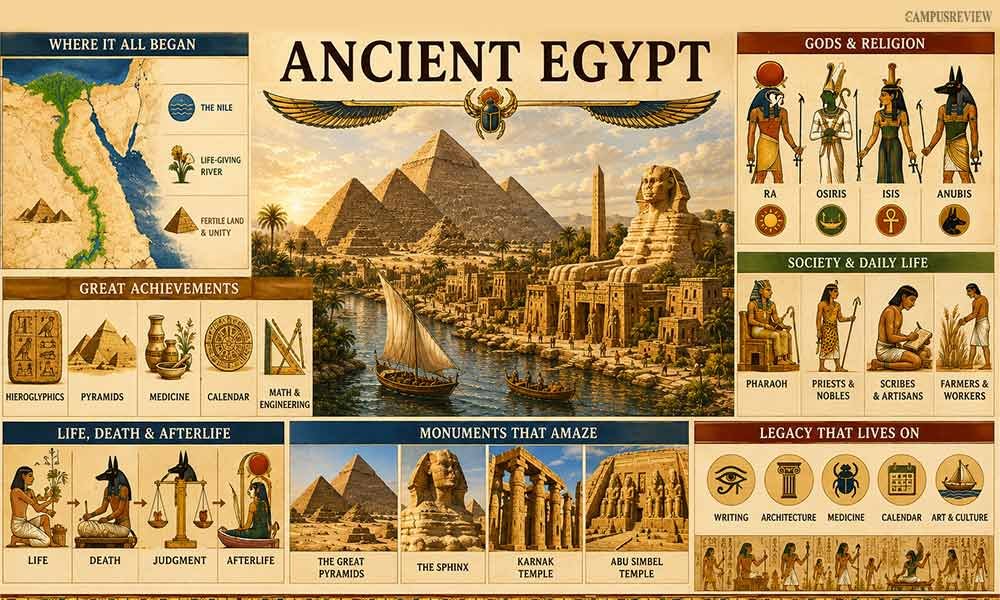
● Location: Along the Nile River in northeastern Africa.
● Time period: United around 3100 BCE, lasted over 3,000 years.
Egypt formed around 3100 BCE when King Narmer united Upper and Lower Egypt. The Nile flooded every year and left rich soil behind. This gave Egyptian farmers steady harvests of wheat, barley, and flax.
A pharaoh ruled as a god-king. Below him sat a large system of officials who managed labor, taxes, and building projects.
Egyptians built the Pyramids of Giza and the Great Sphinx. They also built massive temples at Karnak and Luxor. Scribes wrote in hieroglyphs and hieratic script. They invented papyrus, an early form of paper, and created a 365-day calendar.
Beyond its pyramids and pharaohs, Ancient Egypt is remembered for its powerful gods and goddesses, whose stories reveal how Egyptians understood life, death, and the universe.
Egypt’s biggest strength was staying power. It kept its culture, government, and trade routes stable for thousands of years, reaching across the Mediterranean and Red Sea.
Indus Valley Civilization
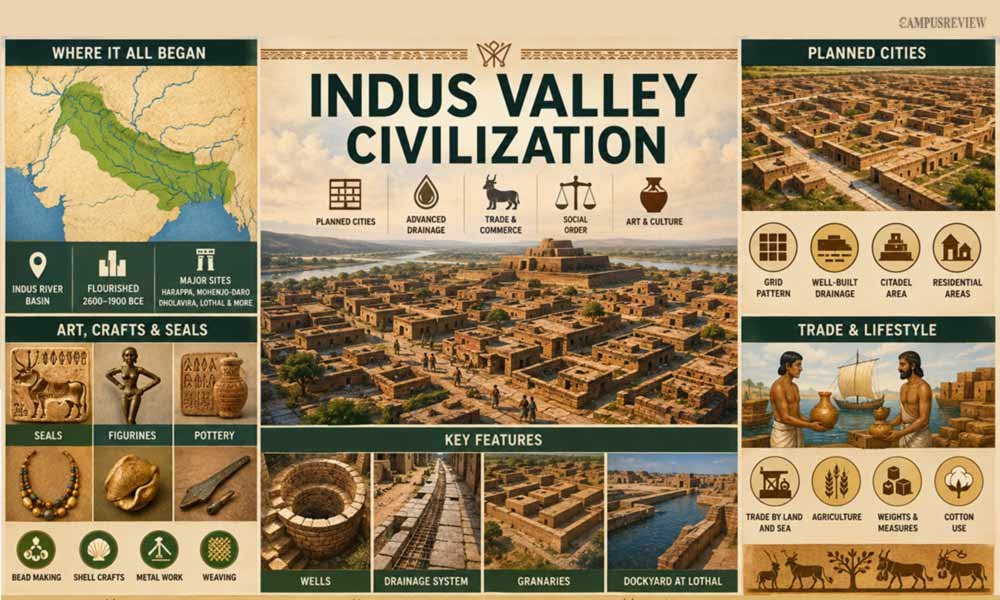
● Location: Along the Indus and Ghaggar-Hakra rivers, in modern Pakistan and northwest India.
● Time period: 2600 BCE to 1900 BCE (mature phase).
The Indus Valley, also called the Harappan civilization, covered more land than Egypt or Mesopotamia. Its major cities were Mohenjo-Daro, Harappa, and Dholavira.
These cities show careful planning. Streets ran in straight grids. Homes used standard-sized bricks. Underground drains carried away waste. Public baths served the whole community.
Harappan traders used standard weights for fair deals. Artisans carved detailed seals from steatite stone. Their script uses hundreds of symbols, and no one has fully decoded it yet.
One striking fact stands out. Archaeologists have found no palaces, no royal tombs, and no signs of a standing army. This suggests the Indus Valley ran on cooperation, not conquest. It built trade links stretching from Central Asia to the Persian Gulf.
Caral-Supe (Norte Chico)
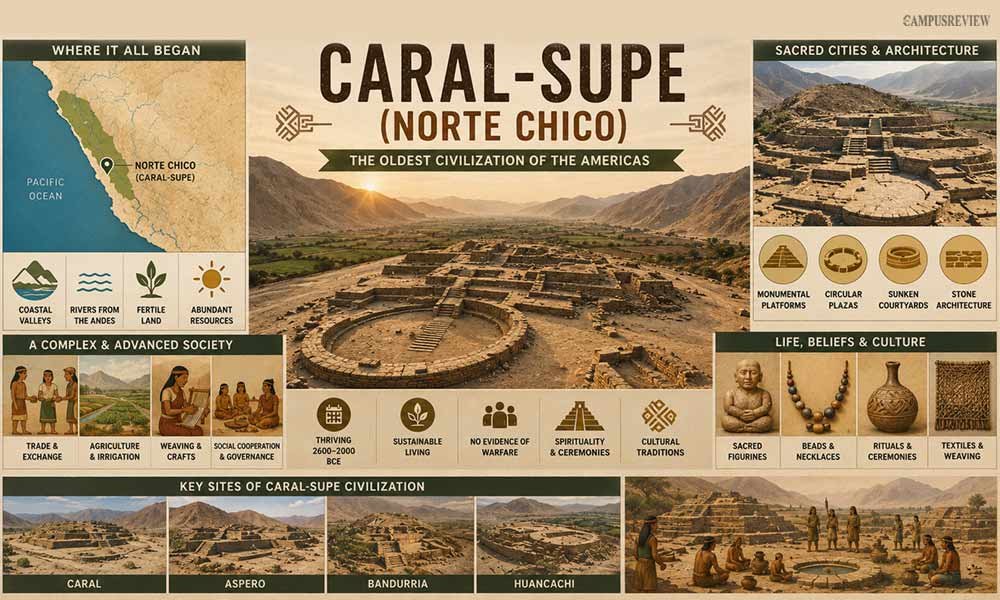
● Location: Supe, Pativilca, and Fortaleza river valleys, coastal Peru.
● Time period: 3500 BCE to 1800 BCE.
Caral-Supe is the oldest known civilization in the Americas. It grew around the same time as early Sumer, on the other side of the world, with no contact between the two. Many historians now treat it as the oldest society in the world outside the Near East.
The culture built about thirty urban centers. The largest, Caral, had stone pyramids, sunken circular plazas, and platform mounds.
Inland farmers grew cotton, squash, and beans using river canals. They traded cotton nets to coastal fishing villages for fish like anchovies and sardines. Both sides depended on each other to survive.
Caral-Supe is unusual because it had no pottery, no grain crops, and no visual art in the way other early cultures did. Instead of writing, it used the quipu, a system of knotted cords, to keep records.
This civilization proves something important. Complex society did not spread from one origin point. It grew on its own, a thousand years after Sumer, purely from local needs. Its building style and cooperative trade shaped later Andean cultures like the Chavín, Moche, and Inca.
Ancient China
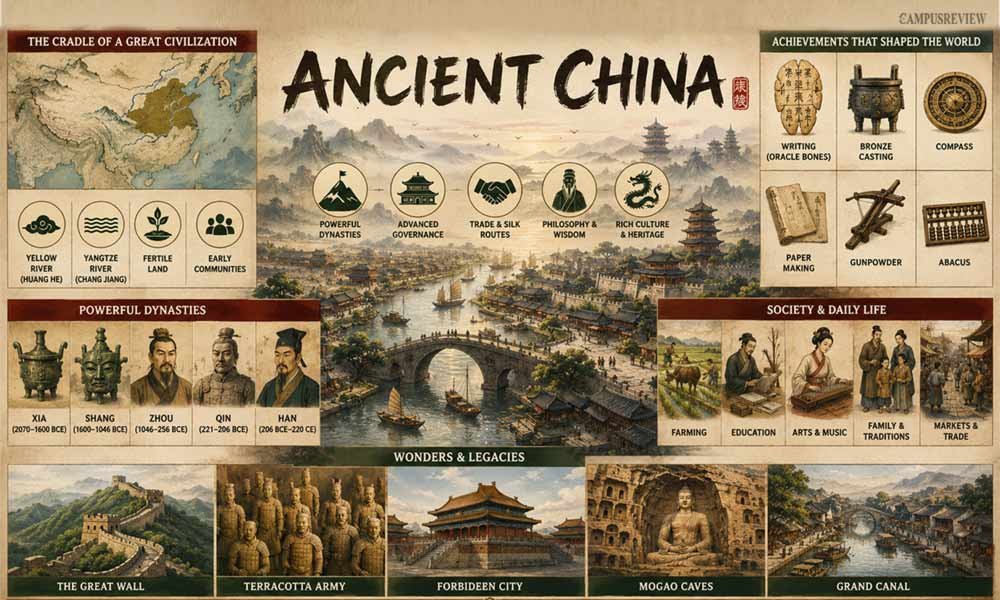
● Location: Yellow River and Yangtze River basins.
● Time period: Erlitou culture from about 1900 BCE, Shang Dynasty from about 1600 to 1046 BCE.
Chinese civilization grew from farming villages along two major rivers. Millet grew well in the drier north. Rice grew well in the wetter south. Both regions needed large water control systems to manage seasonal floods.
The Shang Dynasty mastered bronze casting. Craftsmen made detailed ritual vessels and weapons using a piece-mold method.
Shang scribes carved questions and answers onto ox bones and turtle shells. This is called oracle bone script. It is the direct ancestor of the Chinese writing used today.
Ancient China grew through a network of powerful Chinese cities that served as political capitals, trade hubs, and centers of culture across different dynasties.
China’s real strength is continuity. Its language, respect for ancestors, and system of government adapted through thousands of years of change, right up to the modern era.
Olmec Civilization
● Location: Gulf Coast lowlands of Veracruz and Tabasco, Mexico.
● Time period: 1600 BCE to 400 BCE.
The Olmec built their main cities, San Lorenzo and La Venta, in swampy floodplains. They built raised earthen platforms and drainage systems to manage the wet ground.
The Olmec are famous for carving giant stone heads. Some weigh up to 45 tons. Workers moved these stones over 100 kilometers without wheels or animals to help.
Olmec crafters also mixed rubber tree sap with morning glory juice. This created an early form of rubber, used for balls in a ritual ballgame as far back as 1600 BCE.
A stone slab called the Cascajal Block, dated to around 900 BCE, holds the earliest known writing in Mesoamerica.
Historians call the Olmec the “mother culture” of the region. Their art, gods, and ballgame traditions passed down to the Maya, Zapotec, and Aztec civilizations.
What Makes a Civilization?
A settlement does not become a civilization simply because it is old. Historians use seven key characteristics to identify true civilizations.
● Cities: A place where many people live close together.
● Government: A system that makes laws and keeps order.
● Agriculture: Farming that produces more food than people need day to day.
● Trade: Networks that move goods, materials, and ideas between regions.
● Religion: Shared beliefs that unite people and support the ruling power.
● Writing: A way to record laws, trade, and history.
● Technology: Tools and methods that solve problems, from irrigation to metalworking.
Which Ancient Civilization Still Exists?
Many people wonder whether the world’s oldest civilizations still exist today. The answer depends on whether you are referring to the modern nation or the ancient civilization itself.
Ancient China is widely regarded as the only civilization with an unbroken cultural tradition. Although its dynasties changed over thousands of years, its language, traditions, philosophy, and governance evolved continuously into modern China.
Ancient Egypt survives as the modern nation of Egypt, but its ancient civilization ended after centuries of foreign rule. While the pyramids, temples, and hieroglyphs remain, the political and religious systems of ancient Egypt no longer exist.
Mesopotamia, often called the Cradle of Civilization, gradually became part of successive empires, including the Assyrian, Babylonian, Persian, Greek, and Roman empires. Its cities declined, but its innovations in writing, law, and urban planning influenced civilizations across the world.
The Indus Valley Civilization declined around 1900 BCE. Although many of its cities were abandoned, its people likely integrated with later cultures in the Indian subcontinent, leaving a lasting legacy in agriculture, craftsmanship, and urban planning.
Final Thought
The story of the oldest civilization in the world is not about a single society. Instead, civilizations emerged independently across different regions as people developed agriculture, built cities, expanded trade, and established organized governments.
Each left a lasting legacy. Mesopotamia introduced the earliest known writing system, Ancient Egypt built a civilization that endured for millennia, the Indus Valley Civilization pioneered advanced city planning, Caral-Supe thrived without a confirmed writing system, Ancient China maintained remarkable cultural continuity, and the Olmec civilization laid the foundation for later Mesoamerican cultures.
Frequently Asked Questions
1. Is Mesopotamia older than Egypt?
Yes, Mesopotamia is older than Egypt. Sumerian cities and early writing appeared around 3500-3400 BCE. Egypt unified as one state slightly later, around 3100 BCE.
2. Which civilization invented writing?
The Sumerians invented the earliest known writing system. They created cuneiform around 3400-3200 BCE using a reed pen on wet clay. Egypt developed hieroglyphs soon after. China created oracle bone script by 1200 BCE, and the Olmec made early glyphs by 900 BCE.
3. Is the Indus Valley older than China?
Yes. The Indus Valley reached its city-building peak between 2600 and 1900 BCE. China’s Shang Dynasty, its first confirmed dynastic state, began later, around 1600 BCE.
4. What is the oldest city in the world?
Uruk in Mesopotamia is often called the world’s first true city. It held over 40,000 people by 3500 BCE. Older settlements like Jericho and Catalhoyuk existed earlier, but they lacked the government, class structure, and planning that define a real city.
5. Why is Mesopotamia called the cradle of civilization?
Mesopotamia earned this title because so many “firsts” happened there together. It gave the world its first cities, first writing, first law codes, base-60 math, the wheel, and organized taxation, all feeding into one connected system.