The Amazon rainforest has about 16,000 tree species, yet just 227 account for half of all its trees. This shows why species diversity considers both the variety of species and their abundance.
Species diversity is the number of different species in a habitat and the relative abundance of each one. It helps ecologists understand the health and balance of forests, reefs, and other ecosystems.
This guide covers the species diversity definition, key components, importance, examples and measurement methods, with simple explanations and examples for students.
What Is Species Diversity?
Species diversity is the variety of species living in an area, along with how many individuals each species has. It answers two questions at once. How many species live here? And how evenly are their numbers spread?
In ecology, a species is a group of living things that can breed and produce fertile offspring. A community is all the species living together in one place. Species diversity in ecology tells scientists how rich and balanced that community is.
Think of two school canteens. Both sell ten dishes. In the first canteen, students buy each dish in similar amounts. In the second, nine out of ten students buy only Pizza. The menus match in size, but the first canteen shows much higher diversity because no single item dominates.
Species Diversity vs Biodiversity
Species diversity and biodiversity are not the same thing. Biodiversity, also called biological diversity, covers all the variety of life on Earth. Species diversity is one level within it. Walter G. Rosen coined the word biodiversity in 1985, and biologist Edward O. Wilson helped make it popular.
| Level | What it covers | Example |
| Genetic diversity | Variation in genes within one species | Many varieties of rice grown on Indian farms |
| Species diversity | Variety and abundance of species in one habitat | The trees, birds and insects of one forest |
| Ecosystem diversity | Variety of ecosystems in a region | Forests, wetlands, grasslands and deserts in one country |
Species diversity sits in the middle of this chain. Genes give each species the power to adapt. Ecosystems give each species a place to live. When a region loses species, both ends of the chain feel the damage.
Components of Species Diversity
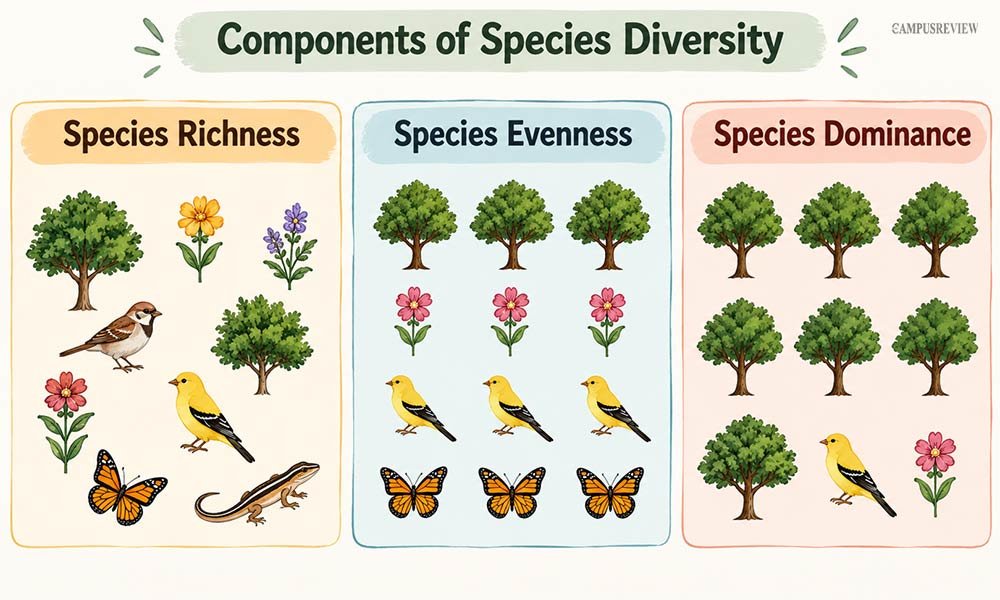
Species diversity has two components: species richness and species evenness. You need both to understand a community. One counts the species. The other checks how fairly they share the space.
Species Richness
Species richness is the number of different species in an area. It counts each species once. It ignores how many individuals each species has.
Suppose you survey a park and find 30 bird species. The species richness is 30. It stays 30 even if the park has 1,000 sparrows and one eagle. Richness is easy to measure, so ecologists use it as a starting point. Its weakness is that it ignores balance.
- School garden: Example: A garden with 12 plant species has a richness of 12.
- Village pond: Example: A pond with 4 fish species and 2 frog species has a richness of 6 for those animals.
- Amazon trees: Example: Scientists estimate about 16,000 tree species in the Amazon, so its tree richness is extremely high.
Species Evenness
Species evenness shows how equally individuals are spread among the species in a community. High evenness means every species has a similar number of individuals. Low evenness means one or two species dominate.
Take two communities with four species each. Both have a richness of 4. Only the spread of individuals differs.
| Species | Community A | Community B |
| Species 1 | 25% of individuals | 85% of individuals |
| Species 2 | 25% of individuals | 5% of individuals |
| Species 3 | 25% of individuals | 5% of individuals |
| Species 4 | 25% of individuals | 5% of individuals |
| Evenness | High | Low |
Community A has higher species diversity. Its species share food and space equally. In Community B, one species controls most of the resources.
Real forests show this pattern too. A 2013 study in the journal Science found that only 227 of the Amazon’s tree species, or 1.4%, make up half of all its trees. The forest has huge richness, but a small group of species dominates it.
Ecologists call the number of individuals of one species its abundance. Evenness compares species abundance across all the species in the community.
- High evenness: Example: A meadow where six wildflower species each cover about the same area.
- Low evenness: Example: A farm field where one crop covers almost the whole land.
Why Is Species Diversity Important?
The importance of species diversity is simple: it keeps ecosystems stable, productive, and useful to people. A community with many species recovers from damage faster and supplies more food, clean water, and medicine. Here are six reasons it matters.
1. It keeps the ecosystem stable. In a species-rich community, several species do similar jobs. If a drought wipes out one grass species, others still hold the soil and feed the grazers. Ecologists call this the insurance hypothesis. It improves resistance (how well a system handles a shock) and resilience (how fast it recovers). This is the core of ecosystem stability.
2. It raises productivity. Different plants use different resources. Some roots reach deep water, while others take nutrients near the surface. Tall trees and low shrubs catch sunlight at different heights. Together, a mixed community grows more plant material than a single crop does.
3. It delivers ecosystem services. Ecosystem services are the free benefits people get from nature, such as pollination and natural pest control. A UN report on global biodiversity warns that up to US$577 billion of yearly crops are at risk because pollinators are declining.
4. It keeps soil, air, and water healthy. Diverse soil microbes and fungi break down dead matter, add nitrogen to the soil, and store carbon. Healthy soil grows better crops and holds more water.
5. It protects food and medicine. Wild plants and animals give farmers new crop genes and give scientists new medicines. NOAA notes that compounds from coral reef organisms hold vast medical potential. Every lost species is a lost chance.
6. It protects the balance between species. Keystone species have a huge effect on a community compared with their numbers. The starfish Pisaster eats mussels that would otherwise crowd out other shore animals. Sea otters eat sea urchins, which protects kelp forests. When keystone species vanish, evenness drops fast.
The stakes are high. The 2019IPBES Global Assessment found that around one million animal and plant species face extinction. It also reported that more than 40% of amphibian species and almost a third of reef-forming corals are threatened. Warming oceans and changing weather add pressure.
Examples of Species Diversity
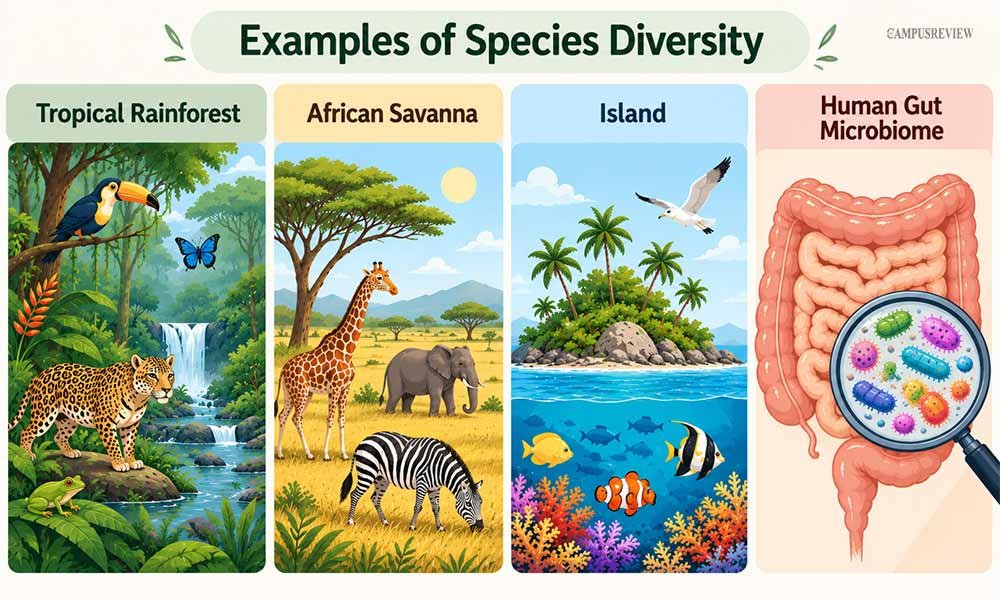
Species diversity changes from one place to another. Physical structure, energy and isolation influence how many species can live in an area and how evenly they share resources. The table gives a quick comparison of the five examples.
| Example | Species richness | Evenness pattern | Main driver |
| Tropical rainforest | Very high | High, with many rare species | Layered canopy and steady sunlight |
| African savanna | Moderate to high | High, influenced by fire and predators | Fire, seasonal rain and grazers |
| Island | Lower than mainland | Many endemic species | Isolation and island size |
| Human gut microbiome | More than 1,000 species | High diversity supports balance | Diet and gut conditions |
Tropical Rainforest
Tropical rainforests have some of the highest species diversity on land. Four layers, from the emergent layer to the forest floor, create different conditions for species.
- High richness: Rainforests have high alpha diversity within sites and beta diversity between locations. The Amazon contains about 10% of known species.
- Many rare species: Thousands of tree species can grow together, with most occurring in small populations.
- Niche sharing: Epiphytes, lianas and dense vegetation create many habitats. Some birds feed in the canopy while others search the forest floor.
African Savanna
African savannas contain grasses, scattered trees and shrubs, supporting diverse plants and animals.
- Fire and rain: Seasonal rainfall and fire prevent woody plants from taking over, maintaining open grassland.
- Resource sharing: Herbivores feed on different plants or plant parts. Zebras graze on tall grass, while giraffes browse tree leaves.
- Predators: Lions, hyenas, and leopards help regulate herbivore populations.
Island Biodiversity
Islands generally have fewer species than mainland areas of similar size but can contain many endemic species, found nowhere else.
- Island biogeography: Species numbers depend on immigration and extinction. Larger islands closer to the mainland generally support more species.
- Adaptive radiation: Isolation can allow species to diversify and fill different niches. Darwin’s finches are a well-known example.
- High risk: Invasive species and habitat loss can strongly affect isolated island populations.
Human Gut Microbiome
The human large intestine contains a diverse community of microorganisms, including bacteria, archaea, fungi, and viruses.
- Microbial diversity: Researchers have identified more than 1,000 species in the gut.
- Competition: Diverse microbial communities compete for food and space, helping limit the growth of harmful bacteria.
- Dysbiosis: A low-fibre diet or antibiotics can reduce microbial diversity and disturb the balance of the community.
How Is Species Diversity Measured?
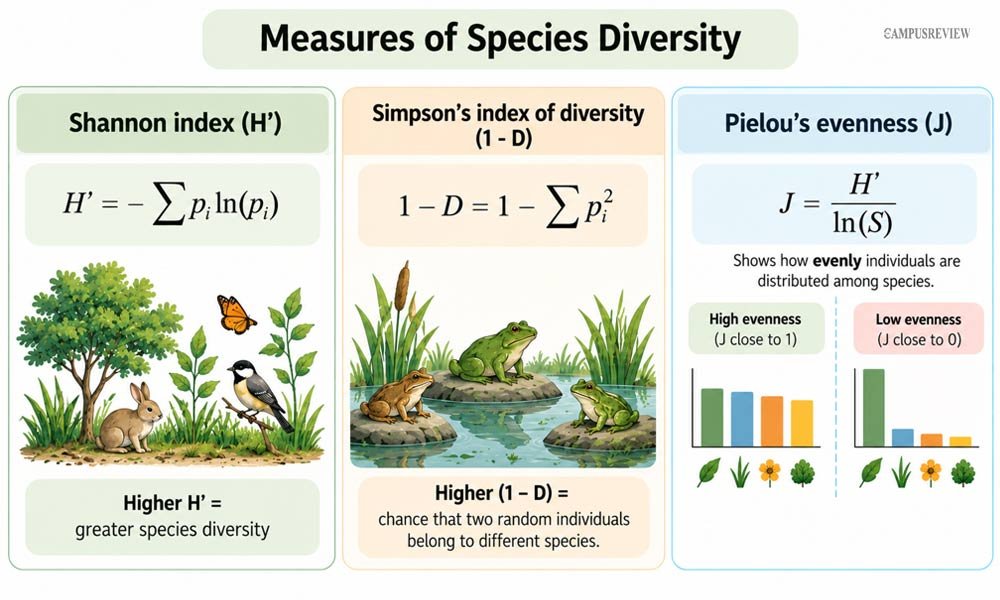
Measuring species diversity starts with counting. Ecologists measure species diversity by counting species and individuals in sample areas, then using a diversity index to turn the counts into one number. The same process lets them compare a healthy forest with a damaged one.
Species Diversity Index
A species diversity index is a number that combines richness and evenness. Three indices appear most often in school and college books.
| Index | What it tells you | Value range | Best for |
| Shannon index (H’) | How hard it is to guess the species of a random individual. Higher means more diverse. | Usually 1.5 to 3.5 | General surveys |
| Simpson’s index of diversity (1 – D) | The chance that two random individuals belong to different species. | 0 to 1 | Spotting dominant species |
| Pielou’s evenness (J) | How evenly individuals are spread among species. J = H’ divided by ln S. | 0 to 1 | Checking evenness alone |
Where:
- p = proportion of individuals belonging to a species
- H’ = Shannon diversity index
- D = Simpson’s dominance value
- J = Pielou’s evenness
- S = total number of species
- ln = natural logarithm
- Σ = sum of the values for all species
How to Calculate the Shannon Index
The Shannon index can be calculated step by step:
- Count the individuals of each species.
- Find p by dividing each species’ count by the total number of individuals.
- Calculate p × ln(p) for each species.
- Add the values for all species.
- Multiply by – 1 to get H’.
Now apply the formulas to Communities A and B discussed earlier in the Species Evenness section.
For example, Community A has four species, each making up 25% of the individuals. Therefore, p = 0.25 for each species.
H’ = −[(0.25 × ln 0.25) + (0.25 × ln 0.25) + (0.25 × ln 0.25) + (0.25 × ln 0.25)] = 1.39
The same species proportions can then be used in the Simpson and Pielou formulas.
| Index | Formula | Community A | Community B | What it shows |
| Shannon (H’) | H’ = −Σ(p × ln p) | 1.39 | 0.59 | A is far more diverse |
| Simpson (1 – D) | 1 − D = 1 − Σp² | 0.75 | 0.27 | B has one dominant species |
| Pielou (J) | J = H’ ÷ ln(S) | 1.00 | 0.42 | A is perfectly even |
Both communities have four species. The indices still separate them clearly because they use evenness, not just richness.
Species Richness and Diversity
Species richness and species diversity are related but not identical. Richness only counts species. Diversity adds evenness. Ecologists also describe the types of species diversity at three scales.
| Scale | Meaning | Example |
| Alpha diversity | Species richness inside one habitat | Species on one hectare of forest floor |
| Beta diversity | How much the species mix changes between habitats | Change from a forest to the nearby grassland |
| Gamma diversity | Total species across a whole region | All species in a river valley with many habitats |
Alpha and beta diversity together build gamma diversity. Conservation planners use all three to decide which landscapes to protect.
Final Thoughts
Species diversity measures both how many species live in a place and how fairly they share it. Richness counts them. Evenness balances them. Indices such as Shannon and Simpson turn both ideas into numbers you can compare.
Healthy species diversity keeps ecosystems stable and keeps food, water, and medicine flowing. Start small. Survey one patch near you, calculate its index, and see what the numbers say. That one exercise teaches more than any definition.
Pranjal Kharche
FAQs
1. What is a biodiversity hotspot?
A biodiversity hotspot is a region with at least 1,500 endemic plant species that has lost 70% or more of its original habitat. These areas are highly important for conservation because they contain many unique species.
2. What does a Shannon index of 0 mean?
A Shannon index of 0 means only one species is present in the community. As the number and evenness of species increase, the Shannon index also increases.
3. What is the IUCN Red List?
The IUCN Red List tracks the extinction risk of species around the world. It classifies species from Least Concern to Extinct based on their conservation status.