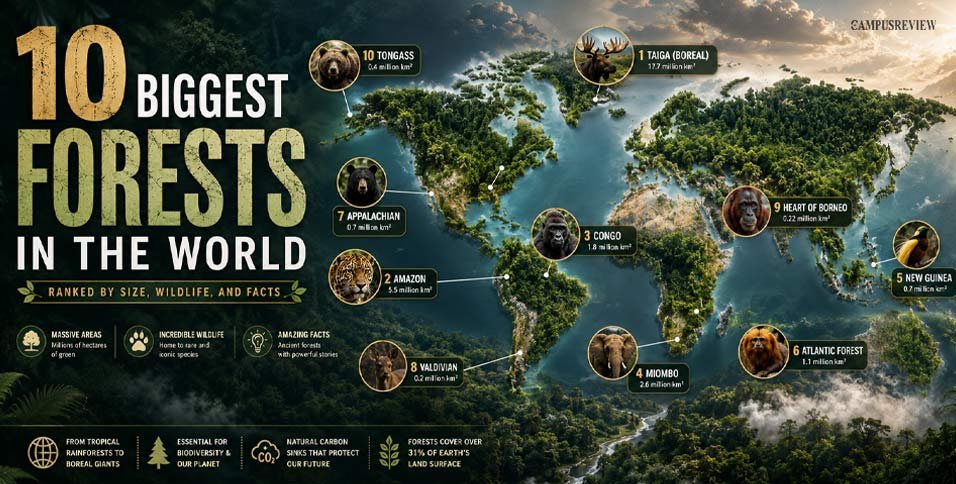
What is the largest forest in the world? The Taiga (Boreal Forest) is the largest forest on Earth, covering about 17 million square kilometers across Russia, Canada, and Scandinavia. It is followed by the Amazon Rainforest and the Congo Rainforest.
Together, the world’s largest forests in the world regulate the climate, store vast amounts of carbon, protect freshwater sources, and support millions of plant and animal species. Forests do more than support wildlife. They also inspire new technologies through biomimicry, where scientists and engineers copy nature’s designs to solve human problems.
In this guide, you’ll discover the 10 largest forests in the world, ranked by area, along with their locations, sizes, unique features, and the iconic wildlife that makes each ecosystem extraordinary.
Top 10 Largest Forests in the World: A Comparison Table
Here are the top 10 largest forests in the world by area
| Rank | Forest | Area | Famous Wildlife |
| 1 | Taiga (Boreal) | 17M km² | Amur tiger, moose |
| 2 | Amazon | 5.5M km² | Jaguar, harpy eagle |
| 3 | Congo | 3.7M km² | Gorilla, bonobo |
| 4 | Miombo | 2.7–3.6M km² | Elephant, black rhino |
| 5 | New Guinea | 780K km² | Tree kangaroo, cassowary |
| 6 | Appalachian | 350K km² | Black bear, red wolf |
| 7 | Valdivian | 248K km² | Pudu, kodkod |
| 8 | Heart of Borneo | 220K km² | Orangutan, clouded leopard |
| 9 | Atlantic Forest | 100–150K km² | Golden lion tamarin, jaguar |
| 10 | Tongass | 68K km²* | Brown bear, bald eagle |
How Do We Rank the World’s Largest Forests?
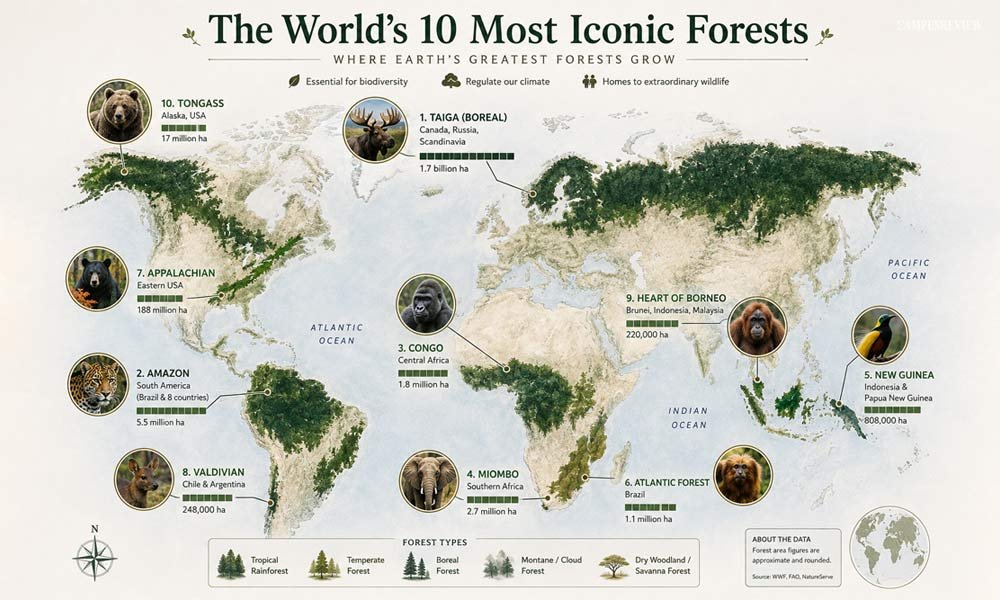
We ranked forests by total area, not by tree count or forest biodiversity. Area data comes from forest research groups like the Food and Agriculture Organization (FAO) and conservation organizations that track forest cover.
Numbers change slightly between sources. Forest boundaries are hard to measure exactly, especially in dry woodlands like the Miombo or fragmented forests like the Atlantic Forest. The figures in this guide use the most commonly cited ranges.
The 10 Largest Forests in the World, Explained
1. The Taiga (Boreal Forest)
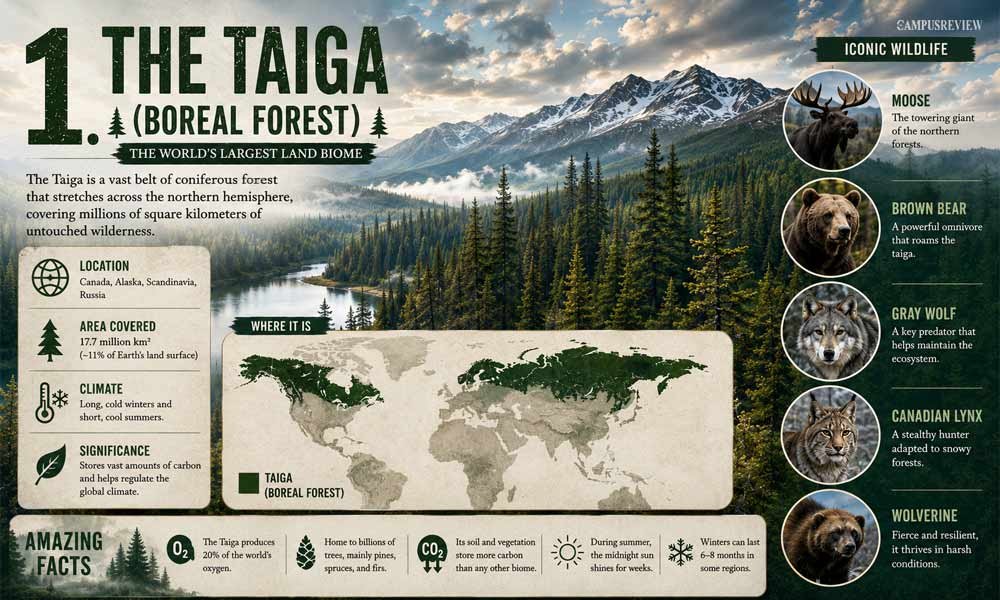
| Area | 17,000,000 km² |
| Countries | Russia, Canada, USA (Alaska), Sweden, Finland, Norway |
| Forest Type | Subarctic Coniferous / Boreal Forest |
| Known For | World’s largest land biome, deep carbon storage |
The Taiga wraps around the top of the globe like a green belt. It runs through Siberia, Canada, and Scandinavia, mostly between 50°N and 70°N latitude, and the taiga is the biggest forest in the world by area. Winters here last up to seven months, and temperatures can drop far below freezing.
Trees like Siberian larch, spruce, and Scots pine survive the cold with thick bark and needle-shaped leaves. Below the surface, deep soil and permafrost store huge amounts of carbon, making the Taiga one of the planet’s biggest carbon sinks. It is also home to the Amur tiger, moose, and brown bear.
Good to know:
- The Taiga stores more carbon underground than most tropical rainforests store above ground.
- Wildfires and thawing permafrost are its biggest threats today.
2. The Amazon Rainforest
| Area | 5,500,000 km² |
| Countries | Brazil (about 60%), Peru, Colombia, and 6 other countries |
| Forest Type | Tropical Broadleaf Rainforest |
| Known For | Highest biodiversity of any forest on Earth |
The Amazon is the world’s largest rainforest. It spans nine countries in South America, though Brazil holds most of it. Scientists estimate the Amazon has around 390 billion trees across 16,000 species.
The forest works like a giant water pump. Trees release moisture into the air, and that moisture travels across the continent as rain. This is one reason the Amazon Basin shapes weather patterns far beyond its own borders. It shelters jaguars, river dolphins, and the harpy eagle.
Good to know:
- The Amazon holds over 10 percent of all known species on Earth.
- Cattle ranching and soy farming are its top threats.
3. The Congo Rainforest
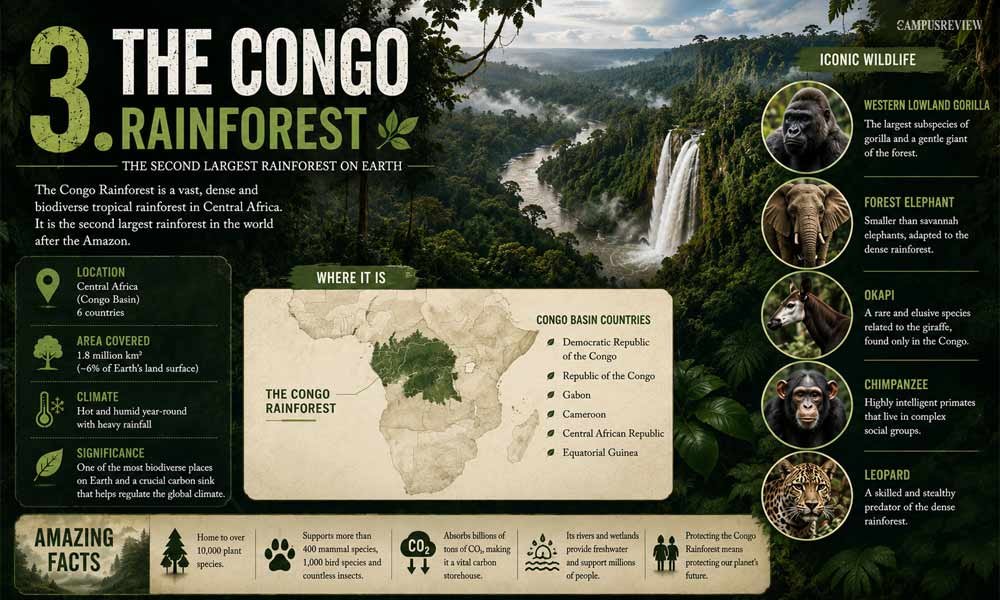
| Area | 3,700,000 km² |
| Countries | DRC, Republic of the Congo, Gabon, Cameroon, and 2 others |
| Forest Type | Tropical Lowland & Swamp Rainforest |
| Known For | Second-largest rainforest, home to gorillas and bonobos |
The Congo Rainforest covers the heart of Central Africa. It is the world’s second-largest tropical rainforest, right after the Amazon. Inside it lies the Cuvette Centrale, a massive peatland that stores billions of tons of carbon.
This forest is one of the last strongholds for gorillas, bonobos, and forest elephants. The okapi, a rare relative of the giraffe, remained unknown to Western scientists until 1901 because the forest is so dense. Indigenous Peoples have lived in and cared for parts of the Congo Basin for generations.
Good to know:
- Part of the Congo Basin is a UNESCO World Heritage Site.
- Logging and charcoal harvesting are shrinking the forest edge.
4. The Miombo Woodlands
| Area | 2,700,000 to 3,600,000 km² |
| Countries | Angola, Zambia, Tanzania, Mozambique, Zimbabwe, and others |
| Forest Type | Dry Tropical Woodland / Savanna |
| Known For | Supports over 150 million people directly |
The Miombo Woodlands do not get much attention, but they form one of the largest forest ecosystems on Earth. This dry woodland spreads across Southern and Central Africa. Unlike a dense rainforest, Miombo has an open canopy with grassy patches underneath.
Millions of people rely on Miombo for firewood, food, and medicine. Most of its trees belong to the legume family. Just before the rains arrive each year, Miombo leaves turn shades of red and gold, a rare sight in forest ecosystems.
Good to know:
- Miombo supports more than 150 million people directly.
- Charcoal harvesting and farming are its biggest threats.
5. The New Guinea Rainforest
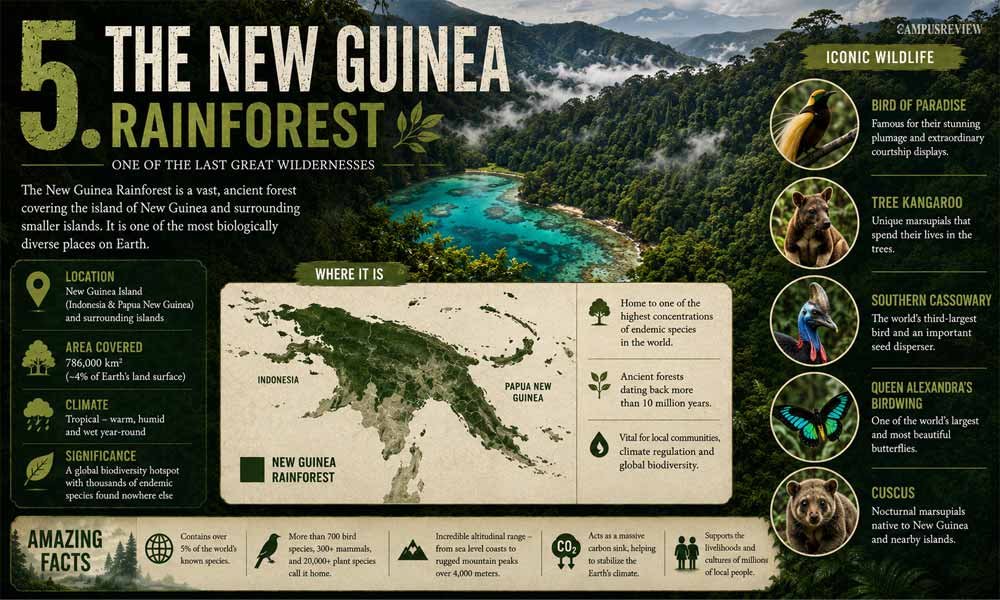
| Area | 780,000 km² |
| Countries | Papua New Guinea, Indonesia |
| Forest Type | Tropical Montane & Lowland Rainforest |
| Known For | Highest plant diversity of any island on Earth |
The New Guinea Rainforest covers over 70 percent of the world’s second-largest island. It holds more plant species than any other island on Earth, including around 13,000 vascular plant species.
Because the island stayed isolated for millions of years, its wildlife looks unusual. There are almost no native placental mammals here. Instead, tree kangaroos, cassowaries, and colorful birds-of-paradise rule the forest floor and canopy.
Good to know:
- New Guinea is home to the world’s largest butterfly, the Queen Alexandra’s Birdwing.
- Palm oil expansion and mining are growing threats.
6. The Appalachian Temperate Forest
| Area | 350,000 km² |
| Countries | United States |
| Forest Type | Temperate Deciduous & Mixed Forest |
| Known For | World’s salamander biodiversity hotspot |
The Appalachian Forest runs along the Appalachian Mountains in the eastern United States. It escaped the last ice age, so many ancient species survived here undisturbed.
This forest holds more than 2,000 species of woody plants and over 55 species of salamanders, more than anywhere else outside the tropics. Black bears, red wolves, and the hellbender salamander all live here. In autumn, its maple, oak, and hickory trees turn brilliant shades of red and orange.
Good to know:
- The Appalachians have more salamander species than any non-tropical region on Earth.
- Invasive pests like the hemlock woolly adelgid are killing native trees.
7. The Valdivian Temperate Rainforest
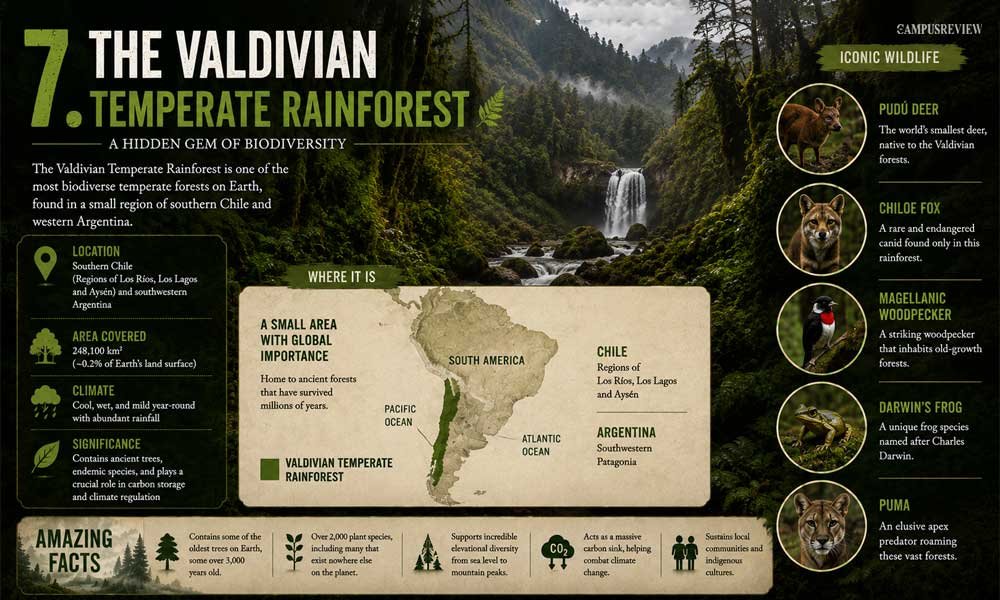
| Area | 248,000 km² |
| Countries | Chile, Argentina |
| Forest Type | Temperate Rainforest |
| Known For | Home of the ancient Alerce tree |
The Valdivian Rainforest sits along Chile’s coast, squeezed between the Pacific Ocean and the Andes. It gets up to 5,000 millimeters of rain a year, making it one of the wettest places on Earth.
Its most famous resident is the Alerce tree, which can live for over 3,600 years, making it one of the oldest living tree species. The forest also shelters the pudu, the world’s smallest deer, and the monito del monte, a tiny marsupial found nowhere else.
Good to know:
- The Alerce tree can live for more than 3,600 years.
- Logging and plantations of exotic pine are shrinking this forest.
8. The Heart of Borneo
| Area | 220,000 km² |
| Countries | Indonesia, Malaysia, Brunei |
| Forest Type | Tropical Dipterocarp Rainforest |
| Known For | Home to the Bornean orangutan |
The Heart of Borneo sits in the mountainous center of Borneo island, shared by three countries. Its canopy trees, called dipterocarps, can grow over 50 meters tall.
This forest is one of the last places on Earth where wild orangutans, pygmy elephants, and clouded leopards still live together. Every few years, the trees here flower all at once in an event called masting, dropping millions of seeds at the same time.
Good to know:
- Borneo’s dipterocarp trees can reach over 50 meters tall.
- Palm oil plantations are the biggest driver of forest loss here.
9. The Atlantic Forest (Mata Atlantica)
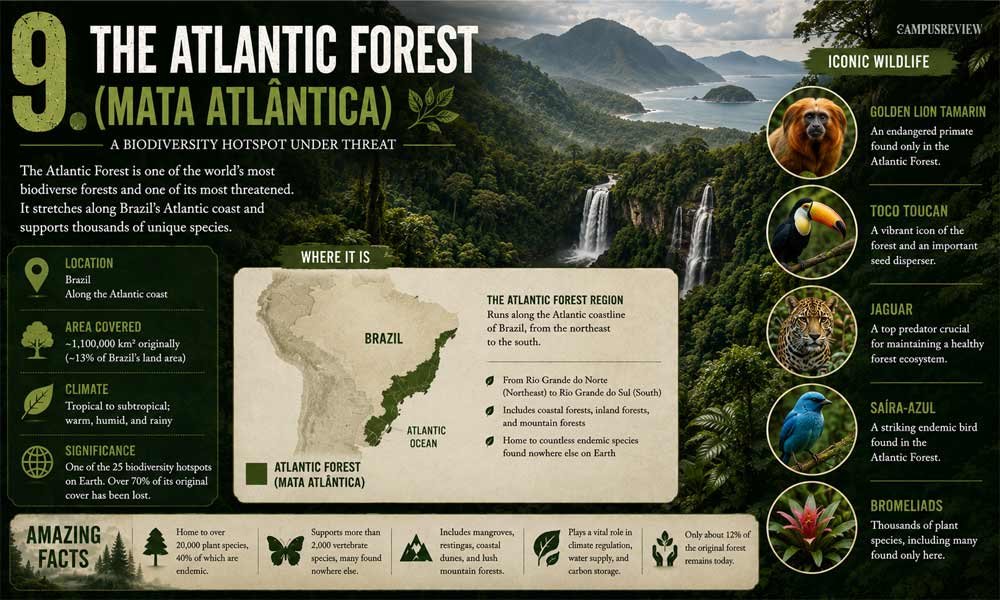
| Area | 100,000 to 150,000 km² today (was 1.2 million km²) |
| Countries | Brazil, Paraguay, Argentina |
| Forest Type | Tropical / Subtropical Moist Broadleaf Forest |
| Known For | Extreme species endemism despite heavy loss |
The Atlantic Forest once covered over a million square kilometers along Brazil’s coast. Today, less than 15 percent remains, broken into small patches. Even so, it remains one of the richest biodiversity hotspots on the planet.
About half of its plant species exist nowhere else in the world. The golden lion tamarin, a small orange monkey, is one of its most famous residents. Cities like Sao Paulo and Rio de Janeiro now sit where this forest once stood.
Good to know:
- More than 20,000 plant species still survive in its remaining fragments.
- Urban growth remains its top threat.
10. The Tongass & Pacific Coastal Rainforest
| Area | 68,000 km² (Tongass core) / 250,000 km² (full coastal belt) |
| Countries | United States, Canada |
| Forest Type | Coastal Temperate Rainforest |
| Known For | Highest carbon density per hectare of any forest |
The Tongass National Forest in Alaska anchors the world’s largest intact temperate rainforest. It stretches down the Pacific coast through Canada and into the northern United States.
Old trees here, some 500 to 800 years old, store more carbon per hectare than most tropical rainforests. Salmon swim upstream every year, feeding brown bears and carrying ocean nutrients deep into the forest. Bald eagles and wolves also thrive along this coast.
Good to know:
- Old-growth Tongass forest stores more carbon per hectare than many tropical rainforests.
- Logging policy changes and warming are ongoing concerns.
Tropical Rainforests vs Boreal Forests: What Is the Difference?
Tropical rainforests, like the Amazon, Congo, and Heart of Borneo, work very differently from boreal forests like the Taiga. Here is a simple side-by-side look.
| Parameter | Tropical Rainforests | Boreal Forests (Taiga) |
| Where carbon is stored | Mostly in trees and plants | Mostly in soil and permafrost |
| Decomposition speed | Fast (months to a few years) | Very slow (decades to centuries) |
| Effect on climate | Cools climate through evaporation | Mixed effect from dark canopy over snow |
| Canopy structure | Dense, many layers | Thinner, needle-leaved |
In simple terms, tropical forests keep most of their carbon above ground in living wood. Boreal forests keep most of their carbon locked underground, sometimes for thousands of years.
Why the Largest Forests in the World Matter
- Carbon sink: forests absorb and store carbon dioxide, which helps slow climate change.
- Biodiversity: forests host most of Earth’s known plant and animal species.
- Water cycle: forests create rainfall patterns that reach far beyond their own borders.
- Indigenous Peoples: many of these forests are home to communities who have protected them for generations.
- UNESCO recognition: parts of the Amazon and Congo Basin hold UNESCO World Heritage Site status for their ecological value.
Threats Facing the Largest Forests in the World
| Threat | Most Affected Forests | Impact |
| Deforestation and farming | Amazon, Congo, Atlantic Forest, Borneo | Habitat loss and reduced carbon storage |
| Permafrost thaw and wildfires | Taiga | Releases stored carbon and damages tree roots |
| Charcoal and fuelwood use | Miombo, Congo | Thins woodland and slows tree regrowth |
| Invasive pests | Appalachian Forest, Taiga | Kills native tree species |
| Old-growth logging | Tongass, New Guinea, Borneo | Loss of ancient, carbon-rich trees |
Conclusion
The largest forests in the world do more than look impressive on a map. They store carbon, shape rainfall, and support millions of people and species. From the icy Taiga to the humid Amazon, each forest plays a different role in keeping the planet balanced.
If you are studying geography, prepping for a competitive exam, or just building general knowledge, remember the basics: area, location, and what makes each forest unique. That is usually enough to answer most questions about the world’s biggest forests.
FAQs
1. Which country has the largest forest area in the world?
Russia has the largest forest area in the world, with over 800 million hectares of forest. Most of this is part of the vast Taiga, the world’s largest forest biome.
2. Which is the largest temperate rainforest in the world?
The Pacific Coastal Temperate Rainforest, including Alaska’s Tongass National Forest, is the largest temperate rainforest on Earth.
3. What is the oldest forest ecosystem in the world?
Many ancient forest ecosystems exist, but regions such as the Valdivian Rainforest and parts of the Australian rainforests contain plant lineages that date back to the ancient supercontinent Gondwana.
4. Which forest is home to the most endangered animals?
Several of the world’s largest forests shelter endangered wildlife. The Congo Rainforest protects gorillas and forest elephants, the Heart of Borneo supports orangutans and clouded leopards, and the Taiga provides habitat for the endangered Amur tiger