The Campus Review
October 7, 2026
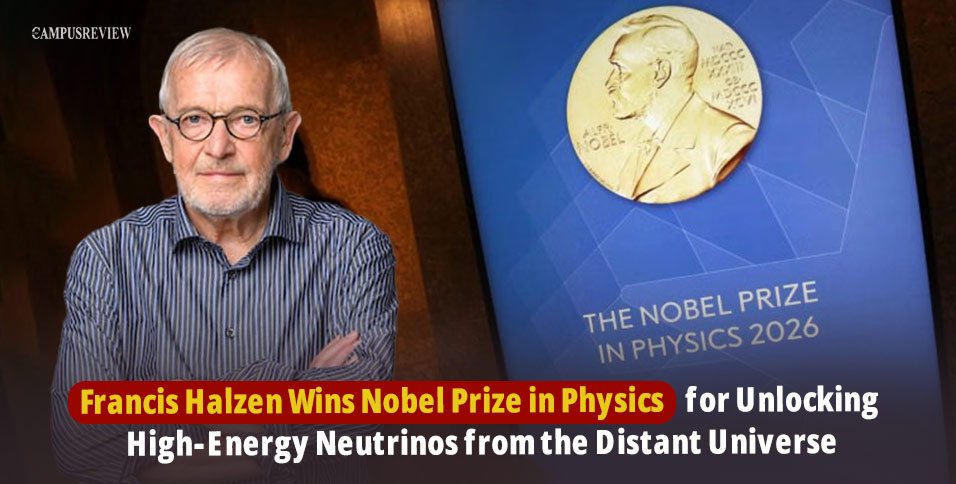
Francis Halzen wins Nobel Prize in Physics 2026 for his decisive contributions to the IceCube Neutrino Observatory and the discovery of high-energy neutrinos of astrophysical origin.
Halzen, a Belgian-American theoretical physicist and professor at the University of Wisconsin-Madison, serves as the principal investigator of the IceCube collaboration. The award includes a cash prize of 12 million Swedish kronor, worth roughly $1.2 million.
The project transformed a cubic kilometer of South Pole ice into a powerful observatory for studying high-energy neutrinos from the universe.
Quick Facts: Francis Halzen Wins Nobel Prize in Physics
| Category | Detail |
| Laureate | Francis Halzen |
| Born | 1944, Tienen, Belgium |
| Primary Affiliation | University of Wisconsin–Madison physicist and professor |
| Awarding Institution | Royal Swedish Academy of Sciences, Stockholm |
| Official Citation | “For decisive contributions to the IceCube Neutrino Observatory and the discovery of high-energy neutrinos of astrophysical origin” |
| Research Facility | IceCube Neutrino Observatory at the Amundsen–Scott South Pole Station |
| Prize Amount | 12 million Swedish kronor (approx. $1.2 million) |
Why Did Francis Halzen Win the 2026 Nobel Prize in Physics?
The Royal Swedish Academy of Sciences recognized Halzen for his decisive contributions to IceCube and the development of high-energy neutrino astronomy. Unlike light, neutrinos have no electric charge and interact very weakly with matter, allowing them to travel vast cosmic distances with little deflection or absorption.
Before IceCube, detecting high-energy neutrinos from outside the Solar System was extremely difficult because their interactions are rare. Halzen recognized that a massive, transparent medium could capture these rare interactions.
Under his leadership, IceCube has helped researchers study cosmic environments that produce high-energy neutrinos and identify links between some neutrino events and distant astronomical sources.
Mark Pearce, Chair of the Nobel Committee for Physics, highlighted the significance of the project:
“Francis Halzen has led an international team of researchers and engineers who have provided us with a fantastic instrument. His tenacity and scientific vision paved the way for a new kind of astronomy.”
What Is the IceCube Neutrino Observatory?
The IceCube Neutrino Observatory is a cubic-kilometer neutrino detector located at the Amundsen-Scott South Pole Station in Antarctica. The detector instruments roughly one cubic kilometer of clear, ancient ice deep beneath the polar surface.
IceCube uses the Earth as a filter to reduce the background from other cosmic particles, allowing researchers to identify neutrino interactions in the Antarctic ice.
Incoming Cosmic Neutrino
An incoming cosmic neutrino enters Earth.
Collision Inside Deep Polar Ice
The neutrino collides with an atomic nucleus inside deep polar ice.
Charged Secondary Particles
The collision creates charged secondary particles moving faster than light travels through ice.
Cherenkov Radiation
The fast-moving particles produce faint blue Cherenkov radiation.
Optical Sensors Detect the Light
5,160 optical sensors detect the Cherenkov light and record the neutrino event.
How Does IceCube Detect Neutrinos?
Detecting particles that rarely interact with matter requires a massive detector and highly sensitive instruments. IceCube accomplishes this through hardware frozen directly into the polar ice cap.
- Drilling the Ice: Engineers used hot-water drilling systems to create 86 boreholes reaching depths of up to 2,450 meters into the Antarctic ice.
- Deploying the Sensors: Teams lowered strings carrying 5,160 digital optical modules into the boreholes between depths of 1,450 and 2,450 meters before the water refroze.
- Recording Cherenkov Radiation: When a high-energy neutrino collides with an atomic nucleus in the ice, it generates secondary charged particles. As these particles travel faster than light travels through ice, they emit faint blue Cherenkov radiation.
- Reconstructing Particle Paths: The optical modules record the timing and intensity of the Cherenkov light, allowing researchers to reconstruct the neutrino’s energy and direction.
Key Milestones in Francis Halzen’s IceCube Work
The 2026 Nobel Prize in Physics recognizes nearly four decades of experimental development, technical innovation, and international collaboration behind IceCube.
- 1987: Supernova 1987A provides important evidence that neutrinos can be detected from an astronomical event outside the Solar System.
- 1988: Francis Halzen proposes using Antarctic ice as a detection medium for high-energy astrophysical neutrinos.
- 1990s: The AMANDA experiment demonstrates the feasibility of using optical sensors embedded in Antarctic ice to detect neutrino interactions.
- 2004-2010: Construction of IceCube takes place over seven years, eventually deploying 86 strings and 5,160 digital optical modules in Antarctic ice.
- 2013: IceCube reports the discovery of a flux of high-energy astrophysical neutrinos originating beyond the Solar System, marking a major step in neutrino astronomy.
- 2018: IceCube and other observatories provide evidence linking high-energy neutrinos to the blazar TXS 0506+056, marking a major milestone in multimessenger astronomy.
- October 2026: The Royal Swedish Academy of Sciences awards Francis Halzen the Nobel Prize in Physics.
Why Are High-Energy Neutrinos Important to Astronomy?
High-energy astrophysical neutrinos provide information about cosmic particle accelerators that electromagnetic observations cannot provide on their own. Because neutrinos interact weakly with matter and are not deflected by magnetic fields, they can carry information from regions that are difficult to study using electromagnetic radiation.
Through neutrino research, scientists pursue several key areas:
- Investigating Cosmic Accelerators: Studying active galactic nuclei and other extreme environments that can accelerate particles to enormous energies.
- Tracing Cosmic Ray Origins: Identifying the physical mechanisms responsible for producing high-energy cosmic rays.
- Fundamental Particle Physics: Studying neutrino properties, cosmic rays, and possible physics beyond the Standard Model under energy conditions that human-made laboratories cannot replicate.
What Comes Next for Neutrino Astronomy?
Researchers have proposed IceCube-Gen2, a next-generation detector with an optical array roughly eight times larger than the current detector. At the same time, deep-water neutrino projects in the Mediterranean Sea and Lake Baikal continue to advance, complementing IceCube’s observations and expanding global neutrino astronomy.
UW–Madison has also expanded its academic focus with its new College of Computing & Artificial Intelligence.
Francis Halzen wins Nobel Prize recognition marks a major milestone for neutrino astronomy, while IceCube continues to provide researchers with a new way to study the universe’s most energetic phenomena.
Pranjal Kharche