A typical career lasts about 80,000 hours, according to the research group 80,000 Hours. That is far too long to spend on a job you picked by guessing.
So, how do you choose a career path? Follow seven steps. Understand yourself, set your priorities, build a shortlist, check the real numbers, test your top picks, close your skill gaps, and score your options.
You do not need a perfect plan. You need a clear next step. Most steps take one to two hours. Testing careers in Step 5 takes a few weeks. Start with Step 1 and move at your own pace.
How to Choose a Career Path: The 7 Steps at a Glance
This career planning process works for school students, graduates, and people who want a change. Read the table first. Then work through each step in order.
| Step | What you do | Time needed | What you get |
| 1 | Understand yourself | 1 to 2 hours | A personal profile |
| 2 | Set your priorities | 30 minutes | Your top five priorities |
| 3 | Build a shortlist | 1 hour | 5 to 8 career options |
| 4 | Check the numbers | 2 hours | Facts on pay and demand |
| 5 | Test in real life | 2 to 4 weeks | Honest insight |
| 6 | Close your skill gaps | 1 hour | A learning plan |
| 7 | Score and decide | 1 hour | Your top choice |
Step 1: Understand Yourself
Start with you, not with job titles. Self-assessment for career choice means finding what you enjoy, what you do well, and what matters to you. Set aside about two hours.
Run an energy audit
List the last 10 things you did. Include classes, projects, hobbies, and part-time work. Mark each one with a plus if it gave you energy, a minus if it drained you, or a zero if it felt neutral. Then look for patterns.
Example: Riya gave a plus to planning her college fest and explaining notes to friends. Both tasks involve organizing people and ideas. That points to teaching, HR, or event management.
Take a career interest assessment
Free career assessment tools give you words for what you already feel. The O*NET Interest Profiler is a career interest assessment from the U.S. Department of Labor. It has 60 questions and takes about 20 minutes.
It sorts your interests into six Holland Code types: Realistic, Investigative, Artistic, Social, Enterprising, and Conventional. Then it lists matching careers.
Check your Ikigai
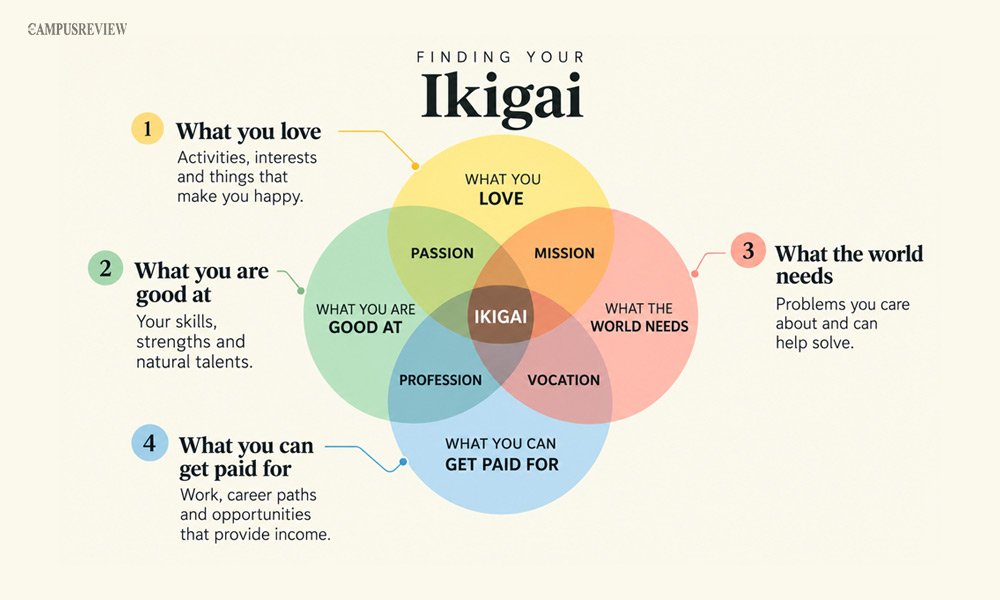
Ikigai is a Japanese idea about a purposeful life. For careers, it asks four questions.
| Ikigai element | Question to ask | How to use your answer |
| What you love | What activities do I enjoy? | Identify careers involving those activities. |
| What you’re good at | What skills do I have? | Match your strengths to job requirements. |
| What the world needs | What problems would I like to solve? | Find careers that address those problems. |
| What you can be paid for | Which matching jobs offer earning opportunities? | Compare salaries, qualifications, and job openings. |
Questions to ask yourself
- Which subject do I read about for fun?
- What do friends ask me for help with?
- When did I last lose track of time while working?
- Do I prefer working with people, data, ideas, or things?
AI shortcut: let a chatbot interview you
An AI chatbot is a tool you type to, and it answers in plain language. ChatGPT, Claude, and Gemini all work well here.
Paste this prompt:
Prompt: “Act as a friendly career counselor. Ask me one question at a time about my interests, strengths, and values. Ask 10 questions. Then list my top five strengths and three work patterns you noticed.”
Answer honestly. When the chat ends, ask: “Which three career areas match these patterns, and why?” Save the answer. You will use it in Step 3.
Step 2: Set Your Priorities and Long-Term Goals
Next, decide what you want from work. Your work values and preferences shape your daily happiness more than a job title does. Your long-term career goals decide which paths make sense. This step takes about 30 minutes.
Rank your top five priorities
Choose five from this list and rank them:
salary, job security, flexibility, creativity, helping others, learning, status, work-life balance, and remote work.
Try the 10-year Tuesday
Imagine an ordinary Tuesday 10 years from now. Where do you wake up? Who do you work with? What do you do all day? Write one page. Then highlight the details that excite you.
Checklist: Are your priorities clear?
- I can name my top three priorities.
- I know the monthly income I need to live comfortably.
- I know whether I want to study or work abroad.
Tip: Write today’s date on your list. Priorities change, so review them every year.
Step 3: Build a Shortlist of 5 to 8 Careers
Now match your profile to real careers. This is career exploration. Aim for five to eight options, including career options after graduation that you have not heard of. Fewer options limit you. More options overwhelm you.
Find options in three ways
- Use your O*NET results. Open the list of matching careers. Pick the 10 that sound interesting.
- Read real job postings. Open three entry-level postings for each role on LinkedIn, Naukri, or Indeed. Read the job responsibilities and qualifications. Ask yourself, “Would I enjoy this every day?”
Circle the five that excite you. Cross out any that feel wrong and write down why. Your reasons teach you as much as your picks. Then write each pick on a career card with three lines: what the job does, why it interests you, and one doubt.
Step 4: Check the Numbers on Salary and Job Outlook
Passion needs facts. Before you commit, check salary and job outlook with official labor market information. Skip viral videos and guesses from friends. This step takes about two hours.
Where to find reliable data
| Source | Country | What you get |
| Occupational Outlook Handbook (BLS) | US | Pay, growth, duties, and education needs for hundreds of jobs |
| CareerOneStop | US | Pay by state and local training options |
| India Skills Report | India | Employability by degree and hiring trends by industry |
| National Career Service portal (ncs.gov.in) | India | Free job listings, career counselling, and skill course details |
What the data says right now
The U.S. Bureau of Labor Statistics (BLS) projects total U.S. employment to grow 3.5% from 2025 to 2035. Some jobs grow much faster, as this table shows.
| Occupation | Projected growth, 2025 to 2035 | Median pay, 2025 |
| Nurse practitioners | 41% | $132,300 |
| Solar photovoltaic installers | 37% | $53,140 |
| Data scientists | 35% | $120,230 |
| Medical and health services managers | 24% | $123,860 |
Source: BLS, Occupational Outlook Handbook, Fastest Growing Occupations.
For India, the India Skills Report 2026 puts overall graduate employability at 56.35%, up from 54.81% in 2025. Computer science graduates score about 80%, and commerce graduates reached 62.81%.
The report also notes about 600% growth in AI and machine learning jobs. An employability score measures test-based readiness. It does not promise a job.
Read the numbers wisely
- Check the date on every figure.
- Look at new jobs, not only growth rates. Solar installers grow 37% but add only about 11,300 jobs. Medical and health services managers grow 24% and add about 155,100.
AI shortcut: research with sources
Perplexity is an AI search engine that shows its sources beside each answer. That makes it useful for fact-checking. Try this prompt:
Prompt: “What are typical entry-level salaries and the 10-year demand outlook for data analysts in India? List your sources and their dates.”
Open every source it lists. AI tools can invent numbers. Confirm each figure on the BLS site, the NCS portal, or the original report before you add it to a career card.
Step 5: Test Your Top Careers in Real Life
Reading about a career is not the same as living it. Practical career experience shows you the boring parts and the good days. Test your top three choices before you commit years or money.
Four low-risk ways to test a career
| Test | Time | What you learn |
| Informational interview | 15 to 20 minutes | Daily tasks, pay growth, and hard parts |
| Job shadowing | 1 to 3 days | How a full workday feels |
| Internship or volunteering | 1 to 3 months | Real tasks and workplace culture |
| Mini project | 1 to 2 weeks | Whether you enjoy the actual work |
How to set up an informational interview
Message three people who work in the role. Find them through LinkedIn, alumni lists, or your college career cell. Keep your message short:
Example: “Hi Meera, I am a final-year student exploring UX design. I liked your work on [project]. Could I ask you three questions on a 15-minute call? I will keep it brief.”
Then ask these questions:
- What does a normal day look like?
- What do you wish you knew before starting?
- What surprised you most?
- Which skills matter most in your first year?
Mini project ideas
- Data: Analyze a free public dataset and share three findings.
- Design: Redesign one screen of an app you use.
- Writing: Write a one-page report on an industry trend.
AI can draft your outreach message and question list. Rewrite both in your own voice before you send anything.
Tip: Hold two career chats for each option. One person’s view can mislead you.
Step 6: Close Your Skill Gaps
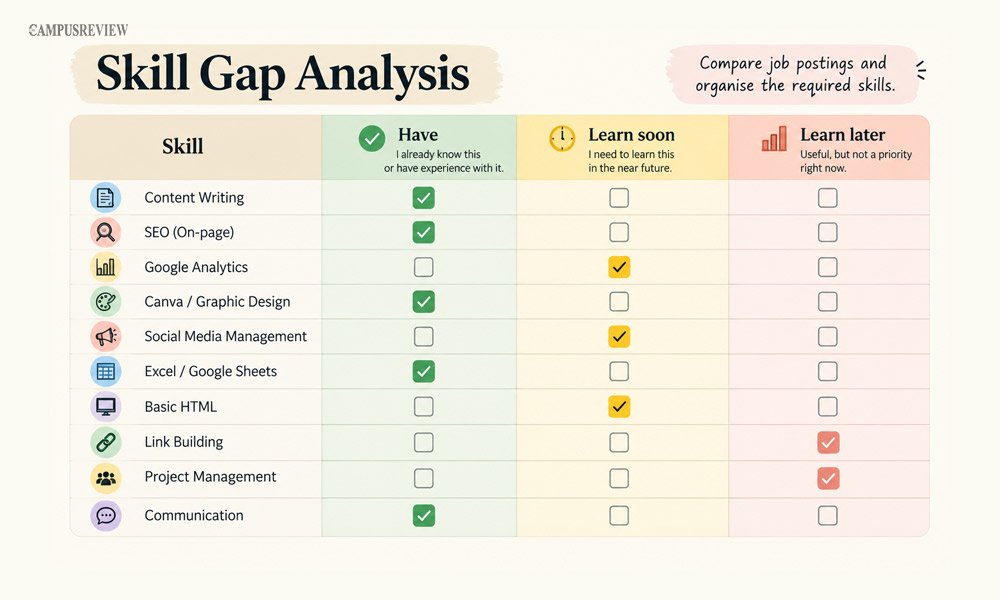
Now compare your skills with what employers ask for. This is how you match skills with careers in a practical way. It also shows you what to learn first.
Run the 3-posting gap test
1. Open three entry-level job postings for your top choice.
2. Copy every required skill into one document.
3. Label each skill: Have, Learn soon, or Learn later.
4. Pick the three most repeated skills in the Learn soon group. Start there.
Use the skills you already have
Transferable skills work in many careers. Writing, teamwork, and problem solving are common examples. List yours and show how each one fits your target role. Transferable skills development also makes a later change of direction easier.
Three skills that help almost everywhere
| Skill | Why it helps | Start with |
| Fast learning | You master new topics sooner | Test yourself with flashcards instead of rereading notes. |
| AI literacy | Employers value people who work well with AI tools | Write clear prompts and use AI for research summaries |
| Communication | You explain ideas and do better in interviews | Practice short written updates and two-minute talks. |
Step 7: Score Your Options and Decide
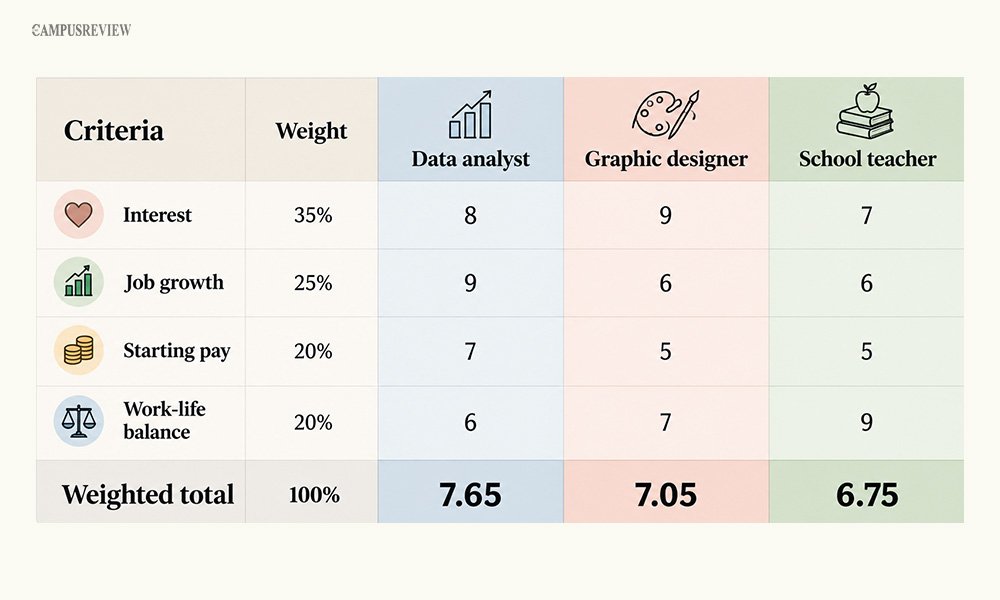
A scorecard makes career decision-making easier. It stops one factor, such as salary, from taking over. Pick your top two or three careers and score them.
Build your scorecard
1. List four to six criteria from Step 2.
2. Give each criterion a weight. The weights must add up to 100%.
3. Score each career from 1 to 10 on every criterion.
4. Multiply each score by its weight.
5. Add up the results for each career.
Here is an example. The scores are for illustration only. Use your own.
Now test your weights. Raise work-life balance to 40%. Lower interest to 30%, growth to 15%, and pay to 15%. The teacher path then scores 7.35 and the data analyst scores 7.20. The ranking flips. This shows why no single best career exists. The best choice depends on your weights.
Check for career capital
Ask whether the path builds skills, contacts, and credentials that keep your options open. 80,000 Hours calls this career capital. It gives you professional growth opportunities and protects you if you change direction.
Make a 90-day plan
- Days 1 to 30: Start one course or mini project.
- Days 31 to 60: Hold two more career chats and apply for one internship.
- Days 61 to 90: Review. Keep your choice, adjust it, or switch to your second option.
Where to Get Good Career Guidance
Good guidance saves months of confusion. Use more than one source.
| Source | Best for | Cost |
| College career centre | Resume help, placements, and campus recruiters | Usually free |
| Career counselor or coach | Personal guidance and tough decisions | Paid |
| National Career Service (India) | Career counselling and job information | Free |
| Mentors and alumni | Real stories from people in the field | Free |
| Online tools | Free government interest and skills tests | Free |
How to pick a good coach or counselor
- Ask about their training, experience, and past clients.
- Ask how they measure fit. Good guides use your data, not only their opinion.
- Walk away if someone promises a guaranteed job or pushes one course or college.
Final words
Choosing a career path is a process, not a one-time test. You understand yourself, set priorities, build a shortlist, check the numbers, test in real life, close skill gaps, and score your options. Each step gives you evidence, and evidence beats guesswork.
Start today. Take the O*NET Interest Profiler and run your first energy audit. Then message one professional this week. Small tests today will guide your next 80,000 hours.
Common Questions About How to choose a career path
1. Should I choose passion or salary?
Aim for both salary and passion. Use the Ikigai check in Step 1 to find the overlap. If you must trade off, decide which priority matters most for the next five years. You can adjust later as your skills and income grow.
2. How do I choose between two careers I like equally?
Run a small test for each one. Do one career chat and one mini project per option, then compare how you feel afterward. If the scores are close, pick the path with more career capital, meaning skills and contacts that keep your options open.
3. What if my interests change after I start my career?
A change of interest after starting a career is normal. Review your goals and skills yearly, and build transferable skills like writing, problem-solving, and teamwork to make career changes easier.
4. How do I identify my personal strengths?
To identify personal strengths, look for tasks that feel easy to you but hard for others. Ask three people what you do well. Compare their answers with your energy audit. Repeated themes show your strengths.