Can you explain your idea clearly in 30 seconds? Many students know their subject but struggle to express their ideas in vivas, group discussions, or interviews. This can affect grades, teamwork, and job opportunities.
Communication skills help you send, receive, and understand messages clearly. You can improve them by practising simple frameworks like the PREP Method, speaking clearly, and seeking regular feedback.
This guide covers four types of communication skills, practical frameworks, student examples, and daily exercises to help you communicate with confidence.
What Are Communication Skills?
Communication skills are the abilities you use to share information and understand other people. They cover speaking, writing, listening, and body language.
Communication skills help you share information and understand others through speaking, writing, listening, and body language. Communication involves sending, receiving, and interpreting messages, with the goal of achieving shared understanding.
Four Steps of Communication
- Encoding: Turning an idea into words, tone, or gestures.
- Transmission: Sending the message through speech, calls, or text.
- Decoding: How the receiver interprets the message.
- Feedback: The receiver responds or asks questions to confirm understanding.
Feedback closes the communication loop and helps prevent misunderstandings. Practising these steps can improve interpersonal communication and help you express ideas clearly.
What Are the 4 Types of Communication Skills?
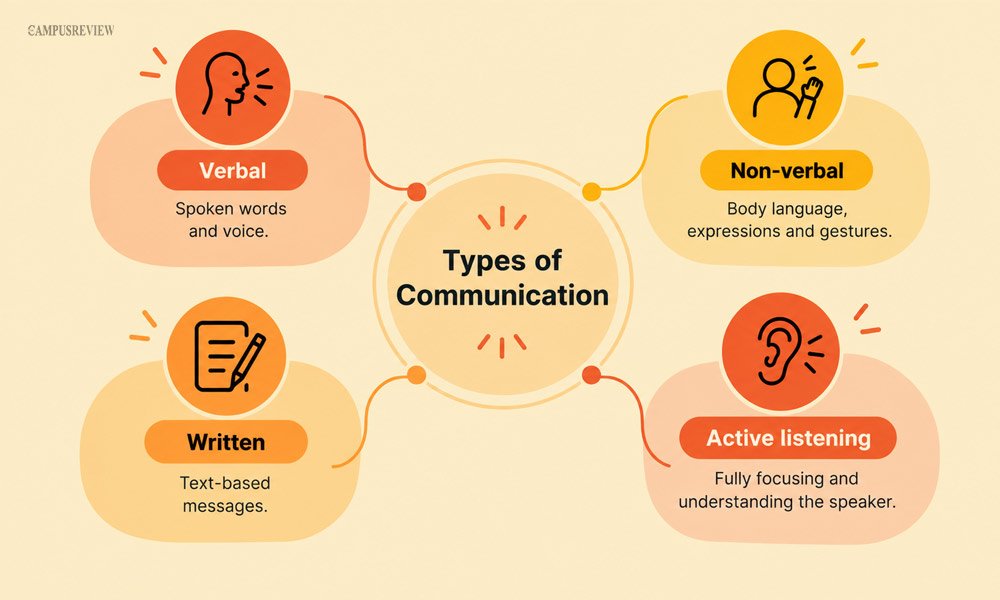
Communication skills for students fall into four types. You use all four every day, often at the same time.
1. Verbal Communication
Verbal communication uses spoken words to share ideas in class discussions, presentations, and interviews. Good verbal communication requires clear language, a simple structure, and the right level of formality.
Example: You tell a friend, “It tracks study hours and shows weekly trends.” To a professor, you explain, “The app records study sessions and compares weekly data to identify patterns.” The idea stays the same, but the detail changes.
2. Non-Verbal Communication
Non-verbal communication includes body language, eye contact, facial expressions, posture, and gestures. These cues can support or contradict your words. Saying you feel confident while looking at the floor may send mixed signals.
You may have heard that body language makes up 55% of communication. This comes from psychologist Albert Mehrabian’s famous 7-38-55 rule, which applies to specific situations involving feelings and attitudes, not communication as a whole.
3. Written Communication
Written communication includes emails, assignments, reports, and messages. Clear structure, short sentences, and plain language help readers understand your point.
For example, replace a vague email subject like “Doubt” with “Assignment 2 Extension Request: [Your Name], Roll No. 24.” Specific messages are easier to understand and refer back to later.
4. Active Listening
Active listening means giving someone your full attention and responding thoughtfully. Unlike hearing, it requires effort and focus.
Communication expert Julian Treasure highlights how much time people spend listening, yet often retain little of what they hear. To listen better, put your phone away, avoid interrupting, and repeat the speaker’s main point in your own words to check your understanding.
| Type | Where students use it | Common mistake | Quick fix |
| Verbal | Viva, seminars, interviews | Rambling without a clear point | Use the PREP Method |
| Non-verbal | Presentations, group talks | Crossed arms and no eye contact | Open posture and steady eye contact |
| Written | Emails, assignments, reports | Long and vague messages | Clear subject line and short paragraphs |
| Active listening | Lectures, group work, feedback | Planning a reply while others talk | Summarise before you respond |
How to Improve Communication Skills: 8 Effective Strategies
You can improve communication skills with eight tested frameworks. These effective communication techniques each work from day one. If you are short on time, start with strategies 1, 3, and 7.
1. Structure Your Answers With the PREP Method
The PREP Method helps you organize your spoken answers so people can follow your ideas easily. Instead of rambling or jumping between points, you make your point, explain your reasoning, give an example, and reinforce your main idea. It is especially useful for class discussions, presentations, public speaking, and interviews.
- Point: State your answer in one sentence.
- Reason: Say why it is true.
- Example: Give a real case, number, or story.
- Point: Repeat your answer to close.
Example: Your viva examiner asks, “Why does biodiversity matter?” You answer: “Biodiversity keeps ecosystems stable (Point). More species help an ecosystem recover after damage (Reason). Mixed forests usually handle pests better than single-species plantations (Example). So protecting biodiversity protects the systems we depend on (Point).”
Try it today: Pick any campus news item. Give a 60-second PREP answer out loud.
2. Control Your Voice With the 4Ps
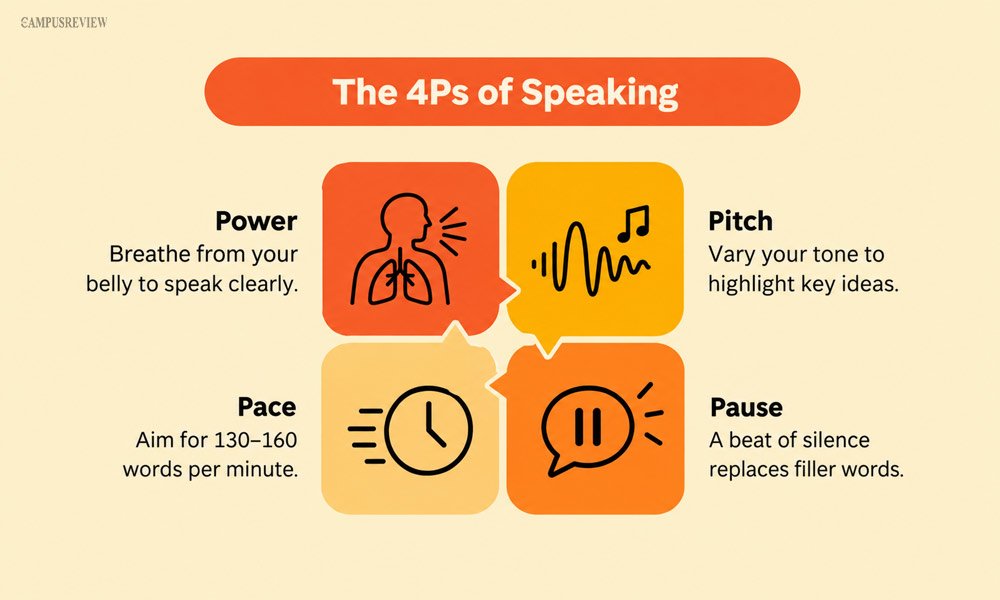
Your voice affects how people understand and respond to your message. The 4Ps model helps you improve your speaking by focusing on four elements: pitch, pace, pauses, and projection. Practising these can make your speech clearer, more engaging, and easier to follow.
- Power: Breathe from your belly so you can speak loudly without strain.
- Pitch: Change your tone so you do not sound flat. Raise it for key ideas.
- Pace: Many coaches suggest 130 to 160 words per minute. Slow down for hard ideas.
- Pause: Stay silent for a beat before or after a key point. A pause replaces “um” and “like.”
Try it today: Read a 150-word paragraph aloud and time yourself. Aim for about one minute. Then pause for two seconds after your main point.
3. Listen With the RASA Model
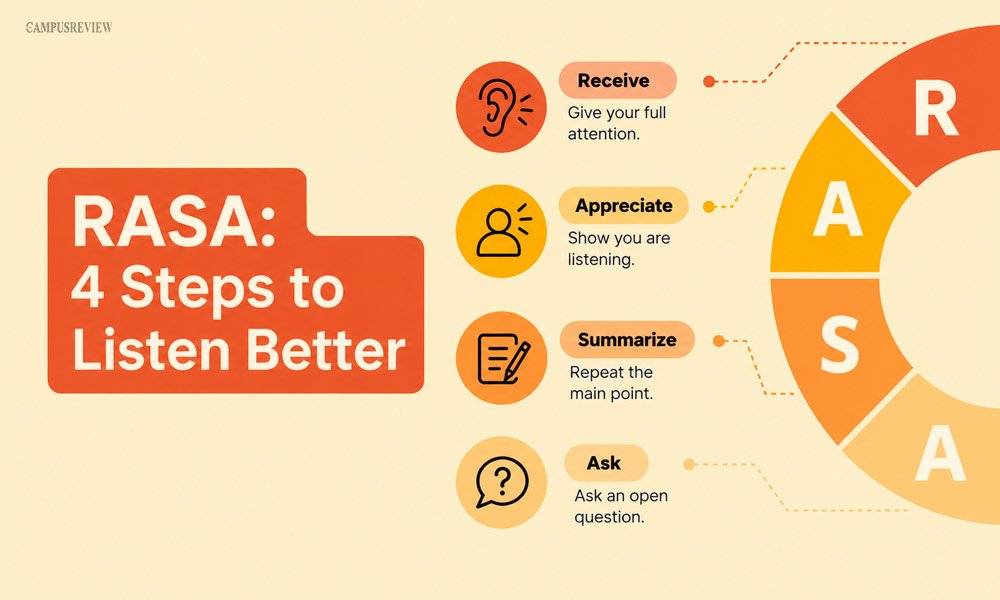
Julian Treasure introduced RASA in his 2011 TED talk. Rasa is a Sanskrit word for “juice” or “essence.” The model turns passive hearing into active listening.This transcript of his talk explains each step.
- Receive: Give the person your full attention. Close your laptop.
- Appreciate: Show you are listening with small signals such as a nod, “hmm,” or “I see.”
- Summarize: Repeat the main point before you add your own. Treasure notes that the word “so” matters here.
- Ask: Ask an open question that starts with how, what, or why.
Example: A teammate says, “I am doing all the research.” You reply, “So you feel the research is not shared equally. Is that right?” Then you ask, “What split would feel fair to you?”
4. Use What? So What? Now What?
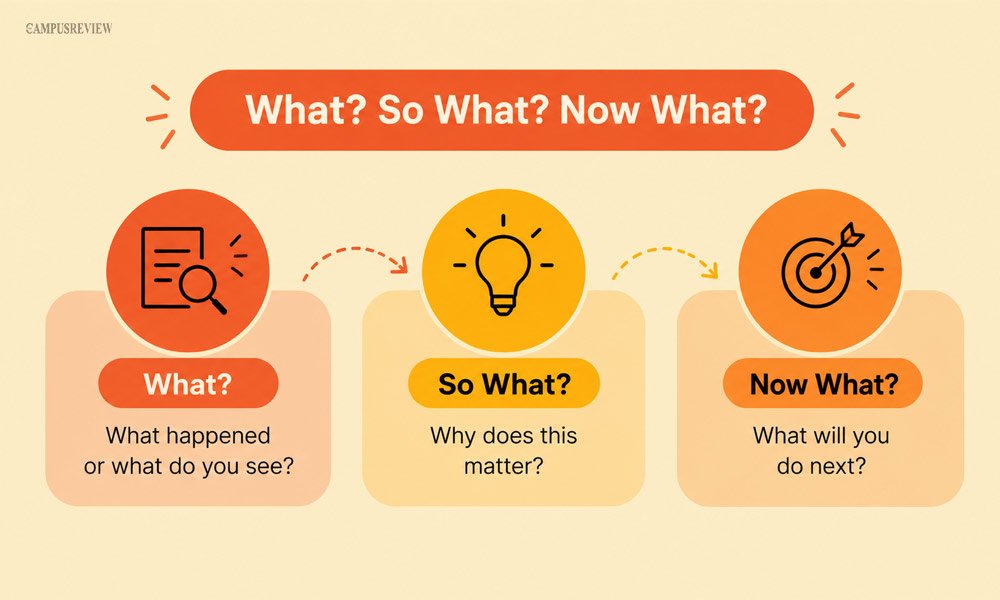
Matt Abrahams, a strategic communication lecturer at Stanford Graduate School of Business, recommends a three-question framework to help you structure answers in meetings, presentations, and conversations. It keeps your message focused on what matters and helps your audience understand why they should care.
- What? State the fact or main point.
- So What? Explain why it matters to the listener.
- Now What? Say the next step or action.
Example: In a placement interview, you hear, “Tell me about a challenge.” Your sample answer: “Our team missed two deadlines in the first month of our final-year project (What).
That put our grade and team trust at risk (So What). I built a weekly task tracker, and we finished on time. I would use the same habit in this role (Now What).
5. Solve Group Conflict With Win-Win Talk
Group projects often involve different opinions, priorities, and working styles. Win-win negotiation helps you resolve disagreements by understanding what each person needs and finding a solution that benefits everyone.
The approach draws on Roger Fisher and William Ury’s book Getting to Yes.
- Separate people from the problem: Discuss the issue without blaming anyone. Say, “The deadline is tight,” instead of, “You are lazy.”
- Focus on interests, not positions: Understand why each person wants something before debating solutions.
- Find shared goals: Look for a solution that helps everyone achieve the team’s main objective.
Example: Two teammates both want to present a group project. Instead of arguing over who gets the role, ask what each person wants to gain.
One wants speaking practice, while the other prefers designing slides. Let one prepare the slides and the other present, then switch roles in the next project. This way, both get a chance to develop their skills.
6. Use the Rule of Three
People remember ideas better in groups of three. Three points feel complete without overloading the listener. Use this rule in speeches, answers, and slide plans.
- Group your key points into threes.
- Use a similar pattern for rhythm, such as “Plan it, test it, improve it.”
- Cut a fourth point or merge it into another.
Example: You open a seminar with, “Today I will cover the problem, the method, and the result.” The audience now knows the full map.
7. Match Your Body Language to Your Words
Body language in communication either backs up your message or weakens it. Use eye contact, posture, and facial expressions on purpose.
- Posture: Keep your arms uncrossed and your shoulders relaxed.
- Gestures: Use open hands above the waist to stress key points. Avoid fidgeting.
- Eye contact: Hold it for about three to five seconds per person, then move to someone else.
- Facial expressions: Smile when you greet people. Show interest when others speak.
Try it today: Record a two-minute answer to “Tell me about yourself” for a class presentation or interview. Watch it with the sound off and check your posture, hands, and face. Then listen without the video and check your voice.
8. Adapt to Your Audience
Effective communication fits the listener. A message that works for a friend may confuse a professor. Ask three questions before you speak. Who is listening? What do they already know? What do they need from me? Then watch faces as you talk. If people look confused, slow down and explain again.
Example: You explain your project to a first-year student. You use daily-life examples and skip jargon. For your professor, you add the method and the data.
Use this table as a quick reference for all eight strategies.
| Framework | Core steps | Best for |
| 1. PREP Method | Point, Reason, Example, Point | Viva, Q&A, debates |
| 2. 4Ps | Power, Pitch, Pace, Pause | Presentations |
| 3. RASA | Receive, Appreciate, Summarize, Ask | Lectures, group work |
| 4. What? So What? Now What? | Fact, meaning, action | Interviews, updates |
| 5. Win-win talk | Separate problem, ask why, share goals | Group projects |
| 6. Rule of Three | Three points, steady rhythm | Speeches, slides |
| 7. Body language | Posture, gestures, eye contact | Interviews, stage talks |
| 8. Audience fit | Who, what they know, what they need | Any talk or email |
What Blocks Good Communication?
Communication barriers are anything that stops a message from landing. You can fix most of them with small changes.
| Barrier | Example | Fix |
| Noise and distractions | A phone buzzes during a talk. | Silence your phone and pick a quiet spot. |
| Nervousness | You speak too fast in a presentation. | Breathe slowly, pause, and practise aloud. |
| Assumptions | You think everyone knows the topic. | Ask what they already know. |
| Jargon | You use technical terms in a class talk. | Use plain words and define new terms. |
| Strong emotions | You reply while angry. | Pause first, then respond. |
| Passive listening | You nod while you think about lunch. | Summarise what you heard. |
How to Practise Communication Skills Every Day
Skills grow through small daily habits. Use this plan for four weeks.
| Exercise | Skill it trains | How often | How to do it |
| Lecture summary | Speaking and thinking | Daily | Explain the main point of a class in two sentences to a friend. |
| Two-paragraph emails | Written clarity | Daily | Cut every email to two short paragraphs. Use active voice. |
| 60-second PREP talk | Quick structure | Daily | Pick a random topic and answer with Point, Reason, Example, Point. |
| Video playback | Voice and body language | Weekly | Record a two-minute answer. Watch it muted, then listen to the audio alone. |
| Plain-language rewrite | Audience fit | Weekly | Rewrite one dense textbook paragraph in simple words. |
Ask for communication feedback after every talk. Request one strength and one fix. Specific questions get specific answers. Ask “Was my pace too fast?” instead of “How was I?” Then write one line in a weekly journal about what worked.
Final Thoughts
Good communication is a habit, not a gift. Clear speaking, active listening, open body language, and tidy writing all grow with practice. Frameworks such as PREP, RASA, and What? So What? Now What? give your thoughts a shape, so you can focus on your message.
Start small. Tonight, pick one topic and give a 60-second PREP answer. Record it. Play it back and fix one thing. Repeat tomorrow. In four weeks, you will likely hear the difference in class, in group work, and in interviews.
FAQs
1. How can I overcome the fear of speaking in front of others?
You can overcome the fear of speaking by practising alone, then with a friend or small group. Prepare your opening line and take a slow breath before speaking.
2. Can introverts improve their communication skills?
Yes. Introverts can improve communication skills by preparing their points, listening actively, and aiming to speak at least once in each meeting.
3. How can I communicate better in English if it is not my first language?
Use simple sentences, practise speaking aloud, and learn common phrases to communicate better in English. Focus on expressing your message clearly rather than using perfect grammar.
4. How do I communicate well on video calls and online?
Keep your message clear and concise, look at the camera when making key points, mute your microphone when not speaking, and summarise next steps.