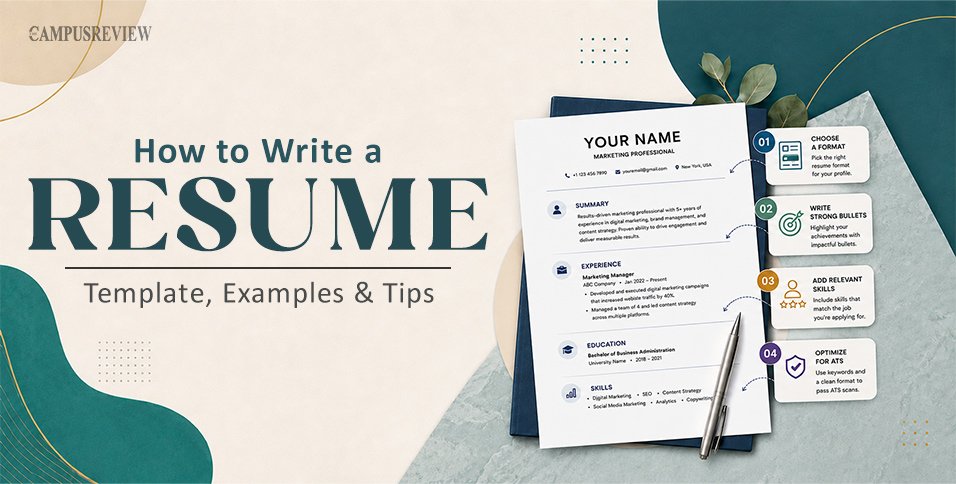
A recruiter looks at your resume for about seven seconds before deciding what happens next. Ladders’ well-known eye-tracking study found hiring managers scan a resume for around 7.4 seconds on the first read. In that short window, your resume has to work fast.
A good resume is not a list of duties. It is proof that you can do the job. It shows your skills, your work experience, and your results in a format a recruiter, and an ATS, can scan in seconds.
This guide walks you through resume writing step by step. You will learn what to include in a resume, how to write a resume with no experience, the best resume format for freshers, and resume writing tips that work in 2026. Real examples are included throughout, so you can copy the structure and add your own details.
What to Include in a Resume
Every strong resume follows the same core sections. Here is what each one should contain.
| Section | What Goes In It |
| Contact information | Full name, phone number, professional email, city, and a LinkedIn or portfolio link |
| Summary or objective | 2 to 3 lines on your role, experience level, and top skills |
| Work experience | Job title, company name, dates, and 3 to 5 result-based bullet points |
| Education | Degree, school name, location, and graduation year |
| Skills | 6 to 10 job-relevant hard and soft skills |
| Certifications or projects | Optional section, useful for freshers and career changers |
How to Write a Resume Step by Step
Here are the key steps for effective resume writing, from choosing the right format to adding your skills, experience, and achievements.
Step 1: Choose Your Resume Format
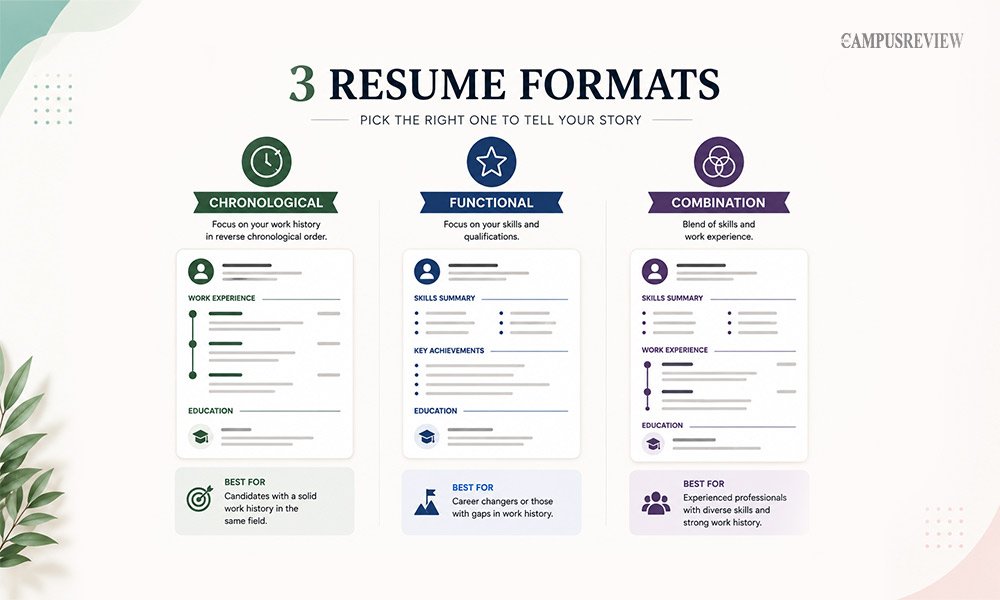
Your resume format decides how a recruiter reads your background, so pick it before you write a single line. There are three main formats, and each one solves a different problem.
- Chronological: Lists your jobs newest to oldest. Use it if you have a steady work history with no major gaps. It is the format recruiters expect, which makes it easy to scan fast.
- Functional: Groups your abilities into skill categories instead of listing jobs in detail. Use it if you have little work history, a career gap, or you are switching fields entirely.
- Combination: Puts a skills summary at the top, followed by a short work history. Use it if you have some experience and want to lead with your strongest skills first.
Once you choose a format, use it consistently throughout your resume. Mixing bullets and paragraphs can make it harder to scan and may confuse ATS software.
Step 2: Write Your Summary
Your summary sits right under your contact details, so it is often the first thing a recruiter actually reads. Keep it to 2 to 3 sentences and follow a simple formula: your role or field, your experience level, your top 2 skills, and one measurable win if you have one.
Avoid vague opening lines like “hard-working individual seeking opportunities.” That tells a recruiter nothing about what you can do. Lead with strength instead.
“Second-year marketing student with hands-on experience in social media campaigns and content writing. Skilled in Canva, copywriting, and audience research. Looking to bring creative and analytical skills to a marketing internship.” – Example resume summary
If you do not have work experience yet, write a resume objective instead.
Step 3: Add Your Work Experience
This is the section recruiters spend the most time on, so it deserves the most care. List your job title, company name, location, and dates worked. Under each role, add 3 to 5 bullet points, newest role first.
Each bullet should start with an action verb, describe what you did, and end with a result. A number, a percentage, or a scale (like team size or budget) makes a bullet far more convincing than a plain duty.
| Weak Bullet | Strong Bullet |
| Responsible for organizing college events | Coordinated a 3-day college fest for 500+ students, managing a 10-person volunteer team and a budget of ₹50,000 |
| Helped with social media | Grew Instagram engagement by 40% over 3 months by planning and posting a weekly content calendar |
If a bullet only describes a task and never mentions an outcome, rewrite it. Ask yourself what changed because you did the work: more sales, less time, fewer errors, happier users. That answer is your result.
Step 4: Add Your Education
List your highest degree first, followed by the school name, location, and graduation year (or expected year, if you have not graduated yet). Freshers can move this section higher, right after the summary, since it is often the strongest credential they have.
“Bachelor of Commerce, XYZ University, Pune | Expected 2027” – Example education entry
Add your GPA only if it is strong and the job post asks for it. If you took coursework directly relevant to the role, list 3 to 4 course names under the degree. Drop your high school details once you have a college degree, unless the job specifically asks for it.
Step 5: List Your Skills
Include a mix of hard skills (teachable, specific abilities like software or data analysis) and soft skills (how you work with others, like communication or time management). Pull skills directly from the job description first, then add ones you genuinely have that are not listed.
| Hard Skills | Soft Skills |
| MS Excel, data analysis | Communication |
| Content writing, Canva | Teamwork |
| SQL basics | Time management |
| Social media management | Problem-solving |
Aim for 6 to 10 skills total. Listing 20 skills waters down the ones that actually matter for this specific job, and it reads as generic rather than targeted.
Step 6: Add Achievements or Certifications
If you have relevant certifications, awards, or projects, add a short section below your education. List the certification or project name, the issuing body or platform, and the year. This section is especially useful if you are still building work experience, since it gives a recruiter more proof of your skills to look at.
Sample Resume Example
Here is what a completed resume looks like once all six steps come together. It uses the same summary and experience bullet from the examples above, put into a full one-page structure a fresher could use.
| Ananya Verma ananya.verma@email.com | +91-98765-43210 | Pune, Maharashtra | linkedin.com/in/ananyaverma SUMMARY Second-year marketing student with hands-on experience in social media campaigns and content writing. Skilled in Canva, copywriting, and audience research. Looking to bring creative and analytical skills to a marketing internship. EDUCATION Bachelor of Business Administration, ABC University, Pune- Expected 2027 EXPERIENCE Event Coordinator (Volunteer), College Cultural Committee Pune | Jan 2025 – Present • Coordinated a 3-day college fest for 500+ students, managing a 10-person volunteer team and a budget of ₹50,000 • Grew Instagram engagement by 40% over 3 months by planning and posting a weekly content calendar SKILLS MS Excel, Content Writing, Canva, Social Media Management, Communication, Teamwork, Time Management CERTIFICATIONS Google Digital Marketing Certificate — Google, 2026 |
Notice how every line does one of two things: it states a fact, or it proves a result. There is no filler, no paragraph-style writing, and every section a recruiter expects is right where they expect to find it.
How to Write a Resume With No Experience
For freshers, resume writing can highlight skills and achievements even without formal work experience. Use projects, internships, education, skills, and volunteer work to demonstrate your abilities.
- Projects: Add academic or personal projects. Explain what you built and what tools you used.
- Internships: Include any internship, even a short one. Focus on what you contributed.
- Education: Move this section near the top if it is your strongest asset right now.
- Skills: List technical and soft skills you have practiced, even outside a job.
- Volunteer work: Include club roles, event organizing, or community work. These show real responsibility.
“Recent graduate in Computer Science seeking an entry-level developer role. Built three personal projects using Python and SQL, including a student attendance tracker used by two college clubs. Eager to apply strong problem-solving skills to a real development team.” – Example resume objective for a fresher
Resume Writing Tips
Use these resume writing tips to make your resume clear, relevant, and easy to read.
- Tailor it to the job: Match your skills and keywords to the specific job description.
- Use action verbs: Start bullet points with strong verbs instead of “responsible for.”
- Keep it concise: One page for freshers. Two pages only if you have 10+ years of experience.
- Use relevant keywords: Repeat key terms from the job post naturally so ATS software can find them.
- Proofread: Read your resume out loud, run spellcheck, and ask someone else to review it.
Use Strong Action Verbs
Use specific action verbs instead of weak phrases to make your resume more impactful and results-focused.
| Instead of | Try These Action Verbs |
| Responsible for managing | Led, Managed, Directed |
| Helped with | Supported, Assisted, Contributed |
| Worked on | Built, Created, Designed |
| Was in charge of | Coordinated, Organized, Oversaw |
| Made better | Improved, Increased, Reduced |
ATS Optimization: Getting Past the Software First
Before a recruiter ever opens your resume, software usually reads it first. An Applicant Tracking System, or ATS, scans your resume, pulls out key information, and ranks it against the job description. Jobscan’s 2025 audit found a detectable ATS at 97.8% of Fortune 500 companies, so for most jobs, this step is not optional.
A few formatting choices make the biggest difference in how well an ATS reads your resume.
- Use standard section headings: “Work Experience” and “Education” parse correctly. Creative titles like “My Journey” often do not.
- Avoid headers, footers, and text boxes: Some ATS platforms skip over content placed inside them entirely.
- Skip tables, columns, and graphics inside the resume itself: These can scramble the reading order or get dropped completely.
- Match keywords from the job post: Use the same terms the employer uses for skills and tools, not just synonyms.
- Save in the requested file format: Most systems handle Word (.docx) and PDF well, but always follow what the job post asks for.
Full keyword strategy, resume scoring tools, and a section-by-section ATS checklist are covered in the dedicated guide below.
Resume Dos and Don’ts
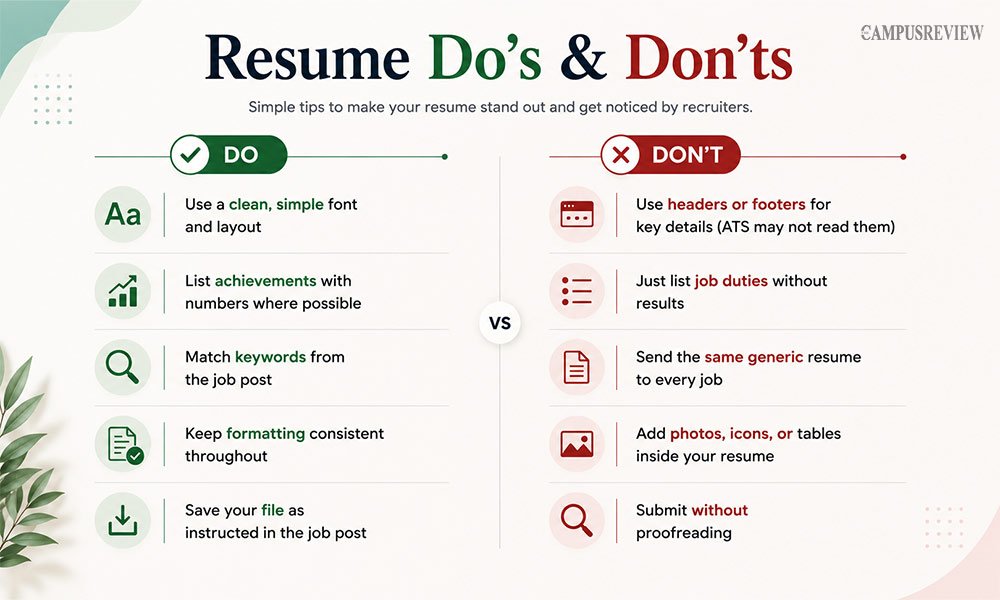
Follow these resume dos and don’ts to improve your resume writing and avoid common mistakes.
Beyond the Resume: The Rest of the Job Application
Strong resume writing can help you get your foot in the door, but it is only one part of the job search. Here is what to prepare next, with a guide for each stage.
Cover Letters
A cover letter tells the story your resume bullets cannot. It explains why you want this specific role, connects your background to the company’s needs, and gives you room to address things like a career gap or a career change. Keep it to 3 to 4 short paragraphs and always tailor it to the job, never reuse one letter for every application.
Interview Preparation
Once your resume and cover letter get a response, start preparing for a job interview.
Research the company, prepare specific examples of your achievements using a structure like situation, task, action, result, and practice answers to common questions out loud, not just in your head. Prepare a few thoughtful questions to ask the interviewer too, since this shows genuine interest in the role.
Salary & Negotiation
Many candidates accept the first number offered because negotiating feels uncomfortable. Research the market rate for the role and your location before any conversation happens, and let the employer name a number first when possible. If you do negotiate salary, base your counter on data and the value you bring, not just a general request for “more.”
Thank-You Email After an Interview
A short thank-you email sent within 24 hours of an interview keeps you top of mind and shows professionalism. Thank the interviewer for their time, reference one specific point from the conversation, and reaffirm your interest in the role. Keep it to a few sentences. This step is easy to skip, but many hiring managers say it genuinely affects their decision.
End Note
A resume is never truly finished. Update your resume writing for each job you apply to, tailor it to the role, and highlight relevant skills and results. A well-structured resume can help you stand out and move one step closer to an interview.
FAQs
1. Resume objective vs. summary: what’s the difference?
A resume summary highlights your experience and top achievements. It works best if you already have some work history. A resume objective focuses on your goals and transferable skills. It works best for freshers, career changers, or anyone with a career gap.
2. One page vs. two pages: how long should a resume be?
Freshers and candidates with under 10 years of experience should keep their resume to one page. Only go to two pages if you have extensive, relevant work history that supports the extra length.
3. How should I list skills on a resume?
List 6 to 10 skills that match the job description, mixing hard and soft skills. A simple bullet list or a two-column layout both work well. Put the most job-relevant skills first.