Interviewers ask “What are your strengths and weaknesses?” in almost every single job interview. A weak answer can end your chances. A strong one can help you win the job.
Here is the short answer. Pick two or three strengths that match the job description. Prove each one with a real example. Then share one honest weakness that does not block the role, and explain how you are fixing it.
This guide covers 10 strengths and 10 weaknesses to mention in an interview, with sample answers you can adapt. It also includes examples for freshers, clichés to avoid, and five tips to answer confidently, even without work experience.
Why Do Interviewers Ask About Strengths and Weaknesses?
Interviewers ask about strengths and weaknesses to check your self-awareness, honesty, and willingness to grow. They also want to see if your skills match the job.
- Self-awareness: Do you know what you do well and where you struggle?
- Honesty: Do you give a real answer or a rehearsed line?
- Growth mindset: Do you work on your gaps, or ignore them?
- Role fit: Do your skills match the job description?
Société Générale’s careers team says the question shows a recruiter your self-awareness and your willingness to improve and learn. The same page calls honesty the number one rule.
How to Answer “What Are Your Strengths” in an Interview
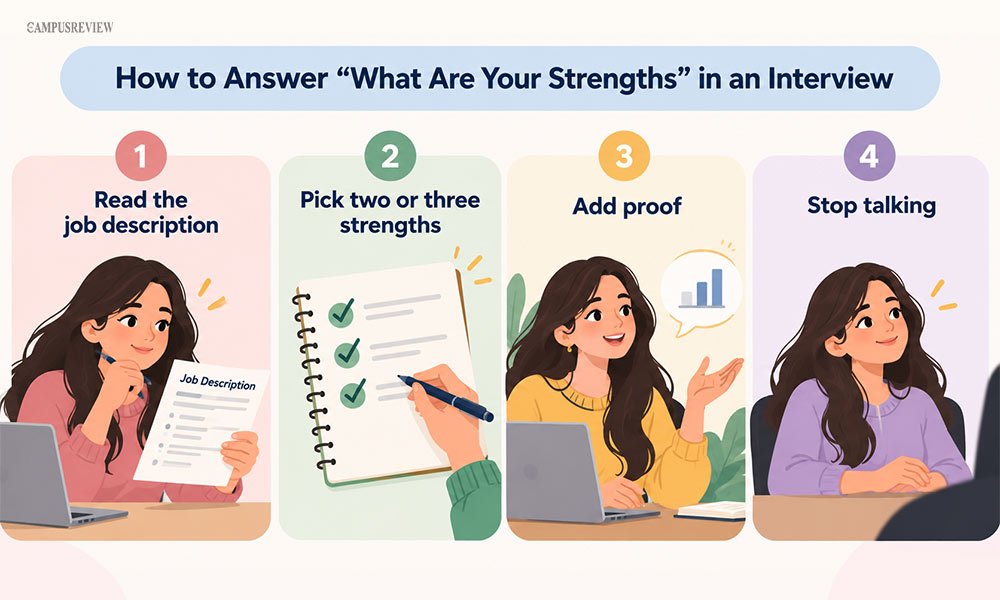
Name two or three strengths that match the job description. Then give one short example for each. Keep the whole answer under 90 seconds.
1. Read the job description. Circle the skills it asks for most. These are the strengths worth mentioning.
2. Pick two or three strengths. Choose traits you can prove. Do not list ten.
3. Add proof. Use this formula: strength, then a real example, then the result.
4. Stop talking. End on the result. Do not repeat yourself or add extra claims.
Keep the answer easy to follow. Say the strength in one short sentence. Add the example in two sentences. Share the result in one sentence. That makes four sentences in total, which is enough.
10 Strengths to Mention in an Interview
Interviewers hear “hard worker” and “team player” often. Try these less common strengths, with simple meanings and sample answers you can adapt to your experience. Use your own experience to make the answers personal.
1. Checking Your Own Assumptions
What it means: You test your own thinking before you act on it.
How to say it: “Before I start a task, I ask myself what I am assuming. In my internship, I assumed customers wanted a discount. I checked the survey first. They wanted faster delivery, so we changed the plan early.”
2. Switching Between Big Picture and Small Details
What it means: You can plan the goal and still fix the small steps.
How to say it: “I can zoom out and zoom in. For my college fest, I kept the main goal in mind, which was 500 visitors. Then I checked every small task, from posters to chairs. We reached 540 visitors.”
3. Borrowing Ideas From Other Fields
What it means: You use a method from one area to solve a problem in another.
How to say it: “I like to borrow ideas. Our canteen queue was long, so I used a method I learned from bank counters. I split orders into quick and slow lines. The wait dropped from 15 minutes to 8.”
4. Knowing Who Really Gets Things Done
What it means: You know who people trust and who can help, beyond job titles.
How to say it: “I learn quickly who people trust. In my internship, the office assistant knew every vendor. I asked for her help before I wrote my report. I finished a week early.”
5. Testing Ideas With Small Trials
What it means: You try an idea on a small scale before you commit.
How to say it: “I test before I scale. Our club wanted to change its meeting day. I tried the new day for two weeks and tracked attendance. It rose by 30%, so we made the change.”
6. Explaining Technical Topics in Simple Words
What it means: You turn hard ideas into clear points for non-experts.
How to say it: “I translate between experts and everyone else. In a data class project, I explained our model to a non-technical judge using a cricket match example. She scored us the highest in the group.”
7. Staying Calm When Instructions Are Unclear
What it means: You do not freeze when nobody tells you exactly what to do.
How to say it: “I stay steady when things are unclear. My first week at my internship had no clear tasks. I listed what I knew, shared a simple plan, and asked my manager to correct it. She approved it that day.”
8. Spotting What Could Go Wrong Early
What it means: You imagine problems before the launch, so the team can fix them.
How to say it: “I ask “What could go wrong?” before a launch. Before our college seminar, I listed seven risks, such as a projector failure. We carried a spare and the event ran smoothly.”
9. Cutting Through Information Overload
What it means: You pick the few facts that matter and ignore the noise.
How to say it: “I find the key facts quickly. During my research project, I had 40 articles. I chose five that answered our question and summarised them on one page. My guide used that page in class.”
10. Removing Small Frictions From a Process
What it means: You notice little delays and extra steps that waste people’s time.
How to say it: “I notice small delays that others ignore. In our hostel’s fee process, students filled out the same form twice. I suggested one combined form. It saved about ten minutes per student.”
Which ones should you choose? Read the job description and pick two or three that match it. A research role may value checking assumptions and cutting through information overload. A sales role may value simple explanations and knowing who really gets things done.
Weaknesses You Can Mention in an Interview
Choose a real but manageable weakness that does not affect the core job. Explain what you are doing to improve it and show your willingness to learn.
Use this formula: weakness, then its small impact, then your fix.
Weaknesses to Avoid (and Why They Backfire)
| Weak answer | Why it backfires |
| I am a perfectionist. | Recruiters hear it all the time. It sounds like a strength in disguise, and it looks like you are dodging the question. |
| I work too hard. | This is a brag. It tells the hiring manager you did not think about the question. |
| I have no weaknesses. | Everyone has weaknesses. This answer shows low self-awareness. |
| I am always late. | It hits a basic job need. A recruiter will worry about your reliability. |
| I get angry easily. | It raises a teamwork red flag, and you offer no fix. |
10 Weaknesses to Mention in an Interview
Here are 10 weaknesses you can mention in an interview, along with sample answers to help you prepare.
1. Nervous About Public Speaking
What it means: Feeling nervous when speaking or presenting in front of a group.
Sample Answer:
“I get nervous before presentations. I used to avoid them. Now I practise aloud the night before and have joined my college debate club. Last month, I presented to 60 students and felt calm.”
2. Difficulty Delegating
What it means: Finding it difficult to share tasks with others and trust them to complete the work.
Sample Answer:
“I sometimes prefer doing tasks myself to make sure they are done correctly. During a group project, this slowed the team down. Now, I assign clear tasks to each member and set check-in times. This helped us finish two days early.”
3. Hesitant to Ask for Help
What it means: Trying to solve every problem alone instead of asking others for support.
Sample Answer:
“I used to struggle alone for too long. Now, I give myself 30 minutes to solve a problem. If I still need help, I ask a teammate. This habit saves me hours every week.”
4. Saying Yes Too Often
What it means: Accepting too many tasks, even when your schedule is already full.
Sample Answer:
“I used to accept every request, and my own work suffered. Now, I check my to-do list before saying yes. If I have too much work, I suggest a later date. My manager appreciates my honesty.”
5. Limited Experience With One Tool
What it means: Not having enough experience with a particular software or work tool.
Sample Answer:
“I have not used advanced Excel formulas yet. I know the basics well. I am taking a free course and practising with real tasks every week. I can already use pivot tables.”
6. Spending Too Long Polishing Work
What it means: Spending extra time making work perfect instead of completing it on time.
Sample Answer:
“I sometimes edit a document longer than necessary. Now, I set a clear goal before starting. I focus on making my work clear and useful rather than perfect. I also use a timer to manage my time.”
7. Impatience With Slow Processes
What it means: Feeling frustrated when tasks or decisions take longer than expected.
Sample Answer:
“I get restless when a process feels slow. In my last role, I pushed for a change too quickly, and my teammates felt ignored. Now, I first understand why a process exists before suggesting improvements.”
8. Sharing Drafts Late
What it means: Waiting too long to share your work because you want it to be perfect.
Sample Answer:
“I used to share drafts only when they looked perfect. This sometimes wasted time when the direction was wrong. Now, I share early drafts and ask for feedback. This helps me make improvements sooner.”
9. Quiet in Fast Brainstorming Meetings
What it means: Finding it difficult to share ideas quickly during group discussions.
Sample Answer:
“I think best when I have time to organise my thoughts. In fast meetings, I sometimes stay quiet. Now, I ask for the agenda in advance and share my ideas in writing after the meeting.”
10. Taking Work Worries Home
What it means: Finding it difficult to stop thinking about work after office hours.
Sample Answer:
“I tend to think about unfinished tasks after work. Now, I write down my next steps before leaving. This helps me switch off, rest, and return with a fresh mind.”
Notice the pattern. Every answer names the weakness, shows a small impact, and ends with a fix. Never pick a weakness that is central to the role. A person applying for a customer service job should not say, “I dislike talking to people.”
Strengths and Weaknesses Examples for Freshers
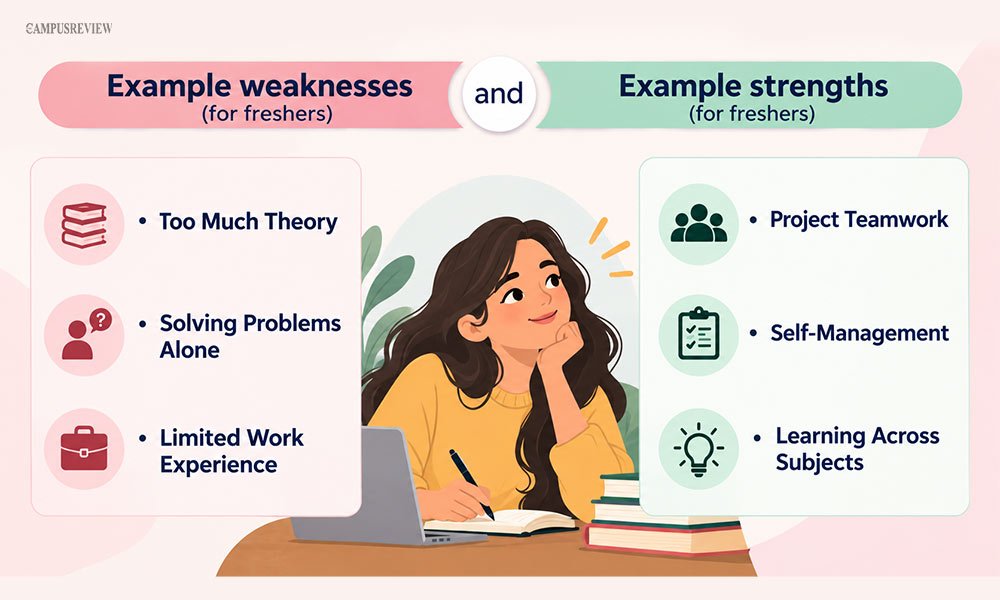
No work experience? That is fine. Freshers can use college projects, internships, clubs, volunteering, part-time jobs, and online courses. These show the same skills. These strengths and weaknesses examples are written for freshers.
Strengths Examples for Freshers
Explore these strength examples for freshers to identify which ones best match your skills and experiences.
Project Teamwork
“In my capstone project, I coordinated four teammates. I made a shared task sheet with deadlines. We submitted a week early, and our faculty used our report as a sample.”
Self-Management
“I tracked my study hours for one semester in a simple notebook. I saw I focused best before noon, so I moved hard subjects to the morning. My marks went up in the next exam.”
Learning Across Subjects
“I took electives in data analytics and psychology. For my class survey project, I used both to study why students skip lectures. My professor praised the mix of methods.”
Weaknesses Examples for Freshers
Explore these weakness examples for freshers to prepare honest and confident interview answers, even without work experience.
Too Much Theory
“Coming from college, I tend to apply textbook ideas first. Real teams have people and limits that books skip. Now I talk to a senior colleague before I finalise any plan.”
Solving Problems Alone
“College grades reward individual work, so I tried to solve problems alone. Now I set a time limit. If I am stuck after 30 minutes, I ask a teammate.”
Limited Work Experience
“I have no full-time experience yet. To close the gap, I did two internships and finished a free course. I learn quickly and ask for feedback often.”
Where do freshers find proof? Look at your college projects, group assignments, club roles, volunteering, and online courses. Each one holds a story with a skill, an action, and a result.
5 Tips to Answer Strengths and Weaknesses Questions Confidently
These five tips will help with interview preparation and make your answer sound calm and clear.
1. Use the S-A-R formula. State the Situation, your Action, and the Result. A story with a result sounds far more credible than a trait on its own.
2. Stay calm and neutral. Talk about your weakness the way you talk about any normal work fact. Do not apologise or sound defensive.
3. Match the company. A small startup may value comfort with unclear tasks. A large firm may value clear communication and teamwork across teams. Read the job description and the company website before you choose.
4. Practise aloud. Record yourself on your phone. Cut filler words and long pauses. Practising out loud is the best form of self-improvement before an interview.
5. Stop when you finish. Many job seekers weaken a good answer by adding extra lines. State the point, add one example, share the result, and stop.
Final Words
The strengths and weaknesses question is a chance to show self-awareness, honesty, and career growth. Choose strengths that fit the role. Pick a real weakness that does not block the job. Then show what you are doing to improve.
Your next steps are simple:
- Pick two or three strengths from the table and add your own real example for each.
- Choose one weakness and write your fix in one sentence.
- Say your answer aloud three times before the interview.
Pranjal Kharche