You have researched the company, updated your resume, and prepared your outfit. Then the interviewer asks, “Tell me about yourself,” and your mind suddenly goes blank. The right preparation can help you avoid that moment.
This guide shares practical tips and advice for job interview success, from answering common questions to handling tricky interview moments with confidence.
What Are the Best Tips and Advice for Job Interview Success?
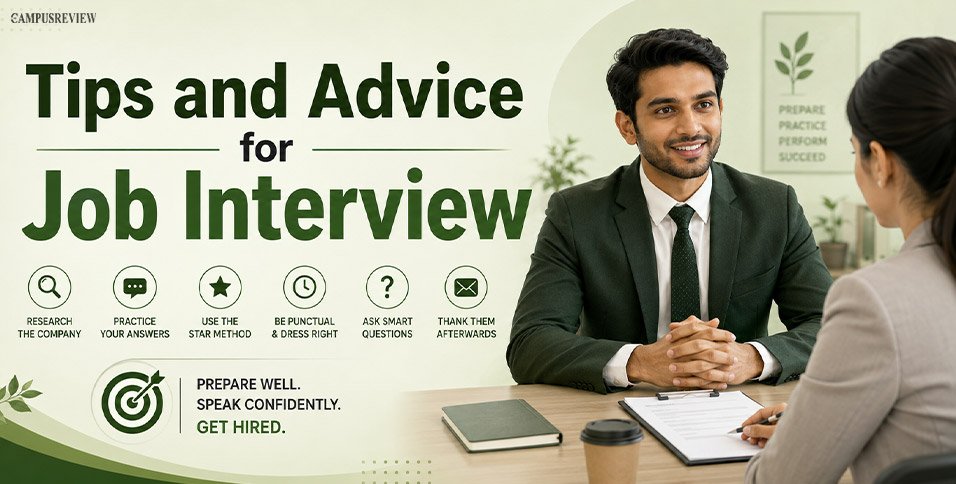
Here are a few tips for a job interview. Do these six things, and you will walk into any interview prepared:
- Research the company before you go.
- Practice answers to common interview questions out loud.
- Use the STAR method to answer tricky behavioral questions.
- Dress appropriately and arrive at least 10 minutes early.
- Prepare two or three smart questions to ask the interviewer.
- Send a short thank-you message within 24 hours.
These tips and advice for job interview preparation can help you feel more confident before, during, and after the interview.
How to Prepare for a Job Interview: Step by Step
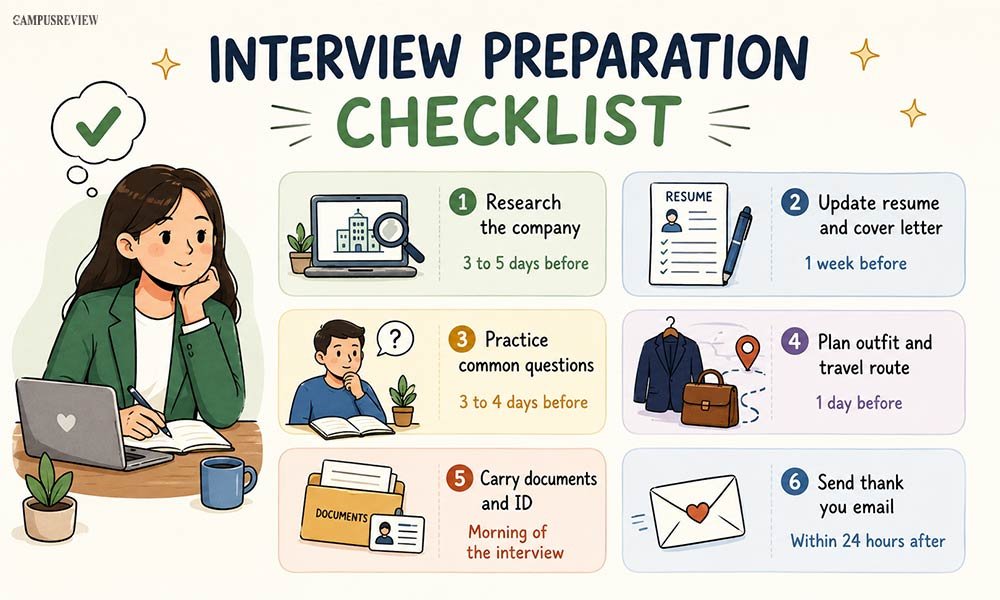
The best tips and advice for job interview preparation start days before the interview, not the night before. Follow these steps in order.
1. Research the company. Check their website, recent news, and social media. Know their products, mission, and recent achievements.
2. Study the job description. Match your skills to each requirement listed. Note the exact words they use, since interviewers often repeat them.
3. Prepare your documents. Carry a printed copy of your resume and a copy of your cover letter. Freshers should keep both simple, clear, and free of spelling errors.
4. Practice common questions. Say your answers out loud, not just in your head. This builds real confidence.
5. Plan your outfit and route. Decide what to wear and how you will reach the venue a day in advance.
6. Prepare your own questions. Interviews are two-way. Bring at least two questions to ask them.
Common Interview Questions and How to Answer Them
Most interviews cover the same core questions. If you prepare for these, you cover 80 percent of any interview.
| Question | What They Really Want to Know | Quick Tip |
| Tell me about yourself | Can you summarize your background clearly? | Use the past-present-future pitch below. |
| Why do you want this job? | Have you actually researched us? | Mention one specific fact about the company. |
| What are your strengths? | Do you know your own value? | Pick one strength and back it with an example. |
| What is your biggest weakness? | Are you self-aware and improving? | Name a real weakness plus the step you are taking to fix it. |
| Where do you see yourself in 5 years? | Do your goals match this role? | Show growth that fits the company, not just yourself. |
| Do you have any questions for us? | Are you genuinely interested? | Always say yes and ask something specific. |
How to Answer “Tell Me About Yourself” (Your 30-Second Pitch)
This question usually opens the interview. Do not repeat your entire resume. Use a simple three-part structure instead: Past, Present, Future.
- Past: where you studied or worked, and your core skill area.
- Present: what you are doing now and one recent achievement.
- Future: why this role and company fit your goals.
Example: “I recently completed my degree in Business Administration, where I led a college fest team of 15 students. Right now I am building my skills in digital marketing through a certification course, and I recently ran a small campaign that grew a college club’s followers by 40 percent. I am excited about this role because it lets me apply that same energy to a real brand.”
Keep your answer under 90 seconds. Practice it until it sounds natural, not memorized.
How to Use the STAR Method for Tricky Interview Questions
Behavioral questions start with phrases like “Tell me about a time when…”. The STAR method gives your answer a clear, easy-to-follow shape.
| Letter | Stands For | What You Say |
| S | Situation | Set the scene in one or two sentences. |
| T | Task | State the exact goal or problem you faced. |
| A | Action | Explain the specific steps you personally took. This is the longest part. |
| R | Result | Share the outcome, with a number if possible. |
Example question: “Tell me about a time you handled a difficult task with limited resources.”
- Situation: Our college wanted a fortnightly newsletter but had no budget or staff.
- Task: I had to design, write, and launch it within 90 days.
- Action: I formed a team of three volunteers, used free templates, and reused existing content to save time.
- Result: We launched two weeks early and grew subscribers by 25 percent in the first quarter.
- Use “I” statements, not “we,” so the interviewer knows exactly what you did.
These tips and advice for job interview answers can help you explain your experience clearly and confidently.
Tips and Advice for Job Interview Success for Freshers
- If you have no work experience, you are not at a disadvantage. Recruiters hiring freshers look for potential, not a long history.
- Talk about college projects, internships, and group assignments as real work experience.
- Show willingness to learn. Mention any certifications or courses you are currently completing.
- Build a strong first impression online too. Recruiters check your LinkedIn profile before the interview, so keep it updated with your skills and projects.
- Keep your resume to one page. List projects with clear outcomes, not just a list of subjects.
Confidence matters more than experience. Recruiters know freshers are still learning. What they want to see is curiosity, honesty, and a willingness to grow.
Types of Job Interviews You May Face Today
The best tips and advice for job interview preparation should cover more than the classic face-to-face chat. Hiring today happens across several formats, often in this order.
| Interview Type | What to Expect | One Prep Tip |
| Phone interview | A short screening call, usually 15 to 30 minutes. | Keep notes and your resume in front of you. |
| Video or AI interview | Recorded or live video, sometimes with automated scoring. | Speak clearly and structure answers with STAR. |
| Take-home assignment | A task to complete on your own time before the next round. | Ask clarifying questions early; do not rush. |
| In-person or panel interview | Face-to-face, sometimes with multiple interviewers. | Make eye contact with everyone, not just one person. |
Phone screenings are often the first real conversation you have with a company. If a recruiter calls to set one up, spend time preparing for a phone interview so you do not get caught off guard.
How to Handle AI Video Interviews and Take-Home Tasks
More companies now use video screening tools before a human ever speaks to you. This can feel intimidating, but a few facts make it simpler.
- Most tools grade what you say, not your facial expressions—structure and clear speech matter more than looking perfect on camera.
- Aim for answers around 90 seconds. Too short looks weak, too long looks unfocused.
- Use a laptop or desktop with a stable connection instead of a phone.
- Sit facing a light source, keep the camera at eye level, and choose a plain background.
For take-home assignments, follow this simple timing rule:
- Ask questions early. If anything is unclear, ask within the first quarter of the time given.
- Do not submit too fast. Submitting instantly can look rushed. Aim to submit with some time still left on the clock, after you have reviewed your work.
- Follow instructions exactly. Answer what was asked before adding extra ideas.
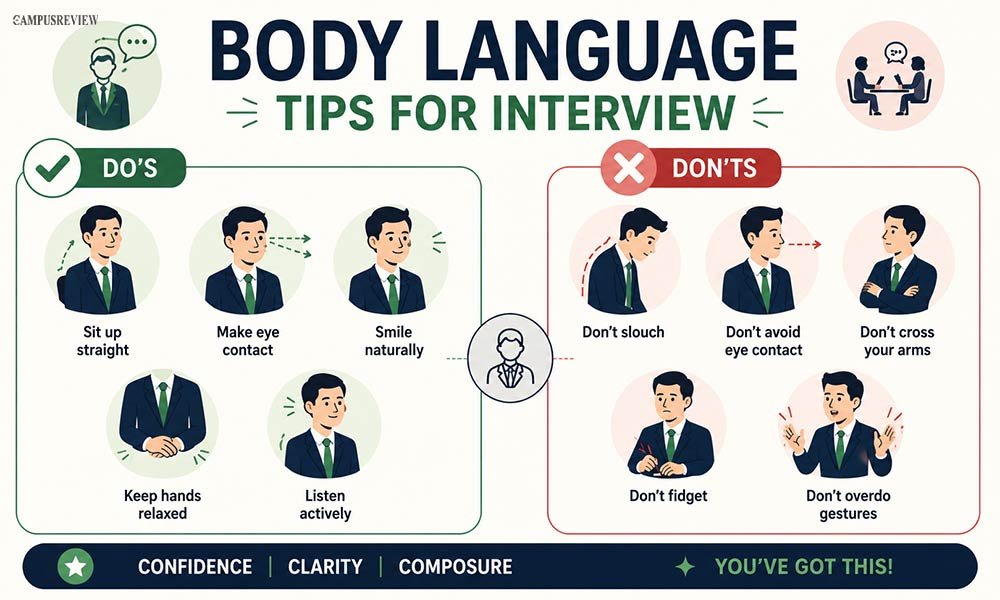
Body Language and Presentation Tips
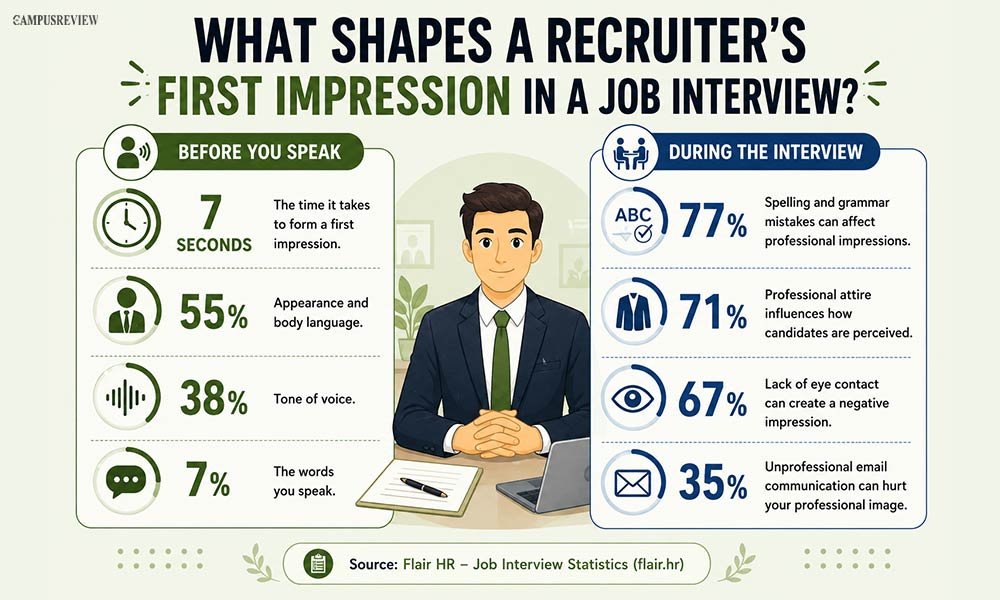
What you say matters, but how you carry yourself shapes the first impression before you speak a word.
- Sit up straight and keep your hands relaxed on the table or your lap.
- Make steady eye contact. Look at the camera lens during video calls, not the screen.
- Offer a firm handshake in person, and smile naturally.
- Avoid fidgeting with your phone, pen, or hair during the conversation.
What to Wear in a Job Interview: Quick Reference
| Interview Setting | Suggested Outfit |
| Corporate or finance role | Formal suit or blazer, neutral colors |
| Startup or creative role | Smart business casual, clean and simple |
| Video interview | Same as in-person from the waist up |
| Campus placement | Institute dress code or formal shirt and trousers |
Questions You Should Ask the Interviewer
One of the most useful tips and advice for job interview success is to prepare questions of your own. Asking good questions shows genuine interest.
- What does success look like in this role after six months?
- How would you describe the team culture here?
- What are the biggest challenges someone in this position would face?
- What are the next steps in the hiring process?
What to Do After the Interview
Your effort should not stop when you leave the room. Follow-up steps often make the difference between two equally strong candidates.
- Send a thank-you email within 24 hours. Keep it short. Thank them for their time and restate your interest in the role.
- Follow up politely if you do not hear back within the timeline they mentioned.
- Prepare for the offer stage. Once you clear the interview, know how to negotiate a salary before you accept anything, so you do not leave value on the table.
Common Interview Mistakes to Avoid
One of the most useful tips and advice for job interview preparation is to practise answering common questions before the big day.
| Mistake | Why It Hurts You | Fix |
| Arriving late | Signals poor time management | Leave early, plan for delays |
| Speaking negatively about a past employer | Raises doubts about attitude | Stay neutral and professional |
| Giving vague answers | Makes it hard to judge your skills | Use the STAR method with real examples |
| Not asking any questions | Looks like low interest | Prepare two questions in advance |
| Rambling without structure | Loses the interviewer’s attention | Keep answers under 90 seconds |
Final Thoughts
Good tips and advice for job interview preparation come down to one idea: know yourself, know the role, and practice saying it out loud. Use this guide as your checklist for every stage, from the first phone screen to the final thank-you note.
When you are ready for the next step, build a strong first job resume and a clear cover letter for a job, polish your LinkedIn profile, and walk into your next interview fully prepared.
Frequently Asked Questions
1. What should I do if I do not know the answer to an interview question?
Stay calm and avoid guessing. Take a moment to think, then explain honestly what you know. You can also say that you are not familiar with the topic but would be willing to learn more about it.
2. Should I memorize my interview answers?
No. Prepare key points instead of memorizing complete answers. Memorized responses can sound unnatural, while understanding your examples helps you answer more naturally.
3. How can I explain a gap in my employment history?
Be honest and keep your explanation brief. Explain how you used the time, such as developing skills, completing a course, caring for family, or searching for the right opportunity. Then shift the focus to your current skills and readiness for the role.
4. What should I do if I accidentally give a wrong answer during an interview?
Correct yourself calmly if you notice the mistake. You can briefly acknowledge the error and provide the correct information. Recovering professionally can show self-awareness and composure.
5. How should I handle a panel interview?
Address the person who asked the question while also making eye contact with the other interviewers. Try to engage with the entire panel instead of focusing on only one person.