The Campus Review
November 5, 2026
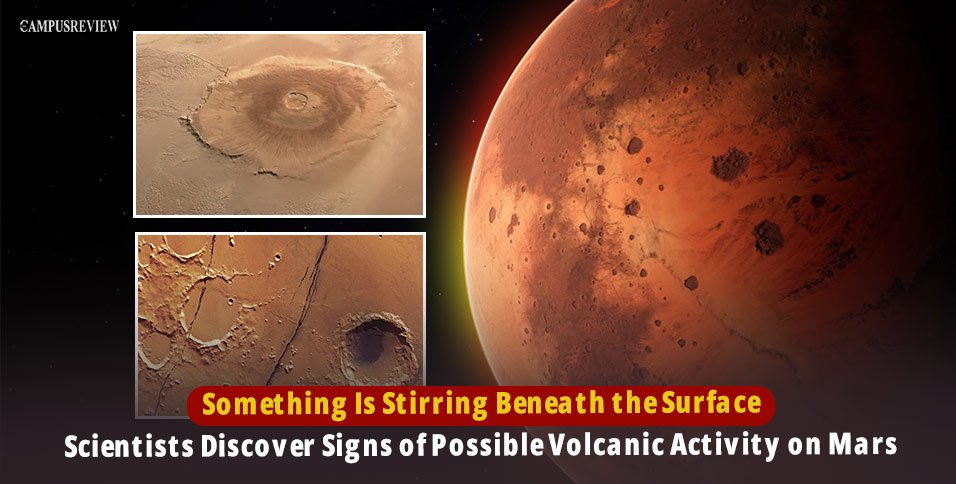
New spacecraft observations suggest that Volcanic Activity on Mars may still be possible beneath the planet’s surface. Researchers analyzing data from the ExoMars Trace Gas Orbiter detected hydrogen chloride (HCl) gas in the Martian atmosphere, concentrated above fractured volcanic regions.
The discovery does not confirm the presence of molten rock. However, scientists believe the gas could be escaping from underground magma sources, offering new clues about possible volcanic activity on Mars.
Mars Volcanic Research at a Glance
| Detail | Current Finding |
| Observation Focus | Signs of possible volcanic activity on Mars |
| Chemical Detected | Hydrogen chloride (HCl) gas at trace concentrations |
| Primary Region | Crustal fractures across the northern flank of Alba Mons |
| Mission | ExoMars Trace Gas Orbiter (TGO) |
| Mission Agencies | European Space Agency (ESA) and Roscosmos |
| Key Instrument | Atmospheric Chemistry Suite (ACS) |
| Imaging Support | CaSSIS and NASA’s High Resolution Imaging Science Experiment (HiRISE) |
| Published Research | Science Advances (November 4, 2026; DOI: 10.1126/sciadv.aeb9422) |
How Scientists Detected Signs of Volcanic Activity on Mars
Although Mars has extensive evidence of ancient volcanic activity, scientists have remained uncertain about whether magmatic processes continue beneath its surface today. The latest observations offer new clues about this possibility.
Using the Atmospheric Chemistry Suite on board the ExoMars Trace Gas Orbiter, researchers identified localized atmospheric HCl detections associated with volcanic regions:
- Seasonal Significance: Unlike the more common HCl detections associated with Mars’ dusty season, these observations appeared during the colder aphelion period. Their concentration over the Alba Mons region made a localized geological source a possibility.
- Regional Association: The gas traces appeared repeatedly over fractured volcanic ground rather than spreading evenly across the planet.
- Scientific Interpretation: The researchers suggest that the localized hydrogen chloride detections could be linked to magmatic activity beneath the Martian surface. However, the gas alone does not confirm the presence of active molten rock.
Why Alba Mons Is Central to Studying Volcanic Activity on Mars
The detections center around the northern slopes of Alba Mons. While Olympus Mons is the tallest volcanic shield on Mars, Alba Mons ranks as the largest volcano on the planet by surface area, spanning hundreds of miles across the northern Tharsis region.
Deep geological fracture systems cut across Alba Mons. Researchers focus on this area because crustal fractures could act as potential pathways for gases escaping from the interior.
Scientists stress that orbiters have not observed active lava flows or open eruptions. Instead, researchers hypothesize that low-level gas releases could happen if deep rock bodies are slowly degassing underground.
What the Research Team Is Saying
Scientists involved in the study emphasize that magmatic seepage represents the most plausible explanation currently available, while cautioning that additional verification remains necessary.
“Looking at the spatial distribution of the seeping, it became instantly obvious to me that there was something volcanic behind it, but it had to be demonstrated.”
Daniel Mège, Professor at the Space Research Centre of the Polish Academy of Sciences and study co-lead author
“If hydrothermal systems are active, they could contain the ingredients and energy needed for microorganisms to develop, and shield microorganisms from the hostile and changing environment above the surface.”
Daniel Mège, study co-lead author
What This Discovery Means for Future Mars Exploration
If future missions confirm that Mars retains active internal heat, the findings could reshape several research priorities across space exploration and planetary science:
- Possible Underground Habitats: Heat beneath Mars could melt some buried ice and create warm, water-rich environments. These places might offer better conditions for microscopic life than the cold, radiation-exposed surface.
- Understanding Planetary Evolution: Mars does not have active plate tectonics like Earth. Studying its internal heat can help scientists understand how rocky planets cool and change over billions of years.
- Future Robotic Missions: These gas signals could help space agencies identify interesting locations for future rovers, landers, and scientific instruments.
Is Mars Still Geologically Active?
Mars may not be as geologically inactive as scientists once believed. The detection of hydrogen chloride near volcanic regions offers new clues about the planet’s internal processes and raises the possibility of recent or ongoing volcanic activity on Mars.
However, researchers still need further observations to establish the source of the gas and determine whether magma is moving beneath the surface. Future missions could help scientists understand how much internal heat Mars retains and whether its volcanic systems remain active today.
Pranjal Kharche