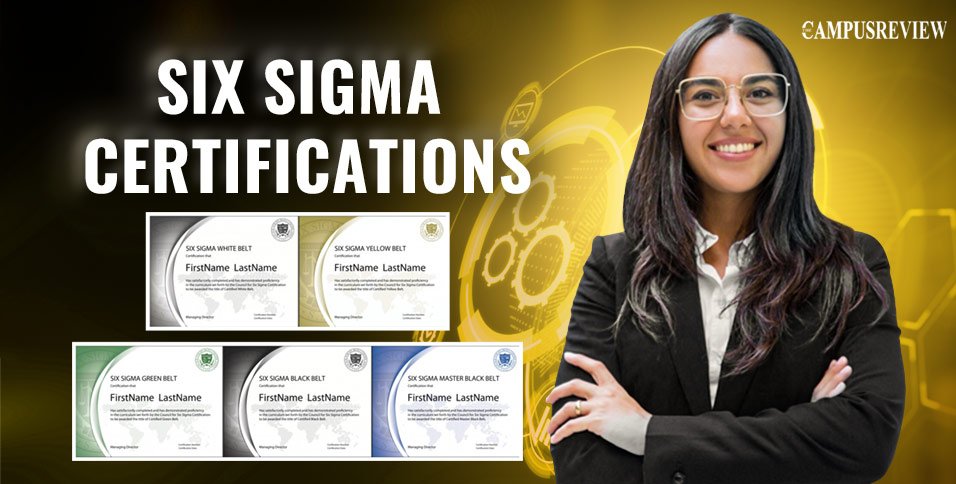
Six Sigma certification teaches students how to spot process problems, cut errors, and improve efficiency. The method uses data and structured steps to solve real business problems. Companies in manufacturing, healthcare, IT, and finance all value these skills.
Students do not need years of work experience to start. Entry-level options like the Yellow Belt build a strong foundation. Higher levels such as Green Belt and Black Belt suit students and professionals with project experience.
This guide covers the 11 best Six Sigma certifications for students in 2026. It explains certification levels, costs, duration, eligibility, and career paths, so you can pick the certification that fits your experience and goals.
What Is Six Sigma Certification?
Six Sigma certification confirms that you understand the Six Sigma methodology. This method uses data to find defects, reduce waste, and improve quality in a process.
The system uses belt levels. Each belt represents a different depth of knowledge, from beginner (Yellow Belt) to expert (Master Black Belt).
Organizations such as ASQ, IASSC, and CSSC issue Six Sigma certifications. Each provider sets its own exam format, eligibility rules, and fees.
Why Should Students Get Six Sigma Certified?
- Builds problem-solving skills that apply across industries
- Shows employers you understand data-driven decision-making
- Requires no advanced degree to start
- Complements degrees in business, engineering, healthcare, and IT
- Adds a recognized credential to your resume before graduation
According to ASQ’s Quality Progress Salary Survey, professionals with Six Sigma training earn more on average than uncertified peers, and the gap widens at each higher belt level.
Six Sigma Certification Levels
Six Sigma uses four main belt levels. Each one builds on the skills of the level before it.
| Level | Experience Needed | Difficulty | Main Skills |
| Yellow Belt | None | Beginner | Six Sigma fundamentals, process mapping |
| Green Belt | Some project or internship experience | Intermediate | DMAIC method, process analysis, small project leadership |
| Black Belt | Significant project experience | Advanced | Statistical analysis, project leadership, mentoring |
| Master Black Belt | Extensive Six Sigma experience | Expert | Program strategy, mentoring Black Belts |
Yellow Belt
The Yellow Belt is the entry point for Six Sigma. It covers basic terms, process mapping, and team roles. Students with no prior experience can start here.
Green Belt
The Green Belt builds on Yellow Belt knowledge. It focuses on the DMAIC method (Define, Measure, Analyze, Improve, Control) and prepares you to lead small improvement projects.
Black Belt
The Black Belt suits professionals who have completed Green Belt training and led projects. It covers advanced statistical tools and project leadership.
Master Black Belt
The Master Black Belt is the highest level. It suits senior professionals who mentor Black Belts and manage Six Sigma programs across an organization.
11 Best Six Sigma Certifications for Students
Each certification below follows the same format: who it suits, its level, its eligibility rules, and its approximate cost.
1. Six Sigma Yellow Belt
- Best for: Absolute beginners and first-year students
- Level: Beginner
- Eligibility: No prior experience needed
- Cost: Often free to a few hundred dollars, depending on provider; CSSC charges approx $99.
This is the perfect starting point for absolute beginners. It covers the foundational principles of Six Sigma, including process mapping, team roles, and basic metrics.
You’ll learn how to identify problems, collect data, and assist in project tasks. It’s short, affordable, and requires no prior experience, making it ideal for students and entry-level professionals.
2. Lean Six Sigma Yellow Belt
- Best for: Students who want Lean and Six Sigma basics together
- Level: Beginner
- Eligibility: No prior experience needed
- Cost: Similar to a standard Yellow Belt, varies by provider
This certification combines Lean principles with basic Six Sigma methods. It teaches you how to remove waste while improving quality. You’ll understand how to spot inefficiencies and suggest quick fixes.
Ideal for fast thinkers and those who love structured problem-solving, it’s great for students wanting to boost their resumes without great technical skills.
3. Six Sigma Green Belt
- Best for: Students with internship or project experience
- Level: Intermediate
- Eligibility: Some providers ask for project experience; requirements vary
- Cost: Typically several hundred to a few thousand dollars depending on provider and training format
For students with some work or internship experience, this level lets you manage small projects and apply Six Sigma tools.
It emphasizes the DMAIC method and teaches how to analyze and solve quality issues. You’ll lead small teams and get noticed for taking initiative. It’s often required before advancing to the Black Belt level.
4. Lean Six Sigma Green Belt
- Best for: Students interested in both process speed and quality
- Level: Intermediate
- Eligibility: Varies by provider; some accept students with coursework only
- Cost: Comparable to a standard Green Belt
This certification gives you the power to lead improvement projects by reducing waste and optimizing processes. It combines Lean’s speed with Six Sigma’s quality methods.
Students with hands-on experience or coursework in business improvement will find this especially useful. You’ll be well-prepared to streamline operations and improve workflows.
5. ASQ Six Sigma Certifications
- Best for: Final-year students who want a globally recognized credential
- Level: Yellow, Green, and Black Belt options
- Eligibility: Green and Black Belt levels generally require documented work or project experience
- Cost: Exam fees generally range from around $300 to $500, higher for non-members
ASQ offers highly respected certifications for serious quality management learners. You’ll need to show proof of work or project experience. ASQ-certified professionals are globally recognized.
If you’re in your final year or have solid internship experience, this could give your resume a global edge.
6. IASSC Certifications
- Best for: Students targeting multinational or international employers
- Level: Yellow, Green, and Black Belt options
- Eligibility: No formal experience required, though training is recommended
- Cost: Exam fees vary by level and region, Aprox $295–$350 for Green Belt and $395–$500 for black belt.
The International Association for Six Sigma Certification offers rigorous exams with worldwide recognition. IASSC’s exams are tough but fair, and ideal for those looking for global job opportunities.
7. CSSC Programs
- Best for: Budget-conscious students
- Level: Multiple belt levels available
- Eligibility: Open to students with no prior experience
This certification body offers flexible and budget-friendly options. Great for students, CSSC provides both free and paid certifications at all levels.
The learning is accessible, and you can get certified at your own pace. It’s recognized in many industries and is suitable for learners without prior technical experience.
8. Certified Six Sigma Professional (CSSP)
- Best for: Interns and fresh graduates with hands-on project exposure
- Level: Practitioner-focused
- Eligibility: Best suited to those with some practical project exposure
This certification is focused on applying Six Sigma in real-world projects. It’s meant for individuals with hands-on experience, like interns or fresh graduates who’ve worked in live environments.
You’ll get to showcase your skills in practical settings and solve business challenges using proven Six Sigma tools.
9. Six Sigma Black Belt
- Best for: Professionals who have completed Green Belt and led projects
- Level: Advanced
- Eligibility: Most providers expect prior Green Belt certification or equivalent project experience
- Cost: Higher than Green Belt, often requiring a completed project for certification
You’ll learn advanced techniques and become a mentor for others. This certification is highly valued for leadership roles and strategic initiatives. If you’ve worked in teams and want to lead bigger ones, this is your step up.
10. Lean Six Sigma Black Belt
- Best for: Professionals moving into managerial roles
- Level: Advanced
- Eligibility: Prior Green Belt experience typically expected
- Cost: Comparable to a standard Black Belt, varies by provider
This builds on Green Belt and focuses on process efficiency and leadership. You’ll lead teams that cut costs and improve speed while maintaining quality. It’s best for professionals aiming to influence large projects.
11. Master Black Belt Certification
- Best for: Senior professionals managing Six Sigma programs
- Level: Expert
- Eligibility: Requires extensive Six Sigma experience and a track record of successful projects
- Cost: The highest among Six Sigma certifications, varies significantly by provider
This is the highest Six Sigma level, meant for those leading entire programs. Master Black Belts design strategies, mentor Black Belts, and work with top management.
This is ideal for experienced professionals managing portfolios or working in consulting. You need deep statistical knowledge and several successful projects to qualify.
How to Choose the Right Six Sigma Certification
- No experience: start with a Yellow Belt
- Some project or internship experience: consider a Green Belt
- Experienced professional who has led projects: move to a Black Belt
- Senior Six Sigma professional managing programs: pursue a Master Black Belt
| If you are… | Consider |
| Completely new to Six Sigma | Yellow Belt |
| A student building career skills | Yellow or Green Belt |
| Interested in process improvement projects | Green Belt |
| An experienced professional | Black Belt |
| A senior Six Sigma professional | Master Black Belt |
One nuance worth knowing: expiration policies differ by provider. ASQ’s Black Belt and Master Black Belt need renewal every three years, while its Yellow and Green Belts are valid for life. IASSC certifications stay “Current” for three years, then lapse to “Elapsed” unless you recertify.
How Much Does Six Sigma Certification Cost?
Cost depends on several factors:
- Certification level (Yellow Belt costs less than Black Belt)
- Provider (ASQ, IASSC, and CSSC price differently)
- Whether training is included or purchased separately
- Exam fees, which are often separate from training costs
- Membership discounts offered by some organizations
As an example, ASQ’s Green Belt exam fee generally falls in the range of a few hundred dollars, with a lower rate for members. Fees change over time, so check the current schedule on each provider’s website before enrolling.
How Long Does Six Sigma Certification Take?
Six Sigma certification duration varies by provider and course format. As general ranges:
- Yellow Belt: usually the shortest option, suitable for a quick introduction
- Green Belt: requires more study time and often includes a practice project
- Black Belt: requires deeper study and typically a completed workplace project
- Master Black Belt: builds on years of applied Six Sigma experience, not a single course
Self-paced online courses let you move faster or slower depending on your schedule. Always confirm the exact duration with your chosen provider.
Do You Need Work Experience for Six Sigma Certification?
- Beginner-level certifications like Yellow Belt are generally open to students with no experience
- Intermediate certifications like Green Belt may ask for project or internship experience, depending on the provider
- Advanced certifications like Black Belt often expect a completed project or prior Green Belt certification
Not every provider has the same rules. Check the specific Six Sigma certification eligibility requirements on the certifying body’s website before applying.
Career Opportunities After Six Sigma Certifications
Six Sigma skills apply across many career paths, including:
- Quality Management
- Operations
- Supply Chain
- Project Management
- Business Process Improvement
- Manufacturing
- Healthcare Operations
- Data and Process Analysis
Certification does not guarantee a job in these fields. It can support the skills relevant to these career paths and help your resume stand out.
Conclusion
Students who are new to process improvement can start with a Yellow Belt certification. Those with project or internship experience can consider a Green Belt. Advanced certifications like Black Belt and Master Black Belt generally suit professionals with years of applied experience.
Choose any of the Six Sigma certifications that matches your current experience level, not the one with the most impressive title. A well-matched certification builds real skills and a credential you can defend in an interview.
FAQs
1. Which Six Sigma certification is best for students?
The Yellow Belt is best for students with no experience. It builds a foundation before moving to Green Belt or higher.
2. How long does Six Sigma certification take?
Duration varies by provider. Yellow Belt is usually the shortest option, while Green Belt and Black Belt take longer because they include project work.
3. Can I add Six Sigma certification to my resume?
Yes. Six Sigma certification is a recognized credential that shows process improvement skills to recruiters.
4. Is Lean Six Sigma different from Six Sigma?
Yes. Six Sigma focuses on reducing defects, while Lean Six Sigma also focuses on reducing waste and improving efficiency.
5. Do Six Sigma certifications require an exam?
It depends on the provider. Some require an exam, while others use assessments or project work.