If you have used ChatGPT to write text, generate ideas, create images, summarize information, or help with code, you have probably already interacted with Generative AI. However, using an AI tool is different from understanding how it works, what it can create, and where its limitations matter.
In this guide, we’ll explain what Generative AI is, how it works, its major types, applications, benefits, risks, popular tools, and how beginners can use it responsibly.
Key Takeaways
- Generative AI creates new content such as text, images, audio, video, and code from learned patterns.
- Generative AI models generate outputs from prompts, context, or other inputs rather than simply following fixed rules.
- Text, image, video, audio, code, and multimodal generation are major categories of Generative AI.
- Generative AI can improve productivity by accelerating content creation, software development, research, and knowledge work.
- Generative AI can produce inaccurate or biased information, so important outputs require human verification.
- Responsible AI use requires clear instructions, suitable tools, secure data handling, and human oversight.
- AI literacy and critical evaluation skills are becoming increasingly important as organizations expand their use of AI.
What Is Generative AI and How Is It Different From Traditional AI?
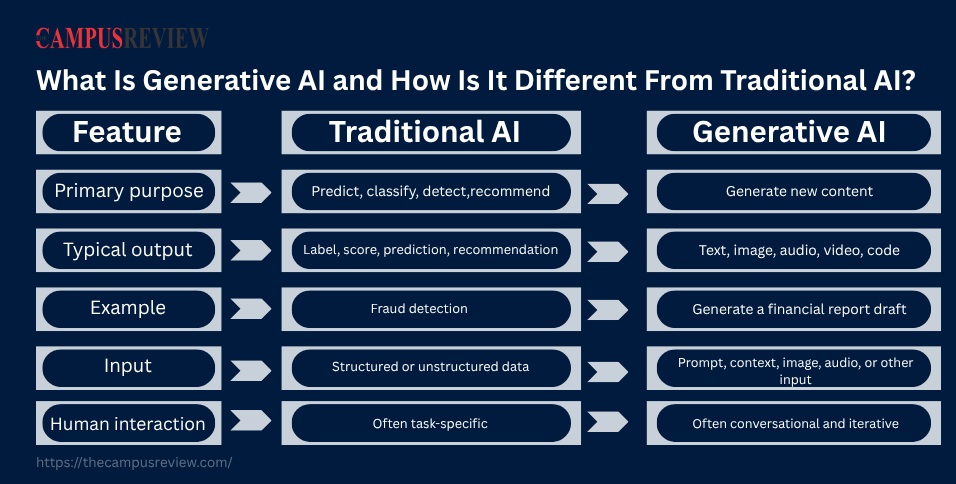
Generative AI is a type of artificial intelligence that creates new content, including text, images, audio, video, and code, by learning patterns from large datasets. Unlike traditional AI systems that often classify, predict, recommend, or detect information, Generative AI is designed to produce new outputs based on an input such as a prompt.
First, think of Generative AI as a pattern-learning and content-generation system. For example, when you ask an AI assistant to write a product description for a laptop, the system does not retrieve one predefined description; it generates a response based on patterns learned during training and the context provided in your prompt.
Moreover, traditional AI and Generative AI can solve different kinds of problems. A traditional machine-learning system might determine whether an email is spam, while a Generative AI system can write a new email responding to a customer.
| Feature | Traditional AI | Generative AI |
| Primary purpose | Predict, classify, detect, recommend | Generate new content |
| Typical output | Label, score, prediction, recommendation | Text, image, audio, video, code |
| Example | Fraud detection | Generate a financial report draft |
| Input | Structured or unstructured data | Prompt, context, image, audio, or other input |
| Human interaction | Often task-specific | Often conversational and iterative |
In addition, Generative AI is a subset of the broader artificial intelligence field, not a replacement for all traditional AI. Many modern applications combine predictive AI, retrieval systems, automation, and generative models.
Why Does Generative AI Matter?
Generative AI matters because it can automate and accelerate many tasks involving language, information, creativity, analysis, and software. Organizations are increasingly experimenting with and deploying the technology across business functions, although many are still working to scale it effectively.
McKinsey’s 2025 research found that more than three-quarters of surveyed organizations reported using AI in at least one business function, while generative AI adoption continued to increase.
Generative AI can reduce the time required for repetitive knowledge work.
For example, a marketing team can use an AI system to create initial campaign ideas, email variations, social-media drafts, and content outlines before human editors refine them.
Moreover, Generative AI is influencing software development, education, research, customer service, design, marketing, and business operations. Microsoft describes potential applications ranging from productivity and customer engagement to business-process transformation and innovation.
In addition, the value of Generative AI increasingly depends on how organizations redesign workflows around it, rather than simply purchasing an AI tool. McKinsey’s 2025 research highlights workflow redesign, governance, leadership involvement, and risk management as important parts of capturing value from AI.
How Does Generative AI Work?
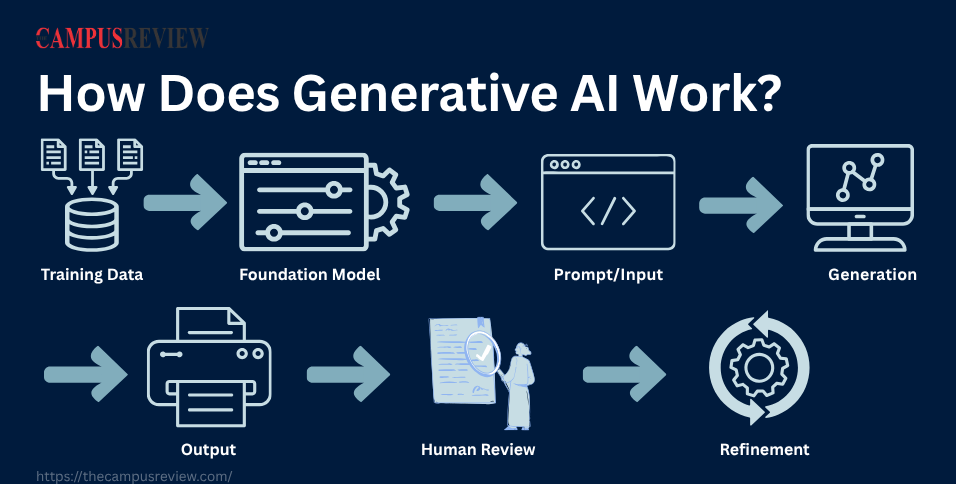
Generative AI works by using trained machine-learning models to predict or generate new outputs based on an input such as a prompt, image, audio file, or other context. The process generally involves model training, tuning or adaptation, generation, evaluation, and refinement.
1. Training Data
First, a Generative AI model learns patterns from large datasets. Depending on the model, the training material can include text, images, audio, video, source code, or combinations of these data types.
For example, a language model can process huge quantities of text and learn statistical relationships between words, phrases, concepts, and structures.
2. Foundation Model
Next, the training process produces a foundation model, which can serve as the basis for multiple applications. Large language models are one important type of foundation model, while other foundation models can support image, video, audio, or multimodal generation.
3. Prompt or Input
Then, you provide an input called a prompt. A prompt might be a question, instruction, image, audio clip, document, or combination of inputs.
For example:
“Write a 150-word beginner-friendly explanation of Generative AI for college students.”
The model interprets the request and uses its learned representations and the supplied context to generate an output.
4. Generation
After that, the model generates an output according to its learned patterns and the context of the request. In a language model, this involves predicting likely tokens or pieces of text sequentially.
For example, an AI writing assistant can produce an introduction, explanation, list, or code snippet based on your instructions.
5. Evaluation and Human Review
Finally, the generated content should be evaluated before important decisions are made. AI-generated output is not automatically accurate simply because it sounds confident or fluent.
For example, an AI-generated article might contain a plausible but incorrect statistic, citation, date, or explanation. Human review remains important for factual accuracy, context, safety, originality, and compliance.
What Are Tokens, Neural Networks, and Transformers?
Tokens are smaller units of information that language models process when generating or interpreting text. A token may represent a complete word, part of a word, punctuation, or another unit depending on the model’s tokenization method.
Next, neural networks are machine-learning systems made from interconnected computational units that learn patterns from data. Generative models use neural networks to represent relationships within their training data.
Furthermore, transformers are a neural-network architecture that uses attention mechanisms to process relationships between elements in sequences efficiently. Transformer-based architectures have become central to many modern Generative AI systems.
What Are the Main Types of Generative AI?
The main types of Generative AI include text, image, video, audio, code, and multimodal generation. Each category focuses on generating or transforming a different type of content.
| Type | What it generates | Example use |
| Text AI | Articles, summaries, emails, answers | Create a blog outline |
| Image AI | Illustrations, designs, images | Create a product concept |
| Video AI | Video clips and scenes | Create marketing footage |
| Audio AI | Speech, sound, music | Generate narration |
| Code AI | Source code and technical explanations | Assist software development |
| Multimodal AI | Multiple content types | Analyze an image and explain it |
- Text generation: Produces written content from instructions or context. Common examples include chatbots, writing assistants, summarizers, and research assistants.
- Image generation: Creates or modifies visual content from prompts or other inputs. Designers can use image models to explore different visual concepts before creating a final design.
- Video generation: Creates or transforms video content for concept development, storytelling, marketing, education, and visual prototyping.
- Audio generation: Creates speech, music, sound effects, and other audio content. Educational creators can use it to generate draft narration for lessons.
- Code generation: Helps developers write, explain, transform, debug, or document software. Generated code still needs testing and security review.
- Multimodal AI: Combines different types of input or output, such as text, images, audio, and video. This lets users interact with AI beyond text-based prompts.
What Can Generative AI Create?
Generative AI can create or transform text, images, audio, video, software code, and other forms of digital content. Modern foundation models can specialize in one modality or work across several modalities.
- Generative AI can produce written content, including summaries, explanations, reports, emails, scripts, product descriptions, and brainstorming ideas. For example, a student could ask an AI system to explain a difficult scientific concept at three different levels of complexity.
- Generative AI can create visual content, including illustrations, concept art, product mockups, and design variations.
- AI systems can generate audio and video, enabling new workflows for creators, educators, marketers, and media teams.
- Generative AI can generate software code, explain programming concepts, suggest fixes, and assist with documentation.
That being said, generating content does not mean producing guaranteed factual or production-ready material. Generation and verification are separate steps.
What Are the Best Examples of Generative AI?
Generative AI examples include conversational AI assistants, image generators, coding assistants, video-generation systems, and AI-powered content-creation platforms. The most useful example depends on the task rather than simply the popularity of the tool.
First, conversational AI assistants can answer questions, summarize information, brainstorm ideas, analyze supplied content, and help draft text.
Second, image-generation systems can convert natural-language descriptions into visual concepts. For example, a marketer could request several creative directions for a campaign.
Third, coding assistants can help developers understand unfamiliar code, generate functions, identify potential bugs, or create documentation.
Fourth, video-generation systems can support visual storytelling, advertising concepts, educational content, and rapid prototyping.
Finally, multimodal assistants can combine text and visual understanding, allowing users to ask questions about images, documents, charts, or other content.
What Are the Most Common Uses of Generative AI?
Generative AI is commonly used for content creation, software development, customer service, research, education, marketing, design, analysis, and business-process support. Its practical value comes from integrating generation into specific workflows rather than using AI simply because it is available.
Marketing and Content
First, marketers use Generative AI for brainstorming, content outlines, email drafts, campaign concepts, audience variations, and creative experimentation.
For example, a marketing team could generate ten headline concepts and then have an experienced editor select and improve the strongest options.
Education
Moreover, Generative AI can support personalized explanations, practice questions, lesson planning, study assistance, and content adaptation.
For example, an educator could ask an AI system to explain the same topic for beginner, intermediate, and advanced learners.
Software Development
In addition, developers can use Generative AI to assist with coding, debugging, documentation, testing ideas, and understanding unfamiliar code.
However, generated software should still undergo testing, code review, dependency checks, and security assessment.
Customer Service
Similarly, Generative AI can assist customer-service teams by drafting responses, summarizing conversations, retrieving relevant information, and supporting conversational interfaces.
Healthcare Research
Furthermore, Generative AI has potential applications in healthcare research and medical workflows, but high-stakes healthcare use requires appropriate validation, governance, privacy controls, and professional oversight.
McKinsey’s 2026 healthcare research reported that 50% of surveyed respondents said their organizations had implemented Generative AI by Q4 2025.
Business Operations
Finally, Generative AI can support document processing, knowledge management, internal communications, research, administrative work, and other information-heavy processes.
What Are the Benefits of Generative AI for Businesses?
The main benefits of Generative AI for businesses include productivity gains, faster content creation, automation, personalization, ideation, and assistance with knowledge-intensive work. IBM identifies efficiency, creativity, decision support, personalization, and continuous availability among potential benefits.
1. Higher Productivity: Generative AI helps employees complete repetitive tasks faster and create first drafts without starting from scratch.
2. Automation: It reduces manual effort by handling repetitive information-processing tasks and routine workflows.
3. Faster Ideation: AI can generate multiple ideas and approaches, giving teams more options to evaluate and develop.
4. Personalization: Businesses can create tailored content for different audiences, customers, or user groups more efficiently.
5. Better Scalability: Teams can produce more content and variations without increasing manual work at the same rate.
6. Improved Accessibility: AI can translate, summarize, simplify, and restructure information to make it easier for different users to understand.
However, the business value is not guaranteed. McKinsey’s 2025 research found that many organizations were still experimenting or piloting AI rather than scaling it across the enterprise.
What Are the Limitations and Risks of Generative AI?
Generative AI can produce inaccurate, biased, insecure, misleading, or inappropriate outputs, making human evaluation and responsible governance essential. NIST identifies risks including confabulation, harmful bias, privacy, information integrity, cybersecurity, and over-reliance on AI systems.
Hallucinations and Inaccurate Information
First, AI hallucination, also called confabulation, refers to confidently presented content that is incorrect or unsupported. NIST specifically identifies this as a Generative AI risk.
For example, an AI model could invent a citation or provide an incorrect historical date while presenting the answer fluently.
Bias
Moreover, models can reproduce or amplify biases present in training data or other system components. NIST identifies harmful bias and performance disparities as Generative AI risks.
Privacy
In addition, sensitive information should not automatically be entered into AI systems. Privacy risks can include unauthorized disclosure or leakage of personal and sensitive information.
Copyright and Intellectual Property
Furthermore, Generative AI raises questions around copyright, licensing, training data, ownership, and permitted use of generated or transformed content. Organizations should evaluate applicable laws, licenses, contracts, and platform policies before commercial use.
Deepfakes and Information Integrity
Similarly, Generative AI can lower the barrier to producing synthetic media, which creates challenges involving misinformation, impersonation, and information integrity. NIST identifies information integrity as a specific Generative AI risk.
Security and Prompt Injection
Finally, AI applications can introduce security risks, including prompt injection and inappropriate tool interactions. NIST’s secure-development guidance specifically addresses security considerations for Generative AI and dual-use foundation models.
Generative AI should be treated as an assistant whose outputs require appropriate evaluation, not as an unquestionable source of truth.
What Are Foundation Models and Large Language Models in Generative AI?
A foundation model is a broadly trained machine-learning model that can serve as the basis for multiple AI applications, while a large language model is a foundation model designed primarily to process and generate language.
First, foundation models can support different modalities, including text, images, audio, video, and multimodal tasks.
For example, a foundation model can provide the underlying capabilities used by an application that answers questions, summarizes documents, or generates content.
Second, large language models, or LLMs, specialize in language-related tasks. They learn patterns in text and use those representations to generate responses based on prompts and context.
Third, the application layer determines how the model is used. An enterprise chatbot, writing assistant, coding assistant, and research application might use different interfaces, instructions, retrieval systems, tools, and safeguards around an underlying model.
What Is Multimodal Generative AI?
Multimodal Generative AI is AI that can work with or generate multiple forms of information, such as text, images, audio, and video. Multimodal foundation models extend Generative AI beyond text-only interaction.
First, multimodal interaction makes AI more flexible. For example, a user might upload a chart and ask an AI system to explain the major trends in plain language.
Second, multimodal systems can connect different types of information in a single workflow. A marketing team, for instance, could combine written campaign instructions with images and brand assets.
Third, multimodal AI can make technology more accessible because users can interact through different input formats rather than relying exclusively on written prompts.
Multimodal AI expands Generative AI from text generation into richer human-computer interaction.
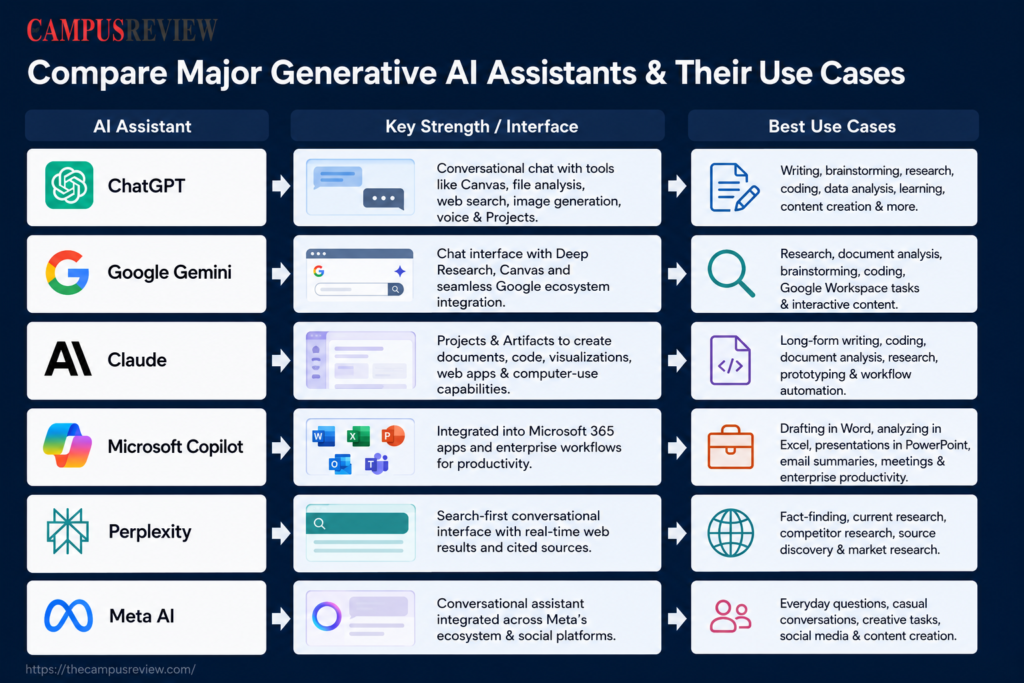
What Are the Most Popular Generative AI Tools?
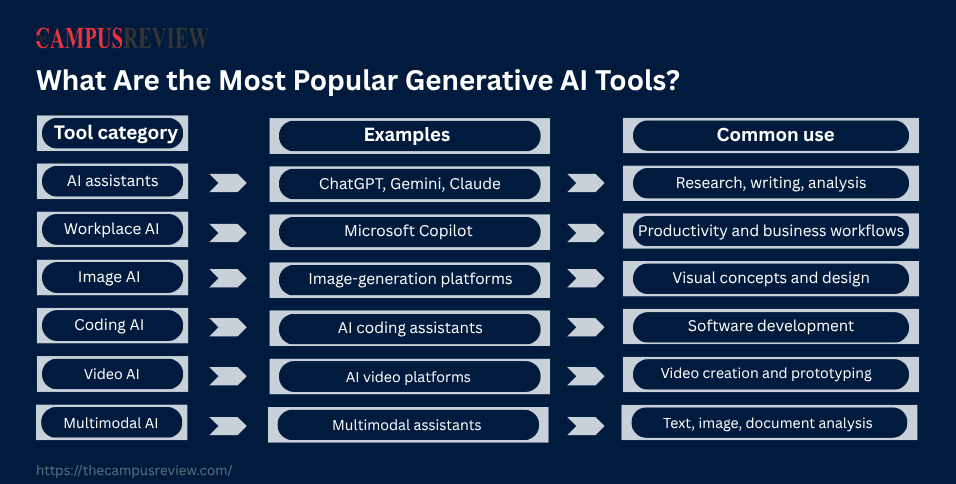
Popular Generative AI tools include conversational assistants, coding assistants, image-generation platforms, video-generation systems, and multimodal AI applications. Tool selection should depend on the user’s task, data requirements, integration needs, privacy considerations, and output quality.
| Tool category | Examples | Common use |
| AI assistants | ChatGPT, Gemini, Claude | Research, writing, analysis |
| Workplace AI | Microsoft Copilot | Productivity and business workflows |
| Image AI | Image-generation platforms | Visual concepts and design |
| Coding AI | AI coding assistants | Software development |
| Video AI | AI video platforms | Video creation and prototyping |
| Multimodal AI | Multimodal assistants | Text, image, document analysis |
First,ChatGPT can support conversational research, writing, analysis, coding, and other workflows.
Second,Google Gemini provides Google’s AI assistant experience across supported tasks and modalities.
Third, Claude is an AI assistant that can support writing, analysis, coding, and document-oriented workflows.
Fourth,Microsoft Copilot integrates Generative AI capabilities into Microsoft’s broader productivity and technology ecosystem.
How Can Beginners Start Using Generative AI?
Beginners can start using Generative AI by choosing one practical use case, selecting an appropriate tool, learning basic prompting, verifying outputs, protecting sensitive data, and building a human-review workflow.
First, choose one problem rather than trying every AI tool. For example, start with summarizing meeting notes, creating content outlines, learning a topic, or brainstorming marketing ideas.
Second, select a tool based on the task. A writing task may require a conversational assistant, while image creation requires a visual-generation system.
Third, learn basic prompting. A useful prompt normally explains the task, context, audience, constraints, desired format, and relevant examples.
For example:
“Explain Generative AI to a college student in 150 words. Use simple language, one real-world example, and three key takeaways.”
Fourth, verify important outputs. Check statistics, citations, technical instructions, legal claims, medical information, financial information, and other high-impact content against reliable sources.
Fifth, protect sensitive information. Avoid sharing confidential business information, passwords, personal data, proprietary documents, or other sensitive material unless your organization’s approved AI environment and policies explicitly allow it.
Sixth, keep humans in the workflow. AI can accelerate drafting and analysis, while humans remain responsible for judgment, context, quality, and final decisions.
What Skills Are Needed to Work With Generative AI?
The most useful Generative AI skills combine AI literacy, prompting, critical thinking, domain expertise, data awareness, and responsible AI practices.
First, AI literacy helps you understand what AI models can and cannot reliably do.
Second, prompting skills help you communicate tasks, context, constraints, and desired outputs more effectively.
Third, critical thinking helps you identify unsupported claims, hallucinations, bias, and weak reasoning.
Fourth, domain expertise remains valuable because AI-generated output becomes more useful when a knowledgeable person can evaluate and improve it.
Fifth, data and privacy awareness helps users avoid exposing sensitive information and understand how data should be handled.
Finally, AI governance knowledge is increasingly important for professionals involved in organizational AI adoption.
McKinsey’s 2025 research found that organizations are creating new AI-related roles and retraining employees as they deploy AI, showing that adoption involves both technology and workforce capabilities.
What Is the Future of Generative AI?
The future of Generative AI is moving toward more multimodal systems, AI agents, personalized experiences, enterprise integration, stronger governance, and closer human-AI collaboration.
1. More Multimodal AI: Generative AI will increasingly work across text, images, audio, video, and other types of information, creating more flexible AI experiences.
2. Growth of AI Agents: AI will move beyond generating content toward completing tasks. AI agents can use tools and applications to perform tasks and work toward specific goals.
3. Wider Enterprise Adoption: Businesses will focus more on using AI to achieve measurable results rather than simply experimenting with the technology.
4. Stronger AI Governance: As organizations use AI for more important decisions and tasks, responsible AI, risk management, transparency, and governance will become increasingly important.
5. Closer Human-AI Collaboration: Future workflows will combine AI’s speed and scale with human judgment, creativity, expertise, and accountability.
What Should You Remember About Generative AI?
Generative AI is a technology for creating new content from learned patterns, but its usefulness depends on the quality of the task, context, model, and human evaluation.
Generative AI can create text, images, audio, video, code, and multimodal outputs. Its applications range from everyday productivity to software development, education, research, marketing, customer service, and business operations.
Generative AI is not infallible. It can generate inaccurate information, biased outputs, privacy risks, security problems, or misleading synthetic content, which makes verification and governance essential.
Learning how to evaluate and use AI is more valuable than simply learning the names of AI tools. Start with one practical use case, develop strong prompting and verification habits, protect sensitive information, and keep human judgment at the center of important decisions.
Conclusion: Generative AI Is a Tool for Human Creativity and Productivity
Generative AI is a powerful technology that can generate new content, accelerate knowledge
work, and support human creativity and productivity. Understanding its basic mechanics helps you use it more effectively, while understanding its limitations helps you use it responsibly.
Moreover, the future of Generative AI will not be defined only by increasingly capable models. It will also depend on AI literacy, governance, security, responsible implementation, and human-AI collaboration.
Therefore, if you are a student, marketer, developer, business professional, educator, or content creator, start small. Choose a useful problem, test an appropriate AI tool, verify what it produces, and gradually build the skills needed to work confidently with Generative AI.