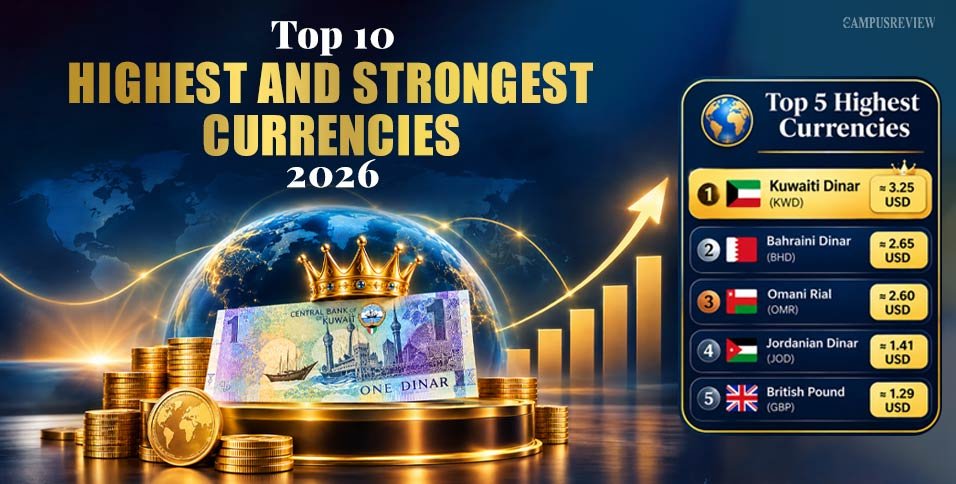
The Kuwaiti Dinar is the highest currency in the world. One dinar trades for about $3.23 to $3.26, or roughly ₹306 to ₹311. That beats the US Dollar, the Euro, and the British Pound.
But here is the twist. The US Dollar is still the strongest currency in the world, even though it sits 10th on the value list.
A currency can be high in value and weak in global power at the same time. Most articles online do not explain why.
This guide covers both lists in full. Every strongest and highest currency in the world in this list gets its own explanation: its current rate, its history, and the real reason it sits where it sits.
The Difference between Strongest Currency and Highest Currency in the world
A currency’s face value is simply the amount assigned to one unit of that currency. It does not show how large or strong a country’s economy is.
Currency strength measures how widely a currency is used in global trade, foreign-exchange markets, international payments, and central bank reserves.
For example, Kuwait maintains a high-value dinar supported by its oil wealth and currency policy. The US dollar has a lower unit value, but it dominates global finance because countries and businesses use it for trade, hold it as a reserve asset, and rely on it for international payments.
Keep that distinction in mind. It explains both lists below.
Top 10 Highest Currencies in the World (2026)
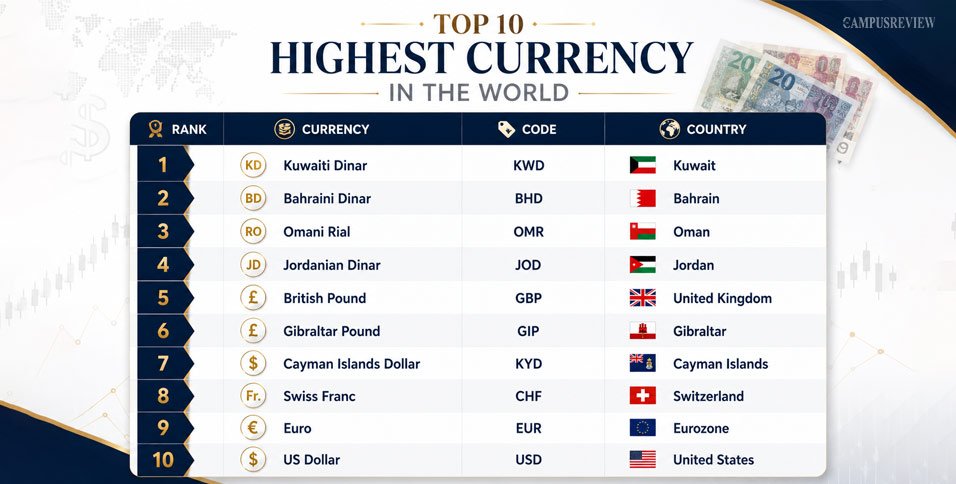
This table ranks currencies with their countries and codes based on face value. The sections after it explain why each currency sits where it does.
| Rank | Currency | Code | Country |
| 1 | Kuwaiti Dinar | KWD | Kuwait |
| 2 | Bahraini Dinar | BHD | Bahrain |
| 3 | Omani Rial | OMR | Oman |
| 4 | Jordanian Dinar | JOD | Jordan |
| 5 | British Pound | GBP | United Kingdom |
| 6 | Gibraltar Pound | GIP | Gibraltar |
| 7 | Cayman Islands Dollar | KYD | Cayman Islands |
| 8 | Swiss Franc | CHF | Switzerland |
| 9 | Euro | EUR | Eurozone |
| 10 | US Dollar | USD | United States |
Rates move daily. Treat these as approximate values, not fixed rates.
1. Kuwaiti Dinar (KWD)
1 KWD = $3.23 – $3.26 (₹306 – ₹311)
The Kuwaiti Dinar entered circulation in 1961, replacing the Gulf Rupee at par with the British Pound. Today, it is the highest currency in the world by nominal value; Kuwait holds close to 6% of the world’s proven oil reserves, and that oil money funds the Kuwait Investment Authority, the world’s oldest sovereign wealth fund. It exists to manage Kuwait’s savings for future generations.
Why Kuwaiti Dinar Has Such a High Nominal Value
The Central Bank of Kuwait does not peg the dinar to the US Dollar alone. It uses an undisclosed basket of currencies, weighted around 84% toward the dollar, with the rest split across the Euro, Yen, and Pound.
This basket cushions Kuwait from sharp dollar swings and gives the country more flexibility than its Gulf neighbours. That is the real reason the dinar holds the top spot: steady oil income backing a currency that is deliberately shielded from single-currency shocks.
2. Bahraini Dinar (BHD)
1 BHD = $2.65 – $2.66 (₹249 – ₹255)
Bahrain launched its dinar in 1965, replacing the Gulf Rupee at a fixed rate of 10 rupees to 1 dinar. Unlike Kuwait.
Economic Background
Bahrain has smaller oil reserves. It leans more on refined petroleum, aluminium manufacturing, and offshore banking to keep its economy running.
The Central Bank of Bahrain fixes the dinar directly to the US Dollar and defends that peg with foreign reserves, backed by financial support from wealthier Gulf neighbours when needed.
3. Omani Rial (OMR)
1 OMR = $2.60 (₹245 – ₹250)
Oman’s currency started life in 1970 as the Saidi Rial, named after the ruling House of Al Said. It was renamed the Omani Rial in 1972 and first pegged to the US Dollar at $2.895, before settling at its current rate in 1986.
Oil and Gas Influence on the Omani Rial
Oman’s economy runs on crude oil and natural gas exports. To defend the peg through swings in energy prices, the government builds reserve buffers and pushes economic diversification beyond oil. The rial’s high value is a policy choice backed by oil revenue, held in place since 1986 regardless of what oil prices do.
4. Jordanian Dinar (JOD)
1 JOD = $1.41 – $1.42 (₹133 – ₹136)
Jordan’s dinar replaced the Palestinian Pound in the early 1950s. Unlike the oil-rich Gulf states above it, Jordan has no major oil wealth and regularly runs fiscal and trade deficits.
Why Its Nominal Value Is High Despite Jordan’s Different Economy
The Central Bank of Jordan has held a fixed peg to the US Dollar since 1995, mainly to control inflation and keep investor confidence. This is the clearest example on this list of a peg doing all the work.
Jordan has no resource wealth backing its currency, yet the dinar trades above $1.40 simply because the government set the peg at that level and has defended it for three decades using remittances, foreign aid, and tourism income.
5. British Pound (GBP)
1 GBP = $1.25 – $1.32 (₹128 – ₹131)
The pound is the world’s oldest currency still in active use, issued by the Bank of England. Unlike the pegged currencies above it, it floats freely on the open market. Its value tracks UK trade performance, monetary policy, and London’s role as one of the world’s biggest hubs for foreign exchange trading and financial contracts.
Why the Pound Ranks Highly by Face Value
The pound stays high not because of a peg, but because global capital keeps flowing through London’s markets. That constant demand for pound-denominated assets is what holds its value up, even after periods of political and economic turbulence.
6. Gibraltar Pound (GIP)
1 GIP = $1.25 – $1.32 (₹128 – ₹131)
The Gibraltar Pound is the official currency of Gibraltar, a British Overseas Territory. Under the Gibraltar Currency Notes Act, the currency runs on a strict currency board, which fixes it at exactly 1:1 with the British Pound.
Why the Gibraltar Pound Matches the British Pound
Every Gibraltar note and coin in circulation must be fully backed by sterling reserves held by the Government of Gibraltar. That legal requirement is why its exchange rate always matches the pound exactly. Gibraltar’s economy runs on financial services, online gaming, maritime trade, and tourism, and the currency board gives businesses total certainty that GIP will never drift from GBP.
7. Cayman Islands Dollar (KYD)
1 KYD = $1.20 (₹113 – ₹116)
The Cayman Islands Dollar was introduced in 1972, after the territory administratively separated from Jamaica, replacing the Jamaican Dollar at par. The Cayman Islands Monetary Authority pegs it to the US Dollar under a 1974 currency law, at a fixed statutory rate.
What Keeps the Cayman Islands Dollar Stable
The Cayman Islands runs as a zero-tax offshore financial centre, home to a dense concentration of hedge funds, private equity firms, and captive insurance companies. The fixed peg removes currency risk for the international capital that flows through the islands, which is exactly what a financial hub built on foreign investment needs.
8. Swiss Franc (CHF)
1 CHF = $1.09 – $1.24 (₹120)
The Swiss Franc, issued by the Swiss National Bank, is the world’s classic safe-haven currency. It floats on the open market, but Switzerland’s low public debt, a constitutional rule that limits government borrowing, and steady trade surpluses keep it consistently in demand.
How Switzerland Supports the Swiss Franc
In January 2015, the Swiss National Bank suddenly dropped a rate floor it had set against the Euro, and the franc jumped sharply in value overnight. That episode showed how much global demand exists for the franc whenever investors get nervous.
Switzerland’s precision engineering, pharmaceutical, and financial services sectors keep steady foreign income flowing in, which supports the currency’s value over the long run.
9. Euro (EUR)
1 EUR = $1.04 – $1.14 (₹111 – ₹112)
The Euro is the shared currency of 20 European Union states, managed by the European Central Bank in Frankfurt. It is a free-floating currency, and its value reflects the combined trade balance, industrial output, and bond market activity of the entire Eurozone.
Why the Euro Holds a High Value
The Euro trades close to parity with the Dollar mainly because both represent massive, developed economies with deep capital markets. Its high unit value is less about scarcity and more about representing a currency bloc large enough to rival the US economy in size.
10. US Dollar (USD)
1 USD = $1.00 (reference unit, ₹95 – ₹96)
The US Dollar ranks 10th by unit value, and that is worth sitting with for a second. The world’s most powerful currency is also one of the “cheapest” by face value on this entire list.
Why the US Dollar Is Not the Highest-Valued Currency
The Federal Reserve manages the dollar under a fully floating regime, and its value depends on US growth, inflation, and global demand for safe dollar-denominated assets. The dollar’s low unit price has nothing to do with weakness. It is simply the reference currency that almost every other exchange rate and global commodity price is quoted against.
The next section explains exactly why that matters more than any Gulf dinar’s face value.
Top 10 Strongest Currencies in the World (2026)
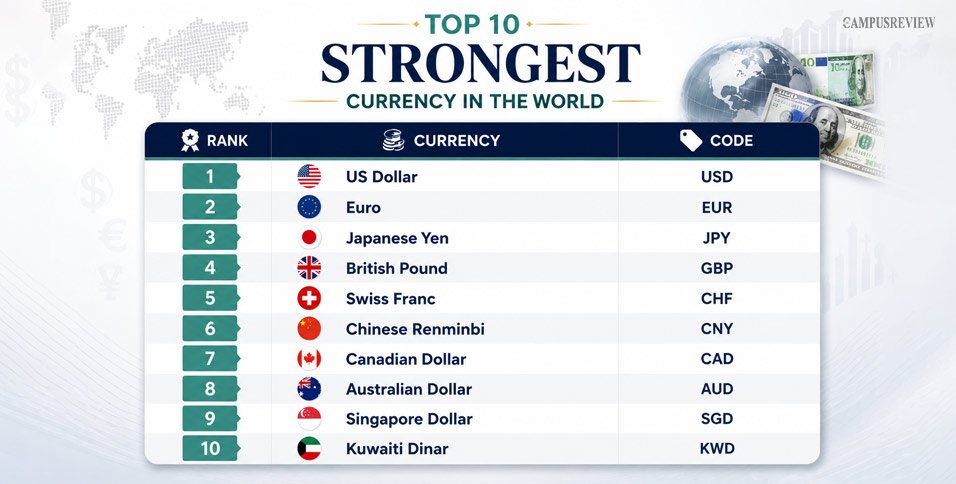
Currency Strength is measured differently from value. Analysts look at four things: how much of a currency central banks hold in official reserves, tracked by the IMF’s COFER database; how much of it trades daily on forex markets, tracked by the Bank for International Settlements (BIS).
How much of global bank payments it carries, tracked by SWIFT, and its weight in the IMF’s Special Drawing Rights basket, a reserve asset used by central banks.
| Rank | Currency | Code |
| 1 | US Dollar | USD |
| 2 | Euro | EUR |
| 3 | Japanese Yen | JPY |
| 4 | British Pound | GBP |
| 5 | Swiss Franc | CHF |
| 6 | Chinese Renminbi | CNY |
| 7 | Canadian Dollar | CAD |
| 8 | Australian Dollar | AUD |
| 9 | Singapore Dollar | SGD |
| 10 | Kuwaiti Dinar | KWD |
Source: IMF COFER database, BIS Triennial Central Bank Survey, SWIFT tracker.
1. US Dollar (USD)
1 USD = $1.00 (reference currency)
The US Dollar is the strongest currency in the world by global financial use. It sits at the center of global finance, backing about 58% of allocated central bank reserves and appearing in roughly 88% of daily currency trades. The $27 trillion US Treasury market gives banks worldwide a safe place to park money, while nearly 80% of trade finance transactions run through the dollar.
2. Euro (EUR)
1 EUR = $1.04 – $1.14
The Euro serves as the backup option to the dollar. It covers about 20% of global reserves and 30% of daily trading. The combined weight of all 20 Eurozone economies gives it deep, liquid bond markets that few currencies can match.
3. Japanese Yen (JPY)
1 USD = ¥159
Japan is the world’s largest net creditor nation, meaning it holds more foreign assets than it owes abroad. This makes the Yen a favorite funding currency for global investors. When markets get shaky, money often flows back into Japan, which pushes the Yen higher.
4. British Pound (GBP)
1 GBP = $1.25 – $1.32
The pound’s strength goes beyond its face value. It accounts for 4.9% of global reserves, 12.9% of daily FX turnover, 5.9% to 7.7% of SWIFT payments, and 7.44% of the SDR basket. London’s role as a major global hub for foreign exchange, interest rate derivatives, and international currency trading keeps the pound structurally important despite short-term UK economic changes.
5. Swiss Franc (CHF)
1 CHF = $1.09 – $1.24
Switzerland’s economy is small, but the franc still grabs 5.2% of daily FX turnover. Political neutrality, low inflation, and a stable legal system make it the currency people trust when everything else looks risky.
6. Chinese Renminbi (CNY)
1 USD = ¥6.72
China’s Renminbi holds the third-largest weight in the IMF’s Special Drawing Rights basket, at 12.28%. It now covers 7.70% of global trade finance. Clearing hubs in Hong Kong, London, and Singapore keep expanding its reach, even though China still limits full capital account access.
7. Canadian Dollar (CAD)
1 USD = C$1.38
The Canadian Dollar is a widely held reserve currency, making up 2.5% of global reserves, 6.2% of daily FX turnover, and 2.5% to 3.2% of SWIFT payments.
Its strength comes from Canada’s oil, minerals, and agricultural exports, strong banking system, and close US trade ties. The Bank of Canada’s transparent inflation-targeting system also makes the CAD a stable option for investors seeking commodity exposure.
8. Australian Dollar (AUD)
1 AUD = $0.72
The Australian Dollar is a liquid currency linked closely to global commodity demand, especially from China. It makes up 2.1% of global reserves, 6% of daily FX turnover, and 1.5% to 1.9% of SWIFT payments.
Its strength comes from Australia’s iron ore, coal, LNG, and agricultural exports, while its floating exchange rate and deep markets make the AUD a popular way to trade exposure to Chinese industrial demand.
9. Singapore Dollar (SGD)
1 USD = S$1.27
The Singapore Dollar holds under 0.5% of global reserves, 3% of daily FX turnover, and up to 1.5% of SWIFT payments. Its strength comes from the Monetary Authority of Singapore’s managed exchange-rate system, which allows the SGD to move gradually within a policy band against a basket of major trading-partner currencies.
Singapore’s AAA credit rating and large sovereign wealth reserves further support its reputation as one of Asia’s most stable financial centres.
10. Kuwaiti Dinar (KWD)
1 KWD = $3.23 – $3.26
The Kuwaiti Dinar closes the list, with less than 0.2% of global daily FX turnover and a small share of central bank reserves outside the Gulf.
Its high value is supported by Kuwait’s strong sovereign assets, the Kuwait Investment Authority’s multi-billion-dollar portfolio, and very low external public debt. It highlights a key point: a currency can have a high unit value without being a major global currency.
Why Do Pegs Exist? A Simple Guide to Exchange Rate Regimes
Every country picks one of a few basic approaches to managing its currency. Here is the simple version.
- Fixed peg (Bahrain, Oman, Jordan, Cayman Islands): The government locks its currency to the US Dollar at a set rate and spends foreign reserves to defend that rate. This kills currency risk for trade and investment, but the country gives up control over its own interest rates.
- Currency board (Gibraltar): A stricter version of a peg. Every note issued must be backed 1:1 by foreign reserves, by law. This builds extra trust but leaves zero room for flexibility.
- Currency basket (Kuwait, Singapore): Instead of pegging to one currency, the country pegs to a mix of several. This cushions the country from swings in any single currency while still giving up some monetary independence.
- Free float (US, UK, Eurozone, Switzerland, Japan, Canada, Australia): The market sets the price through supply and demand. The central bank keeps full control over interest rates but accepts more currency volatility.
Economists call the trade-off behind these choices the “impossible trinity.” No country can have a fixed exchange rate, free movement of money across its borders, and independent control of its own interest rates, all three at once.
Every country on this list has picked two out of three, and that choice explains why its currency behaves the way it does.
Key Takeaway
The Kuwaiti Dinar holds the highest currency in the world, built on decades of oil revenue and a carefully managed currency peg. But the US Dollar and the Euro remain the world’s strongest currencies, because global trade, reserves, and payments run through them at a scale no Gulf currency comes close to matching.
These factors also influence how people earn, spend, and work across borders, including through the growing gig economy.
Before you compare any two currencies, ask what you are actually measuring: unit value, purchasing power, or global economic weight. They rarely point to the same answer.
Frequently Asked Questions
1. What is the strongest currency in the world?
US Dollar is the strongest currency in the world by reserve share, trading volume, and global payment use.
2. What are the top 5 highest currencies in the world?
Kuwaiti Dinar, Bahraini Dinar, Omani Rial, Jordanian Dinar, and British Pound, are the top 5 highest currencies in the world.
3. Why are currencies pegged to the dollar?
Countries peg their currencies to the US dollar to keep exchange rates stable and reduce currency risk. This can make trade, investment, and inflation management more predictable.
4. How do central banks support currency value?
Central banks support currency value by managing interest rates, foreign-exchange reserves, and money supply. They may also buy or sell their currency in foreign-exchange markets to stabilize its exchange rate and control inflation.
5. Does oil make a currency strong?
Oil can support a currency by bringing in export revenue, foreign investment, and foreign-exchange reserves. However, oil alone does not make a currency strong. Government policies, economic stability, interest rates, and currency management also play major roles.