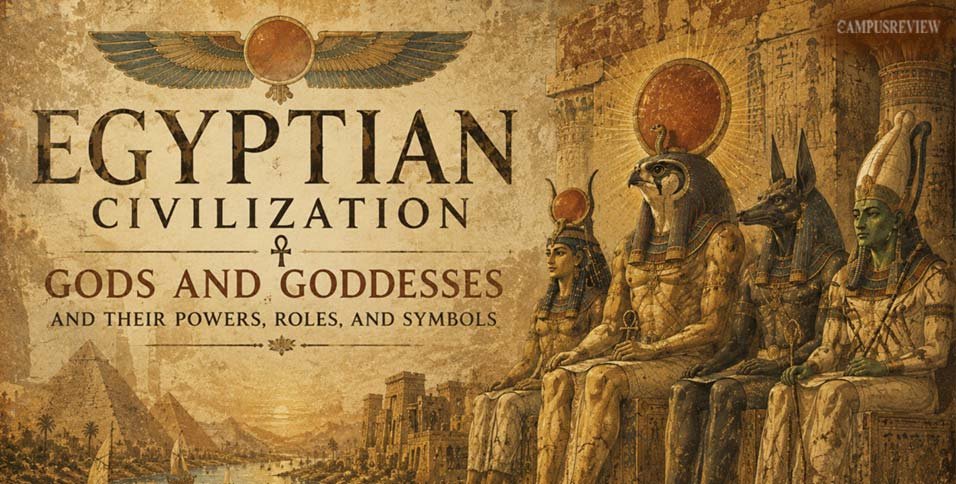
Egyptian civilization gods and goddesses shaped every aspect of ancient Egyptian life, from the sun and the Nile to kingship and the afterlife. Ancient Egyptians worshipped many deities, each with unique powers, symbols, and myths.
In this guide, you will discover the most important Egyptian civilization gods and goddesses, what they ruled, how people worshipped them, and why their stories continue to influence history and culture today.
What Is Ancient Egyptian Religion, in Simple Terms?
Ancient Egyptian religion was not built around one god or one holy book. It was a system of many gods, each one holding power over a different part of life, death, or nature.
A few core ideas ran through Egyptian mythology for over 3,000 years:
- Ma’at meant truth, balance, and cosmic order. Isfet meant chaos and disorder. Every ritual aimed to keep Ma’at in control.
- The pharaoh was seen as a living god, the earthly form of the god Horus.
- Life after death mattered as much as life itself. Egyptians devoted great effort to preparing for the afterlife.
- Gods often shared jobs or merged together, so the pantheon kept changing over time.
This is why ancient Egyptian civilization gods and goddesses can feel confusing at first. The good news: once you know each god’s job and home city, the whole system clicks into place.
How Did Egyptian Mythology Explain the Start of the World?
Different Egyptian cities told different creation stories. Priests did not see this as a problem. Each version simply explained the same event from a different angle.
| Creation System | Home City | Core Idea |
| Heliopolitan Ennead | Heliopolis | Nine gods descend from Atum, who rose from the waters of Nun |
| Hermopolitan Ogdoad | Hermopolis | Eight gods, in four pairs, represent chaos before creation |
| Memphite Theology | Memphis | Ptah creates the world just by thinking it and speaking it aloud |
In the Ennead story, Atum created Shu (air) and Tefnut (moisture). They in turn produced Geb (earth) and Nut (sky). Geb and Nut then had four children: Osiris, Isis, Seth, and Nephthys. This one family tree links almost every major Egyptian deity together.
Egyptian Civilization Gods and Goddesses at a Glance
Here is a quick overview of the most important Egyptian civilization gods and goddesses before we explore each one in detail.
| Deity | Cult Center | Domain | Symbol |
| Ra | Heliopolis | Sun, cosmic order | Falcon head, solar disk |
| Amun | Thebes | Air, hidden power | Double-plumed crown, ram |
| Ptah | Memphis | Craftsmen, creation | Mummified man, scepter |
| Osiris | Abydos | Underworld, resurrection | Green skin, crook and flail |
| Isis | Philae | Magic, motherhood | Throne headpiece |
| Horus | Edfu | Sky, kingship | Falcon head, Double Crown |
| Anubis | Cynopolis | Mummification, underworld | Black jackal head |
| Seth | Ombos | Chaos, storms, deserts | Seth animal head |
| Thoth | Hermopolis | Wisdom, writing, moon | Ibis head or baboon |
| Hathor | Dendera | Love, music, motherhood | Cow horns, solar disk |
Meet the Egyptian civilization’s Gods and Goddesses of Ancient Egypt
There were hundreds of gods and goddesses of Egyptian civilization. Here are the ten that matter most for understanding Egyptian mythology and how the whole system worked.
Ra: The Supreme Sun God
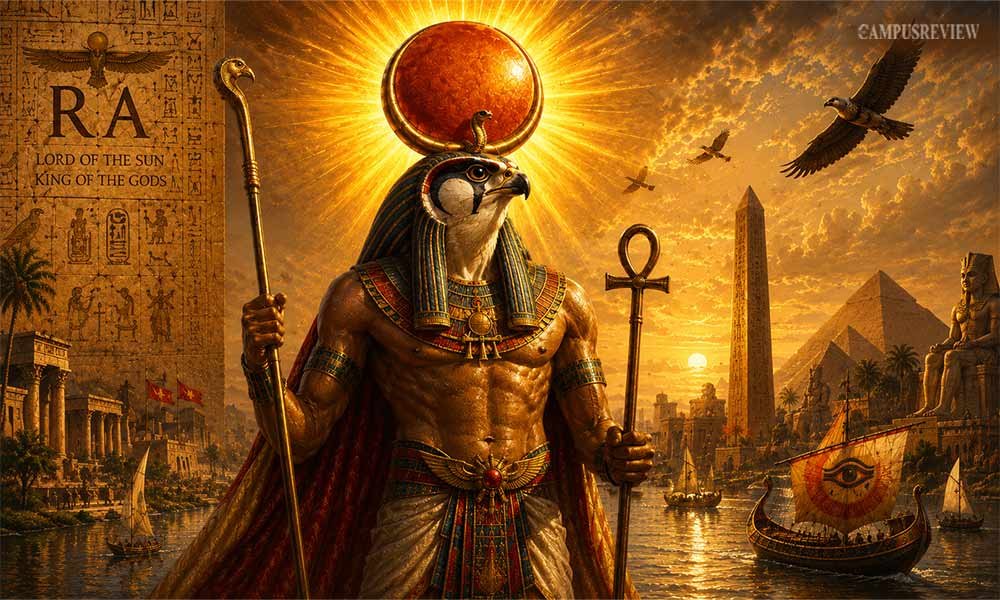
| Cult Center | Heliopolis |
| Domain | The sun, cosmic order, kingship |
| Symbol | Falcon head, solar disk, cobra |
| Family | Self-created, father of many gods |
Ra is the most popular and supreme god among all other Egyptian civilization gods and goddesses. Ra stood at the very top of the Egyptian pantheon. Egyptians believed he sailed across the sky each day in a boat called the Mandjet, bringing sunlight and life.
At night, Ra sailed through the underworld in a second boat, the Mesektet. There, he fought the giant chaos serpent Apophis. If Ra won, the sun rose again the next morning.
People often combined Ra with other gods to show power. Ra-Horakhty joined Ra with Horus. Amun-Ra joined Ra with Amun, once Thebes became the capital.
Fun fact: Ancient Egyptians believed a solar eclipse meant Apophis was winning the nightly battle.
Amun: The Hidden King of the Gods
| Cult Center | Thebes (Karnak) |
| Domain | Air, wind, hidden power |
| Symbol | Double-plumed crown, ram |
| Family | Husband of Mut, father of Khonsu |
Amun started small, as a local wind god in Thebes. Once Thebes became Egypt’s capital during the New Kingdom, Amun’s status grew fast.
His name means “the hidden one.” Egyptians believed Amun’s true form could not be seen, only felt through wind and breath.
When priests merged him with Ra to form Amun-Ra, he became the closest thing ancient Egypt had to a king of the gods. The Karnak Temple, built for Amun-Ra, grew into the largest religious complex in the ancient world.
Fun fact: Karnak Temple took over 2,000 years to build, funded by generations of pharaohs.
Osiris: Ruler of the Underworld
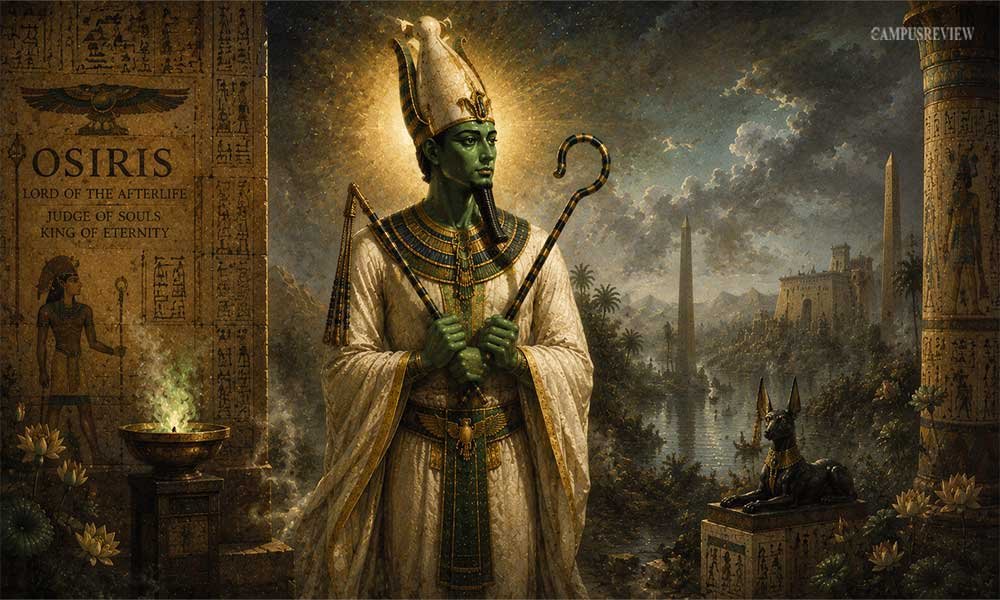
| Cult Center | Abydos |
| Domain | The underworld, resurrection, farming |
| Symbol | Green skin, crook and flail, Atef crown |
| Family | Husband of Isis, father of Horus |
Osiris began as a god of farming and fertile land. His story turned him into ruler of the dead, and one of the most loved gods in ancient Egypt.
According to myth, his jealous brother Seth killed him and cut his body into pieces. His wife Isis gathered the pieces and used magic to bring him back to life, at least long enough to conceive their son, Horus.
Osiris then became judge of the dead in the underworld. Egyptians believed that living a good life meant a place beside Osiris after death.
Fun fact: Osiris was often shown with green or black skin, on purpose, since both colors stood for fertile soil and new life, not decay.
Ptah: The Craftsman Creator
| Cult Center | Memphis |
| Domain | Craftsmen, architects, creation |
| Symbol | Mummified man, skullcap, scepter |
| Family | Husband of Sekhmet, father of Nefertem |
Ptah ruled over builders, sculptors, and anyone who made things with their hands. Egyptians saw him as the master architect behind the physical world.
According to Memphite priests, Ptah did not build the world with tools. He created it purely through thought and speech, simply by thinking of something and saying its name out loud.
Ptah’s scepter combined three symbols in one: Was for power, Ankh for life, and Djed for stability. This single object summed up everything a good ruler needed.
Fun fact: Ptah is one of the earliest examples in world history of a god who creates through pure thought, not physical labor.
Isis: Goddess of Magic and Motherhood
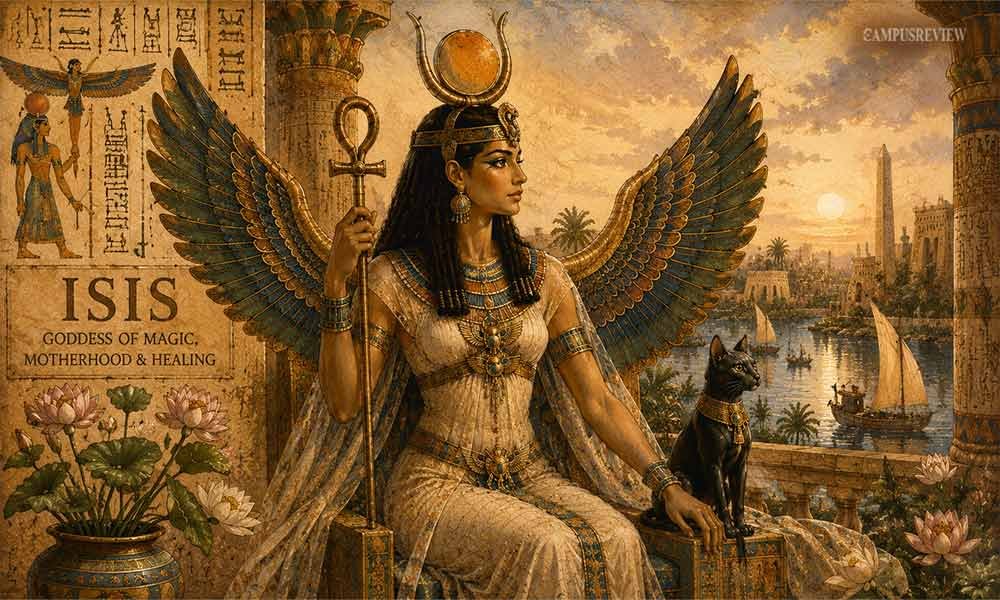
| Cult Center | Philae, Abydos |
| Domain | Magic, healing, motherhood |
| Symbol | Throne headpiece, cow horns with solar disk |
| Family | Wife of Osiris, mother of Horus |
Isis ranked among the most powerful and popular Egyptian goddess names in the entire pantheon. She used magic to heal her husband Osiris and protect her son Horus from danger.
Egyptians saw her as the ideal mother and the protector of the pharaoh. Temples to Isis stood across Egypt, and her worship later spread across the Roman Empire.
Her headdress, shaped like a throne, doubled as the hieroglyph for her own name. In later periods, she also took on Hathor’s cow horns and sun disk.
Fun fact: Worship of Isis spread so far that temples to her stood in Rome and Britain, long after ancient Egypt itself had faded.
Anubis: Guardian of the Dead
| Cult Center | Cynopolis, Memphis |
| Domain | Mummification, the underworld |
| Symbol | Black jackal head |
| Family | Often linked to Osiris and Nephthys |
Anubis guided souls through the underworld, called the Duat. Egyptians trusted him to guard bodies during mummification, since jackals were often seen near burial sites in the desert.
Anubis also oversaw the Weighing of the Heart, a key moment after death. He placed the deceased’s heart on one side of a scale and the feather of Ma’at on the other.
If the heart weighed the same as the feather, the person passed into the afterlife. If not, a monster called Ammit devoured the heart.
Fun fact: Anubis was shown with black skin on purpose. Black stood for the color of mummified flesh and rich Nile soil, both symbols of new life.
Seth: God of Chaos and Storms
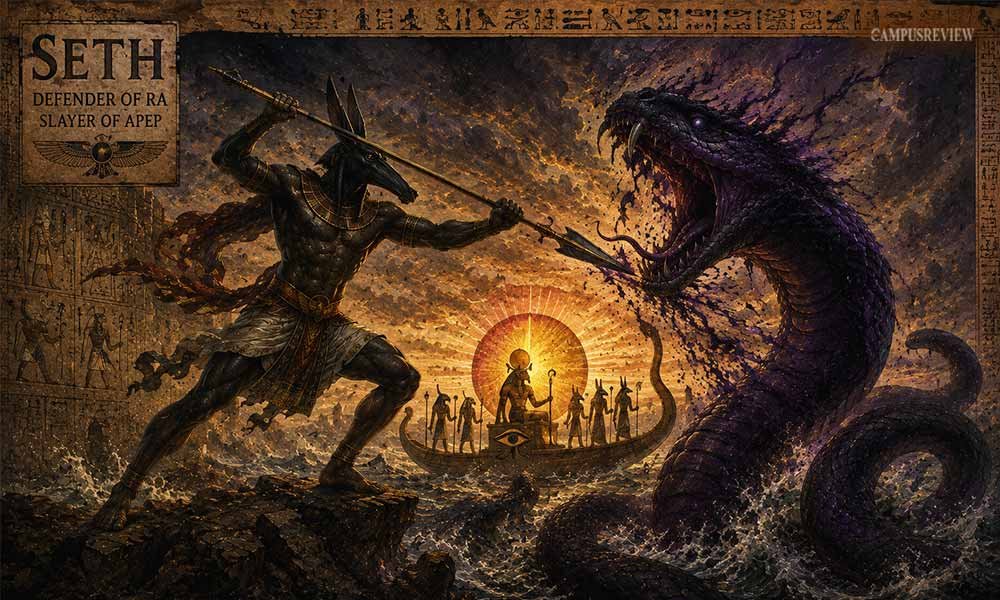
| Cult Center | Ombos, Avaris |
| Domain | Chaos, storms, deserts, foreign lands |
| Symbol | Curved snout, square ears, tufted tail |
| Family | Brother of Osiris and Isis |
Seth is often called the villain of Egyptian mythology, thanks to his role in killing Osiris. But his story is more complex than pure evil.
Seth also played a useful cosmic role. Each night, he stood on the front of Ra’s solar boat and speared the chaos serpent Apophis, helping the sun rise the next day.
Egyptians pictured Seth as a strange animal that does not match any real creature, a sign of how alien and unpredictable chaos felt to them.
Fun fact: Historians still cannot agree on which real animal, if any, inspired the odd Seth creature.
Thoth: God of Wisdom and Writing
| Cult Center | Hermopolis |
| Domain | Wisdom, writing, the moon |
| Symbol | Ibis head or baboon form, scribe’s palette |
| Family | Linked to the Ogdoad |
Thoth invented hieroglyphic writing, or so ancient Egyptians believed. He acted as the record keeper and messenger of the gods.
During the Weighing of the Heart, Thoth stood ready with his scribe’s palette. He recorded the final result, deciding whether a soul passed into the afterlife.
Priests at Hermopolis also credited Thoth’s wisdom with shaping the Ogdoad creation story, the version built on eight gods representing chaos before the world began.
Fun fact: Ancient Egyptian scribes considered Thoth their personal patron god and prayed to him before difficult writing tasks.
Horus: The Falcon God of Kingship
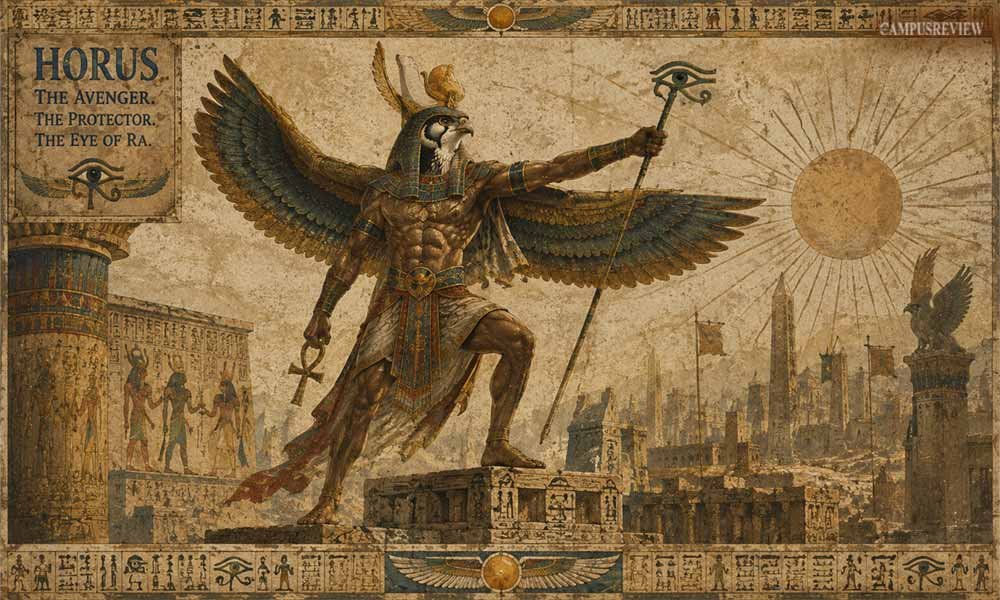
| Cult Center | Edfu, Hierakonpolis |
| Domain | Sky, kingship, protection |
| Symbol | Falcon head, Double Crown, Eye of Horus |
| Family | Son of Osiris and Isis |
Horus took the form of a falcon, flying so high that Egyptians believed his eyes were the sun and the moon.
After Seth killed his father Osiris, Horus fought Seth to win back the throne of Egypt. This battle between order and chaos became one of the most retold stories in Egyptian mythology.
Every living pharaoh was seen as Horus in human form. Several Egyptian pharaohs are also featured among the Greatest Rulers in History for their political achievements and lasting influence. This belief linked ordinary human rule directly to the gods.
Fun fact: The Eye of Horus, or Wedjat, is still used today as a symbol for protection and good health.
Hathor: Goddess of Love and Joy
| Cult Center | Dendera |
| Domain | Love, music, motherhood, the afterlife |
| Symbol | Cow horns with solar disk, sistrum rattle |
| Family | Sometimes called the wife of Horus |
Hathor brought joy, music, and celebration into Egyptian religion. People played her sacred instrument, the sistrum, during festivals in her honor.
She also worked as a protector of the dead, welcoming souls into the afterlife with warmth rather than judgment.
Egyptians often depicted Hathor as a cow, or as a woman with cow ears and horns, associating her with nourishment and motherhood.
Fun fact: Miners and travelers prayed to Hathor for safety before heading into the desert, since she was also seen as the protector of foreign lands.
How Did Ancient Egyptians Worship Their Gods?
- Temple rituals: Priests cared for the gods’ statues by washing, dressing, and offering food and incense each day.
- Religious festivals: Sacred processions carried the gods’ statues through cities, allowing people to celebrate and pray.
- Home worship: Families kept small shrines, amulets, and worshipped household deities like Bes and Taweret.
- Funeral practices: Mummification, prayers, and amulets honored Anubis and Osiris and prepared the dead for the afterlife.
- Pharaoh’s role: The pharaoh was considered a divine ruler, connecting religion, temple worship, and government.
- Offerings and prayers: People gave food, flowers, and incense to seek protection, health, and good harvests.
Conclusion
Ancient Egyptian religion evolved over more than 3,000 years, with beliefs and traditions changing as new gods and local cults became part of everyday worship. The Egyptian civilization gods and goddesses represented different aspects of nature, life, and the afterlife, shaping the culture and beliefs of one of history’s greatest civilizations.
By understanding their roles, symbols, and stories, you gain a deeper appreciation of ancient Egypt and its lasting influence on history, mythology, and modern culture.
FAQs
1. How many gods and goddesses did ancient Egypt have?
Historians estimate ancient Egypt worshipped over 1,500 gods and goddesses across its long history, though only a small number were widely known nationwide.
2. Who is the king of the Egyptian gods?
Amun-Ra held the title of Egyptian god during the New Kingdom, once priests merged Amun with the older sun god Ra.
3. Who is the most powerful Egyptian goddess?
Isis is widely seen as the most powerful and popular Egyptian goddess, thanks to her magic, her protection of the pharaoh, and her role as the ideal mother.
4. Why do so many Egyptian gods have animal heads?
Egyptians linked each god to an animal that matched their power, and that is why Egyptian gods have animal heads. A falcon like Horus flies high and sees far, which fits a sky and kingship god. A jackal like Anubis was often seen near desert graves, which fit a god of the dead.
5. What is the Egyptian pantheon?
The Egyptian pantheon is the full collection of gods and goddesses worshipped across ancient Egypt, including major national gods like Ra and Osiris, plus hundreds of smaller local deities.