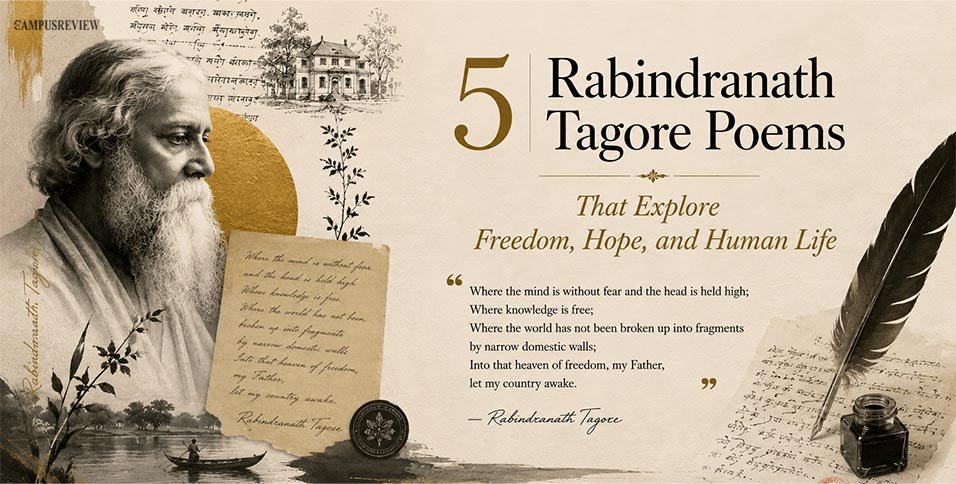
Rabindranath Tagore poems still feel fresh, even after a hundred years. Tagore was a Bengali poet who wrote about freedom, childhood, nature, and God in simple, honest language. In 1913, he became the first non-European to win the Nobel Prize in Literature for his English translation of Gitanjali.
This guide explores five famous Rabindranath Tagore poems and their meaning, from a vision of freedom to a child’s quiet daydream. Each poem includes key themes, verified lines, and a simple analysis.
About the Author: Rabindranath Tagore
Rabindranath Tagore was born on May 7, 1861, in Calcutta, British India. He grew up in a culturally rich family that encouraged his interest in literature, music, and the arts. Tagore began writing poetry at a young age and later worked across several forms, including novels, short stories, plays, essays, and songs.
Rabindranath Tagore also had a deep interest in education and believed in learning through creativity, nature, and independent thinking. Tagore died on August 7, 1941, but his literary and educational influence continues to reach readers around the world.
5 Famous Rabindranath Tagore Poems
1. Where the Mind Is Without Fear
Collection: Naivedya (1901), later Gitanjali Verse 35 (1912)
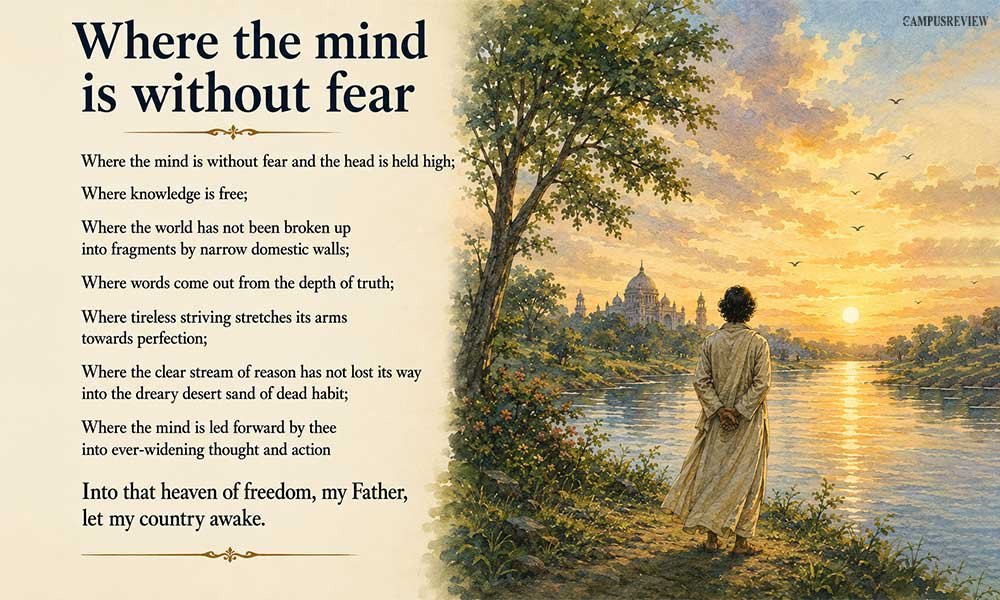
This poem is a prayer for a free nation. Tagore wrote it during British rule. He asks for more than political freedom. He asks for a free mind, free thought, and a united society.
Themes
- Freedom
- Knowledge and education
- Reason over blind habit
- Unity
The Poem
Meaning and Analysis
Tagore is telling readers that true freedom starts inside the mind, not only in politics. He wants people to hold their heads high and think without fear.
The strongest image in the poem compares reason to “a clear stream” and old, unquestioned habit to “the dreary desert sand.” Reason keeps a society alive. Blind habit dries it out.
“Narrow domestic walls” point to caste, religion, and regional pride, the divisions Tagore blamed for weakening India long before colonial rule began.
The poem still matters today because it does not ask for freedom from one ruler alone. It asks for a mind that keeps questioning, in any era. That is why it remains one of the most quoted Rabindranath Tagore poems in schools and public life.
2. The Golden Boat (Sonar Tori)
Collection: Sonar Tori (1894)
A farmer sits alone on a riverbank after the harvest. A boat arrives, and a singing boatman loads all his golden grain onto it. But there is no room left on the boat for the farmer himself.
Themes
- Loneliness
- Time and legacy
- The passing of life
The Poem
| When the gong sounds ten in the morning, and I walk to school by our lane, Every day I meet the hawker crying, “Bangles, crystal bangles!” There is nothing to hurry him on, there is no road he must take, no place he must go to, no time when he must come home. I wish I were a hawker, spending my day in the road, crying, “Bangles, crystal bangles!” When I come back from school at four in the afternoon, I can see through the gate of that house the gardener digging the ground. He does what he likes with his spade; he soils his clothes with dust, nobody takes him to task if he gets baked in the sun or gets wet. I wish I were a gardener digging away at the garden with nobody to stop me from digging. Just as it gets dark in the evening and my mother sends me to bed,I can see through my open window the watchman walking up and down. The lane is dark and lonely, and the street-lamp stands like a giant with one red eye in its head. The watchman swings his lantern and walks with his shadow at his side, and never once goes to bed in his life. I wish I were a watchman walking the streets all night, chasing the shadows with my lantern.street lamp |
Meaning and Analysis
Rabindranath Tagore wrote the golden boat poem while managing his family’s land near the Padma River, but the meaning reaches far beyond farming.
The golden paddy stands for everything a person builds in a lifetime, their work, ideas, and achievements. The boatman stands for time or history, the force that carries our achievements forward long after we are gone. The twist arrives at the end. The boat has room for the grain but not for the farmer, a quiet, sad truth about legacy.
The poem still matters because it names a feeling many people have after finishing something big, pride mixed with a strange emptiness similar to Franz Kafka’s The Metamorphosis. Tagore had already captured that feeling over a century ago.
3. Vocation
Collection: Shishu (1903), translated in The Crescent Moon (1913)
A schoolboy watches a bangle seller, a gardener and a night watchman go about their work. Tired of school bells and fixed routines, he wishes he could live as freely as they do.
Themes
- Freedom from routine
- Connection with nature
- Finding your own calling
The Poem
| WHEN the gong sounds ten in the morning, and I walk to school by our lane, Every day I meet the hawker crying, “Bangles, crystal bangles!” There is nothing to hurry him on, there is no road he must take, no place he must go to, no time when he must come home. I wish I were a hawker, spending my day in the road, crying, “Bangles, crystal bangles!” When at four in the afternoon I come back from the school, I can see through the gate of that house the gardener digging the ground. He does what he likes with his spade, he soils his clothes with dust, nobody takes him to task if he gets baked in the sun or gets wet. I wish I were a gardener digging away at the garden with nobody to stop me from digging. Just as it gets dark in the evening and my mother sends me to bed, I can see through my open window the watchman walking up and down. The lane is dark and lonely, and the street-lamp stands like a giant with one red eye in its head. The watchman swings his lantern and walks with his shadow at his side, and never once goes to bed in his life. I wish I were a watchman walking the streets all night, chasing the shadows with my lantern. |
Meaning and Analysis
Tagore criticised rigid schooling and later founded an open-air school at Santiniketan. That belief strongly shapes this poem.
Each worker represents a freedom the child lacks. The hawker moves freely, the gardener works without restrictions, and the watchman walks alone at night. The repeated line, “I wish I were,” reflects the child’s desire for a life beyond imposed rules.
The poem still resonates because many readers know what it feels like to daydream about escaping a routine they did not choose.
4. Paper Boats
Collection: The Crescent Moon (1913)
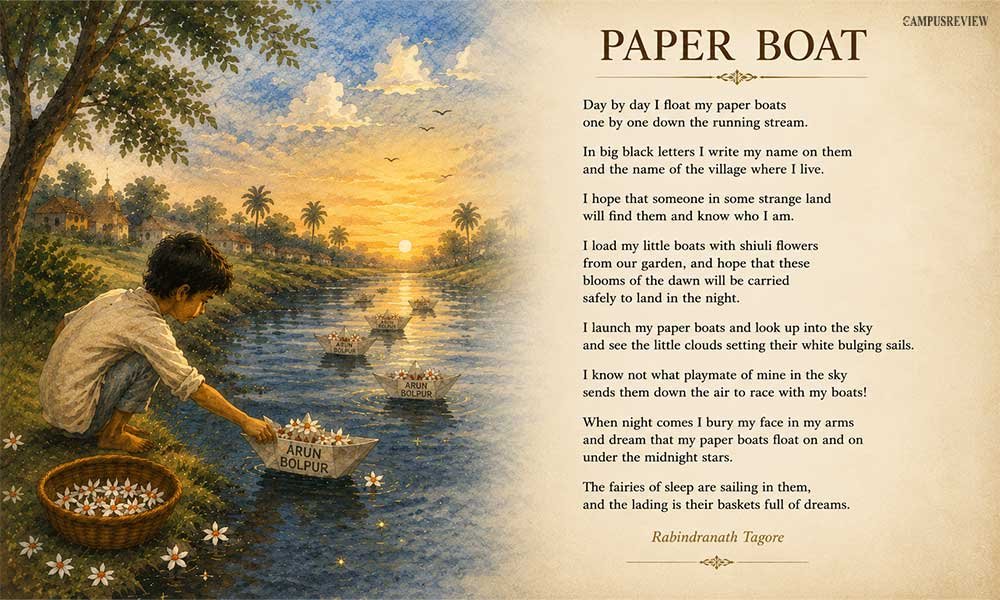
A child floats paper boats down a stream, writing their name and village on each one. It looks like simple play. It is really a poem about wanting to be known by someone far away.
Themes
- Childhood wonder
- Longing for connection
- The fragility of hope
The Poem
Meaning and Analysis
On the surface, this poem shows a child at play. Underneath, it shows a wish every person carries, the wish to be seen and remembered by someone we will never meet.
The child loads the boats with shiuli flowers, a flower that blooms at dawn and falls by morning. That detail matters. The child is sending something beautiful and short-lived into the unknown, hoping it survives the journey. At night, the boats turn into dream-boats carried by “fairies of sleep,” showing that a child’s imagination does not stop when play stops.
This poem still connects with readers because that same wish, to be known beyond our own small world, does not go away with age. It just changes shape.
5. Leave This Chanting
Collection: Gitanjali, Song 11 (1912)
Tagore tells a devotee to stop praying alone behind locked temple doors. He says God is not there. God is outside, working alongside the poorest farmers and labourers.
Themes
- Rejecting empty ritual
- Dignity of labour
- God among people
The Poem
| Leave this chanting and singing and telling of beads! Whom dost thou worship in this lonely dark corner of a temple with doors all shut? Open thine eyes and see thy God is not before thee! He is there where the tiller is tilling the hard ground and where the path-maker is breaking stones. He is with them in sun and in shower, and his garment is covered with dust. Put off thy holy mantle and even like him come down on the dusty soil! Deliverance? Where is this deliverance to be found? Our master himself has joyfully taken upon him the bonds of creation; he is bound with us all for ever. Come out of thy meditations and leave aside thy flowers and incense! What harm is there if thy clothes become tattered and stained? Meet him and stand by him in toil and in sweat of thy brow. |
Meaning and Analysis
This is one of the boldest poems in Gitanjali. Tagore challenges the idea that shutting yourself away in prayer brings a person closer to God.
He describes God working with “the tiller” and “the pathmaker,” wearing dust-covered clothes and standing in sun and rain. This directly challenges devotees who kept themselves clean and separate from ordinary working people. The poem asks readers to leave their flowers and incense and go stand with people who are actually working.
The poem still matters today because it offers a simple test for spirituality: show up for people, and you are already close to the divine. That idea needs no particular religion to make sense.
Final Thoughts
Rabindranath Tagore’s poems move easily between the personal and the universal. A child wishes to escape school, a farmer watches his life’s work disappear into the distance, and a devotee is asked to find God among people who work with their hands.
These poems remain powerful because Tagore does not make their ideas difficult to understand. He writes about freedom, loneliness, childhood, faith, and the desire to connect, which William Shakespeare also explored through poetry and drama. In language that still feels close to everyday life.
That may be why Rabindranath Tagore poems continue to be read today. Their world may belong to another century, but the questions they ask still belong to us.
Frequently Asked Questions
1. What is Rabindranath Tagore’s most famous poem?
“Where the Mind Is Without Fear” is usually named as Tagore’s most famous poem. It first appeared in Naivedya in 1901 and later became Verse 35 of Gitanjali, the collection that won Tagore the 1913 Nobel Prize in Literature.
2. What are the main themes in Rabindranath Tagore’s poems?
Rabindranath Tagore’s poems return again and again to a few core themes: freedom of the mind and the nation, childhood wonder, closeness with nature, and God found in ordinary human labour rather than in ritual alone.
3. Which Rabindranath Tagore poem is about freedom?
“Where the Mind Is Without Fear” is Rabindranath Tagore’s clearest poem about freedom. It asks for intellectual, moral and social liberation, not political independence alone.
5. What is Paper Boats by Rabindranath Tagore about?
“Paper Boats” by Rabindranath Tagore is about a child floating paper boats down a stream, hoping a stranger somewhere will find them. On the surface, it is playful. Underneath, it is about the universal wish to be known by people far beyond our own world.