The Campus Review
October 27, 2026
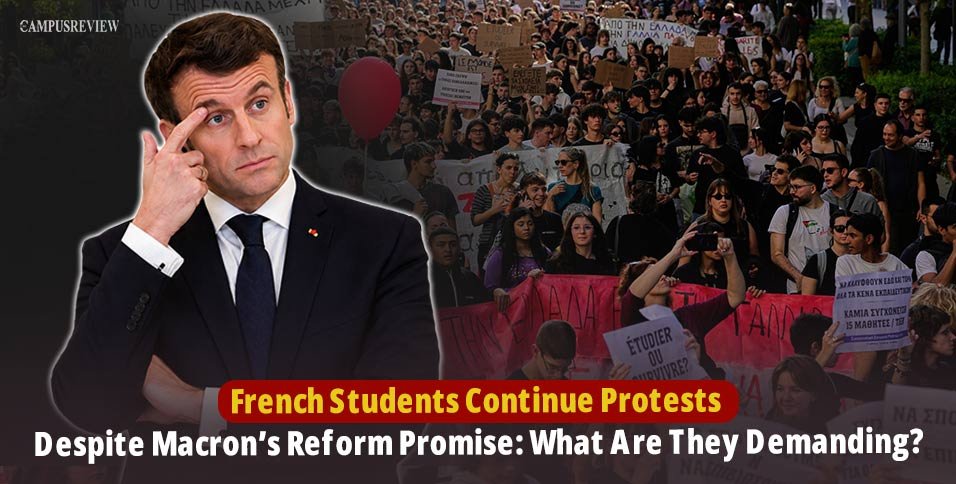
French student protests continue despite the government’s promise of major education reforms, including replacing the university admissions platform Parcoursup by 2028. On October 26, student representatives said the proposed measures did not meet all their demands after talks with government officials.
The package includes funding for school and university renovations, additional higher-education places, student grants, and smaller classes.
The protests in France, which have centred on education funding, classroom conditions, and higher-education access, have widened to include trade unions and Yellow Vest activists amid broader concerns about the cost of living and public services.
Key Facts: The Crisis at a Glance
The following table provides an overview of the movement, official turnout estimates, and the government’s policy announcements.
| Category | Verified Details |
| Grievances | Poor school facilities, teacher shortages, crowded classes, living costs, and admissions stress. |
| Admissions Platform | Parcoursup, France’s national higher-education admissions platform. |
| Turnout | October 24: 410,000 estimated by the Interior Ministry; nearly 800,000 by the CGT. |
| Movement | Students, trade unions, and Yellow Vest activists. |
| Government Measures | €4 billion for school renovation loans, €1 billion for campuses, 15,000 higher-education places, 500 teaching posts, and 920 contract-teacher recruitments. |
| Key Reforms | 28-pupil class cap in first-year lycée classes and Parcoursup replacement by 2028. |
What Sparked the Widening French Student Protests?
French student Protests have focused on poor school facilities, teacher absences, classroom conditions, and rising living costs. Students have also criticised Parcoursup, France’s higher-education admissions platform, over concerns about transparency and access to university places.
The disruption had already forced hundreds of schools to close earlier in October.
The mobilization has broadened beyond schools as other groups joined the demonstrations:
- School Facility Concerns: Students have highlighted overcrowded classrooms and missed lessons caused by teacher absences.
- Admissions Frustrations: Secondary-school students have raised concerns about how Parcoursup allocates higher-education places.
- Coalition Growth: Trade unions and Yellow Vest activists have joined the marches, linking education grievances to wider debates about living costs, wages, and public-service funding.
What Are French Students Demanding?
Student organizations maintain that the measures announced by the French government do not resolve the day-to-day challenges facing the education system. Student and youth organizations have put forward several priority demands:
- Massive University Expansion: Some student groups demand up to 250,000 additional places across public universities to address admission bottlenecks. They argue that the government’s 15,000 additional places are inadequate.
- Non-Algorithmic Higher Education Access: Some protesters call for an admissions model that guarantees access to higher education for all holders of the baccalauréat, without automated screening.
- Long-Term Staffing Solutions: Youth organizations demand permanent teaching hires to reduce cancelled classes and improve pupil-to-teacher ratios.
- Direct Cost-of-Living Protection: Student unions call for expanded grants and support to help students manage housing and food costs.
What Reforms Has the French Government Announced?
The government announced the package after weeks of protests over education funding, classroom conditions, and university admissions.
Education Minister Édouard Geffray and Higher Education Minister Philippe Baptiste presented measures covering schools, universities, and student support.
- School Renovation Loans: A €4 billion public loan envelope through 2030 to help local and regional authorities renovate secondary-school buildings.
- University Modernization: A €1 billion state investment program running through 2029 to upgrade and repair university campuses.
- Targeted Study Places: 15,000 additional higher-education places across 2027 and 2028, comprising 10,000 places in BTS technical programs, 4,000 in BUT university technical tracks, and 1,000 in health-related university courses.
- Teaching Posts and Contract Staff: Funding for 500 additional teaching posts, alongside 920 planned contract-teacher recruitments to help cover classroom absences.
- Class-Size Caps: A maximum of 28 pupils in first-year lycée classes (seconde), starting in less advantaged schools in 2027 and expanding to all lycées in 2028.
- Grant Adjustments: Student grants will be indexed to the cost of living starting with the 2027 academic year.
- Parcoursup Replacement: Initial platform reforms will begin in 2027, followed by a planned replacement of Parcoursup in 2028.
- Student Support: The government has also announced 500 additional support posts, including psychologists, nurses, and social workers, from 2027.
Why Student Leaders Say the Measures Are Insufficient
Despite the detailed government package, student delegations left negotiations without calling off their actions.
“Not all our demands were met. We’ll go on for as long as it takes,” said Louis Letoublon, a representative of the secondary-school organization Les Lycéens!, following talks in Paris, according to Reuters.
Student representatives say the measures do not go far enough to address their concerns about higher-education access, school staffing, and living expenses.
The planned 15,000 additional places will be spread across 2027 and 2028, while the replacement of Parcoursup is not scheduled until 2028.
Looking Ahead
Authorities anticipate further protest activity on October 31, while national trade unions have
called for a wider interprofessional action on November 5. The government’s measures rely on multi-year loan programs and gradual structural changes through 2028.
However, student organizations have called for further demonstrations despite the announced measures, demanding action on staffing levels, living expenses, and university admissions. French student protests therefore remain part of a wider debate about education funding and public services.
Pranjal Kharche