You read a chapter three times and highlight key lines. But when someone asks you to explain it, your mind goes blank. The Feynman Technique helps close that gap between recognising information and truly understanding it.
Feynman study method has four steps: choose a concept, explain it in simple words, identify knowledge gaps, and simplify your explanation. Inspired by physicist Richard Feynman’s learning habits, the method is widely associated with writer Scott Young’s four-step framework.
This guide covers each step, a practical student example, AI prompts, and a weekly study routine you can start today.
What Is the Feynman Technique?
The Feynman Technique is a learning method that tests your understanding. You explain an idea in simple words without looking at your notes.
If you cannot explain it clearly, you have found a gap. You fix the gap and try again. Many students call it the Feynman learning method or a learning-through-explanation habit.
Who Was Richard Feynman, and Who Created the 4 Steps?
Richard Feynman (1918–1988) was an American theoretical physicist known for his work in quantum mechanics and quantum electrodynamics.
He received the 1965 Nobel Prize in Physics for his contributions to the field. He was also admired for his ability to explain complex scientific ideas clearly.
Scott H. Young and the Feynman Technique
Scott H. Young is a writer known for his work on learning, productivity, and self-education. He helped popularise the Feynman Technique as a structured learning method through his writing on effective learning.
His work brought the approach to a wider audience, particularly students seeking practical ways to improve their understanding and learning habits.
Feynman Technique Steps: How to Use the Method
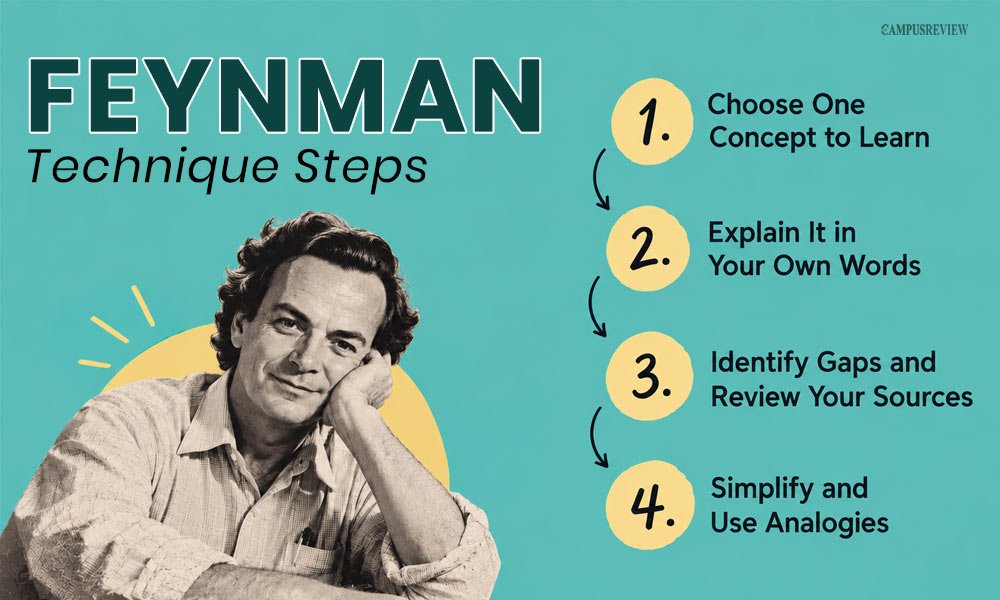
The Feynman Technique steps are simple. You choose one concept, explain it from memory, fix the gaps, and then simplify it with an analogy. Here is the quick view.
| Step | What you do | Rough time |
| 1 | Choose one small concept and write it at the top of a blank page | 5 minutes |
| 2 | Explain it from memory in plain words, with all notes closed | 13 minutes |
| 3 | Mark the gaps, then check your sources only for those gaps | 10 minutes |
| 4 | Rewrite the explanation, simplify it, and add an analogy | 10 minutes |
Step 1. Choose One Concept to Learn
Start small. A whole chapter is too big. Pick one idea you can explain in 10 to 15 minutes. Write it at the top of a blank page. Keep the topic narrow enough to focus on a single idea rather than several related concepts.
| Subject | Too broad | Just right |
| Biology | Cell biology | How osmosis moves water into a cell |
| Economics | Microeconomics | Why a price ceiling creates a shortage |
| Geography | Weather and climate | Why monsoon winds change direction |
Quick test: Can you explain the idea on one page? If not, cut it into smaller ideas.
Step 2. Explain It in Your Own Words
Close your book and notes. Now write or say your explanation as if you were teaching a smart 12-year-old. Explain concepts in simple terms. This is where self-explanation and retrieval practice happen.
Follow these rules
- Do not copy textbook sentences.
- Replace every technical word with a plain description.
- Write “???” when you get stuck. Do not peek.
- Add one real example.
Example: How plants make food. A textbook explanation might say, “Photosynthesis is the process by which plants convert light energy into chemical energy.”
A simpler explanation is: “Plants use sunlight, water, and air to make their own food.” The second version shows that you understand the basic idea. You can also explain it out loud or record yourself on your phone.
Step 3. Identify Gaps and Review Your Sources
Now read your own explanation like a teacher. This is how you identify knowledge gaps. Look for three problems:
- You used a big word instead of explaining what happens.
- You skipped a step or wrote: “and then somehow.”
- You gave no example.
List each problem. This list is your study plan. Open your textbook and read only the parts that fix these gaps. Do not reread the whole chapter.
Example for photosynthesis. Your gap list might say: “I do not understand how plants use sunlight to make food” and “I forgot what plants take in from the air.”
You review the relevant section in your textbook, fill these gaps, and return to Step 2 to explain photosynthesis again in your own words.
Step 4. Simplify and Use Analogies
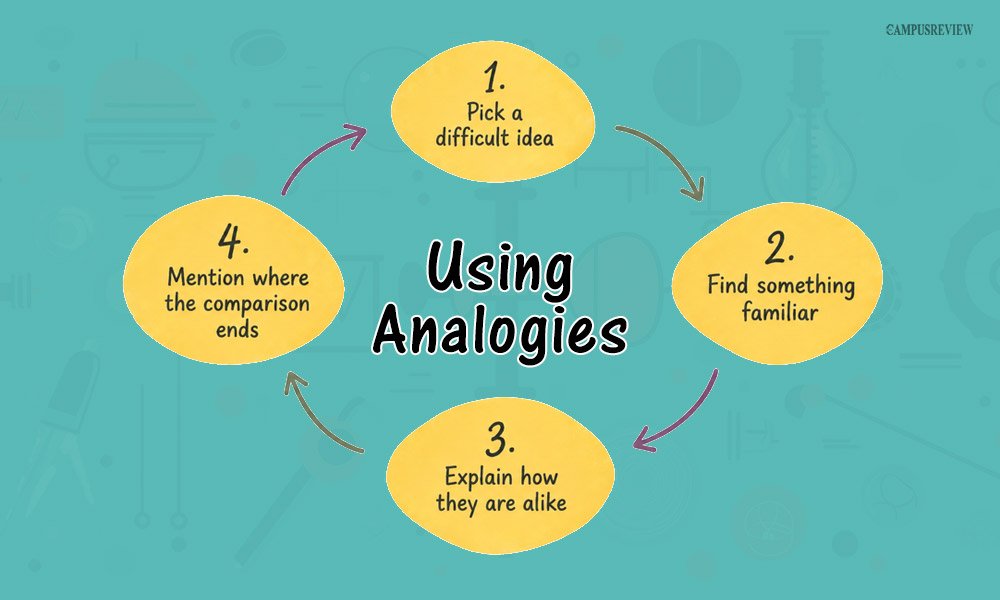
Rewrite your explanation on a fresh page without looking at your notes. Use short, simple sentences and remove unnecessary words. Then, create an analogy, which compares a new or difficult idea to something familiar.
Example: Think of the heart as a pump. Just as a water pump moves water through pipes, the heart pumps blood through blood vessels to deliver oxygen and nutrients throughout the body. This analogy makes the heart’s role easier to understand and remember.
After creating an analogy, check where the comparison stops working. For example, the heart is like a water pump because both move fluid through a network of tubes.
However, the heart is a living organ that adjusts its pumping to meet the body’s needs, while a water pump does not work in the same way. Understanding this difference helps you avoid misconceptions.
How to Use the Feynman Technique for Studying
Feynman Technique works best when you need to understand how or why something happens. It is one of the most practical study techniques for students who want more than memorised lines.
| Study goal | How to use the method | Example |
| Exam preparation | List the topics most likely to appear. Run one session per topic. End with a 2-minute spoken answer. | Explain why demand falls when price rises |
| Science concepts | Explain the process step by step, from cause to effect. | How photosynthesis makes sugar |
| Textbook chapters | Split the chapter into 4 to 6 small concepts. Explain one at a time. | One chapter on the water cycle |
| Revising hard topics | Pick the topics you keep getting wrong. Run the full four steps on each one. | A maths formula you cannot apply |
How to Use AI Tools With the Feynman Technique
An AI chatbot such as ChatGPT, Gemini, or Claude can act like a patient beginner who asks questions. It helps you find gaps faster. But one rule is not negotiable: you explain first.
If you ask the AI to explain the topic, you only read. That is passive learning, and it removes the benefit.
Follow this simple routine:
1. Write your explanation from memory with your notes closed.
2. Paste it into the chatbot with the prompt below.
3. Answer the chatbot’s questions in writing, from memory.
4. Check the facts in your textbook or class notes. AI can make mistakes.
5. Ask the chatbot to quiz you on the topic.
Example prompt: “Act as a curious 12-year-old student. I will explain how the greenhouse effect works. Do not teach me. Read my explanation and do three things. First, point out any jargon or confusing words. Second, ask me three questions about steps I skipped. Third, tell me if I made a factual mistake, but do not give the full correct answer yet. Here is my explanation: [paste your text].”
| AI task | Prompt idea | Why it helps |
| Find jargon | “Highlight every word a beginner may not know.” | Catches the word trap |
| Spot skipped steps | “Ask me where my explanation jumps ahead.” | Finds hidden gaps |
| Test your analogy | “Where does my analogy break down?” | Keeps analogies honest |
| Practise recall | “Quiz me one question at a time.” | Adds retrieval practice |
Try voice too. Record your explanation on your phone. Play it back and listen for pauses and filler words. Each pause points to a gap.
Avoid these two mistakes. Do not paste the AI’s answer as your own explanation. Do not skip the fact check. The AI is your practice partner, not your teacher.
Benefits of the Feynman Technique
Discover the key benefits of the Feynman Technique and learn how it can improve understanding, identify knowledge gaps, and make studying more effective.
- Identifies knowledge gaps: Reveals what you understand and what you still need to learn before an exam.
- Improves understanding: Helps you understand how and why a concept works instead of memorising definitions.
- Simplifies complex ideas: Encourages you to explain difficult topics in clear, everyday language.
- Builds self-awareness: Helps you judge your understanding and recognise when you need more practice.
Limitations and Common Mistakes
Learn the common mistakes and limitations of the Feynman Technique to avoid study pitfalls and make your learning sessions more effective.
- Looking at notes too soon: Try explaining the concept from memory first. Use your notes afterward to check what you missed.
- Choosing a topic that is too broad: Focus on one small concept at a time instead of an entire chapter.
- Skipping the final step: Do not stop after finding gaps. Review them and rewrite your explanation in simpler words.
- Taking on too much at once: Work on two or three concepts per study session to keep the process manageable.
- Using it for simple facts: Flashcards are often more practical for memorising dates, definitions, and vocabulary lists.
- Trusting an incorrect explanation: A simple explanation can still be wrong. Check reliable sources to make sure your understanding is accurate.
Feynman Technique vs. Active Recall
Active recall means pulling facts from memory with flashcards or practice questions. The Feynman Technique means explaining how an idea works. Both rely on retrieval practice, so they work well together.
| Feature | Feynman Technique | Active recall |
| Main goal | Understand how and why | Remember facts and terms |
| Best for | Processes and cause-and-effect ideas | Definitions, formulas, dates |
| Format | Writing or speaking an explanation | Flashcards and practice questions |
| Time | 20 to 40 minutes per concept | Seconds per card |
Here is how to combine them:
1. Use the Feynman Technique first to understand a concept.
2. Turn the key terms and formulas into flashcards.
3. Review the cards using spaced repetition, which means reviewing at growing gaps of time.
4. If one card keeps failing, return to the Feynman Technique for that idea.
If you struggle to stay focused, use timed study sessions with the Pomodoro Technique, which alternates focused work with short breaks.
Simple tools that help:
- A paper notebook or a blank document for your explanations.
- A phone voice recorder for spoken explanations.
- An AI chatbot for question practice, with fact checks.
- A flashcard app or paper cards for spaced review.
Final Words
The Feynman Technique turns studying into a test of real understanding. Choose one small concept. Explain it from memory. Fix the gaps. Then simplify it with an analogy.
Pair it with flashcards and spaced repetition for lasting results. Start tonight with one concept and a blank page. Your first honest explanation will show you exactly what to study next.
Pranjal Kharche