The Campus Review
July 30, 2026
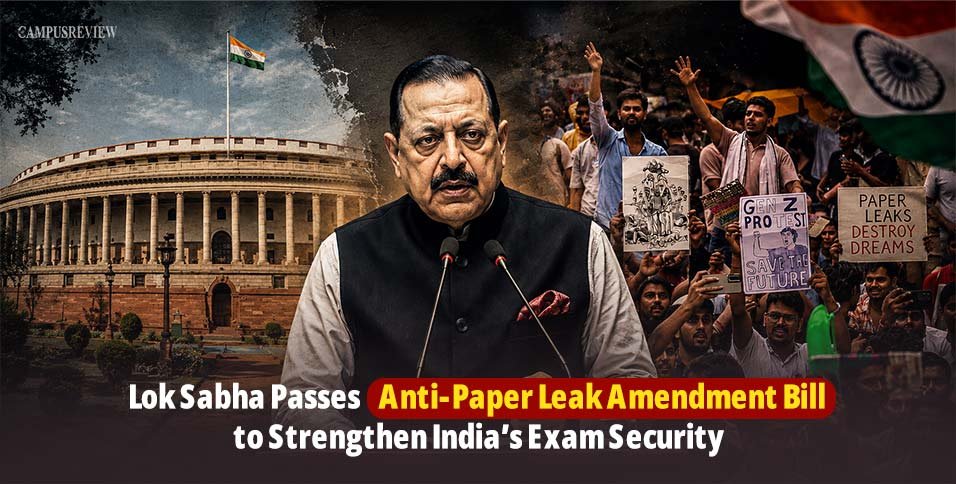
The Lok Sabha on Wednesday passed the Public Examinations (Prevention of Unfair Means) Amendment Bill, 2026, introducing stronger measures to curb paper leaks and organized cheating in public examinations in India.
Union Minister Dr. Jitendra Singh introduced the examination security bill in the House on July 27, following widespread discussions over examination integrity. The legislation aims to tighten legal accountability for entities involved in examination fraud while strengthening security protocols across competitive and recruitment exams in India.
The Anti-Paper Leak Amendment Bill follows several high-profile examination controversies, including the NEET-UG paper leak case and student protests, which raised concerns about the integrity of public examinations and prompted demands for stronger legal safeguards.
Key Highlights of India’s Anti-Paper Leak Amendment Bill
- Focus on Organized Rackets: Focuses enhanced penal provisions on paper-leak syndicates, impersonation rings, and corrupt testing service providers.
- Exemption for Candidates: Honest candidates who appear for public exams do not fall under these penal provisions; candidate misconduct remains governed by examination board administrative rules.
- Time-Bound Investigations: Requires investigating agencies to complete inquiries within two months of registering a case.
- Special Fast-Track Courts: Directs states and Union Territories to designate Courts of Session as Special Fast-Track Courts for daily trials.
Legislative Provisions and Penalties under Anti-Paper Leak Amendment Bill
The Public Examinations (Prevention of Unfair Means) Amendment Bill, 2026 enhances the legal penalties previously set under the 2024 parent act. It establishes a clear legal distinction between individual non-candidate perpetrators and organized, systemic fraud.
| Offence Category | Imprisonment Term | Financial Penalty | Statutory Impact |
| Individual Non-Candidate Perpetrators | 5 to 10 years | Up to ₹50 lakh | Enhanced from previous 3–5 year terms |
| Service Provider Negligence/Fraud | N/A (Corporate Entity) | Up to ₹5 crore | Debarment period doubled from 4 to 8 years |
| Management of Service Providers | 5 to 10 years | Up to ₹5 crore | Penalizes colluding senior personnel directly |
| Organized Paper Leak Syndicates | 7 to 10 years | Minimum ₹1 crore, up to ₹10 crore | Seizure and attachment of proceeds of crime |
| Genuine Exam Candidates | Board administrative rules | Nil (Exempt from Penal Code) | Protected from criminal syndicate prosecution |
Highlights from the Lok Sabha Debate on Anti-Paper Leak Amendment Bill
The floor debate in the Lok Sabha featured sharp exchanges between the government and Opposition members over the implementation of the Public Examinations Amendment Bill, 2026, also informally called the NEET paper leak law:
“The amendment in the bill has been brought to make the law more stringent and ensure speedy justice. The new Bill is a reaffirmation of the government’s commitment to safeguard the welfare of students and youth.”
- Dr. Jitendra Singh, Minister of State for Personnel, Public Grievances and Pensions
“This was a deep expression of the youth of this country, and I feel all political parties must respect this expression… The education system is very expensive and privatized; students are frustrated because they are not allowed to follow their passion or ask questions.”
- Rahul Gandhi, Leader of the Opposition
“We support this Bill because no responsible political party opposes fair exams. But support for this Bill cannot be a substitute for accountability. Whenever governance fails, they change the law… Where is the accountability for administrative negligence or the examination authorities?”
- Abhishek Banerjee, All India Trinamool Congress (AITC) MP
“The opposition parties did not speak on the bill itself; they politicised the issue. Everyone from the NDA who spoke addressed the core provisions of the bill.”
- Kiren Rijiju, Union Minister for Parliamentary Affairs
What Happens Next?
| Legislative Stage | Status |
| Passed by Lok Sabha | Complete |
| Rajya Sabha Approval | Pending |
| Presidential Assent | Pending |
| Enactment into Law | Pending Assent & Notification |
The amendment will now be considered by the Rajya Sabha. If approved there and signed by India’s President, it will come into force after official notification.
If this Anti-paper leak amendment bill becomes law, the strengthened examination framework will support ongoing efforts to improve exam integrity under Education Minister Pralhad Joshi.
Under the proposed provisions, state governments must set up Special Fast-Track Courts to complete trials within three months of chargesheet submission. Central agencies would also gain authority to form a Special Task Force for complex, multi-state examination fraud investigations.