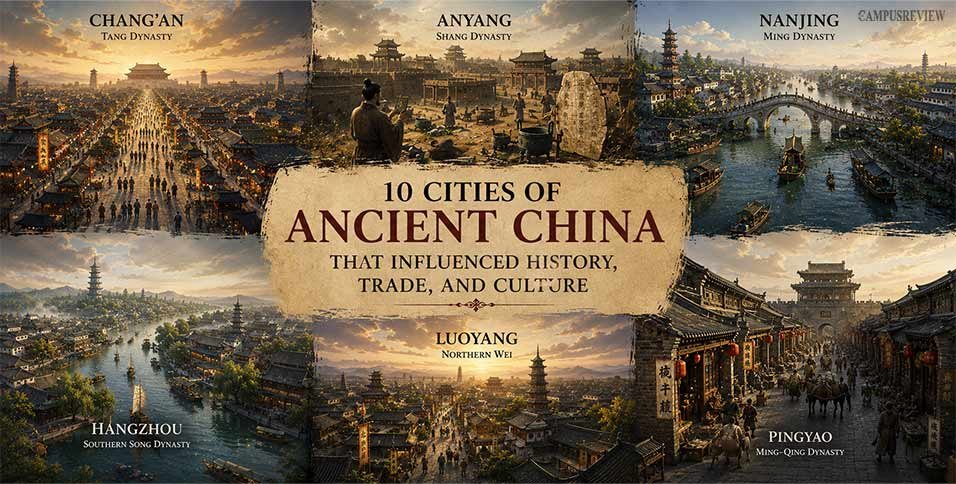
Cities of Ancient China were the political, cultural, and economic centers of one of the world’s oldest civilizations. Over more than 3,000 years, different dynasties ruled from cities such as Chang’an, Luoyang, Anyang, and Kaifeng, making each an important capital at different times.
Some cities prospered through Silk Road trade, while others became known for religion, innovation, or military strength. This guide explains the 10 most important cities of ancient China, the dynasties that ruled them, and their historical significance. If you want to understand ancient Chinese civilization, these cities provide the best place to begin.
Fast Facts About Ancient Chinese Cities
These quick facts provide an overview of the most important cities of ancient China and their role in politics, culture, and trade.
| Fact | Details |
| Oldest major city | Anyang |
| Most famous capital | Chang’an (modern Xi’an) |
| Major trade route | The Silk Road |
| Number of ancient capitals | More than 20 |
| UNESCO World Heritage cities | Beijing, Xi’an, Luoyang, Pingyao, Hangzhou, Dunhuang |
1. Chang’an (Modern Xi’an)
Key facts:
- Capital of the Han, Sui, and Tang dynasties
- Eastern starting point of the Silk Road
- Home to 108 planned city wards and a nightly curfew system
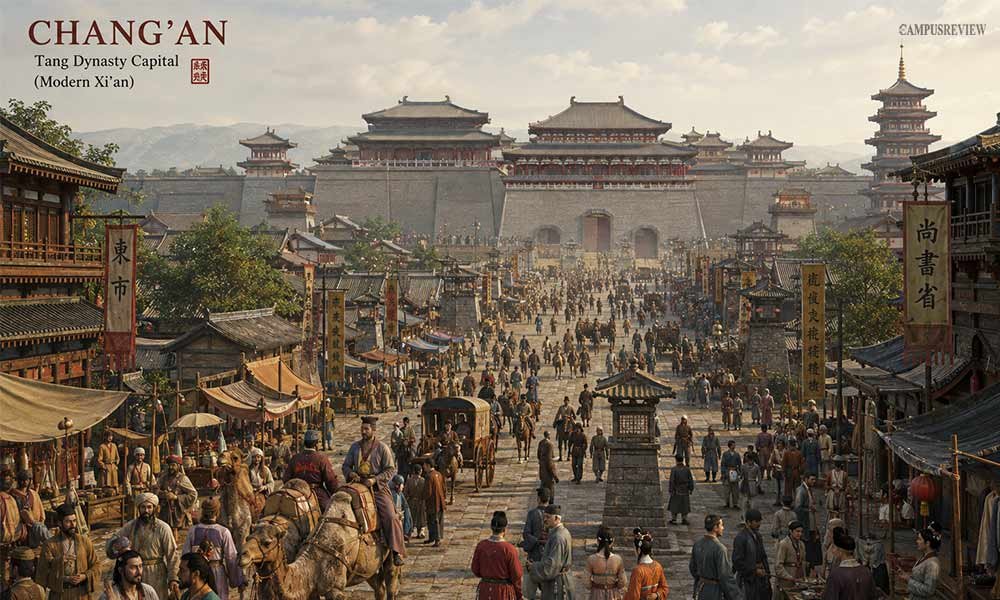
Chang’an was the capital of the Han, Sui, and Tang dynasties. During the Tang dynasty, it grew into the largest planned city in the medieval world. It covered more than 83 square kilometers, far bigger than any European city of that time.
The city had a wide central road called Zhuque Avenue, over 150 meters across. It ran through 108 walled neighborhoods and two state-run markets, the East Market and the West Market. Guards closed the ward gates every evening, so residents lived under a strict nightly curfew. The emperor’s palace sat in the north, looking out over the whole city.
Chang’an also marked the eastern end of the Silk Road. Traders, monks, and diplomats from across Asia filled its streets, making it one of the most diverse cities in the ancient world. The famous Terracotta Army was buried nearby to guard the tomb of Qin Shi Huang, China’s first emperor.
2. Luoyang
Key facts:
- Capital city for 13 dynasties, including the Eastern Zhou and Eastern Han
- Center of early Chinese Buddhism
- Home to the Longmen Grottoes and the Yongning Temple site
- Located at the meeting point of two rivers
Luoyang served as the capital for 13 different dynasties, including the Eastern Zhou, Eastern Han, Northern Wei, and as the eastern capital during the Sui and Tang eras. That makes it one of the most reused capitals in Chinese history. This ancient city sits where the Yi and Luo rivers meet in Henan province, a spot chosen for its central location and easy river transport.
Luoyang also became a major center for Buddhism in China. The Northern Wei rulers built the Yongning Temple pagoda here, and the Longmen Grottoes, a set of Buddhist carvings cut into limestone cliffs along the river, still stand near the city today. Luoyang worked as a partner city to Chang’an, supplying the western capital with grain and goods from the fertile plains around it.
3. Anyang
Key facts:
- Last capital of the Shang Dynasty
- Site of the earliest known Chinese writing
- Famous for oracle bone discoveries
- Marks the start of the Bronze Age in China
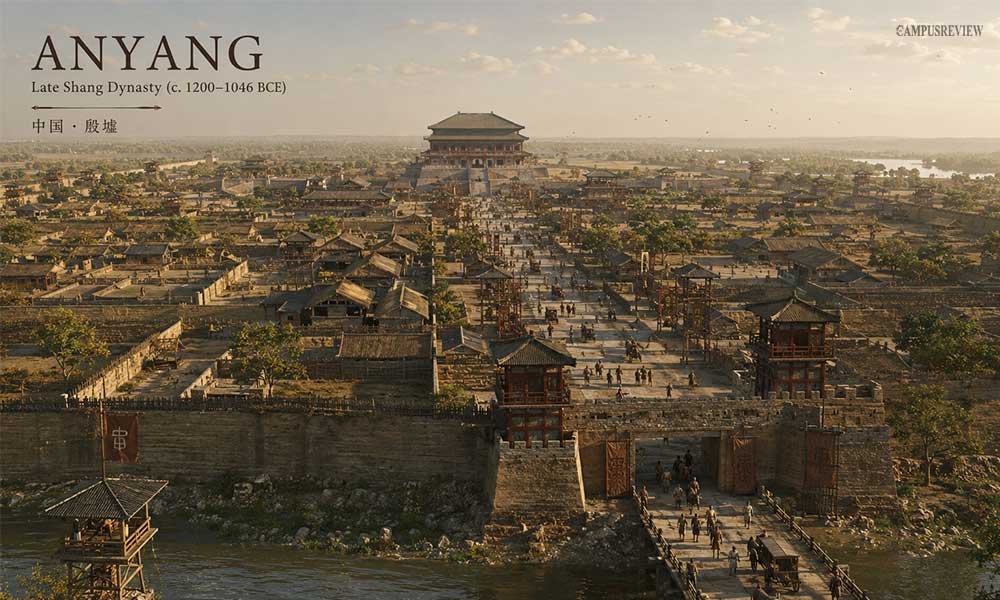
Anyang is one of the oldest cities in China. It served as Yinxu, the last capital of the Shang Dynasty, from around 1600 to 1046 BC. Anyang Shang Dynasty ruins remain one of the richest archaeological sites in the country. The city grew along river terraces, with separate zones for the royal palace, sacrifice sites, bronze workshops, and craft quarters.
Workers found oracle bones here in the late 1800s. People carved questions onto turtle shells and animal bones, then heated them until they cracked, and read the cracks for answers. These bones hold the earliest written Chinese language we know of. Digs at Anyang also uncovered advanced bronze work, chariot parts, and evidence of large ritual sacrifices, showing just how developed Shang society already was.
4. Kaifeng
Key facts:
- Capital of the Northern Song Dynasty
- First major city to open street markets to the public
- Sat at the crossing point of four canals, including the Bian Canal
- Known for its round-the-clock night markets
Kaifeng was the capital during the Northern Song Dynasty. Kaifeng Song Dynasty life looked very different from older capitals like Chang’an.
Older cities kept shops locked inside walled markets with fixed hours. Kaifeng tore those walls down. Shops, restaurants, and entertainment venues called wazi opened right onto the street, day and night. This made Kaifeng one of the busiest and most commercial cities of its time.
Four canals met at Kaifeng, including the Bian Canal, part of the larger Grand Canal system. Boats brought grain, silk, and goods from the south straight to the capital. This constant flow of trade turned Kaifeng into a dense, wealthy city and an early model of a modern commercial hub.
5. Nanjing
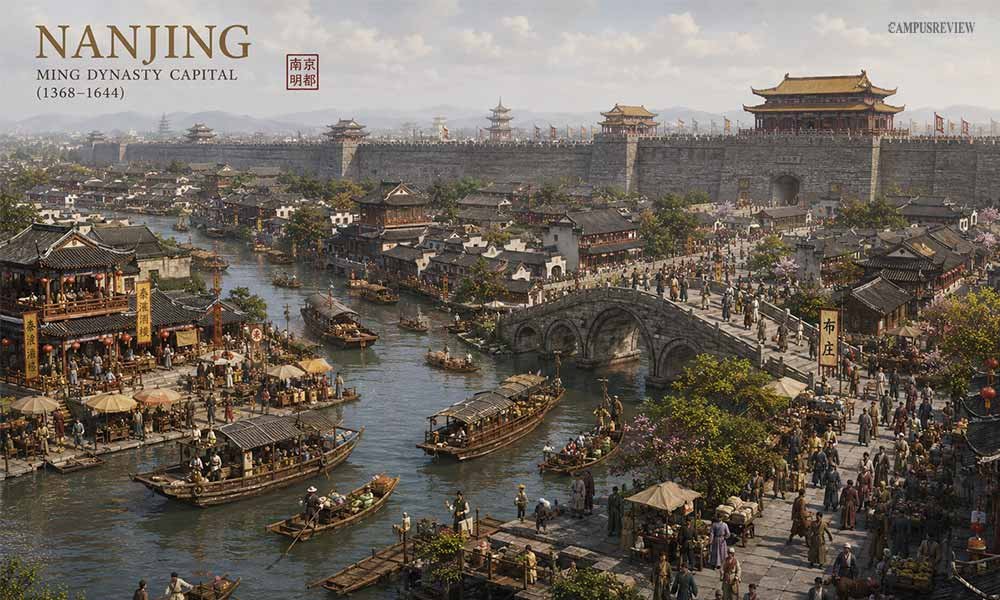
Key facts:
- Capital during the Six Dynasties period and the early Ming Dynasty
- City wall stretched over 35 kilometers
- Also known as Jiankang and Jinling
- Its design directly shaped the later capital at Beijing
Unlike the flat, grid-shaped capitals inland, Nanjing’s planners worked around the land they had. The city wall bent to fit the Yangtze River, Xuanwu Lake, the Qinhuai River, and the ridges of Purple Mountain. Early Ming rulers built a huge brick wall around the city that stretched more than 35 kilometers, one of the longest city walls ever built.
Later, the Yongle Emperor moved the capital north to Beijing. But he took Nanjing’s palace layout and wall-building methods with him, so Nanjing’s design lived on in the new capital.
6. Beijing (Late Imperial Period)
Key facts:
- Capital of the Yuan (as Dadu), Ming, and Qing dynasties
- Home to the Forbidden City
- Central Axis named a UNESCO World Heritage Site in 2024
- Built using four nested city walls around a central axis
Beijing became the capital of the Yuan Dynasty, when it was called Dadu, and later the Ming and Qing dynasties. Its layout followed strict rules passed down from older cities, built around order, balance, and defense against northern invaders.
The city had four rings, one inside the other: the Outer City, the Inner City, the Imperial City, and the Forbidden City at the center. The Forbidden City’s history goes back to the Ming Dynasty, when it became the emperor’s private home and the seat of government.
A straight line called the Central Axis runs 7.8 kilometers through Beijing, from the Bell and Drum Towers in the north to Yongdingmen Gate in the south. Important sites balance each other along this line, including the Temple of Heaven on one side and the Altar of the God of Agriculture on the other. In 2024, UNESCO added the Central Axis to its World Heritage List.
7. Hangzhou
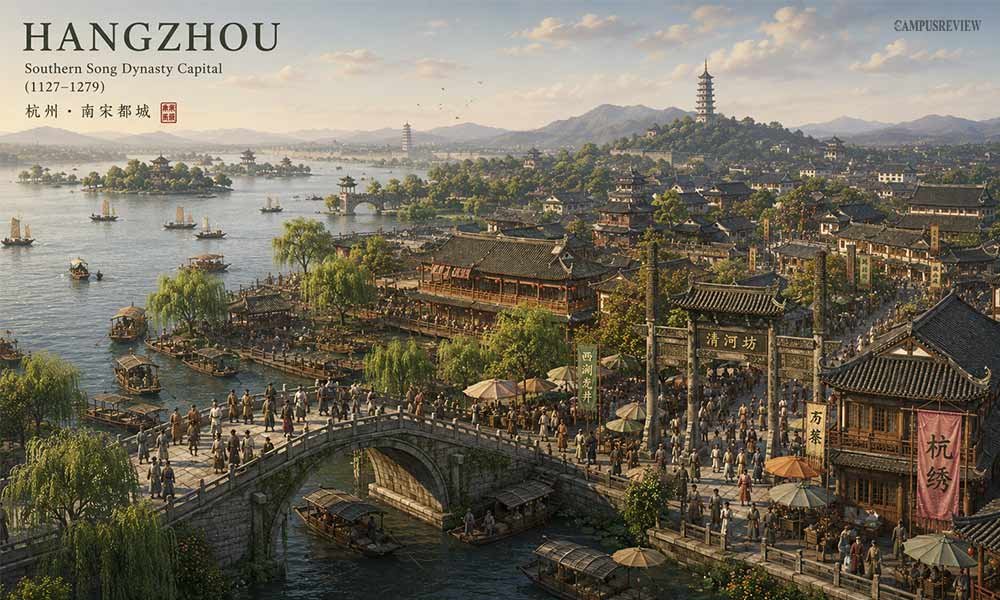
Key facts:
- Capital of the Southern Song Dynasty, known as Lin’an
- Famous for silk manufacturing and tea trade
- Located next to West Lake, at the end of the Grand Canal
- Praised by Marco Polo as a world-class city
Hangzhou became the capital of the Southern Song Dynasty after the Song court was pushed south. People called it Lin’an at the time. The city sits beside the beautiful West Lake, and its streets followed the shape of the lake and the Qiantang River instead of a strict square grid.
Hangzhou grew rich from silk manufacturing and the regional tea trade, helped by its position at the southern end of the Grand Canal.
When the explorer Marco Polo visited in the late 1200s, he called it one of the grandest cities in the world, describing its canals, paved streets, and busy markets. Nearby, the ancient Liangzhu ruins show that people were building advanced water systems in this region as far back as 5,000 years ago.
8. Chengdu
Key facts:
- Capital of the Shu Kingdom during the Three Kingdoms period
- Home to the Dujiangyan Irrigation System, still in use today
- Known as the “Land of Abundance”
- Center for silk weaving, early paper money, and the Southern Silk Road
Chengdu served as the capital of the Shu Kingdom during the Three Kingdoms period. It sits in the fertile Sichuan Basin and has kept the same name and location for more than two thousand years, which is rare for a Chinese city.
An engineer named Li Bing built the Dujiangyan Irrigation System here in the 3rd century BC. It split and controlled the Min River without using a dam, and it still works today. This system stopped flooding and turned the Chengdu Plain into one of the richest farming regions in China, earning it the nickname the Land of Abundance.
Chengdu also became a center for silk brocade weaving and early paper currency, and it linked inland China to the Southern Silk Road, a separate trade route running toward Southeast Asia and India.
9. Pingyao
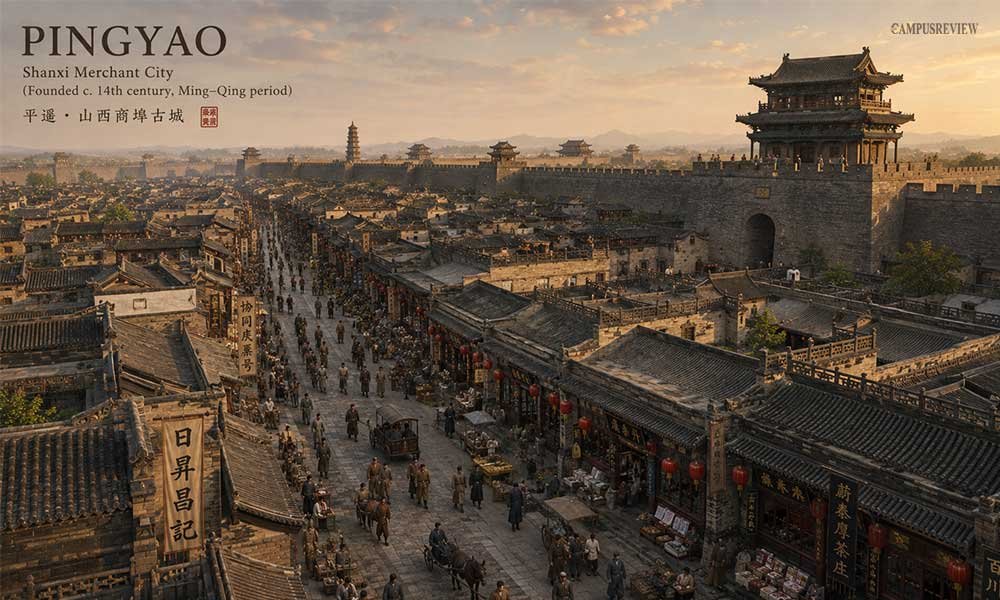
Key facts:
- Best-preserved walled city in ancient China
- Home to Rishengchang, China’s first draft bank
- Full 6-kilometer city wall with 72 watchtowers still stands
- UNESCO World Heritage Site since 1997
Pingyao is the best-preserved ancient walled city in China. Built up during the Ming and Qing dynasties, it still has its full 6-kilometer wall standing, complete with 72 watchtowers and thousands of battlements along the top.
Inside the walls, Pingyao keeps its original grid of cobblestone streets, courtyard homes called siheyuan, and government offices called yamen. In the 1800s, Pingyao became a banking hub. Rishengchang, China’s first formal draft bank, opened here and built a network of branches that let merchants transfer money safely across the country without carrying cash.
10. Dunhuang
Key facts:
- Western gateway of the Silk Road
- Home to the Mogao Caves and the Dunhuang Library Cave
- Mix of Buddhist, Persian, and Central Asian culture
- Started as a Han Dynasty military post under Emperor Wu
Dunhuang sits at a desert oasis in Gansu province, at the narrow neck of the Hexi Corridor. It started as a Han Dynasty military post under Emperor Wu and grew into the western gateway of the Silk Road, the point where the northern and southern trade routes split to go around the Taklamakan Desert.
The city welcomed Buddhist monks from South Asia, Persian traders, and Central Asian artists. Their legacy lives on in the Mogao Caves, a complex of hand-carved cliff shrines filled with ancient Buddhist wall paintings and statues. One hidden chamber, called the Dunhuang Library Cave, held thousands of old manuscripts written in several ancient languages.
Timeline of Major Ancient Chinese Capitals
This timeline highlights how different cities of ancient China served as imperial capitals during successive dynasties.
| Dynasty | Capital(s) | Years |
| Shang | Anyang | 1600-1046 BC |
| Zhou | Luoyang | 1046-256 BC |
| Qin | Xianyang | 221-206 BC |
| Han | Chang’an, Luoyang | 202 BC-220 AD |
| Tang | Chang’an | 618-907 AD |
| Song | Kaifeng, Hangzhou | 960-1279 AD |
| Ming | Nanjing, Beijing | 1368-1644 AD |
| Qing | Beijing | 1644-1911 AD |
Each of these historical cities of ancient China grew for a different reason: defense, trade, farming, or faith. Together, they rank among the most famous ancient Chinese cities and show how Imperial China organized power across three thousand years of dynasties.
Final Thought
The cities of ancient China were more than political capitals. Much like the cities of ancient Mesopotamia, the cities of ancient China demonstrate how geography, trade, and strong governance influenced the rise of early civilizations.
From the bustling streets of Chang’an and the royal palaces of Luoyang to the archaeological treasures of Anyang and the Silk Road hub of Dunhuang, each city played a unique role in the growth of ancient Chinese civilization.
Today, these ancient Chinese cities continue to preserve the legacy of powerful Chinese dynasties, remarkable architecture, and rich cultural traditions.
FAQs
1. Which city was the first capital of ancient China?
There was no single first capital of ancient China. However, Anyang, the last capital of the Shang Dynasty, is one of the earliest well-documented capital cities and is famous for its oracle bones and archaeological discoveries.
2. Which ancient Chinese city is best preserved?
Pingyao is considered one of the best-preserved ancient walled cities in China. Its Ming and Qing Dynasty architecture and city walls have earned it UNESCO World Heritage status.
3. What is the difference between Chang’an and Xi’an?
Chang’an was the historical name of the ancient imperial capital, while Xi’an is its modern name. The city remains one of China’s most important historical and cultural destinations.
4. Are any cities of ancient China still inhabited today?
Yes. Many cities of ancient China, including Xi’an, Luoyang, Nanjing, Beijing, Hangzhou, Chengdu, and Kaifeng, are modern cities that continue to thrive while preserving important historical sites.