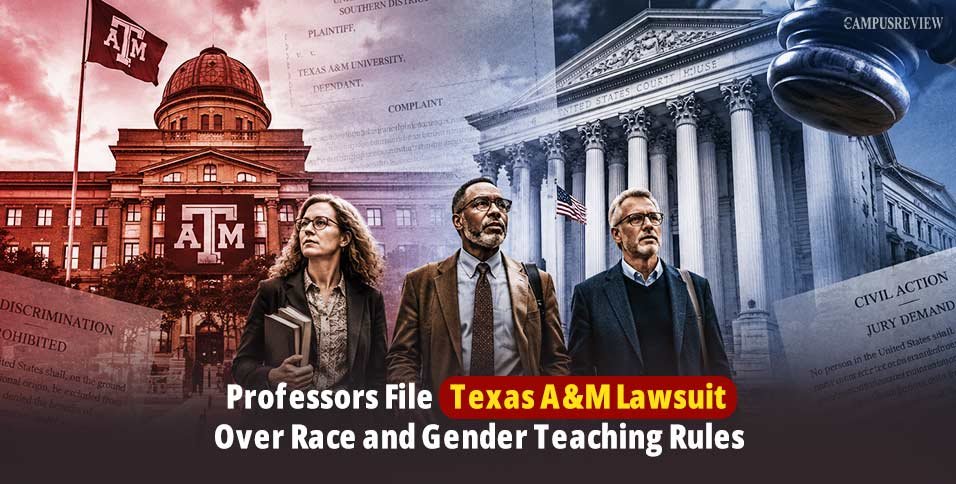
A national faculty organization and four university educators have filed a federal lawsuit against the Texas A&M University System, challenging policies that limit how instructors teach topics related to race, gender, and sexual orientation.
The Texas A&M lawsuit, filed in the U.S. District Court for the Southern District of Texas, argues the rules violate the First Amendment and create a chilling effect across the system’s 12 public universities. Supporters say the policies promote viewpoint neutrality and accountability, while critics argue they restrict academic freedom.
Details of the Legal Challenge
The following summary outlines the primary facts of the case:
| Feature | Detail |
| Plaintiffs | American Association of University Professors (AAUP) and four faculty members |
| Defendants | Board of Regents of the Texas A&M University System |
| Court Venue | U.S. District Court, Southern District of Texas (Houston) |
| Core Issue | Systemwide restrictions on race and gender teaching |
| Scope | All 12 public universities in the Texas A&M System |
| Legal Action | Request for injunction and restoration of canceled courses |
What Triggered the Texas A&M Lawsuit?
The dispute stems from syllabus review policies adopted by the Board of Regents in late 2025.
According to the Texas A&M lawsuit, the policies require presidential approval for certain graduate and non-core courses on race or gender identity and prohibit these topics in core undergraduate courses. The plaintiffs cite several examples of course changes following syllabus reviews:
- Graduate Ethics: According to the complaint, a specialized graduate ethics course at the Bush School of Government was canceled for noncompliance.
- Classical Literature: Plaintiffs state instructors were ordered to remove passages from Plato’s Symposium discussing gender roles.
- Historical Analysis: The lawsuit alleges instructors had to remove historical texts like Kevin Kruse’s White Flight from reading lists.
- Cinema Studies: Film curricula lost access to the Oscar-winning movie Moonlight, according to the filing.
- Academic Programs: The complaint asserts that the university system eliminated its Women’s and Gender Studies program.
Examples Cited in the Texas A&M Lawsuit
Note: According to the complaint, faculty members argue the policy permits or discourages classroom discussions such as those below.
| Subject Area | Alleged Permitted Approach | Alleged Restricted Approach |
| Gender Identity | Instruction asserting biological sex and gender are identical | Instruction discussing a distinction between sex and gender identity |
| Constitutional History | Teaching Phyllis Schlafly’s critique of the Equal Rights Amendment | Teaching Fourteenth Amendment expansions for LGBTQ+ rights |
| Racial History | Lessons presenting systemic racism as a non-existent concept | Lessons asserting systemic racism exists or causes inequality |
| Social Movements | Descriptive lectures without student action projects | Assignments that promote civic activism on racial topics |
Because instructors cannot determine exact legal boundaries, plaintiffs argue that the policy has led many instructors to self-censor to avoid disciplinary action.
Why Texas A&M Professors Are Fighting Back
Four Texas A&M professors joined the suit as co-plaintiffs alongside the AAUP:
- Dr. Leonard Bright (Professor of Public Service, Texas A&M College Station)
- Dr. Vanita Reddy (Associate Professor of English, Texas A&M College Station)
- Dr. Landon Sadler (Instructional Assistant Professor, Texas A&M College Station)
- Dr. Aaron George (Assistant Professor of History, Tarleton State University)
The plaintiffs argue that university classrooms must remain open spaces for critical inquiry rather than administratively monitored environments.
“My ethics course, the only one of its kind available to graduate students, was canceled for noncompliance with a draconian censorship policy. This policy has impacted my ability to do my job, my students’ ability to learn, and my colleagues’ ability to teach without fear of reprisal.”
- Dr. Leonard Bright, Lead Plaintiff and AAUP Chapter President
“By embarking on a campaign of censorship, Texas A&M has abdicated its responsibility to support students’ right to learn and faculty’s right to teach. A university that censors Plato abandons its obligation to truth, free inquiry, and the public trust.”
- Todd Wolfson, President of the AAUP
Legal counsel representing the educators emphasized that viewpoint discrimination hurts public education.
“This broad policy and the university’s opaque enforcement process makes it impossible to teach or to learn freely. It endangers course content about everything from the history of slavery to Shakespeare to the hard sciences.”
- Emerson Sykes, Senior Staff Attorney at the ACLU
Broader Impacts on Higher Education Academic Freedom
Texas A&M lawsuit adds to a broader national debate over higher education academic freedom and state oversight of public universities. It also comes amid increased federal scrutiny of university policies, including the recent medical schools investigation into race-based admissions.
The outcome of this academic freedom lawsuit could set a clear legal precedent. If the federal court upholds the policy, other public systems may adopt similar guidelines. If the judge strikes down the rules, university leaders will face strict limits on how much they can regulate classroom speech.
The plaintiffs seek three specific outcomes from the federal court:
- A formal declaration that the censorship policy violates the First and Fourteenth Amendments.
- An immediate injunction blocking university regents from enforcing Texas A&M teaching restrictions.
- An order requiring the university system to restore all canceled courses and banned texts.
The University System’s Response
In response to the lawsuit, representatives for the Texas A&M System defended their administrative actions. The Texas A&M System maintains that its policies comply with state requirements while protecting educational standards.
“We believe this lawsuit is without merit, and the system will vigorously defend its policies and procedures. The A&M System remains focused on the important work of supporting our students and fulfilling our duty to the state.”
Chris Bryan, Vice Chancellor for Marketing and Communications, Texas A&M System
System leaders contend that public universities must ensure classroom instruction aligns with state standards. However, faculty members argue that rigid policy controls compromise student preparation for the workforce.
Looking Ahead
Both legal teams are gathering evidence regarding course changes and syllabus audits for the federal court review. The court will next consider whether to grant the plaintiffs’ request for preliminary relief while the case proceeds.
The outcome of the Texas A&M lawsuit could shape how public universities across Texas and beyond balance administrative oversight with faculty academic freedom.