The Campus Review
October 16, 2026
The Supreme Court of India has ruled that self-financing higher education institutions cannot ordinarily increase fees midway through professional courses, except in exceptional circumstances, such as unforeseen expenditure.
The SC ruling on college fees also directs fee-fixation authorities to notify the fees for the entire course before admissions begin, giving students and families greater financial certainty.
Delivered on October 14, 2026, the judgment arose from a dispute involving private engineering colleges in West Bengal that increased fees after students had enrolled. The Court upheld the decision that the revised fees could not be imposed midway through the existing batch.
Key Findings of the Supreme Court Fee Hike Ruling
The judgment in Dr. B.C. Roy Engineering College and Another v. State of West Bengal and Others (2026 INSC 1120) clarified the rules governing fees at self-financing professional institutions.
- Advance Fee Notification: Authorities must notify the fees payable for the entire course before students take admission.
- Restriction on Mid-Course Hikes: Colleges cannot routinely increase fees after a course has begun.
- Exceptional Circumstances: Mid-course fee revisions are permissible only in exceptional situations, such as unforeseen increases in expenditure.
- Timely Fee Reviews: Fee-fixation committees must assess costs and make recommendations early enough for authorities to determine fees before admissions.
- Regulatory Accountability: High Courts can review whether fee-fixation committees perform their duties efficiently, with appropriate expertise and integrity.
What the SC Ruling on College Fees Clarifies
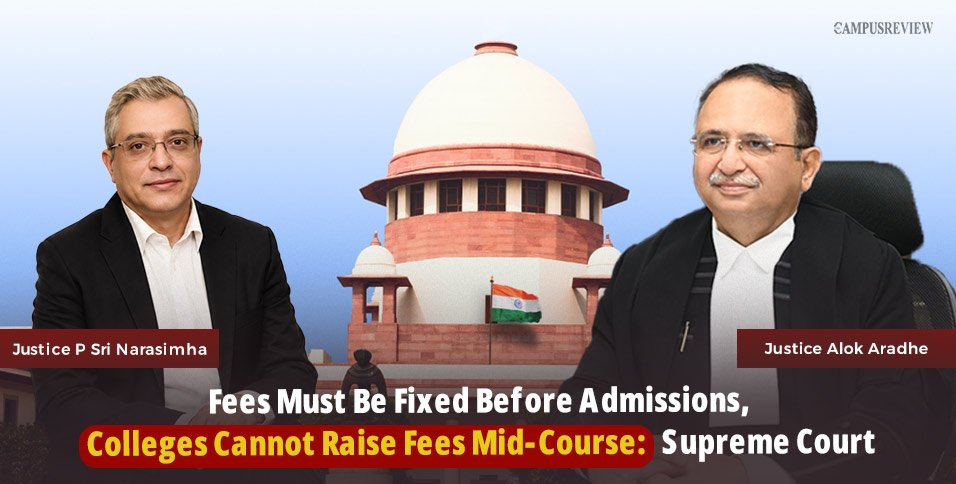
The bench comprising Justice Pamidighantam Sri Narasimha and Justice Alok Aradhe emphasised that students should understand the financial commitment involved before enrolling in a professional programme.
The judgment stated: “A student entering a four-or five-year professional programme should ordinarily know, at the very threshold, the financial liability that they or their family is undertaking.”
The Court said fee regulation must balance students’ need for reasonable, predictable fees with private institutions’ need for adequate resources to maintain infrastructure and provide quality education.
Background of the West Bengal Engineering College Dispute
West Bengal revised the maximum fees for private engineering colleges on October 16, 2023, after admissions for the 2023–2027 B.Tech batch at Dr. B.C. Roy Engineering College had concluded. The college applied the new fee structure from the second semester, reportedly increasing fees by 37.5%.
Students challenged the increase, and the Calcutta High Court ruled that the revised fees could apply only to students admitted on or after the notification date. The Supreme Court upheld the final directions, confirming that the increase could not be imposed midway through the existing batch.
What AICTE Regulations Say About Fee Fixation
The Court referred to the All India Council for Technical Education (AICTE) Regulations, 1994, which establish requirements for fee fixation and notification.
- Regulation 7(4): Fees must be fixed at least once every three years, or at longer intervals if the committee considers them appropriate.
- Regulation 7(7): The fees chargeable for the entire course must be notified in advance.
The judgment highlighted delays in West Bengal’s fee-revision process. The fee structure had not been updated since 2016, contributing to uncertainty when the revised notification was issued after the relevant batch had secured admission.
The SC ruling on college fees emphasises that fee-fixation committees and regulatory authorities must assess and announce fees before admissions, allowing students to understand the full cost of a professional course before enrolling.
When Can Colleges Increase Fees Mid-Course?
The Supreme Court did not provide an exhaustive list of exceptional circumstances. It clarified that colleges may change fees during an ongoing course in exceptional cases, including unforeseen increases in expenditure.
Such changes must remain exceptions, not routine adjustments. Institutions must operate within the applicable regulatory framework, and fee authorities should account for foreseeable costs when determining course fees in advance.
What Students Can Do if Their College Raises Fees
Students facing a mid-course fee increase can take the following steps:
- Check admission documents: Review the original fee schedule, admission notice, and allotment documents.
- Verify the notification: Check the applicable state fee committee or higher education department’s orders.
- Confirm batch applicability: Determine whether the revised fee structure covers continuing students or only new admissions.
- Request written clarification: Ask the college to explain the regulatory basis for the increase.
- Approach the relevant authority: If the issue remains unresolved, contact the competent state fee committee or applicable grievance-redressal body.
End Note
The SC ruling on college fees reinforces the need for fee transparency in professional education. By requiring authorities to announce course fees before admission and restricting mid-course increases to exceptional circumstances, the judgment aims to provide students with financial certainty while recognising the funding needs of self-financing institutions.
Pranjal Kharche
Also Read – Scientists Discover 150-Million-Year-Old Jurassic Bird Fossil That May Have Walked Rather Than Flown