The Campus Review
August 24, 2026
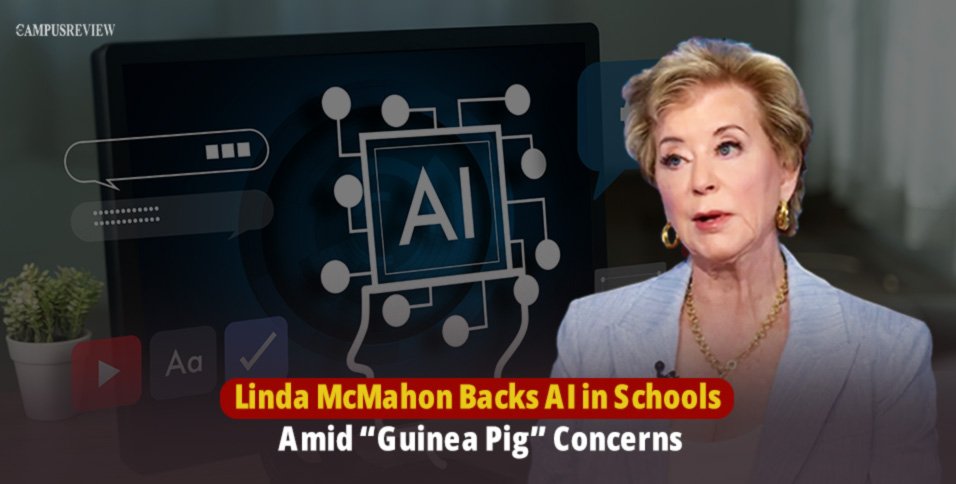
U.S. Education Secretary Linda McMahon supports the use of AI in schools and computer-assisted tutoring. However, she acknowledges that long-term data on its academic effectiveness remains limited. During an August 2026 appearance on CNN’s State of the Union with Dana Bash, McMahon addressed concerns that students could become digital test subjects as schools adopt AI.
McMahon pointed to Austin’s private Alpha School as an example of AI-assisted learning. She called for a careful rollout of generative AI in education, with clear guardrails, parental opt-out rights, and continued human involvement in the classroom.
Key Takeaways: What You Need to Know
- Federal Stance on AI: Secretary Linda McMahon confirmed federal support for artificial intelligence in K-12 education, describing adaptive software as an effective tool when adopted gradually.
- Limited Long-Term Metrics: Responding to concerns about students serving as test subjects, McMahon acknowledged the current lack of multi-year metrics and stated that underperforming products should be removed.
- The Alpha School Reference: McMahon cited Austin’s Alpha School, where students complete core academics on computers in a two-hour morning block before moving to practical life skills.
- The Debate Over Guardrails: While McMahon supports technology in classrooms with guardrails, social psychologist Jonathan Haidt argues schools should keep AI away from elementary students until safety is proven.
Policy Perspectives on Classroom AI
| Factor | Department of Education Stance | Independent Critics & Child Advocates |
| Instructional Focus | Personalized learning with AI to match individual student pace. | Safeguard developmental milestones, deep reading, and critical thinking. |
| Classroom Role | AI tools support foundational drills and individualized practice. | Guard against AI classroom tools reducing direct teacher-led instruction. |
| Screen Time | Differentiates instructional screen time from recreational device use. | Warns against excess total screen exposure and passive dependency. |
| Deployment Strategy | Encourages adoption while monitoring outcomes and establishing guardrails. | Demands strict AI safeguards for students before broad elementary integration. |
What Linda McMahon Said About AI in Schools
During her CNN interview with Dana Bash, McMahon emphasized that artificial intelligence can provide targeted instructional support if districts implement sensible limitations:
“So it’s A.I. with guardrails. And as we introduce it, I think, slowly in schools, it can be a very effective tool used properly.”
McMahon stressed that software cannot substitute for classroom teachers or peer collaboration:
“Human interaction is incredibly important. So, the use of A.I. is a balance… Nothing should replace that one-on-one teacher interaction with students, because they need that. Students need to be able to communicate with each other. And they need to have that interaction.”
Addressing parent concerns regarding untested tools, McMahon affirmed family rights:
“If the parent is not seeing that outcome, the parent has every right to go in and say, no, I want something different for my child.”
Why McMahon Pointed to Alpha School
To demonstrate personalized learning with AI in practice, McMahon pointed to her visit to Alpha School in Austin, Texas:
- Two-Hour Core Block: Students wear headphones and complete core academic subjects through adaptive software during the first two hours of the school day.
- Teacher Supervision: Teachers monitor student progress and intervene when students need direct support.
- Life Skills Focus: The remainder of the day focuses on public speaking, collaborative projects, and practical life skills.
“After this two-hour block, then the rest of the day is spent in the application of what they’re learning. And so it’s incredibly effective for this school, for these students. And I’m not saying that works everywhere.”
The private-school model also raises questions about how easily similar approaches could scale across the broader U.S. education system.
Why Critics Are Raising “Guinea Pig” Concerns
When Dana Bash asked directly whether children are serving as “guinea pigs for chatbots,” McMahon acknowledged the current gap in longitudinal research:
“There aren’t a lot of metrics available now. And I think that’s what we really have to look at as these ed tech companies are introducing these new products to see, what is the effectiveness? Are we seeing better outcomes in schools? And if we’re not, then they should be pulled out.”
Social psychologist Jonathan Haidt has argued for greater caution around AI in K-12 education, recommending that districts keep AI chatbots away from elementary school students until substantial evidence confirms their educational value and safety.
This concern is particularly relevant to preschool education, where early learning and child development remain closely tied to human interaction.
Key risks identified by researchers include:
- Unverified Long-Term Impact: The long-term impact of AI on learning, focus, and cognitive retention remains untested across large student populations.
- Hallucinations and Inaccuracies: AI chatbots can deliver inaccurate information during foundational lessons.
- Passive Shortcuts: Over-reliance on tools like ChatGPT for homework completion can bypass critical thinking and writing practice.
- Social Isolation: Individual computer work risks reducing everyday communication between peers.
What McMahon and Haidt Agree On
Despite opposing views on rollout speed, McMahon and Haidt share common ground: digital tools must never replace human relationships in education. McMahon supports careful, guardrailed adoption, while Haidt urges waiting for rigorous data before bringing software to younger grades. Both maintain that child development and human mentorship remain the central priorities.
The Path Forward
The national debate over AI in schools centers on balancing digital personalization with the proven needs of child development. As states refine classroom guidelines, maintaining human-centered instruction and clear safety standards will determine whether artificial intelligence improves student learning outcomes.