The Campus Review
September 1, 2026
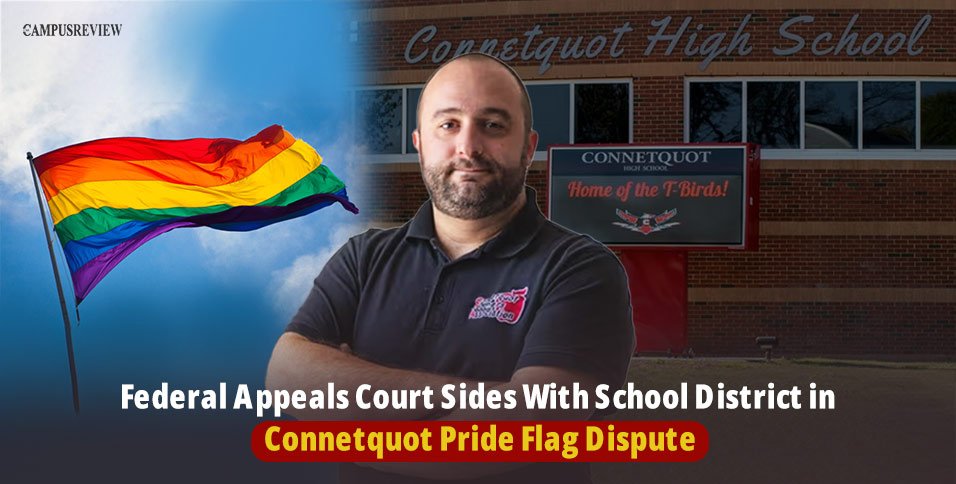
A federal appeals court has sided with the Connetquot Central School District in the Connetquot Pride flag dispute over the display of Pride flags and stickers in high school classrooms. The U.S. Court of Appeals for the Second Circuit upheld the dismissal of a lawsuit filed by three teachers who challenged the district’s order to remove the displays.
The court ruled that the classroom displays constituted government speech and could be regulated by the district because they were connected to the teachers’ professional responsibilities. However, the ruling does not give schools control over all forms of teacher expression. The court distinguished classroom decorations from personal items such as Pride pins, family photos, and religious clothing.
Key Facts of the Connetquot Pride flag dispute
| Detail | Specific Court Finding |
| Case Focus | Dispute over Pride flags, stickers and signs displayed in classrooms |
| School District | Connetquot Central School District (Long Island, New York) |
| Court & Date | U.S. Court of Appeals for the Second Circuit; decision issued August 31, 2026 |
| Legal Classification | Wall and door decorations classified as school-regulated government speech |
| Protected Personal Items | Distinct boundaries maintained for pins, personal photos, and attire |
| Extracurricular Context | Displays permitted during voluntary Gay-Straight Alliance club meetings |
The Background Behind the Connetquot Pride Flag Case
The controversy began in fall 2022 when administrators at Connetquot High School directed a mathematics instructor to remove a Progress Pride flag hanging in her classroom. The directive followed community discussions and questions regarding visual materials displayed inside instructional areas.
When the instructor declined to take down the display, administrators cited district policies governing classroom displays and non-curricular materials. Two additional instructors joined the challenge after receiving directives regarding Pride stickers and signs on their classroom doors.
Assistant Superintendent Reza Kolahifar explained the district’s position in a message to staff, writing, “The only flags that should be hung in a classroom or office are the American flag and the New York State flag.”
The teachers filed a federal civil rights lawsuit against the Connetquot School District. The teachers argued that the directives violated their constitutional rights and restricted their ability to create an inclusive classroom environment for students, an issue that also connects to broader concerns about student mental health in schools.
The district responded that public school classrooms serve as instructional spaces where the school board maintains oversight over visible environment decor.
Timeline of Key Legal Milestones:
- Fall 2022: School administrators direct a teacher to remove a Progress Pride flag.
- Late 2022: Three teachers file a federal civil rights lawsuit against the district.
- April 2025: U.S. District Court for the Eastern District of New York dismisses the lawsuit.
- August 31, 2026: The Second Circuit affirms the dismissal in favour of the school district.
Why the Court Treated Classroom Displays as Government Speech
The Second Circuit evaluated the claims by examining how public employment intersects with constitutional protections. The central legal inquiry focused on whether decorating instructional walls constitutes private citizen expression or official duties carried out on behalf of the public school system.
The court directly addressed whether the same government-speech principle applies to classroom displays. Circuit Judge Alison Nathan wrote,
“The question in this case is whether that same principle applies to displays hung on the walls of a public high school teacher’s math classroom. We hold that it does.”
The court established several key findings:
- Government Speech: The court treated the classroom wall and door displays as government speech because they were connected to the teachers’ professional responsibilities and the instructional environment.
- Personal Expression Distinctions: The court maintained clear legal boundaries between wall and door decorations and personal items such as clothing, pins, or personal photos, which were not at issue in this specific ruling.
- Extracurricular Settings: The court noted that policies governing instructional hours do not automatically restrict extracurricular activity. For instance, teachers can display the Progress Pride flag during voluntary Gay-Straight Alliance club meetings held outside regular class time.
By focusing strictly on wall and door decorations in instructional spaces, the court ruled that the district did not infringe upon protected teacher First Amendment rights.
What the Ruling Does Not Mean
To prevent misinterpretations about teacher free speech and wider LGBTQ rights in schools, the decision also draws important boundaries around what the ruling covers:
- No Total Control Over Expression: The ruling does not mean schools can regulate every form of teacher expression or personal belief.
- Specific to Walls and Doors: The decision specifically addresses classroom wall and door displays used during regular instructional periods.
- Personal Items Remain Distinct: Personal expression, such as clothing, Pride pins, or personal family photographs, can raise different First Amendment questions that this ruling does not eliminate.
- Extracurricular Separation: The court distinguished standard classroom displays from expression connected to voluntary extracurricular activities and student clubs.
What Could This Mean for Other Schools?
For school districts within the Second Circuit, the Second Circuit ruling provides additional guidance on how classroom wall and door displays may be treated under the First Amendment. It also strengthens the district’s position that these displays can be regulated as part of the instructional environment.
However, schools outside the Second Circuit must evaluate this classroom Pride flag dispute and similar controversies under their own circuit precedent, state laws, local school board policies, and the specific facts of each case.
For education professionals and school boards navigating policies on Pride flags in schools, the Connetquot Pride flag dispute reinforces a central First Amendment question: where does an educator’s personal expression end and school-sponsored speech begin? The answer can depend on the setting, the nature of the display, and the teacher’s professional role.