Why does a desert feel nothing like a rainforest? The answer lies in the ecosystem. Ecosystems are broadly classified into natural and artificial ecosystems. Natural ecosystems include terrestrial (land) and aquatic (water) ecosystems, while farms, parks, and aquariums are examples of artificial ecosystems.
This guide explains the main types of ecosystems, their examples, key species, components, and ecosystem services.
What Is an Ecosystem?
An ecosystem is a community of living organisms that interact with each other and with their physical surroundings. An ecosystem can be as small as a rotting log or as large as an ocean. Every ecosystem has four basic parts:
- Biotic factors: Biotic factors are the living parts of an ecosystem, such as plants, animals, fungi, and bacteria. Example: Grass and the zebras that eat it.
- Abiotic factors: Abiotic factors are the non-living parts of an ecosystem, such as sunlight, water, soil, temperature, and air. Example: Rainfall decides whether a forest or a desert forms.
- Energy flow: Energy flow is the movement of energy from the sun to plants and then to the animals that eat them. Example: Grass feeds a grasshopper, and a frog eats the grasshopper.
- Nutrient cycling: Nutrient cycling is the process in which decomposers return nutrients from dead matter to the soil so plants can grow again. Example: Fungi break down a fallen leaf.
Scientists call these processes ecosystem functions.
How Many Types of Ecosystems Are There?
Types of Ecosystems fall into two main categories: natural and artificial. Natural ecosystems include seven common types: forest, grassland, desert, tundra, mountain, freshwater, and marine. The table below compares these ecosystem types at a glance.
| Ecosystem Type | Climate | Example Locations | Key Species |
| Forest | Warm and wet to cold and snowy | Amazon rainforest, Siberian taiga | Jaguars, sloths, wolves, moose |
| Grassland | Mild to warm, moderate rain | African savanna, North American prairie | Zebras, lions, bison, prairie dogs |
| Desert | Very dry, hot or cold | Sahara, Thar, Gobi | Camels, cacti, fennec foxes |
| Tundra | Very cold, frozen ground | Arctic tundra in Alaska and Siberia | Reindeer, Arctic foxes, snowy owls |
| Mountain | Cold and windy, changes with height | Himalayas, Andes, Alps | Snow leopards, yaks, mountain goats |
| Freshwater | Low salt content | Rivers, lakes, ponds, wetlands | Trout, frogs, otters, water lilies |
| Marine | Saltwater | Oceans, coral reefs, mangroves | Corals, sharks, clownfish, whales |
What Are Natural Ecosystems?
A natural ecosystem is a community of living organisms and non-living elements that interact naturally without being created or managed by humans. It maintains its own energy flow, water cycle, and balance of species.
Natural ecosystems are broadly divided into two groups:
1. Terrestrial ecosystems (land ecosystems): Terrestrial ecosystems are ecosystems on land, where temperature and rainfall decide which plants grow. Example: Forests, grasslands, deserts, tundra, and mountains.
2. Aquatic ecosystems (water ecosystems): Aquatic ecosystems are ecosystems in water, where salt level, light, and oxygen decide who can live. Example: Rivers, lakes, oceans, and coral reefs.
Types of Terrestrial Ecosystems
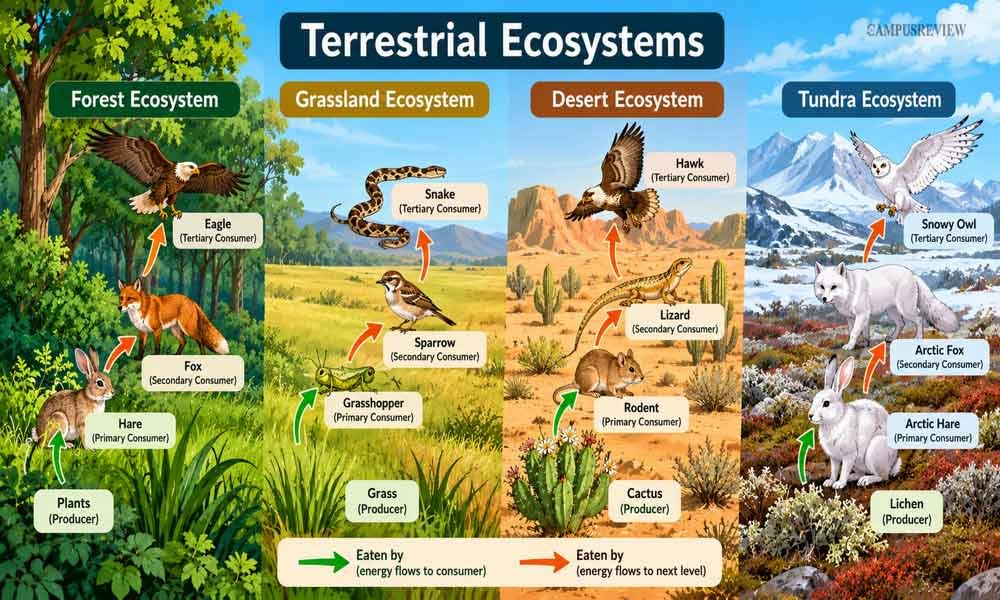
Five main types of terrestrial ecosystems exist: forest, grassland, desert, tundra, and mountain. Each type has its own climate, plants, and animals.
Forest Ecosystem
A forest ecosystem is a terrestrial ecosystem dominated by trees, where plants, animals, fungi, and other organisms interact with their physical environment. Forests store carbon, release oxygen, and protect soil and water.
Forest ecosystem examples fall into three main kinds:
• Tropical rainforest: A tropical rainforest is a dense forest ecosystem near the equator with warm temperatures and heavy rainfall all year. Tall evergreen trees form layered canopies, and tropical rainforests rank among the richest places on land for species. Example: The Amazon rainforest in South America.
• Temperate forest: A temperate forest is a forest ecosystem in the mid-latitudes with four distinct seasons and moderate rainfall. Many of its trees, such as oak and maple, shed their leaves in autumn. Example: The deciduous forests of Europe.
• Taiga (boreal forest): The taiga is a cold forest ecosystem in the far north with long, snowy winters and short, mild summers. Evergreen conifers such as spruce, pine, and fir dominate the taiga. Example: The Siberian taiga in Russia.
Grassland Ecosystem
A grassland ecosystem is a land ecosystem dominated by grasses, with few trees. A grassland receives too little rain for a forest and too much for a desert. Deep roots hold the soil in place, and grazing animals and natural fires stop trees from taking over.
Grassland ecosystem examples include two main kinds:
- Savanna: A savanna is a tropical grassland ecosystem with scattered trees and a clear wet season and dry season. Tall grasses feed huge herds of grazing animals. Example: The Serengeti in Tanzania, home to zebras, wildebeest, and lions.
- Prairie: A prairie is a temperate grassland ecosystem with tall grasses, rich dark soil, and hot summers and cold winters. Prairie soil is so fertile that farmers have turned much of it into cropland. Example: The North American prairie, home to bison and prairie dogs.
Desert Ecosystem
A desert ecosystem is a land ecosystem that gets very little rain, usually under 250 mm a year. Water is the limiting factor, so life depends on smart adaptations. Many desert animals hide underground by day and hunt at night.
Desert ecosystem examples include:
- Hot desert: A hot desert is a desert ecosystem with scorching days, cool nights, and sandy or rocky ground. Cacti store water in thick stems, and the fennec fox uses its huge ears to release heat. Example: The Sahara in Africa, which covers over 9 million square kilometres, and the Thar Desert in India.
- Cold desert: A cold desert is a desert ecosystem with low rainfall and freezing winters, often with snow. Plants and animals here survive long periods of cold and dryness. Example: The Gobi Desert in Asia.
Tundra Ecosystem
A tundra ecosystem is a cold, windy, treeless land ecosystem with a very short growing season. Only the top layer of soil thaws in summer, so roots stay shallow. Mosses, lichens, and low shrubs dominate. Tundra ecosystem examples include:
- Arctic tundra: Arctic tundra is a treeless ecosystem around the North Pole with long, freezing winters and short, cool summers. Example: Northern Alaska and Siberia, where reindeer, Arctic foxes, and snowy owls live.
- Alpine tundra: Alpine tundra is a treeless ecosystem on high mountains above the tree line, with cold, windy weather and thin air. Example: The high peaks of the Himalayas.
- Permafrost: Permafrost is ground that stays frozen for at least two years in a row. Permafrost locks away large amounts of carbon, and carbon dioxide and methane escape into the air when it thaws. Example: The thawing permafrost of Siberia.
Mountain Ecosystem
A mountain ecosystem is a terrestrial ecosystem that changes with altitude. As elevation increases, temperatures drop, and oxygen levels decrease, creating distinct zones where different plants and animals can survive.
A mountain ecosystem usually has three zones:
- Lower slopes: The lower slopes are the base zone of a mountain, where warmer temperatures let forests and farmland grow. Example: The foothill forests of the Himalayas.
- Alpine meadows: Alpine meadows are grassy zones above the tree line, where short grasses and wildflowers grow in cool, windy weather. Example: Yaks graze the high meadows of Tibet.
- Peaks: The highest mountain peaks are the highest zone, covered in bare rock, snow, and ice. Few plants survive there, but some animals hunt on the slopes below. Example: Snow leopards roam the rocky slopes of Central Asia.
Types of Aquatic Ecosystems
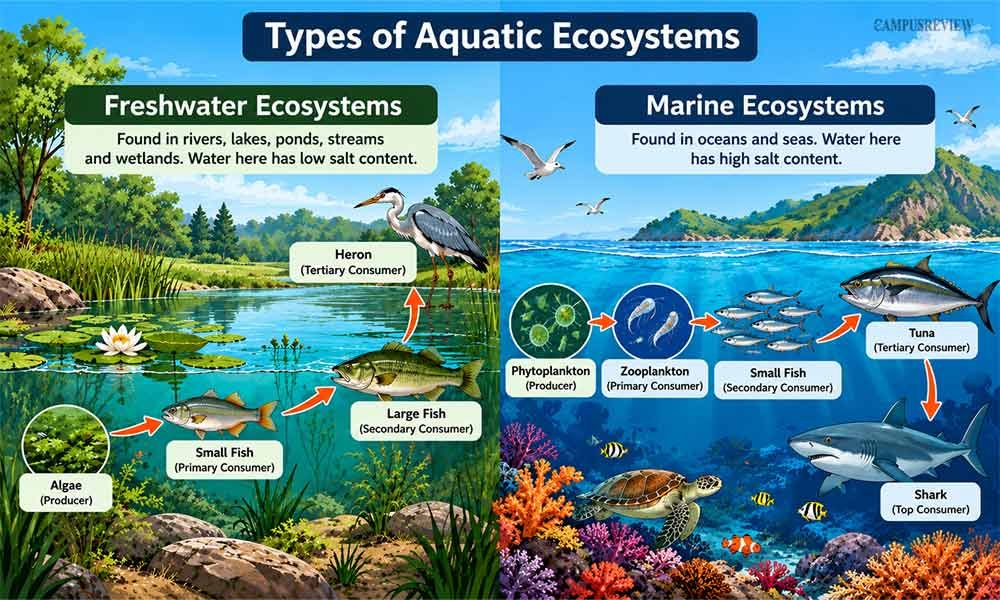
Two main types of aquatic ecosystems exist: freshwater ecosystems and marine ecosystems. Salt content is the main difference between them.
Freshwater Ecosystem
A freshwater ecosystem is a water ecosystem that holds water with very little salt. Freshwater
ecosystems cover a small share of Earth’s surface but support a wide range of life. People rely on freshwater ecosystems for drinking water, food, and farming. Freshwater ecosystem examples include:
- Rivers and streams: A river is a large stream of flowing freshwater that moves toward a lake, sea, or ocean. Fast, oxygen-rich water carries nutrients downstream. Example: The Ganga river system, home to river dolphins.
- Lakes and ponds: Lakes and ponds are bodies of still freshwater surrounded by land. Lakes are larger and deeper, and ponds are small and shallow. Example: Lake Victoria in Africa.
- Wetlands: Wetlands are areas where water covers the soil or stays near the surface for much of the year, such as marshes, swamps, and bogs. Wetlands filter pollution, soak up floods, and shelter young fish and birds. Example: The Okavango Delta in Botswana.
Marine Ecosystem
A marine ecosystem is a water ecosystem that holds saltwater, with about 3.5% salt. Oceans cover about 71% of Earth’s surface. Tiny floating algae called phytoplankton act as producers and feed everything from shrimp to whales. Marine ecosystem examples include:
- Open ocean: The open ocean is the vast saltwater zone far from the coast. Sunlight feeds life near the surface, and the deeper water is cold and dark. Example: The Pacific Ocean, home to whales, tuna, and sharks.
- Coral reef: A coral reef is an underwater ecosystem built from the hard skeletons of coral polyps, tiny animals that live in colonies in warm, shallow, clear water. Coral reefs shelter a huge share of marine species. Example: The Great Barrier Reef in Australia.
- Mangrove: A mangrove is a coastal forest ecosystem of salt-tolerant trees that grow in tidal saltwater. The tangled roots of mangroves shield shores from storms and shelter young fish. Example: The Sundarbans in India and Bangladesh.
- Kelp forest: A kelp forest is an underwater ecosystem of giant brown seaweed that grows in cool, nutrient-rich coastal water. Kelp gives food and shelter to fish, sea otters, and sea urchins. Example: The kelp forests off California.
Terrestrial vs Aquatic Ecosystems
The main difference is where life happens: on land or in water.
| Feature | Terrestrial Ecosystem | Aquatic Ecosystem |
| Location | On land | In water |
| Main limiting factors | Rainfall and temperature | Light, salt level, and oxygen |
| Main producers | Trees, grasses, shrubs | Algae, phytoplankton, water plants |
| Temperature changes | Large swings between day and night | Smaller swings, because water holds heat |
| Types | Forest, grassland, desert, tundra, mountain | Freshwater and marine |
What Are Artificial Ecosystems?
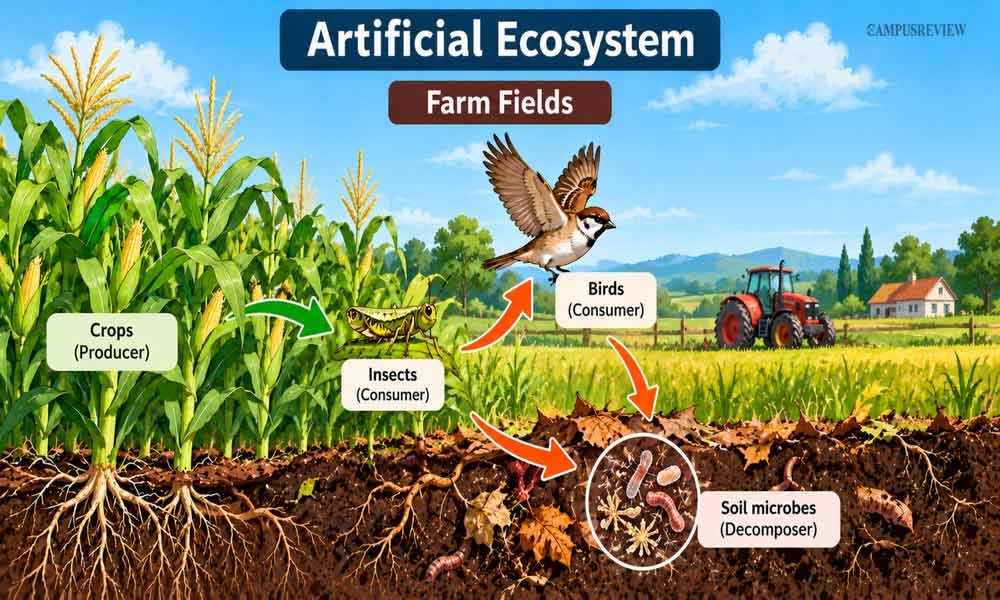
An artificial ecosystem is an ecosystem that humans design and manage for a purpose, such as food, beauty, or research. Humans add water, fertilizer, and feed, and humans remove pests. Without human care, an artificial ecosystem slowly turns into something more natural.
Artificial ecosystems include:
Farm fields: A farm field is an artificial ecosystem where people grow crops for food. Crops act as producers, insects and birds act as consumers, and soil microbes act as decomposers.
Example: A wheat or rice field.
Parks and gardens: Parks and gardens are planted green spaces with trees, lawns, and flower beds that give shade, cooler air, and a place to relax. Example: A city park.
Aquariums: An aquarium is a small artificial water ecosystem in a tank, where the owner supplies light, food, and filtration. Helpful bacteria in the filter break down fish waste. Example: A home fish tank.
| Feature | Natural Ecosystem | Artificial Ecosystem |
| Who controls it | Nature | Humans |
| Species variety | High | Low, often one main species |
| Self-sustaining | Yes | No, it needs constant care |
| Examples | Rainforest, coral reef, savanna | Farm field, park, aquarium |
What Are Producers, Consumers, and Decomposers?
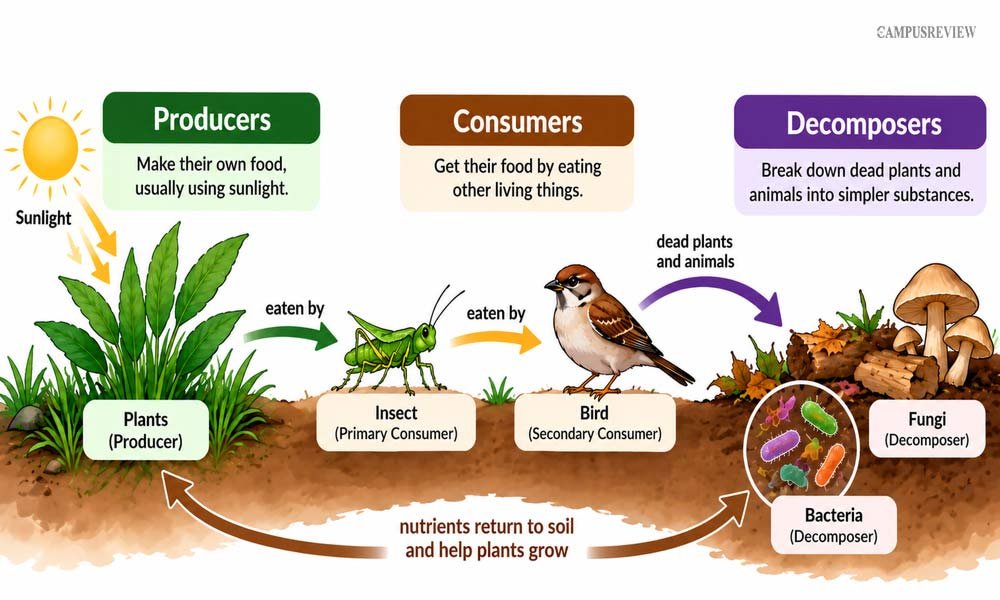
Producers, consumers, and decomposers are the main ecosystem components. Together they form the ecosystem structure. Producers make food, consumers eat it, and decomposers recycle what is left.
Producers: Producers are organisms that make their own food from sunlight, water, and carbon dioxide through photosynthesis. Every food chain starts with producers. Example: Grass, trees, algae, and phytoplankton.
Consumers: Consumers are organisms that get energy by eating other living things. Consumers come in three kinds:
- Herbivores: Herbivores are animals that eat only plants. Example: Deer and rabbits.
- Carnivores: Carnivores are animals that eat other animals. Example: Tigers and hawks.
- Omnivores: Omnivores are animals that eat both plants and animals. Example: Bears and humans.
Decomposers: Decomposers are organisms that break down dead plants and animals and return nutrients to the soil. Example: Fungi, bacteria, and earthworms.
Energy shrinks at each step. A common rule of thumb says only about 10% of energy passes to the next level. That is why nature has far fewer tigers than deer.
| Role | Main Job | Land Example | Pond Example |
| Producer | Makes food from sunlight | Grass | Algae |
| Consumer | Eats other organisms | Deer, tiger | Tadpole, fish |
| Decomposer | Recycles dead matter | Fungi, bacteria | Bacteria in mud |
What Are Ecosystem Services?
Ecosystem services are the benefits people get from ecosystems. Ecosystem services come from ecosystem functions, such as nutrient cycling and water filtration. The UN-backed Millennium Ecosystem Assessment (2005) sorted them into four categories:
- Provisioning services: Provisioning services are the products people take from nature. Example: Food, fresh water, timber, and medicines.
- Regulating services: Regulating services are the natural processes that control conditions around us. Example: Flood control, water cleaning, pollination, and climate control.
- Supporting services: Supporting services are the basic processes that keep all other services alive. Example: Nutrient cycling, soil formation, and photosynthesis.
- Cultural services: Cultural services are the non-material benefits people gain from nature. Example: Recreation, tourism, spiritual value, and art.
Examples of Ecosystem Services
Each ecosystem type delivers its own services. Here are common examples.
| Service | Ecosystem | Benefit to People |
| Fresh water supply | Mountains and wetlands | Clean drinking and farming water |
| Pollination | Grasslands and forests | Bees and birds help crops produce fruit and seeds |
| Coastal protection | Mangroves and coral reefs | Roots and reefs soften storm waves |
| Carbon storage | Forests and tundra soil | Trees and frozen soil hold carbon out of the air |
| Recreation | Parks, reefs, mountains | Places for sport, travel, and relaxation |
Ecosystem services have real value. One study in the Miombo woodlands of Zambia found that forest products made up about 44% of the average household income.
Key Takeaways
1. An ecosystem is a community of living things and their non-living surroundings working together.
2. The two main groups are natural and artificial. Natural ecosystems are split into terrestrial and aquatic.
3. The seven common types are forest, grassland, desert, tundra, mountain, freshwater, and marine.
4. Producers, consumers, and decomposers keep energy and nutrients moving.
5. Ecosystem services fall into four categories: provisioning, regulating, supporting, and cultural.
6. Climate change hits every ecosystem, and coral reefs and the tundra face the sharpest risks.
Final Thoughts
Ecosystems shape the air we breathe, the water we drink, and the food we eat. Once you know the types of ecosystems, you can read any landscape with new eyes. Start with the classification table, practise with food chains, and watch your local park closely. Then explore each ecosystem in more depth, one at a time.
Pranjal Kharche
FAQs
1. Can one ecosystem exist within another ecosystem?
Yes. Smaller ecosystems can exist within larger ones. For example, a pond can form part of a larger forest ecosystem.
2. Why are ecosystems important for humans?
Ecosystems support human life by providing resources such as food and water and helping regulate climate, floods, soil, and other natural processes.
3. What happens when one species disappears from an ecosystem?
The loss of one species from an ecosystem can affect other organisms because species are connected through food chains and food webs.
4. Why do ecosystems differ from one region to another?
Ecosystems differ because temperature, rainfall, water availability, soil, sunlight, and other environmental conditions vary from place to place. These factors determine which plants and animals can survive in each region.