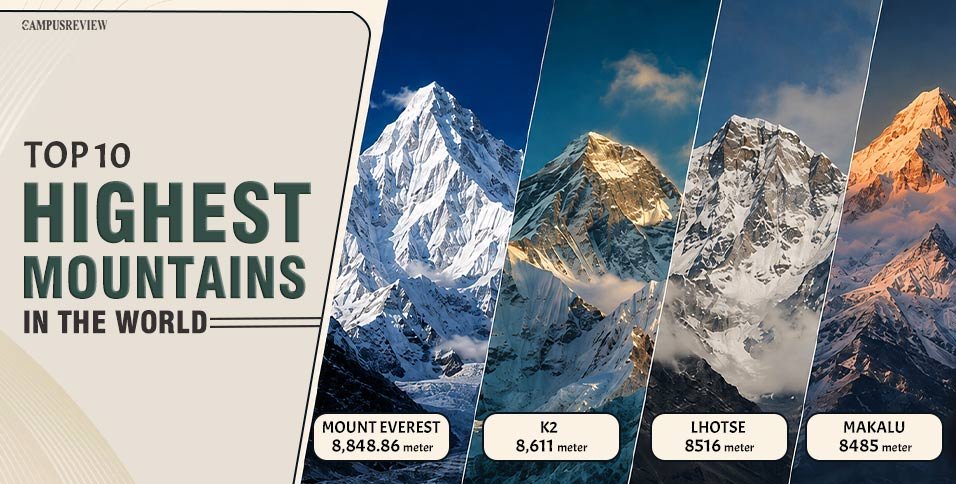
Mount Everest, K2, Kangchenjunga, Lhotse, and Makalu are among the highest mountains in the world, with Everest holding the top spot at 8,848.86 meters (29,031.7 feet). These towering peaks dominate the list of the world’s tallest mountains.
Nine other peaks also cross the 8,000-meter mark, and every one of them sits in Asia. This guide ranks the highest mountains in the world by elevation. You will see each peak’s height, location, and first ascent. You will also find the Seven Summits, the highest mountain peak on every single continent, plus the full list of 14 eight-thousanders.
Top 10 Highest Mountains in the World
The top 10 highest mountains in the world all rise above 8,000 meters. Every one of them sits in the Himalayan or Karakoram range, and eight out of ten are fully or partly in Nepal.
| Rank | Mountain | Height (m) | Height (ft) | Range | Location |
| 1 | Mount Everest | 8,848.86 | 29,031.7 | Mahalangur Himalaya | Nepal / China |
| 2 | K2 | 8,611 | 28,251 | Baltoro Karakoram | Pakistan / China |
| 3 | Kangchenjunga | 8,586 | 28,169 | Kangchenjunga Himalaya | Nepal / India |
| 4 | Lhotse | 8,516 | 27,940 | Mahalangur Himalaya | Nepal / China |
| 5 | Makalu | 8,485 | 27,838 | Mahalangur Himalaya | Nepal / China |
| 6 | Cho Oyu | 8,188 | 26,864 | Mahalangur Himalaya | Nepal / China |
| 7 | Dhaulagiri I | 8,167 | 26,795 | Dhaulagiri Himalaya | Nepal |
| 8 | Manaslu | 8,163 | 26,781 | Mansiri Himalaya | Nepal |
| 9 | Nanga Parbat | 8,126 | 26,660 | Western Himalaya | Pakistan |
| 10 | Annapurna I | 8,091 | 26,545 | Annapurna Himalaya | Nepal |
1. Mount Everest, Nepal/China
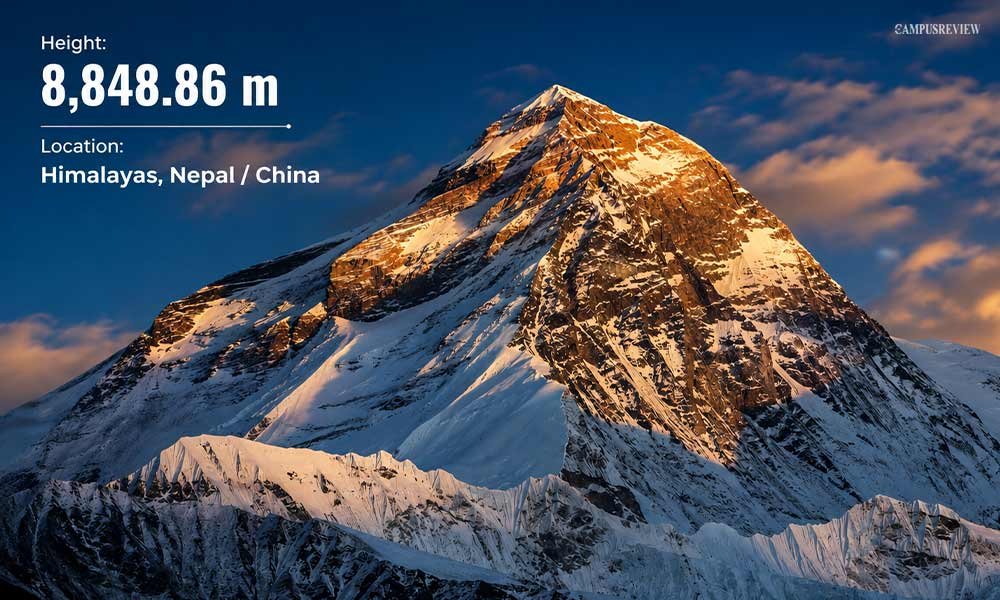
Mount Everest is the highest mountain in the world at 8,848.86 meters. Nepal calls it Sagarmatha, while Tibet calls it Chomolungma. The mountain formed as the Indian Plate pushed into the Eurasian Plate, and rocks near its summit were once part of an ancient seabed.
Sir Edmund Hillary and Tenzing Norgay made the first successful ascent in 1953. Above 8,000 meters, climbers enter the dangerous “Death Zone,” where the body struggles to survive.
2. K2, Pakistan/China
Climbers call K2 the Savage Mountain. It earned the name after American climber George Bell said in 1953 that the mountain tries to kill everyone who attempts it. Unlike Everest, K2 has no easy route. Every path up involves steep ice, exposed ridges, and constant rockfall risk.
The mountain gets its name from a 19th-century survey, when surveyor Thomas Montgomerie labelled it K2. That changed on January 16, 2021, when a team of ten Nepali climbers reached the summit in brutal cold, becoming the first to do it.
Roughly one climber dies for every four who reach the top, which still makes K2 far riskier than Everest.
3. Kangchenjunga, Nepal/India
Kangchenjunga rises to 8,586 meters on the Nepal-India border. Its name means “The Five Treasuries of the Great Snows,” referring to its five main peaks. Before Everest was confirmed as the highest, many geographers considered Kangchenjunga the world’s tallest mountain.
Joe Brown and George Band made the first ascent in 1955. They stopped just short of the true summit to honour a promise that the mountain would remain sacred.
4. Lhotse, Nepal/China
Lhotse connects directly to Everest through the South Col, a narrow ridge nearly 8,000 meters high. Standing fourth among the highest mountains in the world. Fritz Luchsinger and Ernst Reiss made the first ascent in 1956, on the same expedition that pushed further ascents of Everest. Lhotse actually has three summits: the main peak, plus Lhotse Middle and Lhotse Shar, both a little lower.
Lhotse’s South Face is one of the steepest walls on Earth. It climbs over 3,000 meters in less than two kilometres of horizontal distance, which makes it a serious technical challenge even for experienced climbers.
5. Makalu, Nepal/China
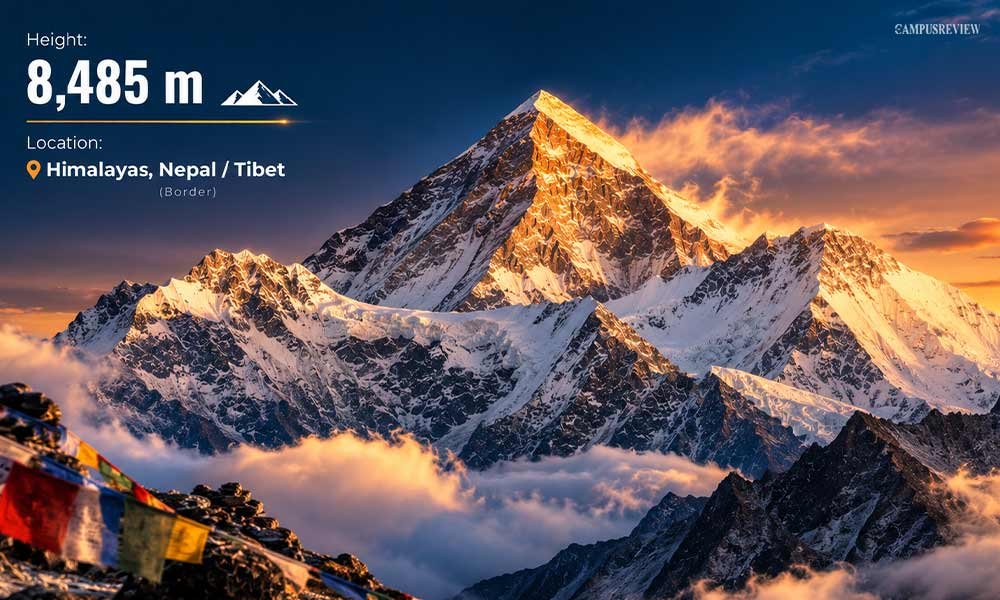
Makalu stands alone, about 19 kilometres southeast of Everest. Its shape looks like a sharp four-sided pyramid with knife-edge ridges running down each side. Lionel Terray and Jean Couzy reached the top first in 1955, with a larger team following close behind over the next few days.
The mountain also has two notable satellite peaks, Kangchungtse and Chomo Lonzo, both taller than 7,600 meters.
Because Makalu sits isolated from other big peaks, it takes the full force of storms crossing the Tibetan Plateau. That isolation is part of what makes it so tough to climb.
6. Cho Oyu, Nepal/China
Cho Oyu means Turquoise Goddess in Tibetan. It sits just 20 kilometers west of Everest, and it holds a reputation as the friendliest 8,000-meter peak to climb. The slopes on its standard route are gentler than on most other giants, which gives it the lowest fatality rate among the fourteen eight-thousanders.
Herbert Tichy, Sepp Jöchler, and Pasang Dawa Lama made the first ascent in 1954. Many climbers still use Cho Oyu as practice before attempting Everest.
7. Dhaulagiri I, Nepal
For nearly 40 years, Western surveyors believed Dhaulagiri was the tallest mountain on Earth, until better measurements proved Everest was higher. A joint Swiss-Austrian-Nepali team, including Kurt Diemberger and Ernst Forrer, finally reached the summit in 1960.
The name comes from Sanskrit words meaning “white” and “beautiful,” a fitting description of its huge snow-covered face.
Dhaulagiri sits beside the Kali Gandaki Gorge, one of the deepest river canyons anywhere on the planet. Its south and west walls rise more than 4,000 meters straight out of the valley floor.
8. Manaslu, Nepal
Manaslu takes its name from the Sanskrit word for soul, which is why locals call it the Mountain of the Spirit. Toshio Imanishi and Gyalzen Norbu made the first ascent in 1956, on a Japanese-led expedition.
That climb still holds a special place in Japan’s mountaineering history, and Japanese teams returned to the region for years afterwards.
The route to the top crosses heavily crevassed glaciers before finishing along a narrow, exposed summit ridge.
9. Nanga Parbat, Pakistan
Nanga Parbat marks the western end of the Himalayan chain. Early expeditions here were so deadly that climbers nicknamed it the Killer Mountain. Austrian climber Hermann Buhl changed that story in 1953.
He reached the summit completely alone, without extra oxygen, and survived a night standing upright near the top because he had no shelter.
The mountain’s Rupal Face is the tallest single wall on Earth, rising 4,600 meters from base to ridge.
10. Annapurna I, Nepal
Annapurna I holds a historic title: it was the first 8,000-meter peak ever climbed by anyone. Maurice Herzog and Louis Lachenal reached the top on June 3, 1950, without oxygen. Their descent through a monsoon storm cost both men several fingers and toes to frostbite.
The name Annapurna comes from Sanskrit and refers to the Hindu goddess of food and nourishment. Annapurna’s north face still has one of the highest fatality rates of any mountain in the world, due to constant avalanche activity and unstable ice.
Where Are the World’s Highest Mountains?
Every mountain above 7,000 meters sits in Central or South Asia. You will find them across the Himalaya, Karakoram, Hindu Kush, Pamir, and Tien Shan mountain systems.
This is not random. The Indian Plate keeps pushing into the Eurasian Plate, and neither one sinks into the mantle because both are made of light continental crust.
That pressure has nowhere to go but up. It folds and stacks the land along major fault lines, building crust up to 80 kilometres thick beneath Tibet. That is why the tallest peaks on the planet all sit in one tight region of Asia, and nowhere else comes close.
These mountain systems also shape many of the world’s major river systems, which makes understanding different types of rivers useful.
What Are the Seven Summits?
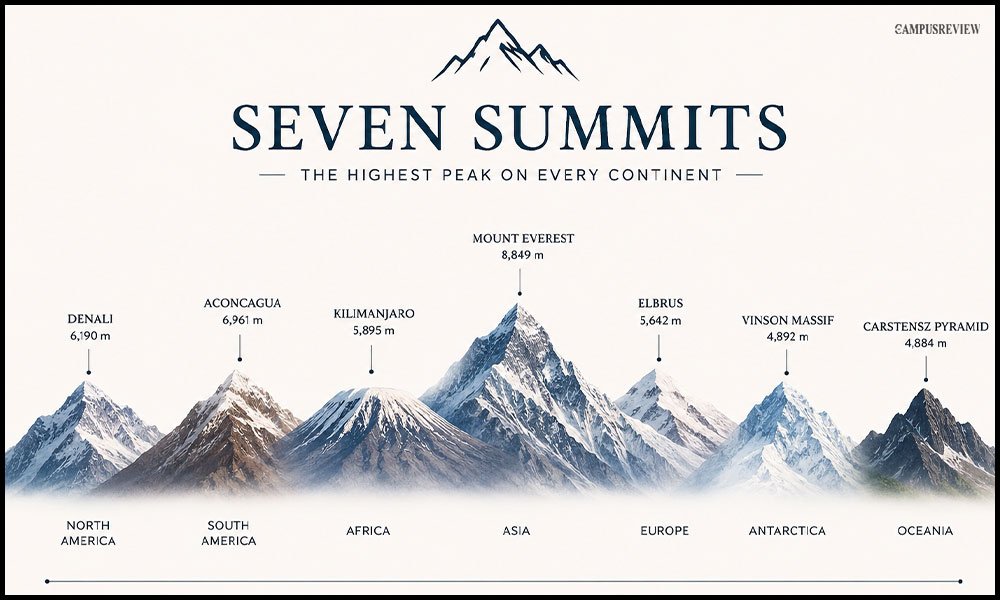
The Seven Summits challenge involves climbing the highest peak on every continent. This list includes the highest mountains in the world, Mount Everest, along with the highest peaks of Europe, Africa, North America, South America, Antarctica, and Oceania.
American businessman Dick Bass came up with the idea and became the first person to finish the Seven Summits in 1985.
| Continent | Peak | Height (m) | Height (ft) |
| Asia | Mount Everest | 8,848.86 | 29,031.7 |
| South America | Aconcagua | 6,961 | 22,838 |
| North America | Denali | 6,190 | 20,310 |
| Africa | Mount Kilimanjaro | 5,895 | 19,341 |
| Europe | Mount Elbrus | 5,642 | 18,510 |
| Antarctica | Vinson Massif | 4,892 | 16,050 |
| Oceania | Carstensz Pyramid | 4,884 | 16,024 |
| Australia | Mount Kosciuszko | 2,228 | 7,310 |
Bass picked Mount Kosciuszko, the highest point on the Australian mainland. Italian climber Reinhold Messner argued for a bigger definition of the region and picked Carstensz Pyramid in Indonesia instead.
Carstensz demands real technical rock climbing through remote jungle, so most modern mountaineers treat theMessner list as the tougher and more complete version. Here is a closer look at each of the eight peaks across both lists.
Mount Everest, Asia
Everest tops Asia’s high points by nearly 2,000 meters. Mount Everest height 8,848.86 meters, stands as the final and hardest peak for Seven Summits climbers, requiring technical skill, altitude experience, and weeks of acclimatisation.
Aconcagua, South America
Aconcagua, in Argentina’s Andes, is an extinct volcano and the highest mountain outside Asia. Matthias Zurbriggen made the first ascent in 1897. Its standard route needs no technical climbing gear, but extreme altitude above 6,000 meters makes it challenging.
Denali, North America
Denali, meaning “the High One” in Koyukon, is North America’s highest peak and officially reclaimed its name in 2015. Its huge base-to-summit rise makes it one of the world’s most prominent mountains. The first successful summit came in 1913, with Alaska Native climber Walter Harper becoming the first to reach the top.
Mount Kilimanjaro, Africa
Kilimanjaro is Africa’s highest peak and the world’s tallest free-standing mountain. This dormant volcano rises from Tanzania’s plains without belonging to a mountain range. Hans Meyer and Ludwig Purtscheller made the first recorded summit in 1889, guided by Yohana Kinyala Lauwo. Its summit ice fields have also shrunk significantly over the past century.
Mount Elbrus, Europe
Mount Elbrus is a dormant volcano in Russia’s Caucasus Mountains and Europe’s highest peak. Its west summit is about 20 meters higher than the east summit. Khillar Khashirov reached the east summit in 1829, while the higher west summit was climbed in 1874 by a British-led team.
Vinson Massif, Antarctica
Vinson Massif, located in Antarctica’s Sentinel Range, is one of the world’s most remote major peaks. The climb is not highly technical, but reaching base camp requires complex logistics and long flights over ice. Nicholas Clinch led the first successful ascent in 1966, and only a few thousand people have reached its summit.
Mount Kosciuszko, Australia (Bass list)
Mount Kosciuszko is the easiest of the Seven Summits, with gentle slopes that make it a simple day hike without technical gear. Polish explorer Paweł Strzelecki made the first recorded ascent in 1840 and named it after Polish general Tadeusz Kościuszko.
Carstensz Pyramid, Oceania (Messner list)
Carstensz Pyramid, also known as Puncak Jaya, is the highest island peak and one of the toughest Seven Summits. Located in New Guinea, it requires technical rock climbing and a multi-day trek through remote jungle. Heinrich Harrer led the first ascent in 1962.
What Are the 14 Eight-Thousanders?
An eight-thousander is any independent mountain that rises above 8,000 meters. There are exactly 14 of them on Earth, and all sit within the Himalaya or Karakoram ranges, spread across Nepal, China, Pakistan, and India.
| Rank | Peak | Height (m) | Range | First Ascent |
| 1 | Mount Everest | 8,848.86 | Himalaya | 1953 |
| 2 | K2 | 8,611 | Karakoram | 1954 |
| 3 | Kangchenjunga | 8,586 | Himalaya | 1955 |
| 4 | Lhotse | 8,516 | Himalaya | 1956 |
| 5 | Makalu | 8,485 | Himalaya | 1955 |
| 6 | Cho Oyu | 8,188 | Himalaya | 1954 |
| 7 | Dhaulagiri I | 8,167 | Himalaya | 1960 |
| 8 | Manaslu | 8,163 | Himalaya | 1956 |
| 9 | Nanga Parbat | 8,126 | Himalaya | 1953 |
| 10 | Annapurna I | 8,091 | Himalaya | 1950 |
| 11 | Gasherbrum I | 8,080 | Karakoram | 1958 |
| 12 | Broad Peak | 8,051 | Karakoram | 1957 |
| 13 | Gasherbrum II | 8,035 | Karakoram | 1956 |
| 14 | Shishapangma | 8,027 | Himalaya | 1964 |
All 14 eight-thousanders enter the “Death Zone” above 8,000 meters, where air pressure falls to about one-third of sea level, making recovery extremely difficult. The first complete ascent came in 1986 when Reinhold Messner climbed all 14 without bottled oxygen. Nirmal Purja later set a 189-day record in 2019, followed by Kristin Harila and Tenjen Lama Sherpa’s 92-day record in 2023.
These peaks span several continents, making a world map a useful reference for locating them.
End Note
The highest mountains in the world are more than numbers on a list. From Everest’s record height to Annapurna’s extreme conditions, each peak has its own story of geography, exploration, and human endurance. Together, they show why the world’s tallest mountains continue to fascinate climbers and geography enthusiasts alike.
FAQs
1. What is the difference between a mountain and a hill?
There is no single global rule for what defines a mountain. Generally, mountains rise at least 300 meters above nearby land and have steeper slopes, while hills are lower and more rounded.
2. Which country has the highest mountain in the world?
Mount Everest sits directly on the border of Nepal and China, so both countries share the claim to the world’s highest peak.
3. What is the highest unclimbed mountain in the world?
Gangkhar Puensum, at 7,570 meters, is the world’s highest unclimbed mountain on the Bhutan-China border. Bhutan banned high-altitude climbing for religious reasons, making the peak off-limits to mountaineers.
4. How many mountains in the world rise above 8,000 meters?
Exactly 14 mountains cross the 8,000-meter mark, and every single one sits in the Himalaya or Karakoram ranges of Asia.
5. What is the highest mountain in India?
Kangchenjunga, at 8,586 meters on the Nepal-Sikkim border, is the highest mountain located in India.