Ancient Africa was home to some of the world’s first great civilisations. Long before Rome ruled the Mediterranean, African kingdoms built pyramids, ran gold trade routes, invented writing systems, and grew rich cities in the middle of the desert.
This guide covers five major ancient African civilisations: Ancient Egypt, the Kingdom of Kush, the Kingdom of Aksum, Carthage, and the Garamantes. It is based on research from materials and trusted historical sources, including Encyclopaedia Britannica, World History Encyclopedia, and other academic and historical references.
What Was Ancient Africa?
Ancient Africa refers to the complex societies and kingdoms that grew across the continent from around 3100 BCE to 700 CE. This period covers the rise of the Egyptian First Dynasty, the many phases of the Kingdom of Kush, the naval power of Carthage, the desert cities of the Garamantes, and the Christian empire of Aksum.
These civilisations traded with the Mediterranean world, the Near East, and even India. Ancient Africa was a central player in the ancient global economy, not a side character.
Ancient Africa was a network of powerful, independent kingdoms across Egypt, Nubia, the Horn of Africa, North Africa, and the Sahara, each with its own government, technology, and trade system.
Where Did Ancient African Civilisations Develop?
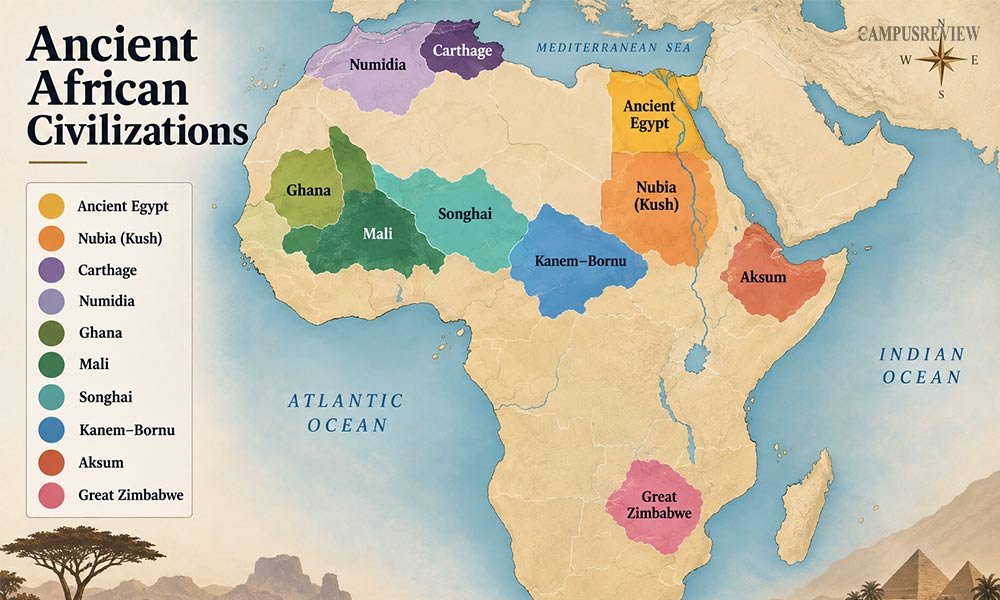
An ancient Africa map shows where ancient African civilisations grew. Each region had its own mix of rivers, deserts, and coastlines, and each civilisation built its economy around that geography.
- Nile Valley: A fertile strip running through Egypt and Nubia (modern Sudan), fed every year by the Nile River’s floods.
- Sahara Desert: A vast dry zone west of the Nile, covering more than 9 million square kilometres. It looks empty, but it hid deep water reserves that some civilisations learned to tap.
- Mediterranean coast: Fertile valleys and natural harbours in modern Tunisia and Libya, home to Carthage.
- Red Sea and Horn of Africa: Highland plateaus in modern Ethiopia and Eritrea, connected by sea to Arabia and India. This is where the Kingdom of Aksum grew.
Around 3500 to 3000 BCE, the Sahara began drying out. This slow climate shift pushed farming and herding communities toward the Nile Valley and a few desert oases. That single environmental change helped trigger the rise of centralised states in Egypt and set the stage for the Garamantes’ unusual desert cities centuries later.
In short, when the climate changed, human settlement patterns changed with it, and new kingdoms grew out of that pressure.
Major Ancient African Civilisations at a Glance
Here is a quick comparison of the five major ancient African civilisations before we go deeper into each one.
| Civilization | Region | Time Period |
| Ancient Egypt | Nile Valley | c. 3100 BCE – 30 BCE |
| Kingdom of Kush | Nubia (Sudan) | c. 1070 BCE – 350 CE |
| Kingdom of Aksum | Ethiopia and Eritrea | c. 100 CE – 700+ CE |
| Carthage | Tunisia | c. 814 BCE – 146 BCE |
| Garamantes | Libya (Sahara) | c. 500 BCE – 700 CE |
Ancient Egypt
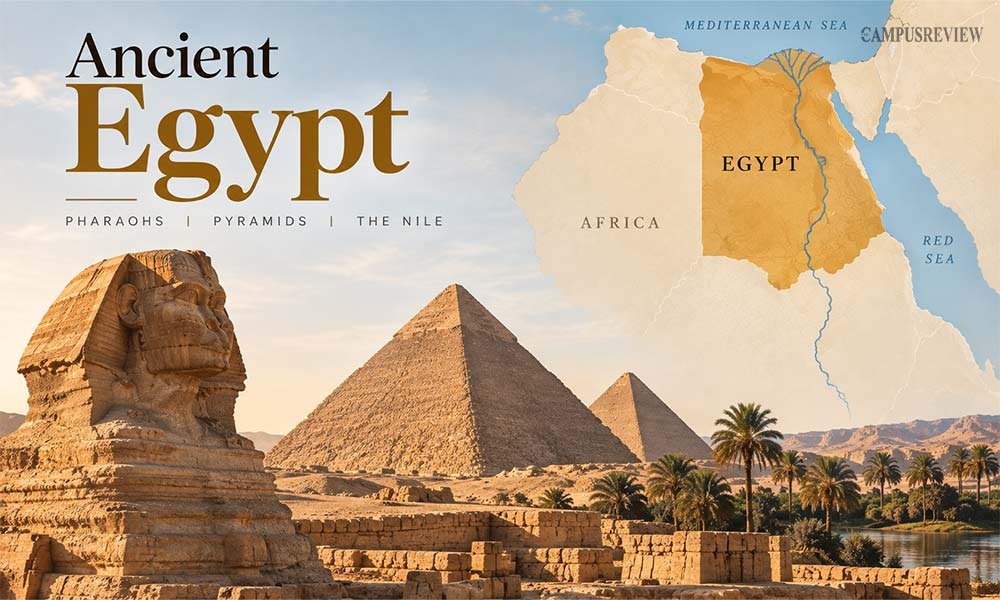
Ancient Egypt was one of the most famous and influential ancient African civilisations, known for the Pyramids of Giza, hieroglyphic writing, mummification, and a long-lasting system of government. Developed along the Nile River, Egyptian civilisation made major contributions to architecture, writing, mathematics, religion, and administration.
Around 3100 BCE, King Narmer united Upper and Lower Egypt into a single kingdom. This kicked off more than 3,000 years of pharaohs, temples, and monumental building.
The Pyramids of Giza
As per Britannica, the pyramid contains roughly 2.3 million blocks of stone, together weighing about 5.75 million tons. Workers were not enslaved captives, as old myths claim. Egyptologists now know that organised crews of farmers built the pyramids during the Nile flood season, when they could not work their fields anyway. The state paid them in grain.
Hieroglyphics and Egyptian Writing
Egyptian scribes developed hieroglyphics for temple walls and royal monuments. For everyday paperwork, like tax records and letters, they used faster cursive scripts called Hieratic and later Demotic, written on papyrus. This writing system ran Egypt’s government for over 3,000 years.
The Nile River and Egyptian Life
The Nile River flooded every year between July and October, dropping rich black silt across the farmland. Egyptians built canals and gates to trap this floodwater on their fields. They even used stone gauges called nilometers to measure the flood and predict the harvest, which let the government set taxes months in advance.
This predictable flood cycle shaped Egyptian religion too. Egyptians believed in Ma’at, the idea of cosmic balance and order, and they saw the pharaoh as the person responsible for keeping that balance in place.
Kingdom of Aksum
The Kingdom of Aksum developed in the northern Horn of Africa, in areas that are now Ethiopia and Eritrea. Its highland location, more than 2,000 meters above sea level, had fertile soil and regular rainfall, which helped support a large farming population.
What Was the Kingdom of Aksum Known For?
Aksum ran its economy through its Red Sea port, Adulis. Ships from Aksum carried ivory, gold, and incense out to Roman Egypt, Arabia, and India, and brought back glass, wine, and cloth.
Around 270 CE, King Endubis made Aksum the first sub-Saharan African state to mint its own gold, silver, and bronze coins. This was a serious economic achievement. It meant Aksumite currency could be trusted and used across the Roman world.
Aksum also created the Ge’ez script, a writing system that added vowel sounds directly onto consonant letters. Ge’ez is still used today as the liturgical language of the Ethiopian and Eritrean Orthodox Churches.
Why Was Aksum Important?
In the fourth century CE, King Ezana converted to Christianity, making Aksum one of the earliest Christian states in the world. This decision shaped the religious identity of the region for the next 1,700 years and still defines Ethiopian and Eritrean Christianity today.
Aksum is also known for its giant carved stone pillars, called stelae, some standing over 30 meters tall. These stone towers copied the look of multi-story palaces, right down to carved windows and doors.
Kingdom of Kush
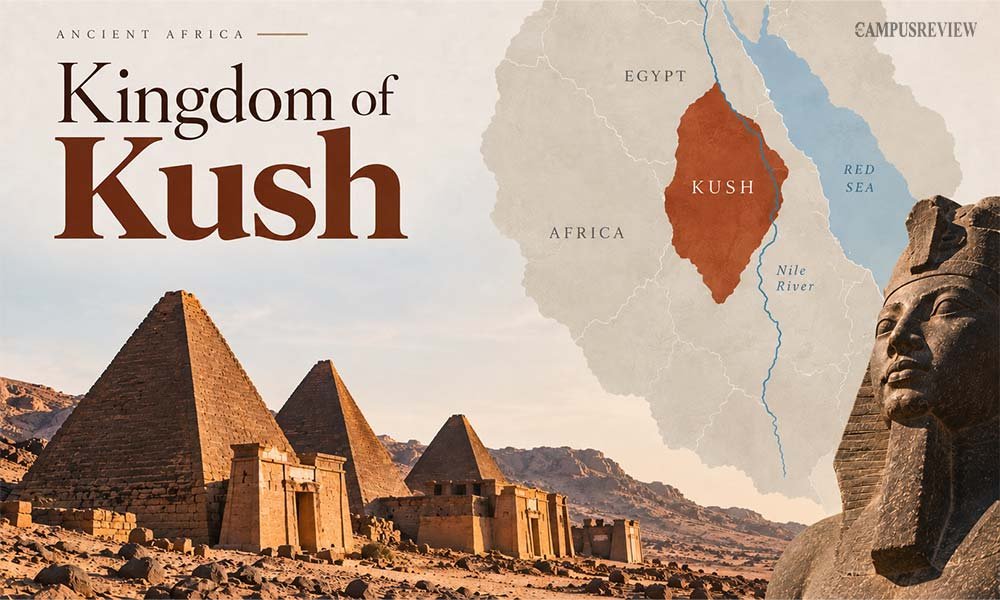
The Kingdom of Kush developed along the Middle Nile in Nubia, in present-day northern and central Sudan. Six rocky cataracts, or rapids, along the Nile helped define the region between Egypt and the lands farther south.
Kush went through three phases, each centred on a different capital: Kerma (around 2500 to 1500 BCE), Napata (around 1000 to 300 BCE), and Meroe (around 300 BCE to 350 CE).
Kushite Trade and Wealth
Kush’s location allowed it to control the trade corridor between sub-Saharan Africa and the Mediterranean world. The kingdom used desert shortcut routes like the Korosko Route to move caravans around the Nile’s dangerous cataract bends. Kush exported ivory, ebony, incense, and cattle, and imported Egyptian linen, Mediterranean wine, and fine bronze goods. This middleman role built serious royal wealth.
What Was the Kingdom of Kush Known For?
Kush built its wealth on gold mining and trade. In fact, the name Nubia likely comes from the ancient Egyptian word for gold, nub. Later, after the capital moved to Meroe, Kush became a major iron-producing centre, using furnaces to smelt local ore into tools and weapons.
Kush is also famous for its pyramids. Sudan actually has more pyramids than Egypt, built by Kushite kings across sites like Meroe and Nuri.
According to World History Encyclopedia, the Kingdom of Kush flourished from about 1069 BCE to 350 CE, with Piye’s conquest of Egypt being one of its major achievements. Kushite pyramids were steeper than Egyptian pyramids, with slopes of about 65-70 degrees compared with Egypt’s 51 degrees. Their burial chambers were built underground instead of inside the pyramids.
| Feature | Egyptian Pyramids | Kushite Pyramids |
| Slope angle | About 51 degrees | 65 to 70 degrees |
| Burial chamber | Inside or below the structure | Underground, beneath the base |
| Entrance | Sealed internal passage | External staircase on the east side |
Carthage
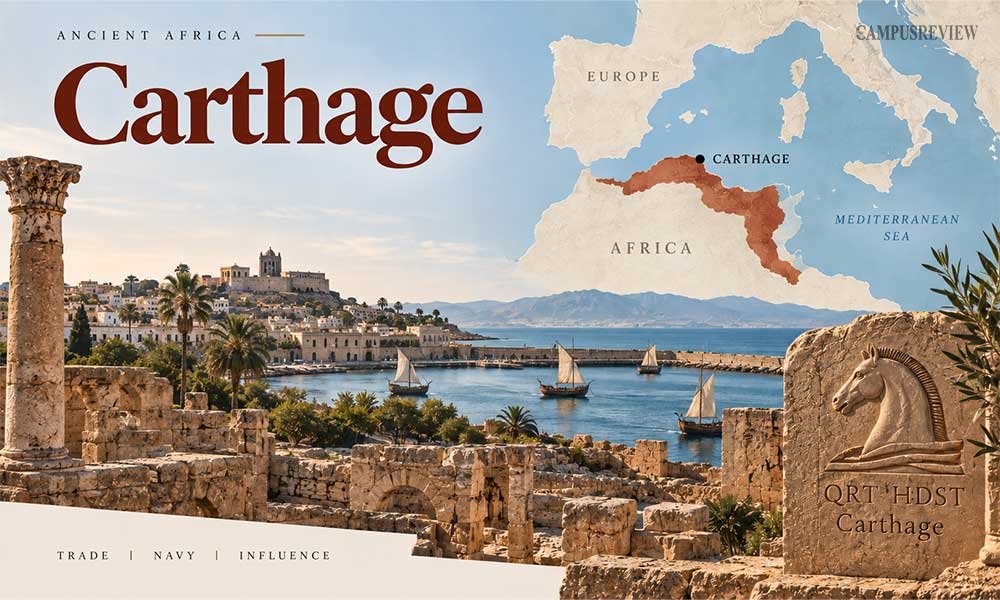
Carthage became one of the most powerful cities of the ancient Mediterranean. Located in present-day Tunisia, it was founded by Phoenicians from Tyre around 814 BCE. Its strong navy and busy trade network helped it become a leading power in the western Mediterranean.
Carthage built an artificial double harbour called a cothon. The outer basin handled merchant ships, while the hidden inner basin could dock 220 warships. This was one of the most advanced naval facilities in the ancient world.
Where Was Ancient Carthage Located?
Carthage sat on a peninsula near modern Tunis, right at the narrow strait separating Sicily from North Africa. This spot let Carthage control shipping traffic through the central Mediterranean Sea, which made it very rich and very hard for Rome to ignore.
Carthage and the Punic Wars
Carthage and the Roman Republic fought three wars, known as the Punic Wars, between 264 and 146 BCE. The most famous moment came in the Second Punic War, when the Carthaginian general Hannibal marched an army, including war elephants, across the Alps into Italy. He won major battles but could not capture Rome itself.
Rome eventually won all three wars. In 146 BCE, Roman soldiers destroyed Carthage after a brutal three-year siege, ending centuries of Carthaginian power in the region.
The Garamantes
The Garamantes built a settled civilisation in the Fezzan region of present-day southwestern Libya around 1000 BCE. They were more than desert raiders, as some ancient Greek and Roman writers described them.
Archaeological evidence shows that they developed an organised urban state that controlled a vast area of more than 180,000 square kilometres across the Sahara.
What Did the Garamantes Invent?
The Garamantes are best known for one remarkable invention: underground irrigation tunnels called foggaras. These tunnels tapped ancient underground water trapped deep beneath the desert, then carried it by gravity to farmland on the surface.
How Did Garamantes Irrigation Work?
The Garamantes used underground irrigation tunnels called qanats to carry groundwater to oasis farms. Workers dug gently sloping tunnels into rock and added vertical shafts for ventilation and maintenance. This helped move water without exposing it to rapid evaporation in the Sahara.
The system supported date palms, fruit trees, wheat, and barley and helped sustain Garama, the Garamantes’ main city. The tunnels tapped ancient underground water that could not be quickly replaced by rainfall.
Over time, heavy water use lowered the water table beyond the tunnels’ reach. As farms failed, the population declined, and the Garamantes kingdom eventually weakened.
Ancient Africa Trade Routes
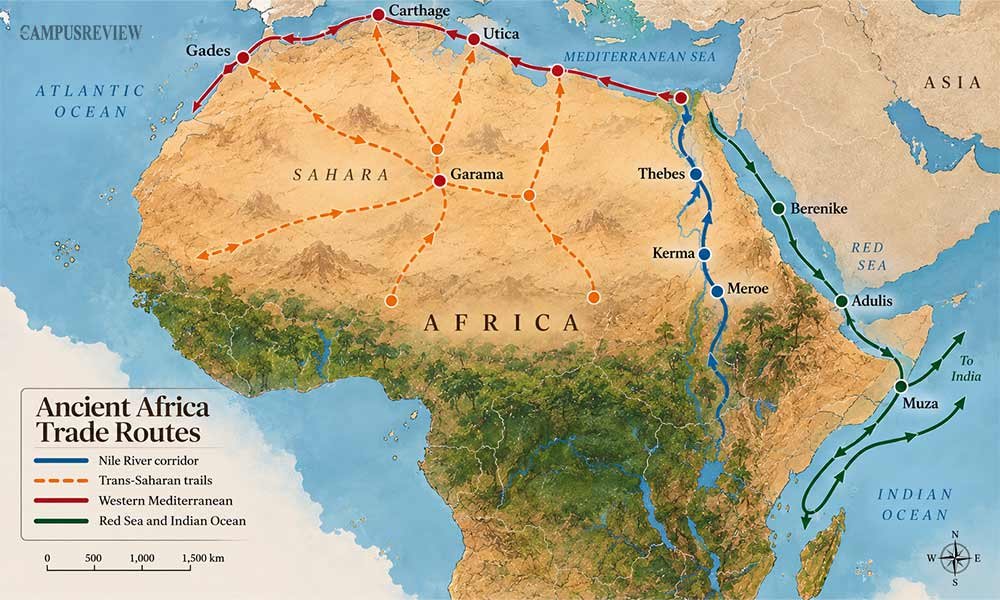
Trade connected every major ancient African civilisation to the wider world. Each region had its own trade network built around its geography.
| Trade Route | Main Goods Exported | Main Goods Imported | Key Hubs |
| Nile River corridor | Gold, ivory, ebony, cattle | Linen, papyrus, wine, bronze goods | Thebes, Kerma, Meroe |
| Trans-Saharan trails | Gold, salt, natron | Roman wine, oil, pottery, glass | Garama, Lepcis Magna |
| Western Mediterranean | Silver, tin, salted fish, purple dye | Greek pottery, Etruscan bronze, textiles | Carthage, Gades, Utica |
| Red Sea and Indian Ocean | Ivory, frankincense, myrrh, gold | Roman glass, Indian silk, spices | Adulis, Berenike, Muza |
How did African civilisations trade across such difficult terrain? The answer is specialisation. Egypt used river barges on the Nile. Carthage built merchant ships for open sea routes.
Aksum used monsoon winds to sail the Red Sea and Indian Ocean. The Garamantes used pack animals, and later camels, to cross the Sahara itself. Each civilisation matched its transport to its landscape, and that is exactly what let goods, gold, and ideas move across the entire continent and beyond.
Ancient African Achievements and Technology
Some of the oldest civilisations were not just monument builders. They solved complex engineering and administrative problems, developing advanced systems that supported cities, farming, trade, and government.
Writing systems: Ancient Africa produced three separate writing systems. Egypt had hieroglyphics and its cursive forms. Kush developed the Meroitic script, which is still not fully translated today. Aksum created the vocalised Ge’ez script, still used in church services now.
Water engineering: Every civilisation here solved water scarcity in its own way.
- Egypt used basin irrigation and nilometers to manage Nile floods.
- Kush built hafirs, huge circular reservoirs up to 250 meters wide, to store monsoon rainwater.
- The Garamantes dug nearly 1,000 miles of underground foggara tunnels.
- Carthage engineered the cothon, its hidden double naval harbour.
Metalwork: Kush ran an industrial-scale iron industry at Meroe, leaving behind massive slag heaps that archaeologists still study. The Garamantes and Aksum both worked gold, silver, and bronze at a high level, with Aksum using its metalwork to strike its own coins.
Mathematics and astronomy: Egyptian scribes used a base-10 number system to calculate field sizes, pyramid slopes, and grain storage volumes. Their 365-day calendar, based on the star Sirius, matched the Nile flood cycle almost perfectly.
African Civilisations Timeline
| Period | Civilization | What Happened |
| c. 3100 BCE | Ancient Egypt | King Narmer unites Egypt, founds the First Dynasty |
| c. 2686-2181 BCE | Ancient Egypt | Old Kingdom; pyramids built at Saqqara and Giza |
| c. 814 BCE | Carthage | Phoenician settlers founded Carthage |
| c. 747-656 BCE | Kingdom of Kush | King Piye conquers Egypt, founds the 25th Dynasty |
| 264-146 BCE | Carthage | The Punic Wars against the Roman Republic |
| 30 BCE | Ancient Egypt | Rome annexes Egypt after Cleopatra VII’s death |
| c. 100 CE | Kingdom of Aksum | Aksum rises as a Red Sea trading power |
| c. 270 CE | Kingdom of Aksum | King Endubis mints Aksum’s first coins |
| c. 330-340 CE | Kingdom of Aksum | King Ezana converts to Christianity |
| c. 350 CE | Kingdom of Kush | Meroe declines; Kush fragments |
| c. 400-500 CE | Garamantes | Water table drops; foggara farms fail |
| c. 600-700+ CE | Aksum and Garamantes | Early Islamic expansion reshapes North Africa and the Sahara |
Why Was Ancient Africa Important?
Development of cities and states: Egypt, Kush, and the Garamantes each proved that complex, centralised government could take root in very different environments, from a river valley to open desert.
1. Long-distance trade: African gold, ivory, and incense supported Mediterranean, Near Eastern, and South Asian economies for over a thousand years.
2. Writing and record keeping: three separate writing systems came out of ancient Africa, and one of them, Ge’ez, is still in active use today.
3. Technological innovation: from nilometers to foggara tunnels to trimetallic coins, African engineers solved problems that still impress historians and archaeologists.
4. Political influence: the Kushite 25th Dynasty ruled Egypt outright, and Carthage fought Rome to a standstill for more than a century.
5. Cultural and religious exchange: Egyptian religious ideas spread across the Mediterranean, and Aksum’s early adoption of Christianity shaped a religious tradition that still exists today.
Together, these achievements show that ancient African civilisations played an important role in shaping the ancient world. Their contributions to trade, technology, government, and culture continue to influence how we understand early human history.