The Campus Review
August 13, 2026
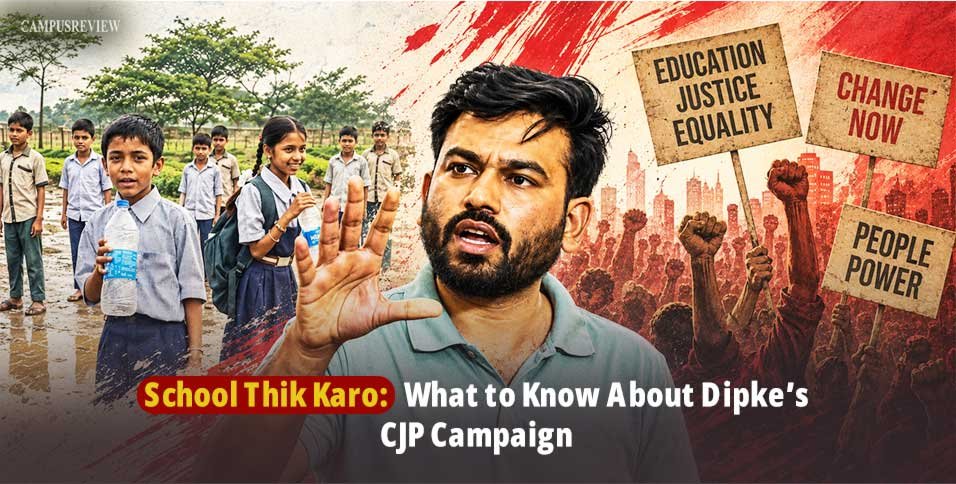
The CJP Campaign titled “School Thik Karo” is a nationwide youth initiative set to launch on August 15, 2026, India’s 80th Independence Day. Spearheaded by Abhijeet Dipke, founder of the Cockroach Janta Party (CJP), the movement aims to improve the condition of government schools in rural villages across the country. While designed as a national effort, Dipke will begin the campaign locally in his hometown of Hingoli, Maharashtra, before expanding its reach.
The primary focus of this rural education campaign is to address long-standing basic infrastructure gaps in public school facilities by encouraging civic participation and local accountability.
What Is “School Thik Karo”? CJP Campaign by Dipke
The “School Thik Karo” campaign is a grassroots initiative designed to fix elementary infrastructure in village schools. According to CJP leader Abhijeet Dipke, children in rural regions continue to lack foundational amenities that urban students take for granted.
In a post shared on X, Dipke stated, “Kids in villages shouldn’t be pleading for basic facilities at school after 80 years of Independence.” He added, “As a country, we have failed rural kids in the worst possible way. This Independence Day, CJP will launch the ‘School Thik Karo’ campaign to improve Govt schools in villages.”
Why Did Abhijeet Dipke Launch the CJP Campaign?
The Cockroach Janta Party launched this initiative after observing decades of neglect in primary educational institutions across rural India. While policy debates often center on advanced reforms, many village institutions still struggle with structural defects and a lack of basic facilities.
- Sanitation: Addressing the lack of proper functional toilets, especially for female students.
- Basic Amenities: Ensuring clean drinking water and electricity in village classrooms.
- Infrastructure Safety: Fixing unsafe buildings, crumbling walls, and damaged roofs.
- Classroom Essentials: Securing proper seating arrangements and basic teaching equipment.
Dipke noted in a video message that government schools in villages have been ignored for 80 years, asking, “How difficult it must be for small girls? So, I feel that this August 15, if we should pay attention to anything, it should be to making a new start, and we must begin by correcting our government schools.”
When Will the School Thik Karo Campaign Begin?
The CJP campaign by Abhijeet Dipke officially kicks off on August 15, 2026. The CJP has asked citizens, parents, and youth nationwide to pledge their support on Independence Day to draw public attention to the conditions of village schools.
What Is the Sarpanch Challenge?
As part of the rollout strategy, the CJP leader is encouraging citizens to take up a direct approach called the Sarpanch Challenge.
Under this model, local youth and residents approach their village Sarpanch to present the current state of their government school and formally request immediate repairs. Dipke stated that village heads and local leaders carry a social and moral responsibility to guarantee safe educational spaces for children.
How Will Parents and Volunteers Participate?
The CJP Campaign relies on civic involvement rather than formal bureaucracy. Parents, students, and local volunteers are encouraged to take up social monitoring within their communities.
- Documenting Conditions: Visiting local government schools to document physical deficiencies.
- Engaging Local Officials: Bringing findings directly to Gram Panchayats and school committees.
- Building Community Awareness: Highlighting school safety and sanitation concerns to prompt local action.
Why Is Hingoli Important to the Campaign?
Although “School Thik Karo” is planned as a nationwide effort, its ground implementation starts in Hingoli, Maharashtra. Hingoli is Abhijeet Dipke’s home district in the Marathwada region. He will launch the movement by personally approaching the local Sarpanch in his village to request immediate improvements to the government school facilities.
What Is Jantar Mantar Season 2?
“Jantar Mantar Season 2” refers to an upcoming protest initiative being planned by the CJP, separate from the “School Thik Karo” education campaign.
The original Jantar Mantar agitation in New Delhi focused on student concerns, including the NEET paper leaks. Those widespread demonstrations led to significant political fallout, including the resignation of Union Education Minister Dharmendra Pradhan on July 25 and the appointment of Pralhad Joshi.
While “School Thik Karo” focuses on constructive rural school improvements, future demonstrations under the Jantar Mantar banner remain part of the group’s wider activism strategy.
What Is the Kya Bolti Public Tour?
The CJP also announced a separate nationwide outreach initiative titled “Kya Bolti Public,” scheduled to launch in September 2026.
| Campaign Detail | Description |
| Official Title | “Kya Bolti Public” Nationwide Tour |
| Start Date | September 2026 |
| Primary Scope | Nationwide listening tour across India |
| Key Focus Areas | Youth unemployment, education costs, and democratic accountability |
Unlike “School Thik Karo,” which targets specific school infrastructure, “Kya Bolti Public” is a broader public engagement tour to understand citizen concerns, particularly regarding degree-holder unemployment and rising educational fees.
Why Is CJP Staying Away From Electoral Politics?
Despite gaining widespread national attention following the NEET student protests and its expanding campaigns, the CJP clarified that it will not contest elections or register as a formal political party.
CJP spokesperson Saurav Das stated that the collective intends to operate solely as a non-partisan pressure group. The leadership emphasized that creating a traditional political entity would dilute its core focus on youth advocacy and citizen-driven social reform.
End Note
The “School Thik Karo” initiative provides a straightforward template for community-driven educational reform. By urging citizens to start locally in places like Hingoli before expanding nationwide, the ongoing CJP Campaign highlights how active civic participation can draw attention to rural government schools and demand better basic facilities for students across India.