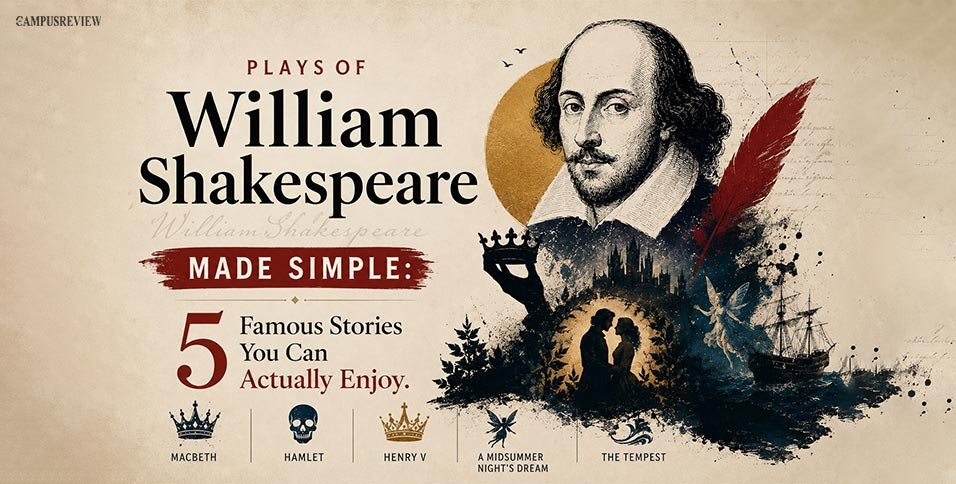
Shakespeare’s plays are stories about love, revenge, power and family. The old language can make his plays feel intimidating. Long speeches, unfamiliar names and words you rarely hear today can make you want to close the book before the story even begins.
But the stories themselves are surprisingly easy to understand. A prince wants revenge. A general becomes obsessed with power. Two lovers get caught in a family feud. A young king leads his army into an impossible battle. A magician tries to find his way home.
That is the key to understanding the plays of William Shakespeare. Once you know what is happening, the language becomes much less intimidating.
In this guide, we will look at five famous plays of William Shakespeare as stories. No complicated literary jargon. Just the stories that made Shakespeare famous.
Which of the plays of William Shakespeare should I read first?
Short answer: It depends on your mood, not on fame.
- Want mystery and deep thinking? Start with Hamlet.
- Want a short, fast tragedy? Start with Macbeth.
- Want magic and comedy? Start with A Midsummer Night’s Dream.
- Want war, leadership, and big speeches? Start with Henry V.
- Want a gentle story about forgiveness? Start with The Tempest.
Every play on this list is one of Shakespeare’s most famous works. None of them is too hard once you know the story first.
List of 5 Famous Plays of William Shakespeare at a Glance
| Play | Genre | Written Around | Good For |
| Hamlet | Tragedy | 1600 | Readers who like mystery and inner conflict |
| Macbeth | Tragedy | 1606 | Readers who want a short, intense story |
| A Midsummer Night’s Dream | Comedy | 1595 | Readers who want fun and magic |
| Henry V | History | 1599 | Readers who like war, leadership, and speeches |
| The Tempest | Tragicomedy | 1611 | Readers who want magic and a happy ending |
Each play of William Shakespeare on this list offers a different experience, from Hamlet’s psychological conflict to the magical world of A Midsummer Night’s Dream.
5 Famous Plays of William Shakespeare
These five plays of William Shakespeare, explained in simple English, cover tragedy, comedy, and history. Each one tells a different story about ambition, love, power, revenge, or forgiveness.
1. Hamlet
Genre
Hamlet is a tragedy. But it is not a normal revenge story. Shakespeare slows the revenge down and spends most of the play inside one man’s mind. That is what makes Hamlet stand out among Shakespeare’s most famous plays.
Main Characters
- Hamlet- Prince of Denmark, grieving and confused
- Claudius- Hamlet’s uncle, the new king
- Gertrude- Hamlet’s mother, now married to Claudius
- Ophelia- Hamlet’s love interest
- Polonius- Ophelia’s father, a nosy royal advisor
- Laertes- Ophelia’s brother
- Horatio- Hamlet’s loyal friend
Summary
Prince Hamlet is mourning his father’s death when his mother marries his uncle Claudius within weeks. Then a ghost appears on the castle walls. It is his father’s spirit, and it says Claudius murdered him.
Hamlet swears revenge. But instead of acting fast, he starts acting strange on purpose. He pretends to be mad so he can watch the court without suspicion.
He hires a group of actors to perform a play that mirrors his father’s murder. When Claudius reacts with panic, Hamlet gets his proof. Still, he hesitates to kill him.
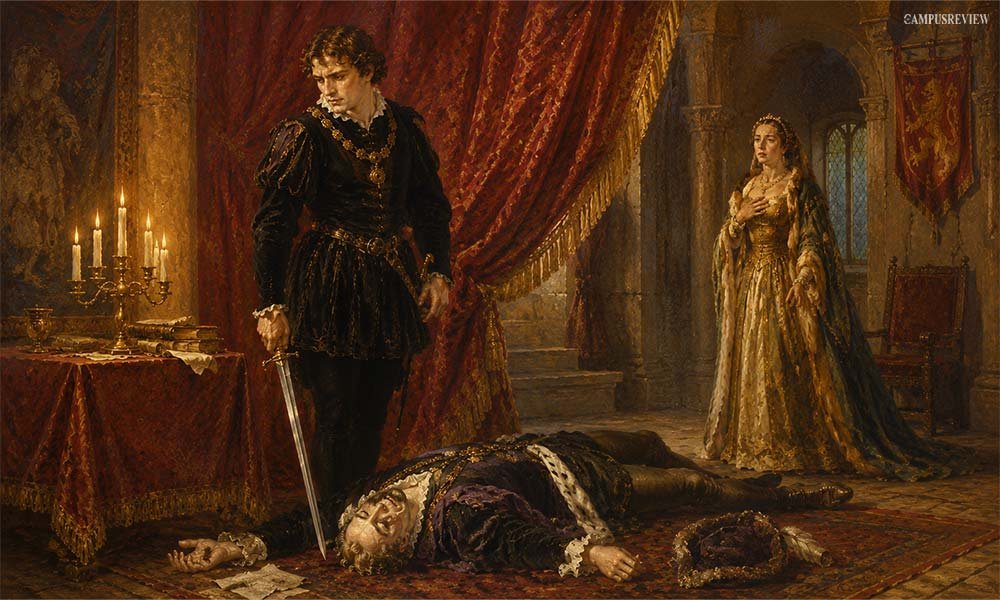
During an argument with his mother, Hamlet hears a noise behind a curtain and stabs blindly. He kills Polonius by mistake. Claudius uses this to send Hamlet away, secretly ordering his death. Hamlet escapes and returns to Denmark.
Ophelia, heartbroken over her father’s death, drowns. Her brother Laertes wants revenge and teams up with Claudius. They plan a sword fight, with a poisoned blade and a poisoned drink as backup.
In the final scene, almost everyone dies. Gertrude drinks the poison by accident. Laertes and Hamlet both get cut by the poisoned sword. Before dying, Hamlet finally kills Claudius.
Famous Quote
As Hamlet lies dying, he speaks his final words:
“The rest is silence.”
– Hamlet, Act 5, Scene 2
My Takeaway
Hamlet is not lazy or weak. He is a smart, thoughtful person stuck in a situation that demands quick violence. His hesitation comes from wanting to be sure before he acts.
If you have ever delayed a big decision because you needed more proof, you already understand Hamlet. Read this play if you enjoy stories that make you pause and think about your own choices, not just watch someone else’s.
2. Macbeth
Genre
Macbeth is a tragedy too. But it moves fast. There is less talking and more action than in Hamlet. Many readers pick this as their first Shakespeare play because the plot is easy to follow.
Main Characters
- Macbeth- A brave Scottish general
- Lady Macbeth- His ambitious wife
- Banquo- Macbeth’s friend and fellow general
- King Duncan- The King of Scotland
- Macduff- A nobleman who becomes Macbeth’s enemy
- The Three Witches- Mysterious figures who predict the future
Summary
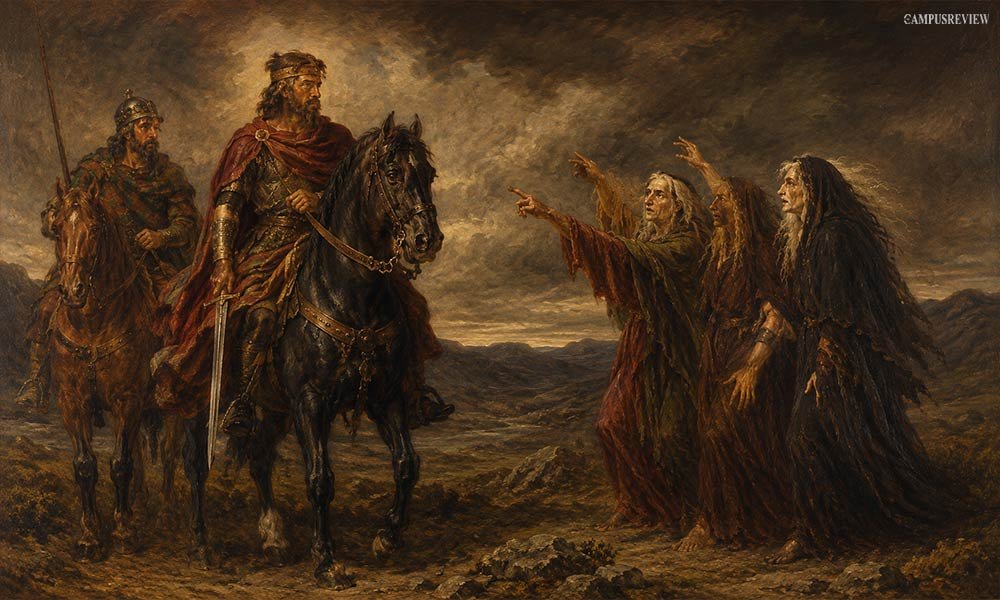
Macbeth and his friend Banquo meet three witches on their way home from battle. The witches predict that Macbeth will become king. Soon after, part of the prophecy comes true when the king gives Macbeth a new title.
Macbeth writes to his wife about the prophecy. Lady Macbeth pushes him to speed things up. She convinces him to murder King Duncan while he is a guest in their home.
After the murder, Macbeth becomes king. But he cannot relax. He remembers the witches also promised the throne to Banquo’s children, so he sends killers after Banquo. Banquo dies, but his son escapes.
At a royal dinner, Macbeth sees Banquo’s ghost and panics in front of his guests. His guilt is starting to show. He visits the witches again and gets three new predictions. He takes them as proof that he cannot be beaten.
Believing he is unstoppable, Macbeth orders more killings, including the family of Macduff, who has fled to join the king’s enemies. Lady Macbeth, meanwhile, is losing her mind from guilt. She sleepwalks and tries to wash invisible blood off her hands.
In the final battle, Macduff reveals a loophole in the witches’ prophecy and kills Macbeth, ending his short and bloody rule.
Famous Quote
As Macbeth faces the emptiness of life, he says:
“Out, out, brief candle! Life’s but a walking shadow, a poor player that struts and frets his hour upon the stage, and then is heard no more.”
– Macbeth, Act 5, Scene 5
My Takeaway
Macbeth shows exactly how one bad decision can drag a person into worse ones. He does not start evil. He starts ambitious, and ambition without limits slowly destroys him.
This play is useful outside literature too. It is a warning about chasing power or success without checking if you are becoming someone you do not like. Read it if you enjoy fast, dark stories with a real emotional cost.
3. A Midsummer Night’s Dream
Genre
This is a comedy, full of magic, mix-ups, and happy endings. After two heavy tragedies, this play feels like a breath of fresh air.
Main Characters
- Hermia- In love with Lysander, ordered to marry Demetrius
- Lysander- In love with Hermia
- Demetrius- Wants to marry Hermia
- Helena- In love with Demetrius
- Oberon- King of the fairies
- Titania- Queen of the fairies
- Puck- Oberon’s mischievous helper
- Nick Bottom- An actor who gets turned into a donkey
Summary
Hermia wants to marry Lysander, but her father wants her to marry Demetrius instead. The ruler of Athens gives her a harsh choice: obey, face death, or live alone forever. Hermia and Lysander decide to run away together through a nearby forest.
Hermia tells her friend Helena about the plan. Helena still loves Demetrius, so she tells him, hoping to win his approval. Demetrius chases the couple into the forest, and Helena follows him.
In the forest, the fairy king Oberon and his wife Titania are fighting. Oberon asks his helper Puck to use a magic flower that makes people fall in love with the first person they see. He wants to use it on Titania as a prank, and also to help Demetrius fall for Helena.
Puck makes a mistake. He puts the potion on the wrong man, and Lysander falls for Helena instead of Demetrius. Trying to fix it, Puck enchants Demetrius too, so now both men love Helena, and no one loves Hermia.Chaoss follows.
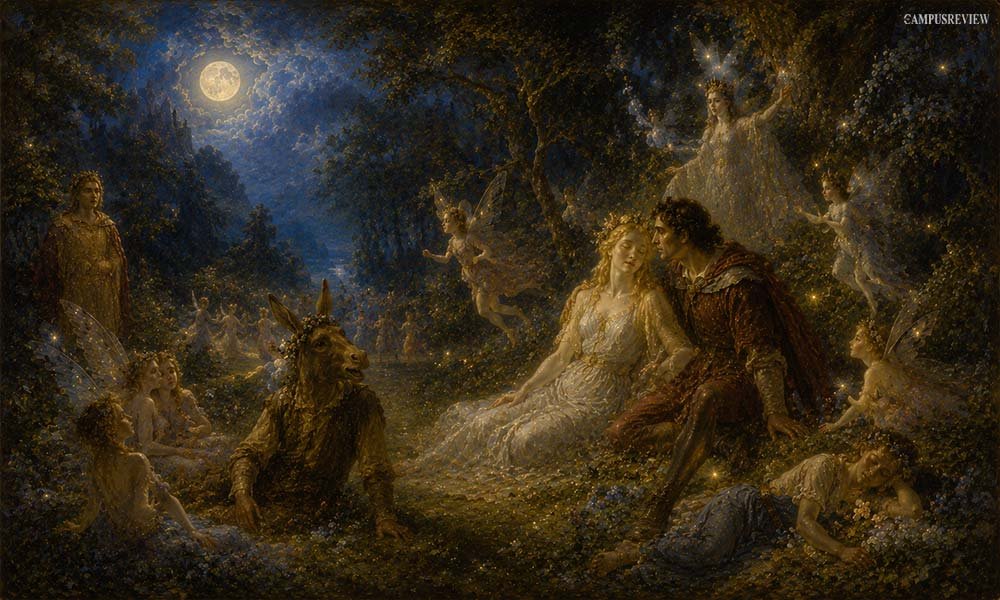
Meanwhile, Puck turns a clumsy actor named Bottom into a donkey. Titania, still under the spell, falls in love with him.
Eventually, Oberon fixes the mess. Lysander goes back to loving Hermia, and Demetrius stays in love with Helena. Everyone wakes up the next morning, unsure if it was all a dream, and three weddings happen together.
Famous Quote
Lysander reflects on the difficulties of love:
“The course of true love never did run smooth.”
– Lysander, Act 1, Scene 1
My Takeaway
This play reminds me that love rarely follows logic. One flower, one mistake, and four people’s feelings flip overnight. Honestly, that chaos feels familiar even without magic involved.
If you enjoy comic books and imaginative stories filled with magic, strange characters, and unexpected twists,A Midsummer Night’s Dream may be the Shakespeare play for you.
4. Henry V
Genre
Henry V is a history play based on a real English king. It mixes patriotism with some uncomfortable truths about war and leadership.
Main Characters
- King Henry V- The young King of England
- The Chorus- A narrator who sets each scene
- Archbishop of Canterbury- Pushes Henry to invade France
- The Dauphin- The mocking French prince
- Princess Catherine- French princess, later Henry’s wife
Summary
Henry V, once known for wild behavior as a young prince, is now a focused king. His advisors encourage him to claim the French throne. When the French prince sends him a mocking gift of tennis balls, Henry takes it as an insult and prepares for war.
Before leaving England, Henry discovers a plot to assassinate him, planned by men close to him. He deals with the traitors without hesitation, showing how serious he now is about ruling.
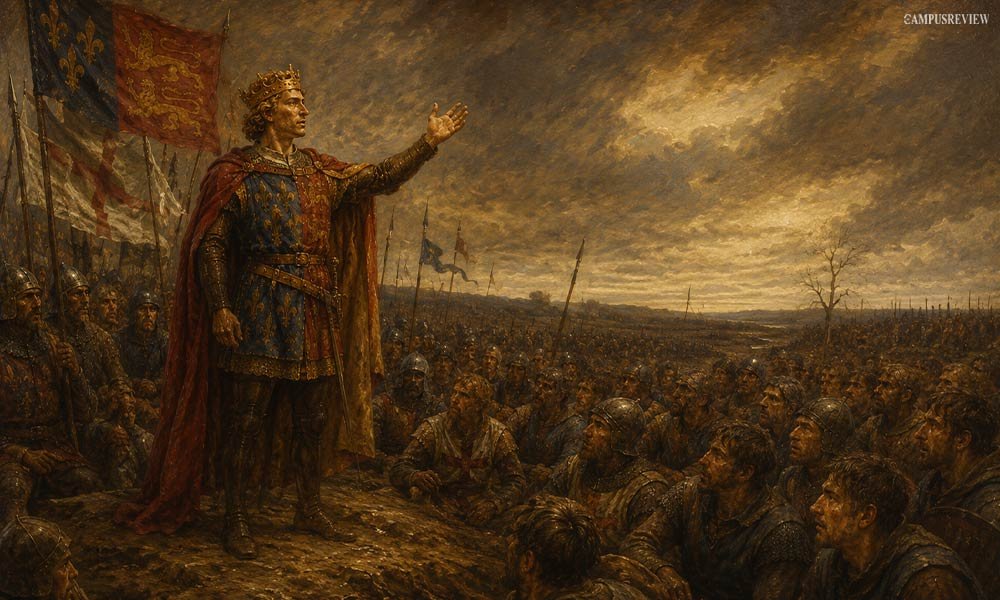
The English army sails to France and captures the town of Harfleur after Henry gives a rousing speech to push his tired soldiers forward. As they march on, disease and exhaustion weaken the English troops. They end up badly outnumbered near a place called Agincourt.
The night before the battle, Henry disguises himself and walks among his soldiers, listening to their fears. Alone afterward, he reflects on how heavy the responsibility of being king really feels.
The next morning, he delivers his famous speech about honor and brotherhood, and it works. Against the odds, the English win a huge victory. Henry returns home a hero and later marries the French princess Catherine, sealing peace between the two nations.
The story ends on a bittersweet note. A narrator reminds the audience that Henry would die young, and his infant son would later lose everything he won.
Famous Quote
Before the Battle of Agincourt, Henry inspires his soldiers:
“We few, we happy few, we band of brothers; for he to-day that sheds his blood with me shall be my brother.”
– King Henry V, Act 4, Scene 3
My Takeaway
Henry V made me think about leadership differently. Words move people just as much as weapons do, and a good leader knows exactly when to use which one.
Read this play if you are curious about how leaders inspire people during hard times, Personal development, and about the quieter cost hidden behind every victory speech.
5. The Tempest
Genre
The Tempest is part tragedy, part comedy, often called a tragicomedy. It is believed to be Shakespeare’s last play written alone, which makes it feel like a farewell.
Main Characters
- Prospero- Exiled Duke of Milan, now a magician
- Miranda- Prospero’s daughter
- Ariel- A magical spirit who serves Prospero
- Caliban- The island’s original inhabitant, now enslaved by Prospero
- Ferdinand- A prince who falls for Miranda
- Antonio- Prospero’s brother, who stole his title
Summary
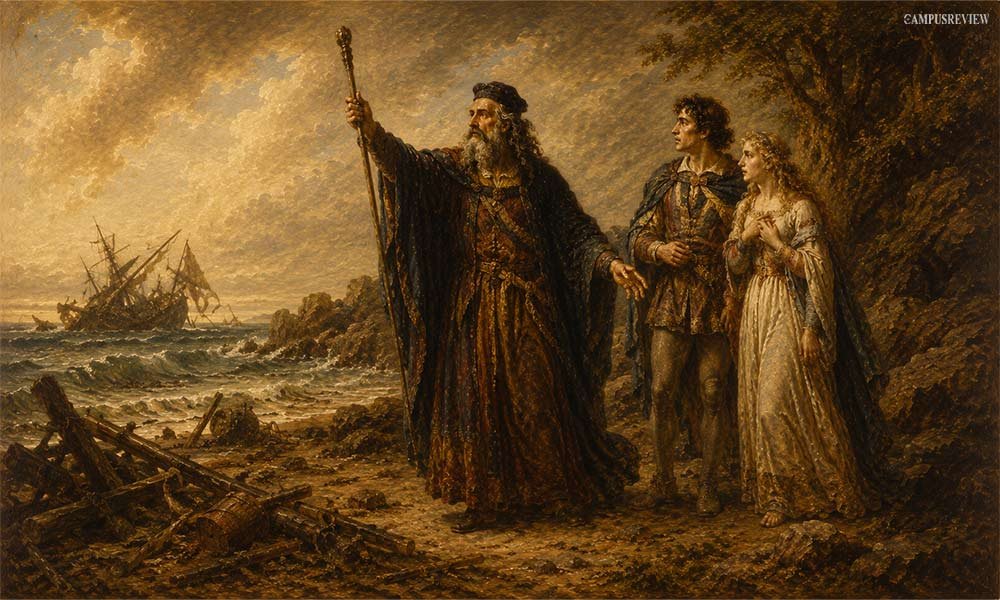
A storm wrecks a ship near a magical island. On board are the men who once betrayed Prospero, the rightful Duke of Milan, including his own brother Antonio, who stole his title years ago and set him adrift at sea with his baby daughter Miranda.
Prospero and Miranda survived and built a strange new life on the island. Prospero freed a spirit named Ariel from a curse, and Ariel now serves him in exchange for future freedom.
Prospero also rules over Caliban, the island’s original inhabitant, who resents him deeply.
When the ship of his old enemies gets close, Prospero uses his magic to create the storm and separate the survivors across the island. Miranda meets Ferdinand, one of the shipwrecked princes, and the two fall in love almost instantly.
Elsewhere, some of the survivors plot new betrayals. Meanwhile, Caliban meets two drunk sailors and convinces them to help him kill Prospero and take over the island.
Prospero could easily punish everyone who wronged him. He has full control and every reason for revenge. But watching his enemies suffer, he changes his mind. He decides forgiveness matters more than punishment.
He releases Ariel, forgives his brother, blesses the marriage of Miranda and Ferdinand, and gives up his magic for good.
Famous Quote
Prospero reflects on the temporary nature of life:
“We are such stuff as dreams are made on, and our little life is rounded with a sleep.”
– Prospero, Act 4, Scene 1
My Takeaway
The Tempest reads like Shakespeare’s own goodbye. Prospero has every reason to seek revenge, and he chooses to let go instead.
Read this play if you want a story about giving up control rather than winning at all costs. It is a quieter, gentler ending compared to the tragedies on this list, and it stays with you differently.
Final thoughts
These plays of William Shakespeare are not exam torture. They are old stories about very human problems: grief, ambition, love, power, and forgiveness. Once the story makes sense, the language stops being a barrier.
Pick one play from this list based on your mood today. Read the Shakespeare plays summary again if you need it. Then pick up the real play and enjoy the language on top of a story you already understand.
FAQs
1. Are Shakespeare’s plays hard to understand?
No, Shakespeare’s plays are not hard to understand once you know the story. The language may feel old, but the plots focus on familiar ideas such as love, power, jealousy, and family. Reading a summary before starting a play can make the story much easier to follow.
2. Can I understand a Shakespeare play just by reading a summary?
Yes, a summary can help you understand the main storyline of a Shakespeare play. However, reading the original play lets you experience Shakespeare’s language, humour and emotion, which a summary cannot fully capture.
3. Do all Shakespeare plays end in tragedy?
No, not all Shakespeare plays end in tragedy. Shakespeare wrote tragedies, comedies and histories. A Midsummer Night’s Dream has a happy ending, while The Tempest ends with forgiveness. Only some of Shakespeare’s most famous plays end in death.