Your palms sweat. Your heart races. Your voice shakes. Almost every student feels this before a class presentation. The good news is simple. You can improve public speaking skills with a clear structure, regular practice, and a few small habits.
Public speaking skills are a mix of voice, body language, and speech preparation that help you share ideas clearly. You do not need a special talent. You learn these skills step by step, like cycling or cooking.
This guide shows you what to do. You will learn proven frameworks, voice and body techniques, common mistakes, ways to calm your nerves, and the best places to practise.
What Are Public Speaking Skills?
Public speaking skills are the abilities that help you deliver a message to a group clearly and with confidence. They cover what you say, how you say it, and how you carry yourself. Effective public speaking also means you adjust your talk to the people in the room.
You use these skills in class presentations, seminars, viva sessions, group discussions, and job interviews. You use them again in team meetings and client pitches. Strong verbal communication skills help you in every one of these moments.
| Part of the skill | What it means | Simple example |
| Speech organization | Arranging ideas in a clear order | Opening, three main points, closing |
| Voice control | Managing pace, pitch, volume, and pauses | Slowing down on an important number |
| Nonverbal communication | Using posture, gestures, and eye contact | Open hands and a steady gaze |
| Nerve management | Handling stress before and during a talk | Slow breathing before you start |
Presentation skills for students improve fastest when they start small, such as answering one question in class. Shy students often prepare more carefully than others, and careful preparation is the base of every good talk.
Why do public speaking skills matter for students?
Employers look for them. NACE’s Job Outlook 2026 Spring Update says employers want new graduates who show teamwork, problem-solving, and communication skills. NACE leaders also say candidates must give examples, not just list skills. A strong class presentation gives you a real example to share in an interview.
Good speakers also learn faster. When you explain an idea out loud, you find the gaps in your own understanding.
How to Improve Public Speaking Skills
Follow five steps to improve public speaking skills. Structure your talk, write short notes, rehearse out loud over several days, know your audience, and ask for feedback. The steps below explain each one with examples.
Step 1: Structure your talk with a proven framework
A messy talk confuses listeners and pushes speakers to ramble. A framework gives you a map. Use Monroe’s Motivated Sequence when you want people to act. Alan H. Monroe developed this five-step model at Purdue University. The example below shows how it works for a talk on sleep before exams.
| Step | What you do | Example line |
| Attention | Open with a hook | “Raise your hand if you pulled an all-nighter before an exam.” |
| Need | Show the problem | “Many of us lose sleep before tests and feel foggy during them.” |
| Satisfaction | Give the solution | “Plan study blocks that end by 10 pm and sleep a full night.” |
| Visualization | Paint the result | “Picture yourself walking into the exam rested and clear.” |
| Action | Ask for one step | “Tonight, set a phone alarm for lights out.” |
Your opening matters most. Listeners form a first impression within moments. Compare these two openings for the same talk on study habits.
| Opening type | Weak version | Strong version |
| Question | “Today I will talk about study habits.” | “When did you last study for two hours without checking your phone?” |
| Short story | “Hi, my name is Riya. I will present now.” | “Last April, I opened my notes at midnight and could not remember one page.” |
| Bold statement | “Studying is important for all students.” | “Long study hours do not guarantee good marks. Smart study does.” |
Step 2: Use the PREP method when you must speak without notes
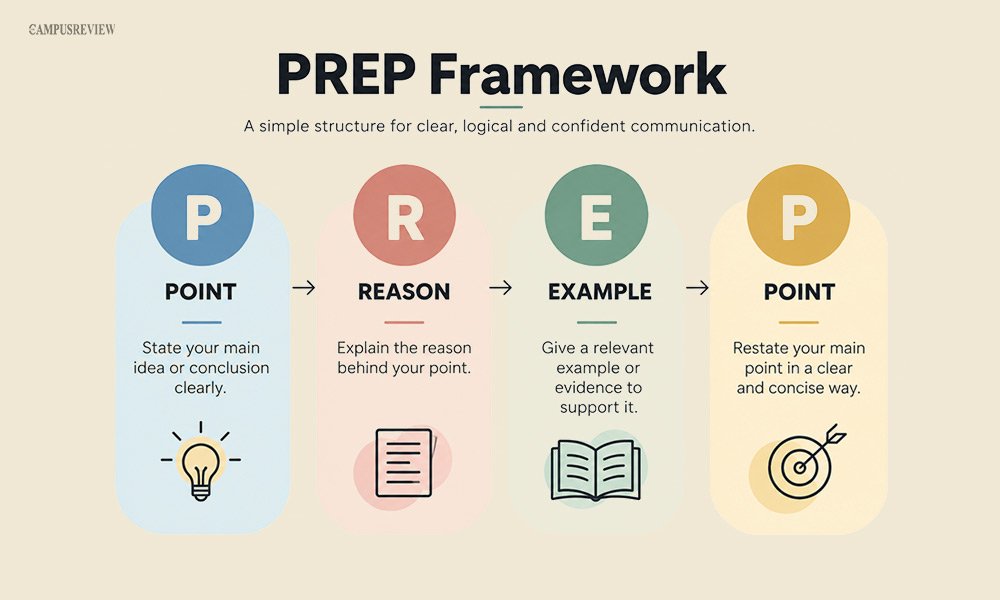
PREP stands for Point, Reason, Example, Point. Use it for seminar questions, group discussions, and interview answers. It keeps your reply short and organized, even when you have ten seconds to think.
Question: “Should colleges make attendance mandatory?”
- Point: Colleges should make attendance mandatory.
- Reason: Regular attendance builds steady study habits.
- Example: Last semester, I missed two labs and struggled in the practical exam.
- Point: That is why I support mandatory attendance.
Step 3: Rehearse with cue cards, not a script
Many students memorize every word. Then they forget one line and panic. Write your full speech once. Next, cut it down to keywords on cue cards. This keeps your speech delivery natural and conversational.
Spread your rehearsal over several days. Short, repeated sessions help you remember material better than one late-night session. Always practise out loud, because silent reading hides the places where you stumble.
| Day | What to do |
| Day 1 | Write the full speech. Mark your main points. |
| Day 2 | Turn the speech into keywords on cue cards. Speak it aloud once. |
| Day 3 | Record a full run on your phone. Watch it once. |
| Day 4 | Practise with your presentation slides and clicker. Speak to a friend. |
| Day 5 | Do one short, calm run. Sleep early. |
Step 4: Know your audience and use slides wisely
Ask three questions before you write. Who will listen? What do they already know? What do they need from me? The answers decide your examples and your level of detail.
Then use simple audience engagement techniques:
- Ask a question and wait two seconds for hands or nods.
- Tell a short story. Storytelling helps listeners remember your point.
- Use a local example. A college canteen example beats a distant case study.
Presentation slides should support you, not replace you. Use one idea per slide. Add a large image or a few keywords. Never paste full paragraphs. If your audience reads while you talk, they stop listening.
Step 5: Ask for feedback early
Feedback helps you identify speaking habits you may not notice yourself. Ask a friend, teacher, or mentor to review your practice speech, or record yourself to check your pace, eye contact, body language, and filler words.
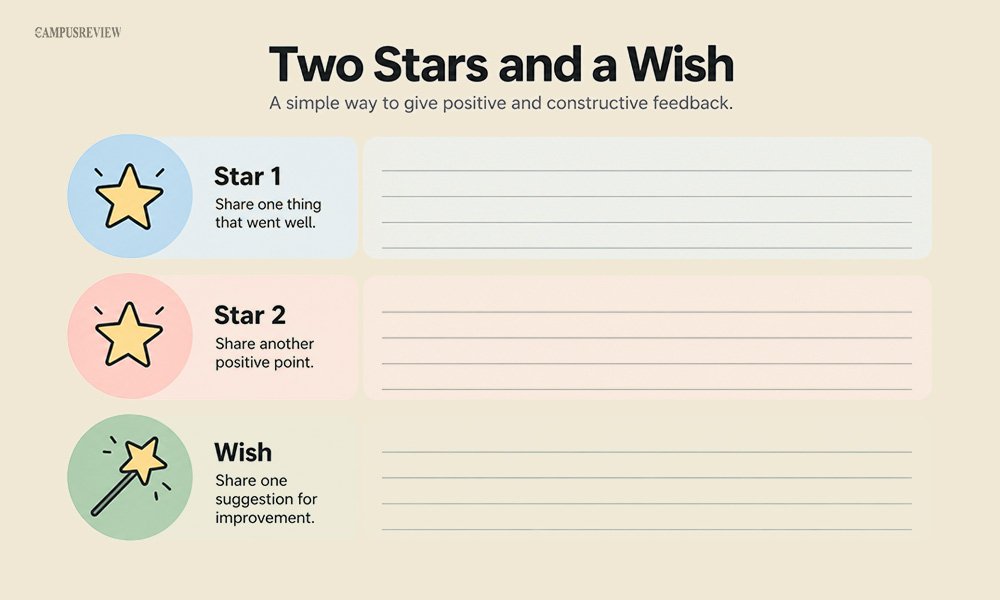
Use the “Two Stars and a Wish” framework:
- Two stars: Identify two things you did well, such as clear speech or good eye contact.
- One wish: Choose one area to improve, such as speaking too quickly or using too many filler words.
Focus on one improvement at a time, then practise again and compare your progress. This makes feedback specific, manageable, and easier to apply.
Public Speaking Techniques for Beginners
These public speaking tips for beginners focus on two things first. Fix your voice. Then fix your body language. These speech delivery techniques work in any room, from a small seminar to a large hall. Small changes make a big difference.
How fast should you speak?
Most speakers sound clear at 140 to 160 words per minute. Nervous speakers often rush past 180. Speaking coaches suggest slowing down when your content is technical. Treat the numbers below as guides, not strict rules.
| Speaking situation | Pace (words per minute) | Why this pace works |
| Standard class presentation | 140 to 160 | Clear and confident |
| Technical or data-heavy talk | 130 to 140 | Gives listeners time to process |
| Persuasive speech | 150 to 160 | Adds energy and urgency |
| Q&A and conversation | 120 to 180 | Flexible and natural |
Quick pace test: Read a 150-word paragraph aloud and time it. It should take about one minute.
Next, practise voice modulation with three habits:
- Pause instead of saying “um.” A one to two-second silence sounds confident and gives you time to breathe.
- End sentences on a falling tone. A rising tone makes statements sound like questions.
- Stress key words. Say “The deadline is Friday” with extra weight on the last word.
What body language works best?
Stand with your feet shoulder-width apart, keep your hands near your waist, and maintain an open posture. Look at listeners one at a time to appear confident and approachable.
Use the triangle method: Divide the room into left, center, and right zones. Make eye contact with one person for 3-4 seconds before moving to another zone. This helps you engage the entire audience naturally.
- Plant your feet. Avoid swaying, pacing, or crossing your ankles.
- Gesture between your belt and chest. Open palms look natural.
- Move with purpose. Stay still for a main point. Step sideways when you change topics.
How do you build confident speaking habits every day?
Confident speaking comes from small daily reps. Spend ten minutes a day on this routine:
| Daily drill | Time | How to do it |
| Read aloud | 3 minutes | Read a news article aloud. Slow down at every full stop. |
| One-minute PREP | 3 minutes | Pick a random topic. Answer it with Point, Reason, Example, Point. |
| Mirror or phone check | 2 minutes | Record yourself. Look at your posture and filler words. |
| Speak up once | 2 minutes | Ask or answer one question in class, lab, or a group chat call. |
How Do You Give a Good Online Presentation?
For an effective online presentation, place your camera at eye level and look into the lens when making key points. Test your microphone, use a quiet space, and share only the presentation window to avoid distractions.
Keep your slides simple, speak clearly, and smile at the start to create a welcoming connection with your audience.
Common Public Speaking Mistakes to Avoid
Most students make the same five mistakes. Each one has a simple fix.
| Mistake | Why it happens | Quick fix |
| Reading from slides | Fear of forgetting content | Glance at a keyword, turn to the audience, then speak. |
| Speaking too fast | Nerves speed up your sense of time | Add // pause marks to your notes and breathe at each one. |
| Memorizing every word | Wish for full control | Learn the order of ideas, not exact sentences. |
| Avoiding eye contact | Fear of judgment | Use the triangle method. Hold each gaze for three to four seconds. |
| Fidgeting and filler words | Nervous energy | Rest your hands at your waist. Close your mouth and breathe silently. |
How to Overcome the Fear of Public Speaking
Your body treats a watching crowd as a threat. Your heart speeds up, your breathing turns shallow, and your hands shake; these are the signs of anxiety. Fear of public speaking has a name: glossophobia. It is a normal survival response, not a personal flaw.
Say “I am excited” instead of “Calm down”
Most people tell themselves to relax before a speech, but research by Harvard Business School’s Alison Wood Brooks found another approach. In a 2014 study published in the Journal of Experimental Psychology: General, people who told themselves “I am excited” performed better than those who tried to calm down. Audiences also rated them as more persuasive, confident, and competent.
Anxiety and excitement both cause a racing heart, so changing how you interpret that feeling may be easier than forcing yourself to relax. Before speaking, say, “I am excited to share this.”
Calm your body with breathing
Shallow chest breathing raises your voice and shortens your sentences. Try these two exercises before you speak:
- Belly breathing: Breathe in through your nose and let your lower belly expand. Breathe out slowly through your lips.
- Cyclic sighing: Take two short breaths in through your nose. Then breathe out slowly through your mouth. Repeat three times.
- Foot press: Press your feet into the floor for five seconds. This releases extra energy without visible shaking.
Build confidence in small steps
Confidence grows through gradual practice, not willpower. Use this four-week ladder:
| Week | Practice setting |
| Week 1 | Speak alone in an empty room or classroom. |
| Week 2 | Speak to one trusted friend. |
| Week 3 | Speak to a group of three or four classmates. |
| Week 4 | Present to the full class or a club. |
Also shift your focus. Do not ask, “How do I look?” Ask, “What does my audience gain from this?” This mindset moves your attention from your fear to your listeners.
Best Resources to Practise Public Speaking
Good public speaking practice needs two things. You need regular speaking time, and you need honest feedback. These options give you both.
| Resource | Best for | What you get |
| Toastmasters International | Live practice | Club meetings, impromptu Table Topics, and written and verbal feedback on every speech. |
| Coursera | Guided learning | The University of Washington’s Dynamic Public Speaking specialization, taught by Dr. Matt McGarrity, covers speechwriting, persuasion, and delivery. |
| Campus speaking centers | Free coaching | Peer tutors who review outlines and slides and run mock presentations at many universities. |
| Self-recording | Daily habit | A video record of your habits. Costs nothing. |
| Peer feedback | An outside view | Honest comments from classmates using a simple form. |
Toastmasters Table Topics also teaches pacing. Speakers get one to two minutes for each surprise question. A green light appears at one minute, yellow at one minute thirty seconds, and red at two minutes. You can copy this system at home with a phone timer.
Regular speaking practice helps you become more comfortable with pronunciation, vocabulary, and expressing ideas clearly. These skills are also useful when learning a new language, where consistent practice plays an important role
Try the three-pass video check
Record a three-minute talk. Then watch it three times:
- Pass 1, video only (sound off): Check your hands, feet, face, and eye contact.
- Pass 2, audio only (screen dark): Check your pace, tone, and filler words.
- Pass 3, full playback: Check how voice, body, and slides work together.
When classmates give feedback, ask them to use four headings: content, voice, slides, and timing. Specific notes help far more than “It was good.”
Final Thoughts
Public speaking skills grow with preparation, steady practice, and honest feedback. Structure your talk, rehearse with cue cards, and speak at a calm pace. Look at your audience and treat nerves as excitement. Then use Toastmasters, Coursera, or a simple video check to keep improving.
Pick one action today:
- Write one talk using the PREP method.
- Record a one-minute speech on your phone.
- Join a Toastmasters or campus speaking club.
Pranjal Kharche
FAQs
1. How long does it take to improve public speaking skills?
Most students notice improvement within a few weeks of regular practice. Short daily exercises and tracking one skill at a time can help build confidence.
2. What should you do if you forget your lines during a speech?
If you forget your lines during a speech, pause, take a breath, and check your cue card. If you get stuck, rephrase your last point or move to the next one.
3. How do you answer tough questions after a presentation?
While answering tough questions after a presentation, listen carefully, pause, and answer clearly. If you do not know the answer, be honest and offer to follow up rather than guessing.
4. Can you practise public speaking alone?
Yes, you can practice public speaking alone. Practise in front of a mirror, record yourself, or rehearse aloud. For better feedback, also practise with a friend or a speaking group.