The Campus Review
September 4, 2026
The Indonesia free school meals initiative faces intense scrutiny after recent food-poisoning incidents have raised serious concerns about food safety, meal storage and delivery.
Officially titled Makan Bergizi Gratis (MBG), the flagship initiative aims to improve child nutrition and help address stunting across the country. However, new outbreaks have prompted public health investigations, kitchen suspensions and renewed calls from lawmakers to strengthen food-safety controls.
Key Highlights of the Crisis
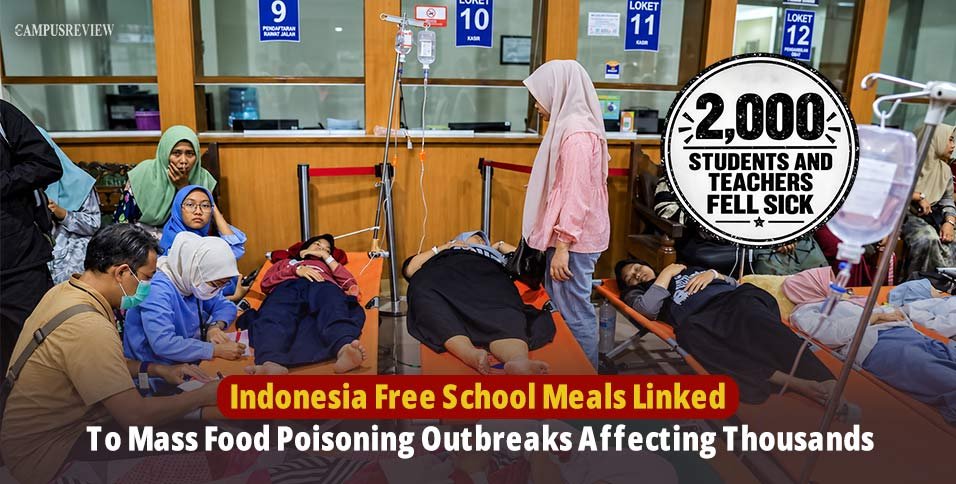
- Recent Illnesses: Around 2,000 students and teachers reportedly fell sick after eating program meals.
- Cumulative Toll: Lawmakers said 50,059 people were affected across 560 incidents in 36 provinces.
- Food Safety Concerns: Authorities cited improper storage and delayed delivery as possible factors.
- Government Action: BGN imposed a 30-day suspension on the Sidoarjo partner kitchen.
- Public Sentiment: Recent polling shows satisfaction with the rollout at about one-third.
What You Need to Know
| Category | Key Information |
| Official Program Name | Makan Bergizi Gratis (MBG) / Free Nutritious Meals |
| Launch Date | January 2025 |
| President | Prabowo Subianto |
| Financial Scale | Rp 240 trillion proposed for 2027 (adjusted from earlier budgets) |
| Target Demographic | Schoolchildren and other vulnerable groups, including pregnant women and young children |
| Key Affected Regions | Central Java, East Java, and West Sumatra |
| Reported Symptoms | Nausea, vomiting, stomach cramps, and dizziness |
Why Indonesia Free School Meals Face Scrutiny
The Prabowo free meals program represents one of the largest social welfare investments in Southeast Asia. Despite its nutritional mission, recent events show the complex logistical hurdles of distributing fresh meals across diverse island provinces.
Delivery time gaps remain an active focus for investigators. In Lasem, Central Java, chicken served through the program was reportedly cooked at about 3 a.m. and consumed around noon. In Sidoarjo, East Java, authorities noted that meals prepared around 5 a.m. arrived only between 11:30 a.m. and 11:40 a.m. and were eaten after midday, well beyond the recommended consumption window. Such delays can increase food-safety risks when perishable meals are held for extended periods.
Medical facilities treated affected students and staff for symptoms including nausea, vomiting and stomach pain. Health officials collected meal samples and ingredient batches as investigations continue into the cause of the illnesses.
Recent Outbreaks by Region
Recent reports trace food-related illnesses across several major provinces, highlighting logistical challenges in regional clusters:
- Lasem, Central Java: Roughly 752 students and 25 teachers were affected in the incident, with several requiring hospitalisation.
- Sidoarjo, East Java: More than 500 students in Sidoarjo, East Java, fell ill after eating meals supplied through the program, prompting an immediate 30-day suspension of the local partner kitchen.
- Agam, West Sumatra: Local clinics treated 237 people, including students and staff, who reported symptoms after eating distributed lunches.
- Nganjuk, East Java: Authorities documented 49 cases of suspected food poisoning tied to distributed rations.
Official Voices: Perspectives on the Ground
Public officials and lawmakers have offered direct assessments as regional inquiries continue:
According to Sudaryono, Head of Indonesia’s National Nutrition Agency (BGN), meals in the Sidoarjo incident had been prepared at approximately 5 a.m. and were meant to be consumed before 9 a.m. However, deliveries arrived between 11:30 a.m. and 11:40 a.m., meaning students ate after noon.
Lawmakers have underscored that the scale of the problem points to systemic vulnerabilities:
“This is a failure of the system. These are not isolated incidents.”
- Charles Honoris, Indonesian Lawmaker
President Prabowo Subianto has consistently defended the broader mission of the policy:
“We start with the most fundamental aspect: nutrition. Our children must not study while hungry… We cannot accept a situation where one in four Indonesian children suffers from stunting.”
- Prabowo Subianto, President of Indonesia
What Actions Are Underway?
Government officials and parliamentary committees are moving to address parent concerns and adjust operational protocols:
- Kitchen Suspensions: The National Nutrition Agency enforced a 30-day suspension for the partner kitchen linked to the Sidoarjo incident while audits continue across local facilities.
- Laboratory Testing: Public health laboratories are analysing meal specimens taken from the affected schools to identify the underlying cause of the illnesses.
- Delivery and Labelling Review: BGN identified failures in meal-delivery timing and package labelling in Sidoarjo, mandating that every food container clearly display preparation and consumption-time limits.
- School-Based Kitchens Proposed: Lawmakers in Commission IX have proposed shifting from centralised kitchens toward school-based meal preparation to reduce delivery distances and improve food safety.
The Indonesia free school meals program remains a major government effort to improve child nutrition, but recent Indonesia school meal food poisoning incidents have highlighted serious food-safety and distribution challenges. Investigations are ongoing as authorities face growing pressure to strengthen meal preparation, storage and delivery standards.