Ever frozen mid-conversation because you could not find the right words? Learn English phrases instead of individual words to speak more naturally. These common word groups, such as “How are things with you?” and “Could you do me a quick favour?”, help you form sentences faster. Research by Erman and Warren suggests that fixed word combinations account for about 58% of spoken English.
Learn 100+ English phrases for daily use with simple meanings and examples. From greetings and college conversations to workplace communication and phone calls, practise useful phrases to speak English naturally and confidently.
Meaning of an English Phrase
A phrase is a group of words that works as one unit of meaning, such as “by the way” or “as soon as possible.” Linguist Michael Lewis popularised this idea in his 1993 book The Lexical Approach, which emphasised learning word chunks alongside vocabulary and grammar.
Learning phrases as complete units helps you speak more smoothly because you spend less time building sentences word by word. English also borrows expressions from other languages, including French phrases, which appear in everyday conversations.
Download the free PDF of 100+ phrases with meanings and examples to review them anytime and build your English vocabulary.
Download the 100 Common English Phrases PDF Guide
Read or download the complete guide below.
View / Download PDF100 Common English Phrases With Meanings and Examples
This section lists common English phrases for everyday conversations, with simple meanings and examples.
Greetings and Introductions
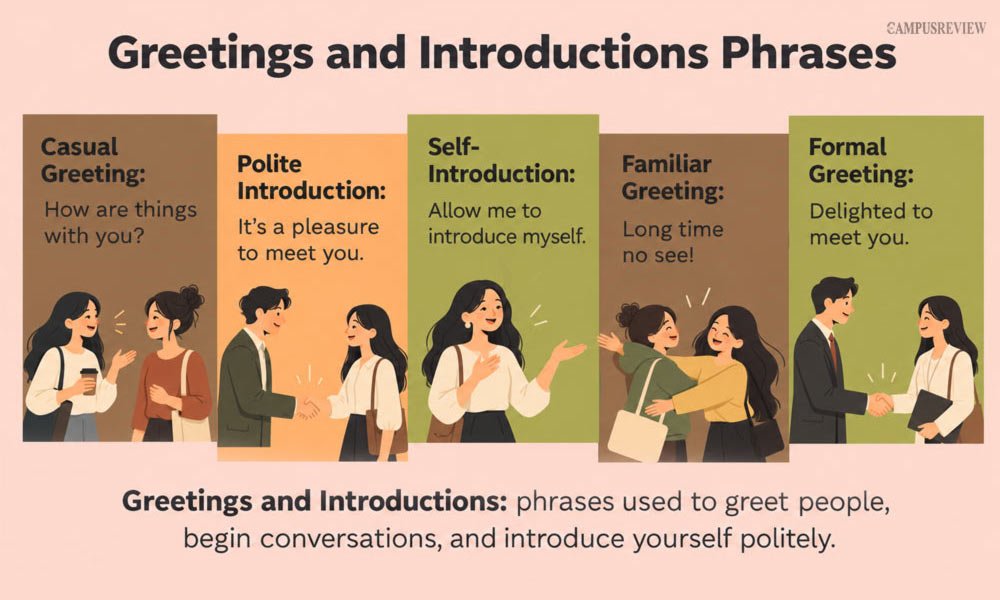
Basic English phrases for greetings help you start any chat. Pick the phrase that fits the person and the place.
How are things with you?
- Meaning: Asks casually how someone is doing.
- Example: “Hey Dev, long time! How are things with you?”
It’s a pleasure to meet you.
- Meaning: A polite greeting at a first meeting.
- Example: “Welcome, Dr. Rao. It’s a pleasure to meet you.”
Allow me to introduce myself.
- Meaning: A formal way to start an introduction.
- Example: “Allow me to introduce myself. I am Neha, the project lead.”
Long time no see!
- Meaning: A warm greeting after a long gap.
- Example: “Riya! Long time no see! Where have you been?”
What have you been up to lately?
- Meaning: Asks about someone’s recent activities.
- Example: “I saw your post. What have you been up to lately?”
I’d like you to meet my colleague.
- Meaning: Introduces a coworker to someone.
- Example: “Before we start, I’d like you to meet my colleague, Mr. Shah.”
Delighted to meet you.
- Meaning: A polite reply after an introduction.
- Example: “Thank you for joining us, Sarah. Delighted to meet you.”
Polite English Phrases
Polite English phrases keep your tone kind. They work well with teachers, seniors, and strangers.
If you don’t mind me asking,
- Meaning: Softens a personal or sensitive question.
- Example: “If you don’t mind me asking, how long did the course take?”
Pardon the interruption,
- Meaning: Excuses you before you cut into a talk.
- Example: “Pardon the interruption, but your cab has arrived.”
Would you be so kind as to…
- Meaning: A very polite way to ask for help.
- Example: “Would you be so kind as to hold the door?”
With all due respect,
- Meaning: Softens a disagreement.
- Example: “With all due respect, the data shows a different trend.”
Please feel free to…
- Meaning: Invites someone to go ahead without worry.
- Example: “Please feel free to take a snack from the table.”
May I have a moment of your time?
- Meaning: Asks a busy person for a short chat.
- Example: “Excuse me, ma’am, may I have a moment of your time?”
After you, please.
- Meaning: Lets someone go first.
- Example: “Please go ahead. After you.”
Phrases for Asking Questions
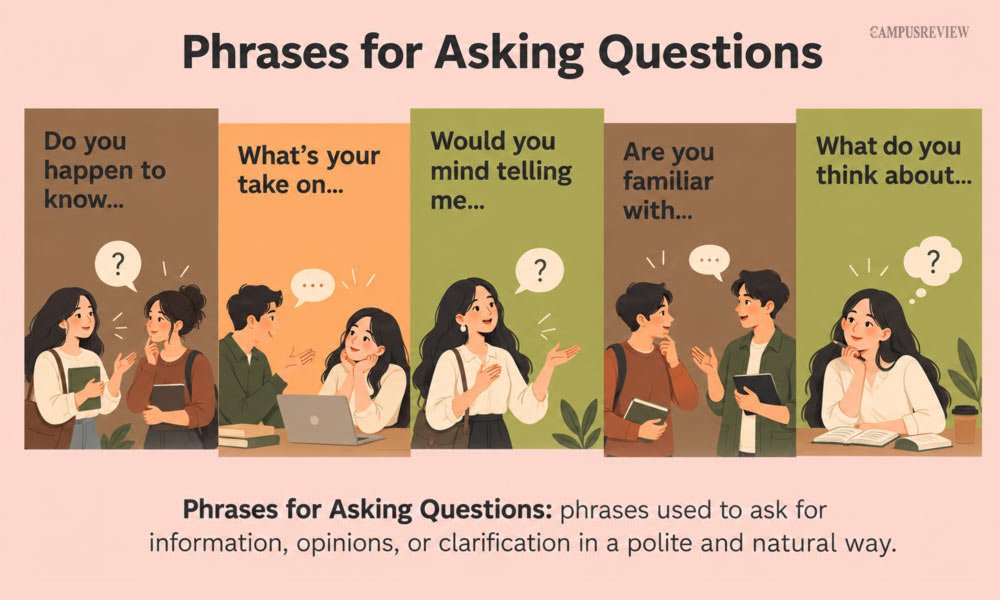
Use polite question openers to make requests more courteous and get clearer answers.
Do you happen to know…
- Meaning: A gentle way to ask for information.
- Example: “Do you happen to know when the library closes?”
What’s your take on…
- Meaning: Asks for someone’s opinion.
- Example: “What’s your take on online classes?”
Could you shed some light on…
- Meaning: Asks for help with a confusing point.
- Example: “Could you shed some light on how grading works?”
Would you mind telling me…
- Meaning: A soft way to ask for information.
- Example: “Would you mind telling me where the admin office is?”
Can you walk me through…
- Meaning: Asks for a step-by-step explanation.
- Example: “Can you walk me through how to fill this form?”
What led you to decide that?
- Meaning: Asks for the reason behind a choice.
- Example: “What led you to pick this course?”
Are you familiar with…
- Meaning: Asks if someone already knows a topic.
- Example: “Before the demo, are you familiar with Excel formulas?”
Phrases for Expressing Opinions
These phrases help you express opinions confidently without sounding too forceful.
The way I see it,
- Meaning: Introduces your view of a situation.
- Example: “The way I see it, daily practice beats long weekend sessions.”
To the best of my knowledge,
- Meaning: Limits a claim to what you know.
- Example: “To the best of my knowledge, the exam is on Monday.”
I am under the impression that…
- Meaning: Shares a belief you are not fully sure about.
- Example: “I am under the impression that the deadline moved to Friday.”
From where I stand,
- Meaning: Gives your view from your own position.
- Example: “From where I stand, the team worked very hard.”
Speaking from experience,
- Meaning: Backs your view with real experience.
- Example: “Speaking from experience, early revision cuts exam stress.”
As far as I’m concerned,
- Meaning: Shows a strong personal view.
- Example: “As far as I’m concerned, honesty comes first.”
Phrases for Agreeing and Disagreeing
Use these lines to agree or disagree without upsetting anyone.
I see eye to eye with you.
- Meaning: You fully agree.
- Example: “On study habits, I see eye to eye with you.”
You’ve hit the nail on the head.
- Meaning: You have understood something correctly or identified the main point of a situation. This is an idiom.
- Example: “Yes! You’ve hit the nail on the head.”
I’m afraid I hold a different view.
- Meaning: A polite way to disagree.
- Example: “I’m afraid I hold a different view on the fee plan.”
We are on the same page.
- Meaning: You share the same understanding.
- Example: “I read your plan, and we are on the same page.”
I’m inclined to agree with that.
- Meaning: You agree after some thought.
- Example: “Given the test results, I’m inclined to agree with that.”
I see your point, but I have doubts.
- Meaning: Accepts the point, then raises a concern.
- Example: “I see your point, but I have doubts about the timeline.”
Phrases for Making Requests
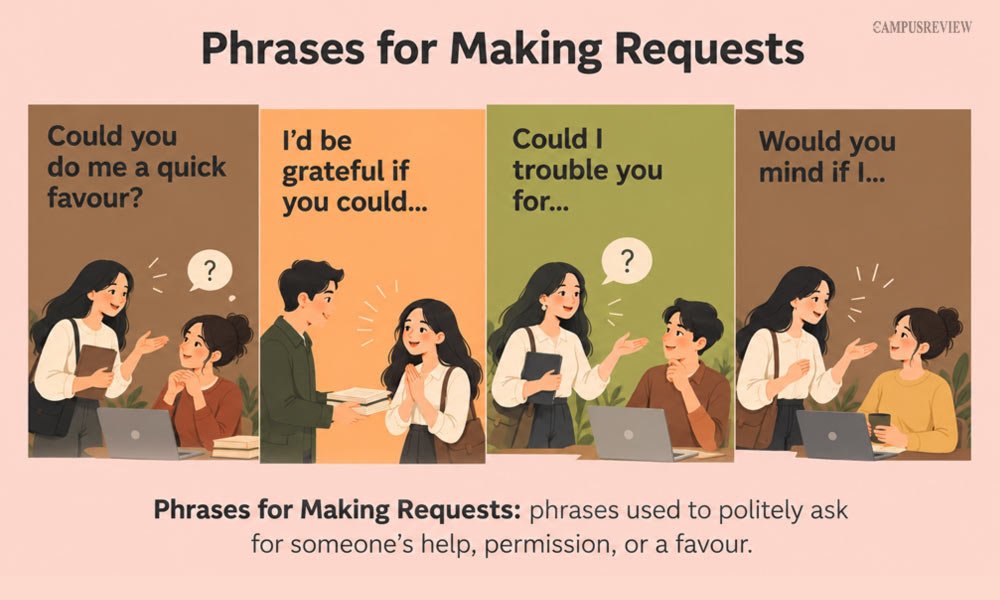
Polite requests give others the option to agree rather than feel ordered around.
Could you do me a quick favour?
- Meaning: Opens a small request.
- Example: “Could you do me a quick favour and print this page?”
Would it be possible for you to…
- Meaning: A polite request that adds no pressure.
- Example: “Would it be possible for you to move the meeting to 4 pm?”
I’d be grateful if you could…
- Meaning: Shows thanks before the task is done.
- Example: “I’d be grateful if you could check my draft tonight.”
Would you mind if I…
- Meaning: Asks permission to do something.
- Example: “Would you mind if I joined the class a few minutes late?”
I was wondering if you could…
- Meaning: A very soft, indirect request.
- Example: “I was wondering if you could review my slides.”
Could I trouble you for…
- Meaning: A polite way to ask for a small item.
- Example: “Could I trouble you for a copy of the agenda?”
If it’s not too much trouble,
- Meaning: Admits the request may take effort.
- Example: “If it’s not too much trouble, please send me the notes.”
English Phrases With Friends
Use short, relaxed phrases to keep conversations with friends natural and casual.
What’s the plan for tonight?
- Meaning: Asks what the group will do.
- Example: “It’s Friday! What’s the plan for tonight?”
Let’s grab a bite to eat.
- Meaning: A casual invite to eat together.
- Example: “I’m starving. Let’s grab a bite to eat.”
Count me in!
- Meaning: Says you will join the plan.
- Example: “A concert on Saturday? Count me in!”
That totally slipped my mind.
- Meaning: Admits you forgot something.
- Example: “I meant to call you, but it totally slipped my mind.”
I’ll take a rain check.
- Meaning: Declines for now and offers a later date.
- Example: “I have an early flight, so I’ll take a rain check.”
Let’s catch up over coffee.
- Meaning: Invites a friend to meet and talk.
- Example: “It’s been too long. Let’s catch up over coffee on Thursday.”
Are we still on for Saturday?
- Meaning: Checks that a plan still holds.
- Example: “Hey Clara, are we still on for Saturday?”
English Phrases for Shopping and Travel
Use short, direct questions when shopping, travelling, or checking into hotels.
Do you have this in a medium size?
- Meaning: Asks if the shop stocks another size.
- Example: “I like this shirt. Do you have this in a medium size?”
Do you accept card or UPI?
- Meaning: Asks which payment methods a shop takes.
- Example: “I have no cash. Do you accept card or UPI?”
Which platform does the train leave from?
- Meaning: Asks for the platform number.
- Example: “Excuse me, which platform does the train leave from?”
Is there a fitting room available?
- Meaning: Asks where to try on clothes.
- Example: “I’d like to try these jeans on. Is there a fitting room available?”
Is there a shuttle to the airport?
- Meaning: Asks about hotel transport.
- Example: “We check out at 5 am. Is there a shuttle to the airport?”
Is breakfast included in the price?
- Meaning: Asks if a hotel rate covers breakfast.
- Example: “Before I book, is breakfast included in the price?”
Phrases for Saying Thank You and Apologising
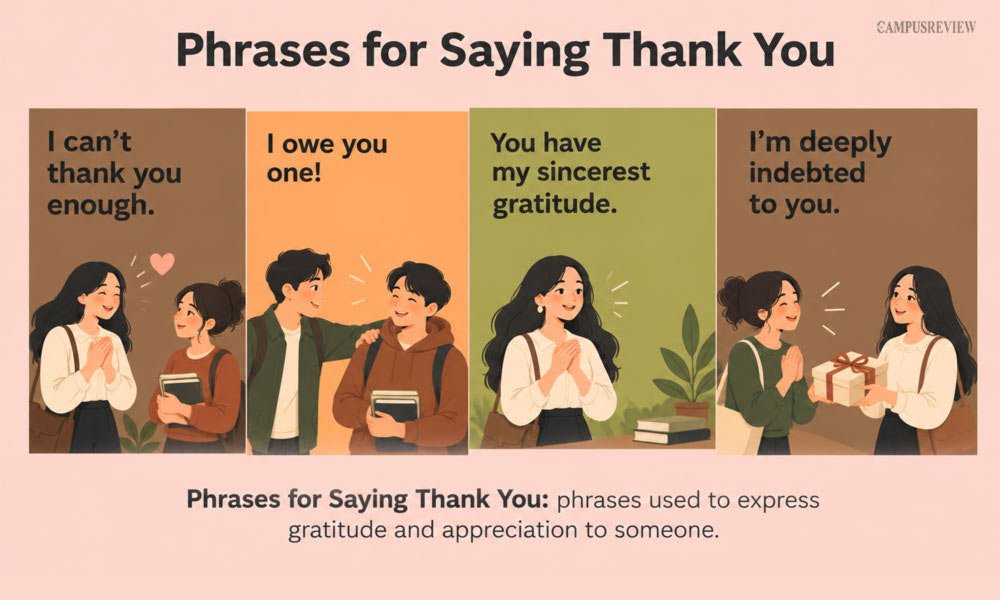
Use clear thank-you and apology phrases to express gratitude, apologise politely, and resolve everyday issues.
I can’t thank you enough.
- Meaning: Shows deep thanks.
- Example: “You fixed my laptop in an hour. I can’t thank you enough.”
I owe you one!
- Meaning: Casual thanks with a promise to return the favour.
- Example: “Thanks for covering my shift. I owe you one!”
Please accept my sincere apologies.
- Meaning: A formal apology.
- Example: “Please accept my sincere apologies for the delay.”
You have my sincerest gratitude.
- Meaning: A formal, heartfelt thanks.
- Example: “For your years of support, you have my sincerest gratitude.”
I’m deeply indebted to you.
- Meaning: Shows you owe someone a lot.
- Example: “Without your guidance, I would have failed. I’m deeply indebted to you.”
Please forgive my delayed response.
- Meaning: A polite apology for a late reply.
- Example: “I was travelling last week. Please forgive my delayed response.”
I take full responsibility.
- Meaning: Admits the mistake is yours.
- Example: “The error was mine. I take full responsibility.”
My apologies for any inconvenience caused.
- Meaning: A standard apology for a problem you caused.
- Example: “The class ran late. My apologies for any inconvenience caused.”
English Phrases for Everyday Conversations
Here are phrases for everyday conversations in class, with friends, on trips, and on calls. These English speaking phrases fit real situations you face each week.
English Phrases at School and College
These English phrases for students help you in class, in the library, and in the hostel.
Can I borrow your lecture notes?
- Meaning: Asks a classmate for notes you missed.
- Example: “I missed Tuesday’s class. Can I borrow your lecture notes?”
When is the assignment due?
- Meaning: Asks for the submission deadline.
- Example: “Excuse me, sir, when is the assignment due?”
Let’s form a study group.
- Meaning: Suggests studying together.
- Example: “Maths is hard this term. Let’s form a study group.”
Could you go over that again?
- Meaning: Asks a teacher to explain once more.
- Example: “I lost track at step three. Could you go over that again?”
Has the professor posted the syllabus yet?
- Meaning: Asks if the course outline is out.
- Example: “Classes begin tomorrow. Has the professor posted the syllabus yet?”
Is this topic going to be on the exam?
- Meaning: Asks if a topic will be tested.
- Example: “Before we move on, is this topic going to be on the exam?”
English Phrases for Phone Calls
Use clear, concise phrases to communicate effectively during phone calls and avoid misunderstandings.
Thanks for getting back to me.
- Meaning: Thanks someone for returning your call.
- Example: “Good afternoon, Mrs. Gable. Thanks for getting back to me.”
Could you speak up a little? The line is breaking up.
- Meaning: Asks for a louder voice because of a bad signal.
- Example: “I can barely hear you. Could you speak up a little? The line is breaking up.”
Hold on a second, please.
- Meaning: Asks the caller to wait briefly.
- Example: “Let me find your file. Hold on a second, please.”
I’m calling about your email.
- Meaning: States why you are calling.
- Example: “Hello, this is Arthur. I’m calling about your email on the contract.”
You’re cutting in and out.
- Meaning: Says the signal keeps breaking.
- Example: “You’re cutting in and out. Can you hear me?”
May I take a message?
- Meaning: Offers to note a message for someone who is away.
- Example: “Mr. Drake is in a meeting. May I take a message?”
Formal and Informal English Phrases
Choose formal English for professional situations and informal English for casual conversations with friends.
Formal Phrases for Professional Communication
Formal English expressions fit emails, interviews, and meetings with seniors.
I am writing to inquire about…
- Meaning: A standard opening for a formal email.
- Example: “I am writing to inquire about the scholarship deadline.”
Please find the document attached.
- Meaning: Tells the reader a file is in the email.
- Example: “As discussed, please find the document attached.”
At your earliest convenience,
- Meaning: A polite way to say “as soon as possible.”
- Example: “Please review the contract at your earliest convenience.”
We are pleased to inform you that…
- Meaning: Announces good news officially.
- Example: “We are pleased to inform you that your application is accepted.”
Thank you for your prompt reply.
- Meaning: Thanks someone for answering fast.
- Example: “Thank you for your prompt reply. It solved our scheduling issue.”
Please do not hesitate to contact me.
- Meaning: A polite closing line for emails.
- Example: “I hope this helps. Please do not hesitate to contact me.”
Informal Phrases for Casual Conversations
Use these with friends, classmates, and close family.
What’s up?
- Meaning: A common casual greeting.
- Example: “Hey, what’s up? Long time no chat!”
No worries!
- Meaning: A relaxed reply to thanks or sorry.
- Example: “Thanks for holding the door! No worries!”
Catch you later!
- Meaning: A casual goodbye.
- Example: “I have class in ten minutes. Catch you later!”
I’m beat. Time to hit the hay.
- Meaning: Says you are tired and going to sleep.
- Example: “We walked all day. I’m beat. Time to hit the hay.”
That sounds like a blast!
- Meaning: Shows excitement about a plan.
- Example: “Rafting this weekend? That sounds like a blast!”
Give me a shout when you’re free.
- Meaning: Asks a friend to call or text when free.
- Example: “I’m around all afternoon. Give me a shout when you’re free.”
When to Use Formal or Informal Phrases
Use formal phrases with seniors, clients, and strangers. Use informal phrases with friends and peers. When you feel unsure, start formal. You can relax later if the other person does.
| Factor | Formal | Informal |
| Who you talk to | Teachers, bosses, new clients | Friends, classmates, family |
| Where you use it | Emails, interviews, official letters | Chats, voice notes, social media |
| Goal | Show respect and stay clear | Build friendship and keep it easy |
| Sound | Full words, careful tone | Short forms, relaxed tone |
Mixing the two causes trouble. “Dear Sir, what’s up?” sounds odd in any setting.
English Phrases for Speaking Confidently
Use transition phrases to organize your ideas, guide listeners, and keep presentations clear and engaging.
Phrases for Presentations and Discussions
To kick things off,
- Meaning: Starts a talk with energy.
- Example: “To kick things off, let’s look at last month’s results.”
Now, let’s move on to the next point.
- Meaning: Shifts the audience to a new idea.
- Example: “Now, let’s move on to the next point: costs.”
I’d like to open the floor for questions.
- Meaning: Invites the audience to ask.
- Example: “That is my last slide. I’d like to open the floor for questions.”
I’d like to draw your attention to this chart.
- Meaning: Points the audience to a visual.
- Example: “I’d like to draw your attention to this chart on page four.”
Let’s look at the bigger picture.
- Meaning: Steps back from small details.
- Example: “Instead of line items, let’s look at the bigger picture.”
To recap what we covered,
- Meaning: Sums up the main ideas.
- Example: “To recap what we covered, we saw three key trends.”
Phrases for Giving Opinions and Suggestions
Use opinion and suggestion phrases to share your views clearly and offer helpful ideas politely.
One option would be to…
- Meaning: Offers an idea without pressure.
- Example: “One option would be to test the plan in two cities.”
I would strongly suggest that we…
- Meaning: Shows firm support for a plan.
- Example: “I would strongly suggest that we start revision early.”
It might be worth considering whether…
- Meaning: Offers a gentle idea to a senior or a group.
- Example: “It might be worth considering whether we can automate this step.”
Have we weighed the pros and cons of…
- Meaning: Asks the group to compare both sides.
- Example: “Before we sign, have we weighed the pros and cons of this deal?”
I suggest we pilot this on a smaller scale.
- Meaning: Proposes a small test first.
- Example: “Instead of a full launch, I suggest we pilot this on a smaller scale.”
An alternative is to…
- Meaning: Adds a second choice.
- Example: “If the hall is full, an alternative is to meet online.”
Phrases for Clarifying Information
These phrases fix confusion before it grows. Use them freely.
If I understand you correctly, you are saying that…
- Meaning: Repeats the other person’s point to check it.
- Example: “If I understand you correctly, you are saying that the test moved.”
Could you give me an example?
- Meaning: Asks for a real case.
- Example: “You mentioned delays. Could you give me an example?”
To put it another way,
- Meaning: Explains your own point in simpler words.
- Example: “We spend more than we earn. To put it another way, we are losing money.”
Could you elaborate on that?
- Meaning: Asks for more detail.
- Example: “Could you elaborate on that last point?”
Let me rephrase that.
- Meaning: Restates your own idea more clearly.
- Example: “I see some confused faces, so let me rephrase that.”
Just to be clear, are we agreeing to…
- Meaning: Confirms the final decision.
- Example: “Just to be clear, are we agreeing to submit by Thursday?”
How to Learn and Use English Phrases Effectively
English language learning works best when you learn phrases the way you meet them in real life. Long English vocabulary lists fade fast. Phrases tied to a scene stay.
Learn Phrases in Context
Learn each phrase inside a full sentence or a real scene. Linguist Richard Schmidt explained that you learn what you consciously notice. So watch, read, and listen with attention.
- Watch interviews, vlogs, or series with English subtitles.
- Pause when you hear a phrase that repeats.
- Write down the full sentence and who said it.
- Note whether the tone was formal or informal.
Practise Through Everyday Conversations
Applied linguist Merrill Swain argued that you improve when you speak or write, not only when you listen. Use a simple daily routine.
1. Pick three phrases each morning.
2. Use each phrase once in a real chat, call, or voice note.
3. Record yourself on your phone for 30 seconds.
4. Replay the clip and fix one mistake.
5. Review the three phrases again before bed.
Example: send a voice note to a friend that says, “Count me in! What’s the plan for tonight?” You practise two phrases in ten seconds.
Keep a Personal Phrase List
Group phrases by situation, not by alphabet. A situation list helps you find the right line fast. Add your own example sentence for each entry.
| Situation | Phrase | My own example |
| Asking for help | Could you do me a quick favour? | Could you do me a quick favour and share the slides? |
| Disagreeing politely | I see your point, but I have doubts. | I see your point, but I have doubts about the budget. |
| Fixing confusion | To put it another way, | To put it another way, we need one more week. |
Review the list after one day, three days, and one week. This spacing helps new phrases stay in your memory.
Final Thoughts
English phrases give you ready-made words for real moments. Start small. Pick three phrases from this guide today. Use them in a chat, a call, or a class. Repeat the next day with three new ones.
Within a few weeks, your spoken English will feel smoother and more natural. Bookmark this page and come back whenever you need the right line.
Pranjal Kharche