You reread your notes three times, yet struggle to remember the answers during an exam. The problem is that familiarity does not always mean learning. Active recall strengthens memory by forcing you to retrieve information without looking at your notes.
Research by Roediger and Karpicke (2006) found that self-testing can improve long-term retention compared with repeated studying. This guide explains how to practise active recall with five simple techniques, examples, AI tools, and spaced repetition.
How to Practise Active Recall
To practise active recall, study one small topic, close your notes, and write or say everything you remember. Then check your notes, find the gaps, and test those gaps again on another day.
Follow these five steps:
1. Pick one small topic. Choose a single idea, such as photosynthesis. Do not pick a whole subject.
2. Close everything. Shut your book, notes, and phone.
3. Pull it out of your head. Write, speak or draw what you remember. Keep going when it gets hard. The struggle helps you learn.
4. Check your notes. Compare your answer with the source. Mark every miss with a different coloured pen.
5. Turn gaps into questions. Add each miss to your flashcards or question list. Test it again in a day or two.
Active recall feels harder than rereading. That is normal. Rereading makes the text look familiar, so you think you know it. Psychologists name this the illusion of competence.
Self-testing breaks that illusion because it shows what you really know. Checking your own understanding like this builds metacognition.
Scientific Evidence for Active Recall
Recall After Studying vs. Retrieval Practice
The percentage of passage information recalled on a later test after different time intervals. The study compared repeated studying with retrieval practice.
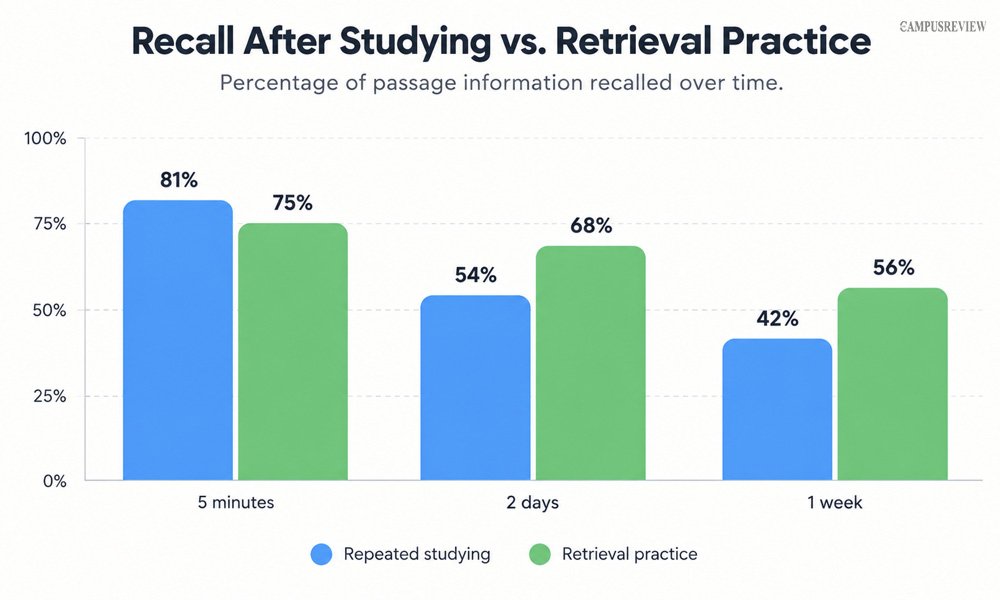
Source:Roediger and Karpicke (2006). Percentages are rounded from the study’s reported results.
What Does the Graph Show?
Repeated studying improved immediate recall, but retrieval practice improved long-term retention. After two days, students recalled 68% of the material with retrieval practice, compared with 54% after repeated studying. After one week, recall was 56% with retrieval practice and 42% with repeated studying.
5 Active Recall Techniques for Students
These five active recall techniques suit different jobs. Pick one from the table, then follow its steps.
| Technique | Best for | Suggested time | Level |
| Flashcards | Facts, definitions, formulas, vocabulary | 10 to 20 minutes | Easy |
| Practice questions | Exam-style problems | 30 to 60 minutes | Medium |
| Blurting | Checking a full chapter fast | 10 to 15 minutes | Easy |
| Teach what you learned | Hard ideas | 10 to 15 minutes | Medium |
| Blank-page method | Structure and big picture | 15 to 20 minutes | Medium |
1. Flashcards
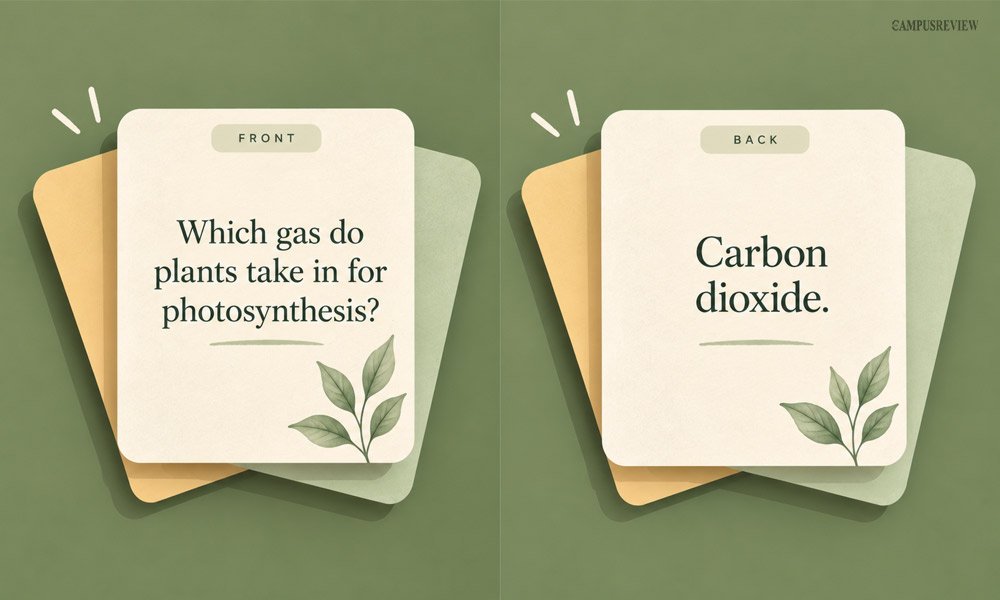
Flashcards pair a question with one short answer. They suit definitions, formulas, dates, and
vocabulary. Good flashcard revision starts with simple cards.
- Write one fact per card. Short cards test your memory better than crowded ones.
- Say or write the answer before you flip the card.
- Make some cards two-way. Card A asks, “Capital of Australia?” Card B asks, “Canberra is the capital of which country?”
- Rate each card as easy, medium, or hard. Apps use this to plan reviews.
Example: Front: “Which gas do plants take in for photosynthesis?” Back: “Carbon dioxide.”
2. Practice Questions
Practice questions help you apply what you have learned in exam-style situations. They test your understanding and show which concepts you need to revise.
- Collect questions from past papers, sample papers, and chapter exercises.
- Sit like it is an exam. Set a timer and shut your books.
- Keep an error log. Label each mistake as a knowledge gap, a method error, or a careless slip.
- Work only on your logged errors next time.
Example: Question 7, parallel resistors.
Mistake type: method error.
Fix: solve three more parallel circuit problems.
3. The Blurting Method
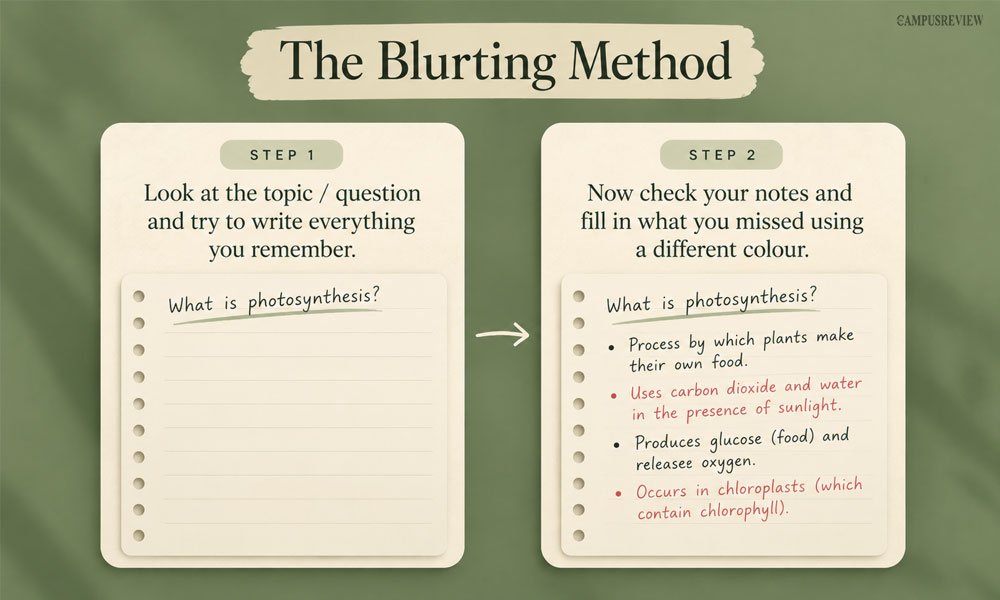
Blurting involves quickly writing down everything you remember about a topic without checking your notes. It reveals what you know well and what you need to review.
1. Pick one topic and set a timer for 10 to 15 minutes.
2. Close your notes. Write every fact, link, and step you remember. Do not edit.
3. Open your notes. Use a different colour pen to add what you missed or got wrong.
4. Turn each correction into a question for tomorrow.
Example: You write down everything you remember about photosynthesis but forget what chlorophyll does. Add that question to your flashcards for tomorrow.
4. Teach What You Have Learned
Teaching a concept in simple words helps you check how well you understand it. This approach is known as the Feynman technique, named after physicist Richard Feynman.
1. Pick one hard idea.
2. Explain it out loud to a friend, a study group, or an imaginary Class 6 student.
3. Use simple words and everyday examples. Skip the jargon.
4. Mark every spot where you get stuck. Check your notes and explain again.
Example: Explain inflation to a younger cousin. “Prices rise, so the same ₹100 buys less than it did last year.”
5. The Blank-Page Method
The blank-page method tests how well you understand a topic as a whole. Start with an empty page and rebuild the main ideas, headings, and connections from memory. Blurting helps you recall facts; the blank-page method helps you organise them.
1. Take a clean sheet. Add no headings or outline.
2. Write the main parts of the topic first.
3. Add smaller details under each part.
4. Compare with your notes. Check whether you forgot the structure or only the small details.
Example: For the Indian Constitution, write the main parts first: Preamble, Fundamental Rights, Directive Principles and Fundamental Duties. Then add details under each.
Tools for Active Recall
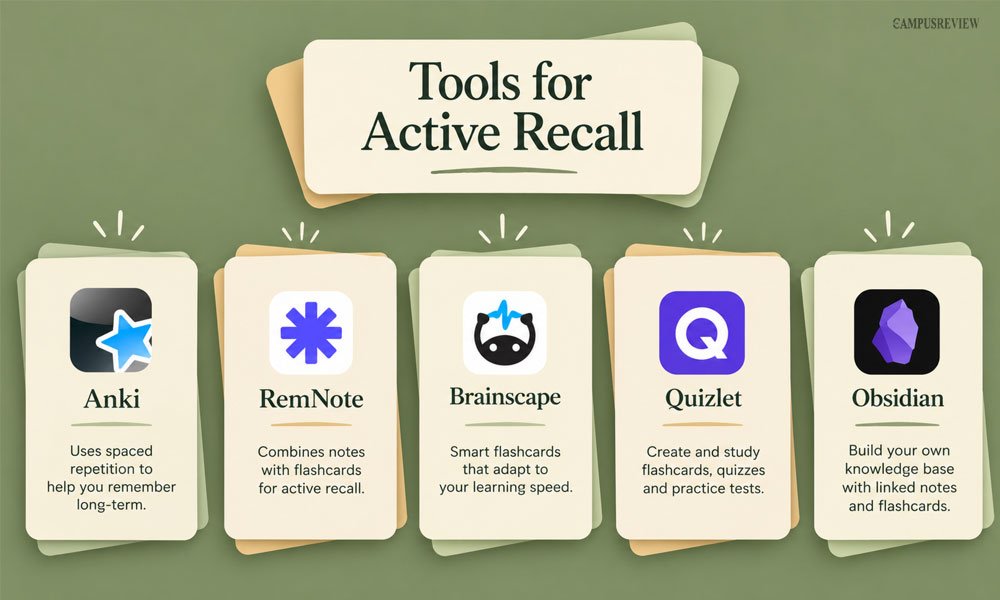
Apps schedule your reviews and track progress. These five tools work well.
| Tool | Best for | Why it helps |
| Anki | Large syllabuses and vocabulary | Flexible flashcards with fill-in-the-blank cards and automatic review timing. |
| RemNote | Students who take notes and want cards from them | Turns your notes into flashcards automatically. |
| Brainscape | Exams and certifications | You rate each answer from 1 to 5. Hard cards come back sooner. |
| Quizlet | School-level facts and vocabulary | Easy decks, tests and matching games. |
| Obsidian | Note lovers who link ideas | With community plugins, you add review cards inside your notes. |
How to Use AI Tools for Active Recall
Use AI as your examiner, not your note-taker. Ask it to quiz you. Answer from memory. Then let it check your work. If you only read AI summaries, you’ll fall back into the rereading trap. Smart AI use also supports memory improvement.
Which AI Study Tools Help With Active Recall?
| AI tool | What it does for active recall | Best for |
| ChatGPT, Claude or Gemini | Chat assistants. Paste your notes and ask for a quiz, a marking table or flashcards. | Daily quizzes on any topic |
| Google NotebookLM | You upload your own notes or PDFs. It answers from those sources and can build quizzes and flashcards. | Quizzes from your own syllabus |
| Anki with FSRS | Not a chatbot. It uses machine learning to show each card just before you forget it. | Long-term review |
| Quizlet and RemNote AI features | Create flashcards from notes you add. | Fast card making |
Features change often, so check each app for its latest options. These AI study tools help most when you answer first and read second.
5 AI Prompts for Active Recall
Copy each prompt and replace the words in [brackets] with your own subject and topic.
1. The Strict Examiner
Use it when: you want a long test on one topic.
“Act as a strict examiner for [Class 12 Chemistry]. Test me on [Electrochemistry]. Ask one hard question at a time. Do not give hints or answers. After I reply, tell me what is right, what is wrong and what I missed. Then ask the next question. Keep going until I say stop.”
How it works: The AI asks, “Why does a battery’s voltage fall as it runs down?” You type your answer from memory. The AI replies, “Good start, but you missed the role of changing concentrations.” At the end, say, “List every point I missed as flashcards.”
2. The Easy-to-Hard Ladder
Use it when: you want to move from basic recall to deeper thinking.
“Use my notes below to write six questions that go from easy to hard.
Question 1: a definition.
Question 2: Explain it in my own words.
Question 3: solve a new problem.
Question 4: Compare two ideas.
Question 5: link two chapters.
Question 6: judge the limits of the theory.
Give only the questions. Do not give answers until I reply. [Paste notes]”
How it works: The six levels follow Bloom’s taxonomy, a popular way to rank thinking skills. Answer in writing, in order. Then ask, “Score each answer out of 10 and give one tip.”
3. The Tricky Options Quiz
Use it when: you face multiple-choice exams such as NEET.
“Write three short real-life situations that test the difference between [aerobic respiration] and [anaerobic respiration]. Give four options for each. Make the three wrong options match mistakes students often make. Hide the answers until I send my choice and my reason.”
How it works: Pick an option and write one line on why. The AI then explains why each wrong option tempts students. Follow-up: “Write two more questions on my mistake.”
4. The Flashcard Maker
Use it when: you have good notes but no time to make cards.
“Turn my notes below into 20 flashcards. Put a question on the front and a short answer on the back. Use one fact per card. Add five fill-in-the-blank cards. Do not add facts that are not in my notes. [Paste notes]”
How it works: Read the cards once and delete any mistakes. Import them into Anki or Quizlet. Answer aloud before you flip each card.
How to Combine Active Recall With Spaced Repetition
Do active recall on a topic, then repeat it after longer gaps, such as 1 day, 3 days, 1 week, and 1 month. Active recall strengthens memory, while spaced repetition helps you decide when to test yourself again. Both are useful parts of effective exam preparation.
Ebbinghaus showed that we forget information quickly after learning it. His forgetting curve drops steeply in the first few days. Spaced testing helps counter this decline. A short delay makes recall slightly harder, and the extra effort can improve long-term retention.
Spacing also reduces the need for last-minute cramming and helps you retain information for longer.
Try the Leitner Box
The Leitner box combines both ideas with paper cards and five sections of a box.
| Box | You review it | If you answer right | If you answer wrong |
| Box 1 | Every day | Card moves to Box 2 | Card stays in Box 1 |
| Box 2 | Every 3 days | Card moves to Box 3 | Card goes to Box 1 |
| Box 3 | Every 7 days | Card moves to Box 4 | Card goes to Box 1 |
| Box 4 | Every 14 days | Card moves to Box 5 | Card goes to Box 1 |
| Box 5 | Every 30 days | Card counts as learned | Card goes to Box 1 |
One wrong answer sends a card back to Box 1. Weak memories get daily practice. Strong ones fade into the background.
Final Thoughts
Active recall is simple. Close your notes, pull the answer from memory, check it, and repeat the gaps later. Pair it with other effective study techniques, and let AI act as your personal examiner.
Start small. Tonight, pick one topic and run a 10-minute blurt. Tomorrow, turn the misses into flashcards. Within a week, you will know which topics need more work, and your study habits will start to change. Better learning strategies beat longer hours. Smarter testing wins.
Pranjal Kharche
Frequently Asked Questions About Active Recall
1. Can active recall help with subjects that require problem-solving?
Yes. In subjects such as mathematics, physics, and chemistry, solve problems without checking worked examples first. This helps you practise choosing formulas, applying concepts, and identifying mistakes.
2. What should you do when you cannot remember an answer?
When you cannot remember an answer, try to recall the answer for a short time before checking your notes. Review the correct explanation, identify what you missed, and test yourself again later.
3. Can you use active recall while studying a new topic?
Yes, you can use active recall while studying a new topic, but first learn the basic concepts. After studying a small section, close your notes and recall the main ideas.
4. How do you know if active recall is improving your memory?
Track your accuracy across review sessions. If you can answer questions correctly after longer intervals, explain concepts in your own words, and solve unfamiliar problems, these are useful signs that active recall is improving your memory.