The Campus Review
October 19, 2026
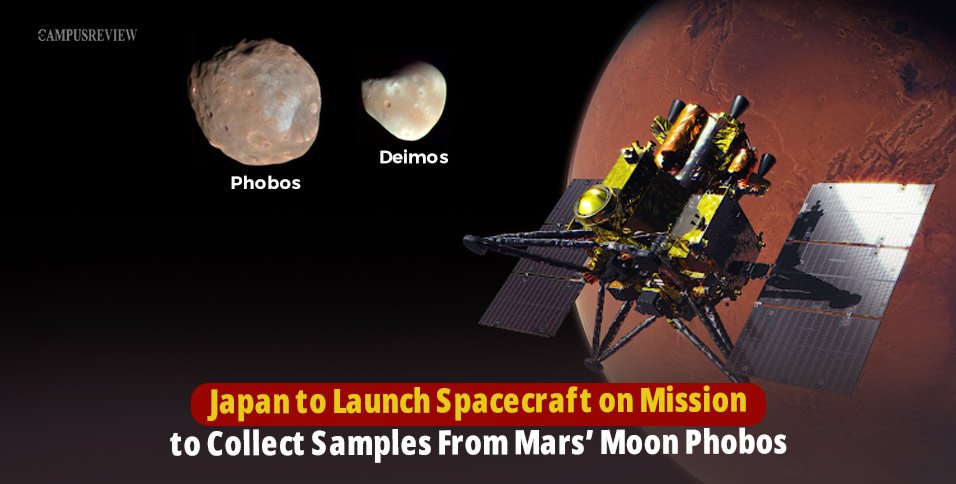
Japan is set to launch a spacecraft on October 20, 2026, as part of its Martian Moons eXploration (MMX) mission to study Mars’s two moons and collect samples from Phobos. The Japan Aerospace Exploration Agency (JAXA) will launch the robotic spacecraft aboard an H3 rocket from Tanegashima Space Center.
The mission aims to return at least 10 grams of material from Phobos to Earth in 2031. Scientists will analyze the samples to investigate the moon’s origins and better understand the evolution of the Martian system.
Mission at a Glance: Key Facts and Figures for Japan to Launch Spacecraft
The following breakdown outlines the planned schedule, target parameters, and mission architecture for the MMX project:
| Mission Parameter | Planned Schedule / Specification |
| Mission Name | Martian Moons eXploration (MMX) |
| Lead Space Agency | Japan Aerospace Exploration Agency (JAXA) |
| Launch Vehicle | H3 Launch Vehicle (Flight No. 10) |
| Launch Site | Tanegashima Space Center, Kagoshima, Japan |
| Scheduled Launch Time | October 20, 2026, at 4:41:03 a.m. JST (October 19, 19:41:03 UTC) |
| Primary Target | Phobos (the larger of Mars’s two moons) |
| Secondary Target | Deimos (remote observations and flybys) |
| Planned Sample Quantity | At least 10 grams of Phobos surface material |
| Target Mars Arrival | August 2027 |
| Surface Operations & Sampling | Rover deployment and two soft-landing sampling operations planned during 2027 to 2030 |
| Planned Earth Return | 2031 (sample recovery capsule targeted in Woomera, Australia) |
Understanding the Origins of Phobos and Deimos
Planetary researchers study Phobos and Deimos to understand how small moons form around rocky inner planets. Scientists currently focus on two leading hypotheses, though neither fully accounts for every observed physical feature:
- The Captured Asteroid Theory: Phobos and Deimos may be asteroids captured by Mars’s gravity early in the solar system.
- -The Giant Impact Theory: A large object may have collided with Mars, sending debris into orbit that later formed the moons.
Analyzing returned samples from Phobos in terrestrial laboratories will allow scientists to measure precise isotopic compositions and mineral structures. Because Phobos orbits close to Mars, impacts on the Martian surface have scattered dust and rock fragments across the moon over billions of years.
Consequently, retrieved regolith could contain native Phobos material along with ancient Martian ejecta, offering vital physical evidence to evaluate both origin theories.
“The Martian moon Phobos remains an unexplored frontier for humankind,” said MMX Project Manager Yasuhiro Kawakatsu.
Scientists hope that analyzing pristine surface material will shed light on how the Martian moons formed, how the Martian system evolved, and how water and organic compounds moved across the terrestrial planets.
The Planned Flight Path: Key Mission Phases
The five-year MMX flight path includes deep-space cruising, complex orbital adjustments, and coordinated surface operations:
1. Launch Phase (October 20, 2026): The H3 rocket carries the multi-module MMX spacecraft into an interplanetary transfer orbit toward Mars.
2. Mars Arrival (August 2027): The spacecraft reaches Mars and performs maneuvers to match its trajectory with Phobos’s orbit.
3. Rover Deployment (2027–2030): From an orbit around Phobos, the spacecraft deploys the IDEFIX rover. The rover studies the surface, tests soil conditions, and helps identify safe sampling sites.
4. Phobos Sampling: After the rover’s surface evaluation, the main spacecraft plans two soft landings to collect at least 10 grams of surface material using its two collection systems.
5. Deimos Flybys (Planned for 2030): The spacecraft leaves Phobos to conduct close flybys and survey Deimos from different angles.
6. Earth Return (Planned for 2031): The spacecraft leaves the Martian system and returns toward Earth. It releases a protected sample capsule for recovery in Australia.
Technical Challenges in Microgravity
Landing on Phobos presents unique challenges due to its low gravity, which is roughly 1/2,000th of Earth’s gravity. A lander touching down too quickly risks rebounding off the surface and escaping back into orbit.
To ensure stability, the lander uses specialized landing gear with integrated shock absorbers. JAXA previously collected samples from asteroids Itokawa and Ryugu. The mission builds on JAXA’s experience with the Hayabusa and Hayabusa2 asteroid-sampling missions while addressing the distinct challenges of operating near Mars and its moons.
International Collaboration and Science Payloads
The MMX mission unites key space agencies to provide specialized instruments, hardware, and tracking support:
- NASA: Supplies the MEGANE (Mars-moon Exploration with GAmma rays and NEutrons) spectrometer to identify surface elemental compositions from orbit. NASA also provides the pneumatic P-Sampler, which uses pressurized gas to collect loose surface material, and supports flight operations through its Deep Space Network.
- JAXA: Builds the core spacecraft modules, manages the launch vehicle, and provides a coring mechanism designed to collect material from beneath the surface.
- CNES and DLR: The French and German space agencies jointly developed the four-wheeled IDEFIX rover, which gathers on-site mobility data to assist the main spacecraft’s landing operations.
- ESA: Provides deep-space communication hardware, including transponders and power amplifiers, along with tracking network support through the European Space Agency’s tracking (Estrack) system.
What to Watch Next
As the October 20 launch approaches, mission teams in Japan and partner centers worldwide are preparing to track the spacecraft’s ascent and entry into orbit.
Japan to launch spacecraft on October 20, 2026, although the timing depends on operational readiness and weather conditions at Tanegashima Space Center, according to JAXA. If the mission proceeds as planned, the spacecraft will reach Mars in August 2027.
It will then begin rover operations and sample collection before returning the samples to Earth in 2031. The mission aims to bring back the first samples collected from a Martian moon.
Pranjal Kharche