The Campus Review
September 8, 2026
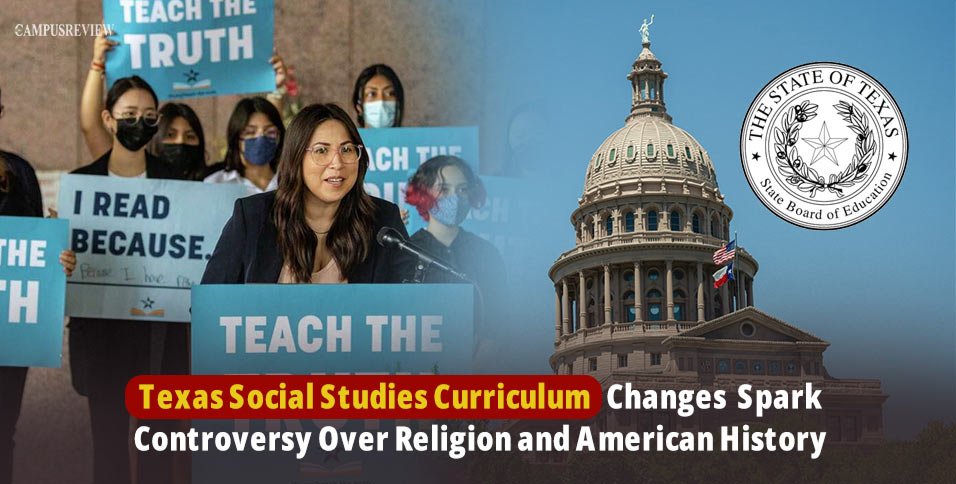
The Texas State Board of Education approved a wide-ranging overhaul of the Texas social studies curriculum for public high schools after extensive public hearings and debate. The elected 15-member board voted along party lines, with the Republican majority advancing the revised standards over opposition from Democratic members. The changes will affect how public schools teach major world religions, American legal traditions, and global conflicts.
The newly approved Texas high school curriculum directs students to examine early Islam through topics including military campaigns and captive practices, while directing students to examine the role of radical Islam in the September 11 terrorist attacks. At the same time, the updated guidelines integrate biblical references into civics coursework and emphasize Judeo-Christian concepts within American jurisprudence. The standards are scheduled for classroom implementation beginning in the 2030-31 school year.
Texas Curriculum Changes at a Glance
| Aspect | Adopted Policy Details |
| Governing Authority | Texas education board (Texas State Board of Education) |
| Grade Levels Affected | High school courses (grades 9 through 12), following earlier K through 8 revisions |
| Key Subjects Covered | U.S. History, World History, World Geography, and U.S. Government |
| Religious Framework | Expands biblical references; focuses early Islamic history on military conflict |
| Classroom Rollout | Scheduled for classroom implementation beginning in the 2030-31 school year |
| Board Vote | Approved along party lines by the Republican majority over Democratic opposition |
Core Changes in the Texas Social Studies Standards
The updated Texas social studies standards, known formally as the Texas Essential Knowledge and Skills (TEKS), establish the learning expectations that guide classroom instruction, instructional materials, and state assessments:
Sure. Here’s a shorter, cleaner version while keeping the key facts:
- Instruction on Islam: Students will examine early Islam through Muhammad’s military campaigns, slavery, and captive practices. The board rejected an amendment to remove the word “brutal” and declined to restore standards on Muslim contributions to astronomy and algebra.
- Radical Islam and Terrorism: The standards direct students to examine the role of “radical Islam” in the September 11, 2001, attacks.
- Christianity and Western Heritage: Students will study Christian influences on Western law, including Blackstone’s views on divine law and the historical role of the Ten Commandments.
- Earlier K-8 Revisions: The high school changes build on earlier revisions, including the removal of the standalone sixth-grade world cultures course in favor of greater focus on American civics and Western traditions.
Debate Over the New Texas High School Social Studies Framework
The public testimony sparked debate among parents, faith groups, historians, and educators. Supporters said the revisions address past omissions and highlight Western civic and religious heritage.
During floor deliberations, Republican board member Brandon Hall defended the specific language used to describe early religious conflicts:
“We’re whitewashing and watering down a part of history that I think is very consequential to understanding world events throughout history, and understanding the context of one of what’s considered one of the major religions of today.”
As reported by FOX 4 Austin, school board member Julie Pickren characterized the approval as the culmination of an extended effort:
“This social studies law that got us here, I’ve been working on for over 10 years with the House and the Senate… and so this is such a huge accomplishment; this vote kind of bookends 12 years of life’s work”.
Board Chairperson Aaron Kinsey emphasized the deliberative nature of the process after days of public hearings:
“There’s been a lot said out of this room, particularly to sensationalize all these topics and to make them seem more divisive than they actually are. Fifteen people sat in the room, and we worked through, democratically, how to make those choices on behalf of our constituents.”
Muslim community leaders and civil rights groups argued that the curriculum unfairly singles out Islam and presents an incomplete view of history. During testimony, Bahia Amawi called for equal academic standards:
“Uphold Islam to the same standard as other religions by teaching students its core principles and contributions. Remove standards that reduce Islam to violence and restore the board’s own written standard about its contribution.”
Following the vote, the Council on American-Islamic Relations (CAIR) Texas chapter sharply criticized the board’s decision in a published release:
“The board has turned our classrooms into a place where prejudice is taught as fact and entire communities are written out of their own history.”
Why the Texas Public School Curriculum Matters Nationwide
The Texas public school curriculum affects more than 5.5 million students, giving the state’s education policies influence beyond Texas.
- Textbook Impact: Publishers often design textbooks to meet Texas standards, which can shape materials used in other states.
- National Influence: Other states may look to Texas as they review their own history and humanities curricula.
- Legal Questions: The changes could raise First Amendment concerns regarding the teaching of religion in public schools. Texas has also faced separate education-related legal disputes, including a lawsuit involving Texas A&M professors.
Long-Term Outlook for Texas Curriculum Changes
The vote concludes a multi-year effort to rewrite Texas social studies standards. While school systems have until the 2030-31 school year to complete textbook procurement and educator training, coalition leaders and civil rights advocates have pledged to challenge the standards through future board elections, administrative appeals, and legal action.
As implementation approaches, the conversation surrounding the Texas social studies curriculum reflects a broader national discussion about how public schools navigate world history, religious literacy, and civic values for future generations.