The Campus Review
September 21, 2026
Italy is preparing new school rules that could limit the number of non-Italian students in individual classes and ban face veils in schools. Prime Minister Giorgia Meloni announced the proposals on September 20 at Fenix, a youth festival organized by her Brothers of Italy party.
The package would also require some parents of foreign students facing serious integration difficulties to learn Italian. The government has not yet announced the exact classroom cap or finalized the legislation.
Italy’s Proposed School Measures
| Key Fact | Details |
| Foreign student cap | Exact percentage has not been announced |
| Face veil ban | Proposed restrictions on burqas and niqabs |
| Parent language courses | Proposed for some parents facing integration difficulties |
| Student population | 931,323 students with non-Italian citizenship in 2024/25 |
| National share | 11.6% of Italy’s student population |
Why Italy Is Proposing the New Rules
Meloni said the government wants to address classrooms where large numbers of students have limited Italian-language skills. She argued that smaller concentrations can make it easier for students to learn Italian and integrate with classmates and teachers.
She announced that the government would set a legal limit on foreign students per class and require some parents to learn Italian if their children face serious difficulties integrating at school.
Meloni said:
“If there is only one child in a class who does not understand Italian, that child will likely learn the language and integrate quickly with the help of classmates and teachers.”
She contrasted this with classrooms where students who do not understand Italian form a large proportion of the class, saying this would no longer represent effective integration.
What the Proposed School Rules Include
The Italy school rules 2026 proposals focus on four main measures:
- Classroom cap: Italy plans to establish a legal maximum for students with non-Italian citizenship.
- Face coverings: The proposal targets full-face coverings such as burqas and niqabs.
- Parent language learning: Some parents may be required to learn Italian when their children experience serious integration difficulties.
- Classroom integration: The government wants to reduce high concentrations of students who have limited Italian-language skills.
The exact percentage for the classroom cap remains unknown.
Scope of the Face Veil Ban in Schools
The proposed face veil ban in schools would target garments that cover the face.
| Garment | Description | Proposed Position |
| Burqa | Covers the body and face, with a mesh screen over the eyes | Proposed restriction |
| Niqab | Covers the face except the eyes | Proposed restriction |
| Hijab | Covers the hair and neck while leaving the face visible | Different from a face veil |
Reuters reported that the proposal would ban burqas and niqabs in schools. The final legislation will determine the precise legal wording and scope of the restriction.
How Many Non-Italian Students Attend Italian Schools?
The proposed Italy foreign student cap comes as non-Italian students make up a significant part of the country’s school population.
Official Italian integration data shows that 931,323 students with non-Italian citizenship attended schools during the 2024/25 school year. They represented 11.6% of all students.
The share varies by school level:
- Primary schools: 13.7%
- Early childhood education: 12.7%
- Lower secondary: 12.6%
- Upper secondary: 8.6%
More than 65% of students with non-Italian citizenship attend schools in northern Italy, according to the same data.
Citizenship figures should not be confused with migrant background. Some students with non-Italian citizenship were born in Italy but have not acquired Italian nationality.
Parent Language Requirements
The proposed language requirement would target specific families rather than automatically applying to every foreign parent.
Who could be affected?
Parents whose children face serious integration difficulties at school.
What is proposed?
Italian-language learning for those parents.
What remains unclear?
- Who will provide the courses?
- How the programs will be funded
- How participation will be monitored
The government has linked the measure to its wider focus on Italian-language learning and school integration.
What Could Be Difficult to Implement?
1. Setting the classroom cap
The government still needs to establish the exact percentage and rules for applying the limit.
2. Managing school enrollment
Schools in areas with high concentrations of non-Italian students could face capacity and transportation challenges if pupils need to be reassigned.
3. Running parent language courses
Authorities will need to clarify funding, course providers and participation requirements.
What Happens Next?
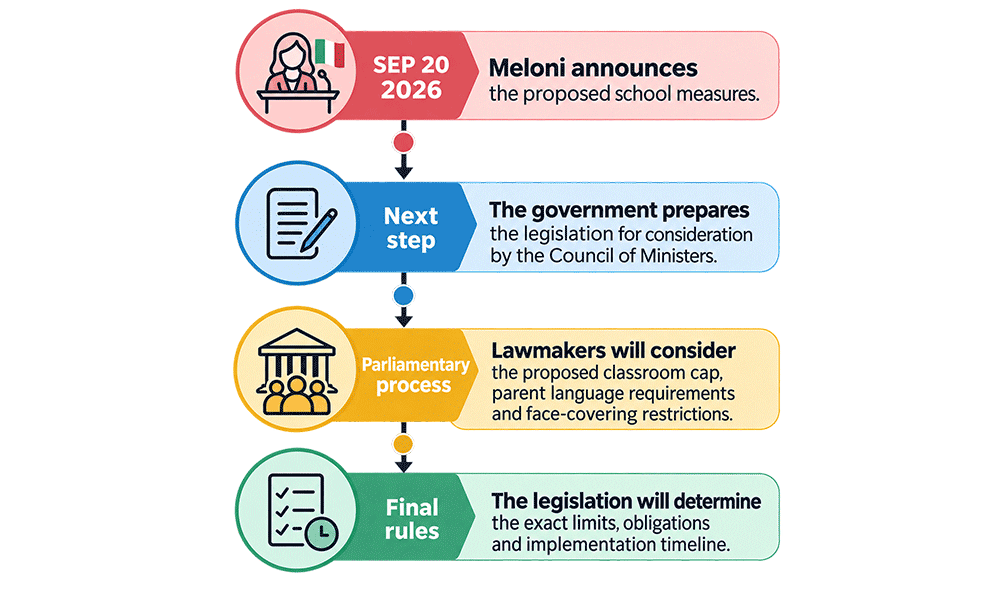
Italy’s proposed reforms would introduce a classroom cap, a face veil ban in schools covering full-face coverings, and Italian-language requirements for some parents.
However, the measures are still proposals, and important details remain undecided.
The biggest unanswered question is the foreign student cap. Until the government publishes the final legal text, schools and families will not know the exact ratio or how the new rules would work in practice.
Also read – University of St. Thomas $1 Billion Fundraising Campaign Receives $82 Million Gift