Biodiversity is the variety of life on Earth, including organisms, their genes, and the ecosystems they form. It supports food, medicine, clean water, and a stable climate.
Biodiversity in ecosystems sustains pollination, nutrient cycling, and water purification. It includes three levels: genetic, species, and ecosystem diversity.
However, habitat loss, climate change, pollution, overexploitation, and invasive species threaten biodiversity. This article covers its types, importance, threats, conservation, and biodiversity hotspots.
What Is Biodiversity?
Biodiversity, or biological diversity, is the variability among all living organisms from all sources, including land, sea, and other aquatic ecosystems, and the ecological systems of which they are part. The Convention on Biological Diversity uses this definition. Biodiversity exists at three scales: genes, species, and ecosystems.
For example, a tropical forest shows all three scales. Trees of one species carry different genes, which affect their resistance to insects. Many species, such as birds, bats, fungi, and insects, live in the forest. The forest also interacts with nearby rivers, soils, and wetlands.
Types of Biodiversity
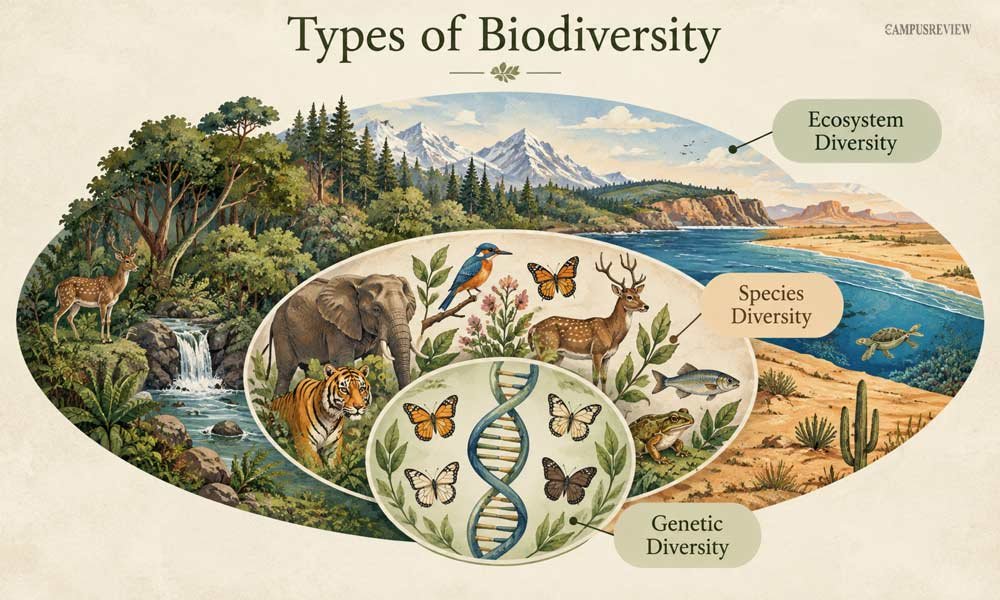
Biodiversity has three types: genetic diversity, species diversity, and ecosystem diversity.
Genetic Diversity
Genetic diversity is the variation in genes among individuals of the same species. Genes carry the instructions for traits such as disease resistance and tolerance to heat or drought. A population with high genetic diversity contains individuals with many different traits, so some individuals usually survive when conditions change. A population with low genetic diversity faces a higher risk of inbreeding and disease.
For example, wild roses (genus Rosa) differ widely in their traits. Rosa rugosa tolerates salty soil and cold. Rosa chinensis gave many garden roses the ability to flower repeatedly. Rosa damascena yields the oil that the perfume industry uses. When wild roses lose habitat, these useful genes disappear.
Species Diversity
Species diversity is the variety and abundance of species in a habitat or region. It has two components. Species richness is the number of different species. Species evenness is the degree to which individuals are distributed equally among those species.
For example, coral reefs cover less than 1% of the ocean floor, yet they support about one quarter of all marine species. Parrotfish graze on algae and keep surfaces free for young corals. If one grazing species declines, another can perform the same function. Ecologists call this functional redundancy.
Ecosystem Diversity
Ecosystem diversity is the variety of habitats, biological communities, and ecological processes in a region or on Earth. Forests, deserts, grasslands, wetlands, rivers, and oceans are different ecosystems, and each performs different functions. Ecosystems also depend on each other. Rivers carry nutrients to the sea, and migratory animals connect distant habitats.
For example, mangrove ecosystems protect coastlines from storms and serve as nurseries for young fish. The loss of mangroves removes both services.
Why Is Biodiversity in Ecosystems Important?
Biodiversity keeps ecosystems healthy and supports food production, clean water, and climate stability.
1. Maintaining Ecosystem Balance
Biodiversity maintains ecosystem balance by supporting food webs and essential ecological processes. The insurance hypothesis suggests that species with similar functions can help ecosystems continue functioning when one species declines.
A keystone species has a disproportionately large effect on its ecosystem. For example, sea otters control sea urchin populations and help protect kelp forests that shelter marine life.
2. Supporting Food Production and Pollination
Pollination enables plants to produce fruits and seeds. Bees, butterflies, bats, and beetles support crop production. IPBES reports that more than 75% of leading food crop types depend at least partly on animal pollinators.
Crop wild relatives also provide useful genes for pest and disease resistance. For example, wild rice (Oryza nivara) has provided resistance to grassy stunt virus in cultivated rice.
3. Providing Natural Resources and Medicines
Biodiversity supplies timber, fibres, rubber, and medicinal compounds. Many medicines originate from natural sources or were inspired by them.
Examples include paclitaxel from the Pacific yew for cancer treatment, artemisinin from sweet wormwood for malaria, and vincristine from Madagascar periwinkle for childhood leukaemia.
4. Regulating Climate and Storing Carbon
Carbon sequestration is the capture and long-term storage of carbon dioxide. Forests, peatlands, wetlands, and oceans act as carbon sinks.
Mangroves, salt marshes, and seagrass beds store carbon in their soils, while phytoplankton absorb carbon dioxide. Diverse forests also support carbon storage and influence rainfall patterns.
5. Protecting Soil and Freshwater
Biodiversity supports soil fertility, water quality, and erosion control. Bacteria, fungi, and earthworms help maintain healthy soils, while mycorrhizal fungi improve plant nutrient uptake.
Nitrogen fixation converts atmospheric nitrogen into forms plants can use. For example, Rhizobium bacteria fix nitrogen in the root nodules of legumes. Wetlands and riverbank vegetation also filter pollutants and reduce soil erosion.
6. Supporting Human Health and Livelihoods
Biodiversity supports human well-being through food, clean water, medicines, and natural resources. Healthy ecosystems also sustain livelihoods linked to agriculture, fisheries, forestry, and ecotourism. Biodiversity loss can therefore threaten food security, income, and access to essential resources.
How Does Biodiversity Support Ecosystems?
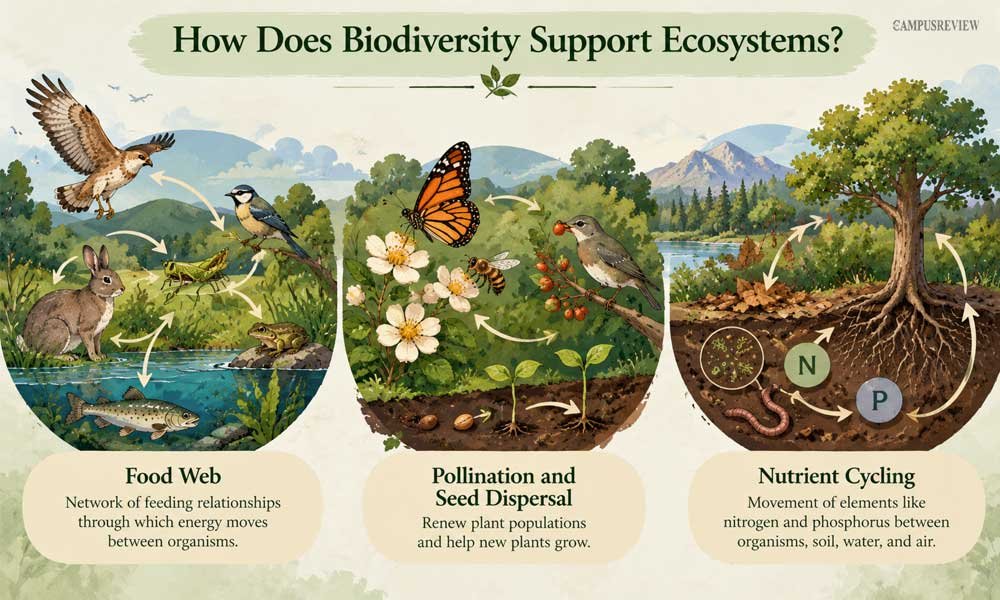
Biodiversity supports ecosystem functioning through three main processes. A food web is the network of feeding relationships through which energy moves between organisms.
Pollination and seed dispersal renew plant populations. Nutrient cycling is the movement of elements such as nitrogen and phosphorus between organisms, soil, water, and air.
Ecosystems with more species generally perform these processes more reliably and recover faster from disturbance.
Forests
Forests have several layers, and each layer supports different species. For example, in tropical forests, fungi and insects decompose fallen leaves, and shallow roots reabsorb the released nutrients. Predators control the numbers of plant eaters, which allows young trees to grow.
Grasslands
Grassland biodiversity is concentrated below ground. Deep roots store carbon and build fertile soil. For example, grazing animals return nitrogen to the soil through dung, and burrowing animals loosen the soil.
Freshwater Habitats
Freshwater habitats cover a small part of Earth but support a large share of animal species. For example, fallen leaves feed aquatic insects, and the insects feed fish, frogs, and birds. Freshwater mussels filter the water and keep it clear.
Marine Ecosystems
Marine food webs begin with phytoplankton, which are microscopic organisms that photosynthesise. For example, phytoplankton feed zooplankton and small fish, which feed larger fish, seabirds, and whales. Dead organisms sink and supply energy to life on the seabed.
What Are Biodiversity Hotspots?
A biodiversity hotspot is a biogeographic region that contains a very high number of endemic species and has lost most of its natural vegetation. Endemic species live in one region and nowhere else. Hotspots identify the areas where conservation can protect the most species.
A region must meet two criteria to qualify:
Plant endemism: The region must contain at least 1,500 species of vascular plants that occur nowhere else. This number equals more than 0.5% of the world’s plant species. Vascular plants have tissues that carry water and nutrients.
Habitat loss: The region must have lost at least 70% of its original natural vegetation.
Norman Myers identified the first 10 hotspots in 1988. Conservation International adopted the concept in 1989 and later extended the list. Current research shows the following:
- The world has 36 biodiversity hotspots.
- The hotspots cover only about 2.5% of Earth’s land surface.
- They contain more than half of the world’s endemic plant species and nearly 43% of endemic birds, mammals, reptiles, and amphibians.
- India has four hotspots: the Himalaya, Indo-Burma, the Western Ghats and Sri Lanka, and Sundaland, which includes the Nicobar Islands.
Important hotspots include the following:
Tropical Andes: This hotspot has about 15,000 endemic plant species. Farming, mining, and grazing threaten it.
Western Ghats and Sri Lanka: The purple frog and the lion-tailed macaque live here. Plantations and dams cause habitat loss.
Madagascar: All lemur species are endemic to the island. Slash-and-burn farming and logging reduce the forest.
Sundaland: The Bornean orangutan lives here. Oil palm plantations have replaced large forest areas.
Examples of Biodiversity
The following regions show biodiversity on land and in the sea.
- Amazon Basin: It is the largest tropical rainforest on Earth. It contains roughly 10% of all known species, including more than 40,000 plant species.
- Coral Triangle: This marine region lies between Indonesia and the Solomon Islands. It contains over 600 species of reef-building corals, about three quarters of the global total.
- Serengeti-Mara: This savanna ecosystem in Tanzania and Kenya supports over 1.5 million wildebeest, along with zebras, gazelles, and large predators. These grazers feed on different parts of the same plants, which reduces competition.
- Boreal peatlands: These wetlands lie in northern Canada, Europe, and Siberia. Sphagnum moss forms waterlogged soil that stores large amounts of carbon.
What Are the Major Threats to Biodiversity?
IPBES identifies five major direct drivers of biodiversity loss: land and sea use change, overexploitation, climate change, pollution, and invasive species.
Habitat Loss and Fragmentation
Habitat loss occurs when natural areas are destroyed or converted for human use. Fragmentation divides habitats into smaller, isolated patches, restricting animal movement and gene exchange.
- Agricultural expansion: Farming is a major cause of habitat loss. More than one-third of the world’s land surface produces crops or livestock.
- Wetland loss: More than 85% of wetlands present in 1700 had disappeared by 2000.
- Isolation: Roads and dams separate populations, increasing inbreeding risks.
Climate Change
Rising temperatures and changing weather patterns force species to shift habitats and disrupt seasonal events. Marine heatwaves cause coral bleaching, while ocean acidification makes it harder for corals and shellfish to build skeletons and shells. Forest loss can also release stored carbon and worsen global warming.
Pollution
Pollution harms wildlife and disrupts ecosystems in several ways:
- Nutrient pollution: Fertiliser runoff causes algal blooms and oxygen-depleted dead zones.
- Chemical pollution: Pesticides and heavy metals accumulate in organisms and food chains.
- Plastic and wastewater: Plastic harms wildlife, while untreated wastewater contaminates aquatic habitats.
Overexploitation of Natural Resources
Overexploitation occurs when resources are harvested faster than populations can recover. Overfishing reduces marine populations, while poaching threatens elephants, rhinoceroses, and pangolins. Unsustainable hunting can also disrupt seed dispersal and forest regeneration.
Invasive Species
Invasive species are non-native organisms that spread and harm native species or ecosystems. They can outcompete native wildlife, spread diseases, and disrupt food webs.
- Brown tree snake: Eliminated most native forest birds on Guam.
- Chytrid fungus: Has caused major declines in amphibian populations.
- Lantana camara: Spreads through forests and restricts the growth of native trees.
How Can We Conserve Biodiversity?
Biodiversity conservation is the protection and sustainable use of biodiversity in ecosystems. It has two main strategies: in-situ conservation and ex-situ conservation. Individual action supports both.
In-Situ Conservation
In-situ conservation is the protection of species in their natural habitats. The main tools are national parks, wildlife sanctuaries, biosphere reserves, and marine protected areas. These protected areas limit mining, logging, and industrial fishing. Wildlife corridors reconnect fragmented habitats and allow animals to move between them.
Under the Kunming-Montreal Global Biodiversity Framework, countries have agreed to protect at least 30% of land, inland waters, and seas by 2030. This target is known as “30×30”. IPBES also reports that Indigenous Peoples and local communities manage at least a quarter of the world’s land, so their knowledge contributes to species conservation.
Ex-Situ Conservation
Ex-situ conservation is the protection of species outside their natural habitats. It acts as a safeguard against extinction. The main methods are:
- Seed banks: These facilities store seeds at low temperatures. Examples include the Svalbard Global Seed Vault in Norway and the Millennium Seed Bank at Kew in the United Kingdom.
- Botanical gardens: These gardens keep living collections of threatened plants.
- Captive breeding: Zoos and breeding centres raise endangered animals for release. This method helped save the California condor, the Arabian oryx, and the black-footed ferret.
| Feature | In-situ conservation | Ex-situ conservation |
| Location | Natural habitat | Seed banks, gardens, zoos, laboratories |
| Main methods | Parks, sanctuaries, corridors, marine reserves | Seed vaults, captive breeding, gene banks |
| Advantage | Keeps natural interactions and evolution going | Provides a backup for species at risk of extinction |
| Limitation | Needs large, protected areas | Cannot replace a wild ecosystem |
How Individuals Can Help Conserve Biodiversity
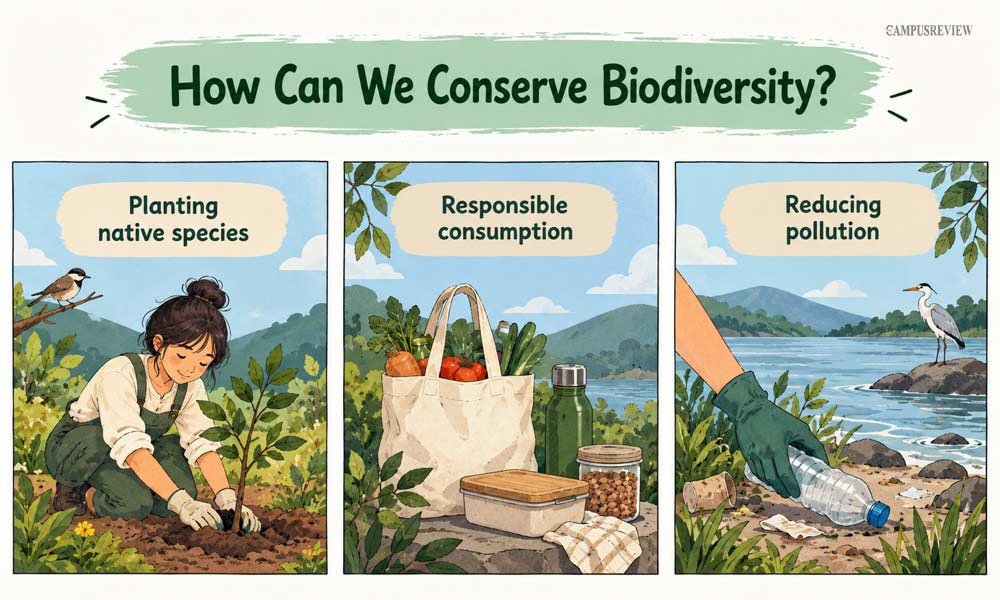
Individuals can support biodiversity conservation through the following actions:
Planting native species: Native plants provide food and shelter for local pollinators and birds.
Responsible consumption: Choose certified products, such as FSC wood, RSPO palm oil, and MSC seafood, to reduce pressure on forests and fisheries.
Reducing pollution: Lower use of plastic, pesticides, and chemicals reduces harm to habitats.
Preventing invasions: Cleaning boots and gear after trips and avoiding the release of pet fish or exotic plants stops the spread of invasive species.
Citizen science: Recording sightings on iNaturalist or eBird supports research and restoration.
Final Thoughts
Biodiversity in ecosystems consists of genetic, species, and ecosystem diversity, and it supports food production, medicine, climate regulation, and healthy soil and water. Habitat loss, climate change, pollution, overexploitation, and invasive species threaten it. In-situ and ex-situ conservation, global protection targets, and responsible individual choices can slow this decline.
Pranjal Kharche
Frequently Asked Questions About Biodiversity
1. How many species live on Earth?
Scientists estimate that Earth has about 8 million animal and plant species, but only a fraction have been formally described. IPBES estimates that about one million species face extinction.
2. What is the difference between biodiversity and an ecosystem?
Biodiversity is the variety of genes, species, and ecosystems, while an ecosystem is a community of organisms interacting with their non-living environment. For example, a coral reef is an ecosystem, and its variety of corals, fish, and genetic traits represents its biodiversity.
3. What are megadiverse countries?
Megadiverse countries are 17 nations that collectively contain a large share of the world’s biodiversity and endemic species. India is one of them and includes four biodiversity hotspots: the Himalaya, Indo-Burma, the Western Ghats and Sri Lanka, and Sundaland.
4. Which international agreements protect biodiversity?
The Convention on Biological Diversity (CBD), adopted in 1992, aims to conserve biodiversity, promote its sustainable use, and ensure fair sharing of benefits from genetic resources. In 2022, countries adopted the Kunming-Montreal Global Biodiversity Framework, which includes the target of conserving 30% of land and sea areas by 2030.