Have you ever said “c’est la vie” after a bad day? Then you already use French phrases. English borrows hundreds of them, and most people use them without a second thought.
French phrases are expressions that English speakers take straight from French. They keep the original spelling and sound. The Norman Conquest of 1066 started this trend. Food, fashion, art, and travel kept it going.
This guide covers 25 popular French phrases used in English with meanings and example sentences for everyday conversations, dining, feelings, and culture. Listen to audio pronunciations to learn how to say each French phrase correctly.
What Are French Phrases Used in English?
French phrases used in English are expressions borrowed from French that often retain their original form and meaning. Examples include c’est la vie (that’s life) and bon voyage (have a good trip).
Dictionaries such as Merriam-Webster and Cambridge Dictionary list many of them as foreign phrases.
French words in English fall into two groups. Some words changed to fit English spelling. Phrases kept their French shape. Learners often call the phrases French idioms, even though each one has its own history.
French Loanwords vs French Expressions
French-origin words and French phrases are not the same thing. Read the table to see the difference.
| Feature | French-origin words | French phrases |
| Spelling | English style, often no accents | French spelling, often with accents |
| Sound | Usually English pronunciation | Close to the French sound |
| Feels like | Normal English | A stylish extra touch |
| Examples | garage, menu, ballet | faux pas, c’est la vie, touché |
This blog focuses on phrases.
25 French Phrases With Meanings and Examples
This guide covers 25 popular French phrases used in English with meanings, simple example sentences, and easy french pronunciation guides. Capital letters mark the stressed syllables, and audio examples help you practise saying each phrase correctly.
Common French Phrases
1. C’est la vie
- Meaning: “That’s life.” People say it when they accept bad luck or a small setback.
- Example: I missed the bus, but c’est la vie. I will walk.
- Pronunciation: say lah VEE
🎧 Listen to the Pronunciation
Click play to listen Pronunciation: say lah VEE.
2. Déjà vu
- Meaning: “Already seen.” It describes the odd feeling that you have lived this moment before.
- Example: I walked into the new café and felt strong déjà vu.
- Pronunciation: day-zhah VOO
🎧 Listen to the Pronunciation
Click play to listen Pronunciation: day-zhah VOO.
3. Faux pas
- Meaning: “False step.” It means a social mistake, such as saying the wrong thing by accident.
- Example: Wearing casual clothes to a formal dinner was a faux pas.
- Pronunciation: foh PAH
🎧 Listen to the Pronunciation
Click play to listen Pronunciation: foh PAH.
4. Je ne sais quoi
- Meaning: “I don’t know what.” It names a special quality you like but cannot explain.
- Example: That old bookshop has a je ne sais quoi that I love.
- Pronunciation: zhuh nuh say KWAH
🎧 Listen to the Pronunciation
Click play to listen Pronunciation: uh nuh say KWAH.
5. Fait accompli
- Meaning: “Accomplished fact.” It means something is already done, so nobody can change it.
- Example: The school announced the new timetable as a fait accompli.
- Pronunciation: fay-tah-kom-PLEE
🎧 Listen to the Pronunciation
Click play to listen Pronunciation: fay-tah-kom-PLEE.
6. Raison d’être
- Meaning: “Reason for being.” It means the main purpose of a person, group, or thing.
- Example: Helping students is the club’s raison d’être.
- Pronunciation: ray-zohn DET-ruh
🎧 Listen to the Pronunciation
Click play to listen Pronunciation: ray-zohn DET-ruh.
7. Vis-à-vis
- Meaning: “Face to face” in French. English speakers use it to mean “compared with” or “in relation to.”
- Example: Her scores look strong vis-à-vis last year’s results.
- Pronunciation: vee-zah-VEE
🎧 Listen to the Pronunciation
Click play to listen Pronunciation: vee-zah-VEE.
8. À propos
- Meaning: “To the point.” It means fitting for the moment, or “about” a topic.
- Example: Her comment was à propos, so everyone nodded.
- Pronunciation: ah-proh-POH
🎧 Listen to the Pronunciation
Click play to listen Pronunciation: ah-proh-POH.
9. Touché
- Meaning: “Touched.” You say it when someone makes a clever point against you.
- Example: You said I never cook. Touché. I only boil noodles.
- Pronunciation: too-SHAY
🎧 Listen to the Pronunciation
Click play to listen Pronunciation: too-SHAY.
10. Bon voyage
- Meaning: “Good journey.” It wishes someone a safe and happy trip.
- Example: We waved at the station and shouted, “Bon voyage!”
- Pronunciation: bohn vwah-YAHZH
🎧 Listen to the Pronunciation
Click play to listen Pronunciation: bohn vwah-YAHZH.
French Food and Dining Phrases
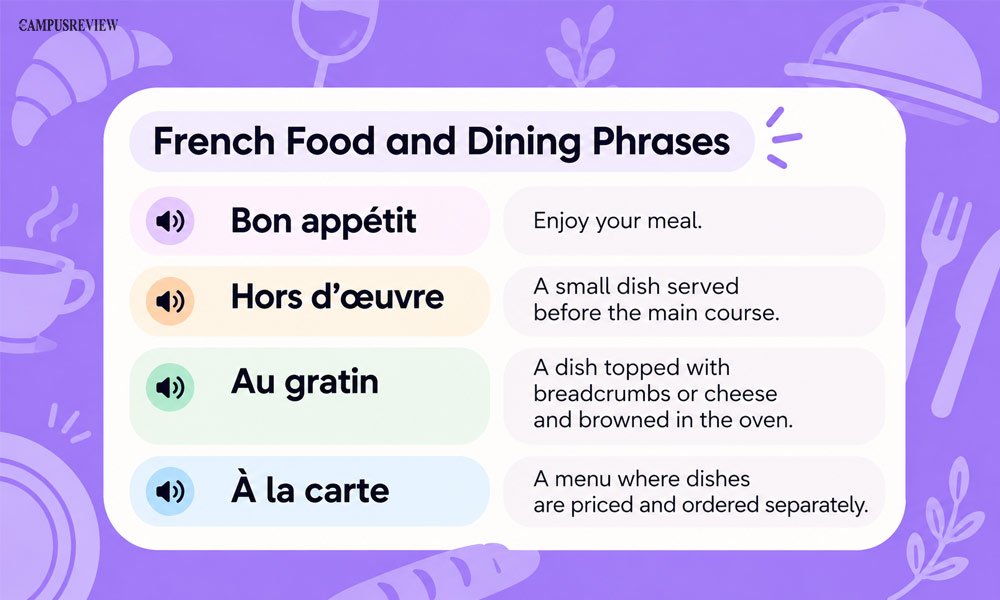
French food phrases show up on menus around the world. These five help you order and enjoy a meal with confidence.
11. Bon appétit
- Meaning: “Good appetite.” It wishes someone an enjoyable meal.
- Example: She set the pasta down and said, “Bon appétit!”
- Pronunciation: bohn ah-pay-TEE
🎧 Listen to the Pronunciation
Click play to listen Pronunciation: bohn ah-pay-TEE.
12. Hors d’œuvre
- Meaning: “Outside the work.” It means a small starter served before the main meal.
- Example: The caterer served mini samosas as the hors d’œuvre.
- Pronunciation: or-DERV
🎧 Listen to the Pronunciation
Click play to listen Pronunciation: or-DERV.
13. Au gratin
- Meaning: A dish topped with cheese or breadcrumbs and baked until golden.
- Example: We ate potatoes au gratin for dinner.
- Pronunciation: oh GRAH-tahn
🎧 Listen to the Pronunciation
Click play to listen Pronunciation: oh GRAH-tahn.
14. À la carte
- Meaning: “By the menu.” You order each dish separately and pay for each one.
- Example: The restaurant lets you order à la carte or pick the set lunch.
- Pronunciation: ah lah KART
🎧 Listen to the Pronunciation
Click play to listen Pronunciation: ah lah KART.
15. Pièce de résistance
- Meaning: “Piece of resistance.” It means the standout item, the best part of something.
- Example: The chocolate cake was the pièce de résistance of the party.
- Pronunciation: pyess duh ray-zee-STAHNS
🎧 Listen to the Pronunciation
Click play to listen Pronunciation: pyess duh ray-zee-STAHNS.
French Phrases Used to Describe People and Feelings
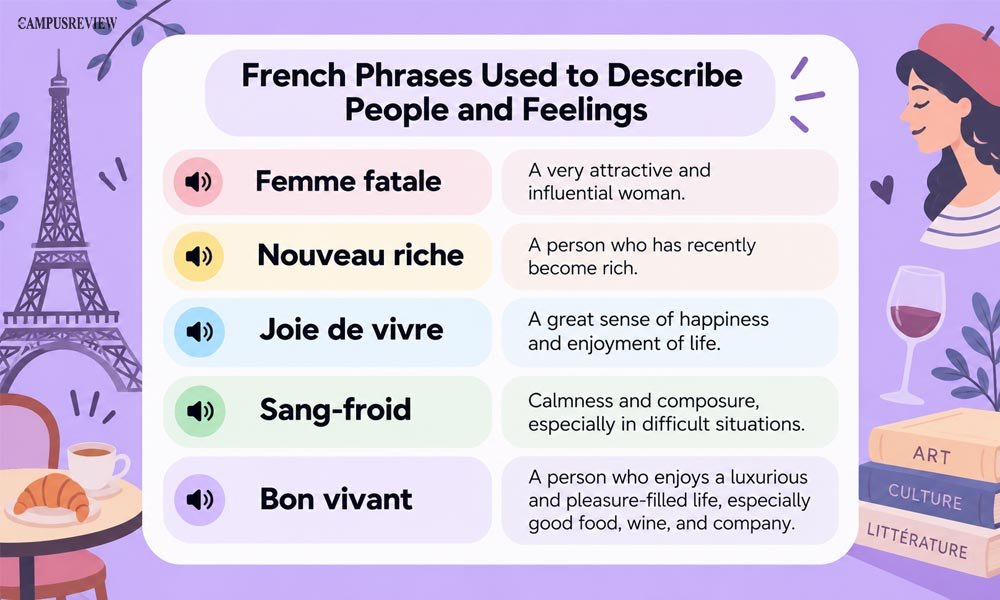
French phrases for describing people give English short, sharp labels. Use them carefully, because some carry a hidden tone.
16. Bon vivant
- Meaning: “Good liver.” It means a person who enjoys good food, drink, and company.
- Example: Uncle Raj is a bon vivant who loves long dinners.
- Pronunciation: bohn vee-VAHN
🎧 Listen to the Pronunciation
Click play to listen Pronunciation: bohn vee-VAHN.
17. Femme fatale
- Meaning: “Deadly woman.” It means a charming woman who leads others into trouble.
- Example: The movie’s femme fatale tricks the detective.
- Pronunciation: fem fah-TAL
🎧 Listen to the Pronunciation
Click play to listen Pronunciation: fem fah-TAL.
18. Nouveau riche
- Meaning: “New rich.” It means people who became wealthy recently.
- Example: Old money families sometimes call new millionaires nouveau riche.
- Pronunciation: noo-voh REESH
🎧 Listen to the Pronunciation
Click play to listen Pronunciation: noo-voh REESH.
19. Joie de vivre
- Meaning: “Joy of living.” It means a cheerful love of life.
- Example: My grandmother’s joie de vivre lights up every family trip.
- Pronunciation: zhwah duh VEE-vruh
🎧 Listen to the Pronunciation
Click play to listen Pronunciation: zhwah duh VEE-vruh.
20. Sang-froid
- Meaning: “Cold blood.” It means calm in a crisis.
- Example: The pilot showed great sang-froid during the storm.
- Pronunciation: sahn FRWAH
🎧 Listen to the Pronunciation
Click play to listen Pronunciation: sahn FRWAH.
French Phrases Used in Art, Culture and Everyday English
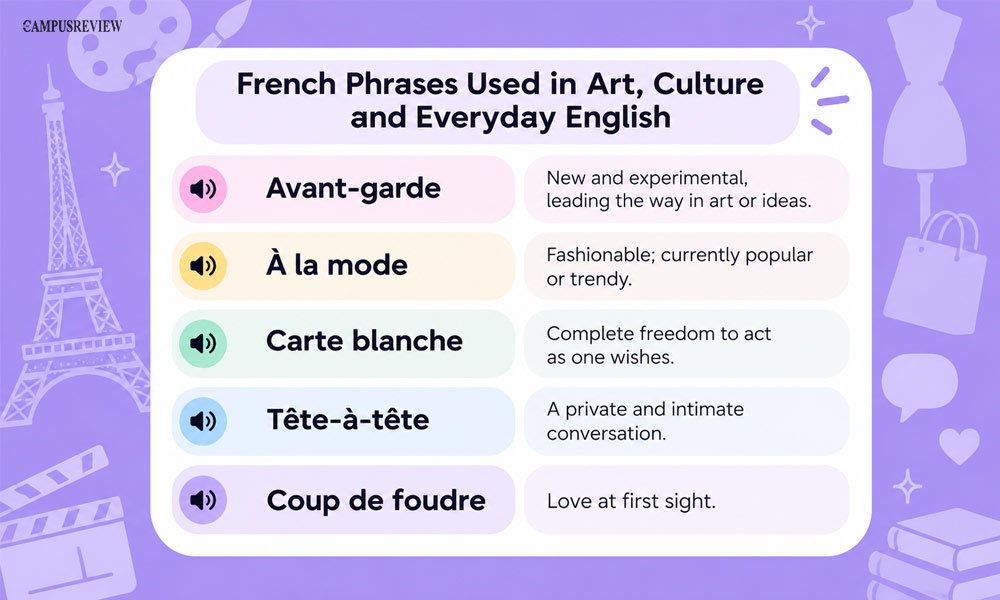
These popular French expressions appear in galleries, fashion shows, and love stories.
21. Avant-garde
- Meaning: “Advance guard.” It means new, bold ideas, especially in art, music, and fashion.
- Example: The gallery shows avant-garde paintings by young artists.
- Pronunciation: ah-vahn GARD
🎧 Listen to the Pronunciation
Click play to listen Pronunciation: ah-vahn GARD.
22. À la mode
- Meaning: “In the fashion.” It means stylish and trendy.
- Example: Long coats are à la mode this winter.
- Pronunciation: ah lah MOHD
🎧 Listen to the Pronunciation
Click play to listen Pronunciation: ah lah MOHD.
23. Carte blanche
- Meaning: “White card,” or a blank card. It means full freedom to decide.
- Example: The editor gave me carte blanche to design the page.
- Pronunciation: kart BLAHNSH
🎧 Listen to the Pronunciation
Click play to listen Pronunciation: kart BLAHNSH.
24. Tête-à-tête
- Meaning: “Head to head.” It means a private chat between two people.
- Example: The principal had a tête-à-tête with the new teacher.
- Pronunciation: tet-ah-TET
🎧 Listen to the Pronunciation
Click play to listen Pronunciation: tet-ah-TET.
25. Coup de foudre
- Meaning: “Stroke of lightning.” It means love at first sight.
- Example: Meeting her was a coup de foudre for him.
- Pronunciation: koo duh FOO-druh
🎧 Listen to the Pronunciation
Click play to listen Pronunciation: koo duh FOO-druh.
How Can You Learn and Use French Phrases With Confidence?
You can learn French phrases for students and everyday conversations with a few simple steps:
1. Learn sound and meaning together. Say each phrase aloud using the pronunciation guide, then learn its English meaning.
2. Pick one phrase a week. Use it in a sentence at school, at work, or in a chat.
3. Match the tone. “Touché” and “c’est la vie” suit casual conversations, while “vis-à-vis” can fit formal writing.
4. Check spelling in a dictionary. Copy accents correctly when using French phrases in essays or exams.
5. Use phrases sparingly. One French phrase can add style to a paragraph, but too many may sound forced.
Like English idioms, French phrases often express ideas beyond their literal meanings, so understanding the context helps you use them naturally.
What Mistakes Do People Make With French Phrases?
| Phrase | Common mistake | Better use |
| Faux pas | Using it for any mistake | Use it for social blunders only |
| Vis-à-vis | Using it only as “face to face” | Use it as “compared with” or “about” |
| Nouveau riche | Using it as a neutral label | Know that it can sound rude |
| À la mode | Missing the ice cream meaning | Check the context: style or dessert |
Final Thoughts
French phrases add style, humour, and precision to English. You now know 25 of them, with meanings, quick facts, and examples. Start small. Pick three phrases from this list, say them aloud, and use them this week. Soon, c’est la vie will feel like your own phrase.
Pranjal Kharche
Frequently Asked Questions
1. Should you write French phrases in italics?
Not always. English dictionaries treat common phrases like “faux pas” and “bon voyage” as English, so most writers use plain text. Less common phrases often get italics. Check the style guide of your platform and stay consistent.
2. Can you use French phrases in formal writing?
Yes, in small amounts you can use french phrases in formal writing. Phrases like “vis-à-vis,” “à propos,” “raison d’être,” and “fait accompli” fit essays and reports.
3. What is the difference between à la carte and prix fixe?
À la carte means you order each dish separately and pay for each one. Prix fixe means “fixed price.” You get a set meal for one price, and the restaurant often limits your choices.
4. Do French phrases mean the same thing in France?
Not always. English changed some meanings over time. “Vis-à-vis” means “facing” in French, but English speakers use it for “compared with.” “À la mode” means “in fashion” in France, but in the US it often means “served with ice cream.”
5. How do you type French accents on a keyboard?
On a Mac, hold the letter key (for example, e) and pick the accent from the pop-up. On Windows, switch to the US-International keyboard layout, or type Alt + 0233 for é. On a phone, press and hold the letter.