
Your recruiter just said the number. Your hands go a little cold. You want to say something back, but you nod and say, “Sounds great.” Sound familiar?
You should negotiate your salary. Most employers expect it and plan for it. Fewer employers than you think ever pull an offer over a polite, well-prepared counter. The real risk is not asking.
A small gap in your starting salary compounds over time, since raises, bonuses, and future offers all get calculated from your current base salary.
This guide breaks down how to negotiate a salary step by step. You get scripts, email templates, and real examples.
Salary Negotiation Tips You Should Know
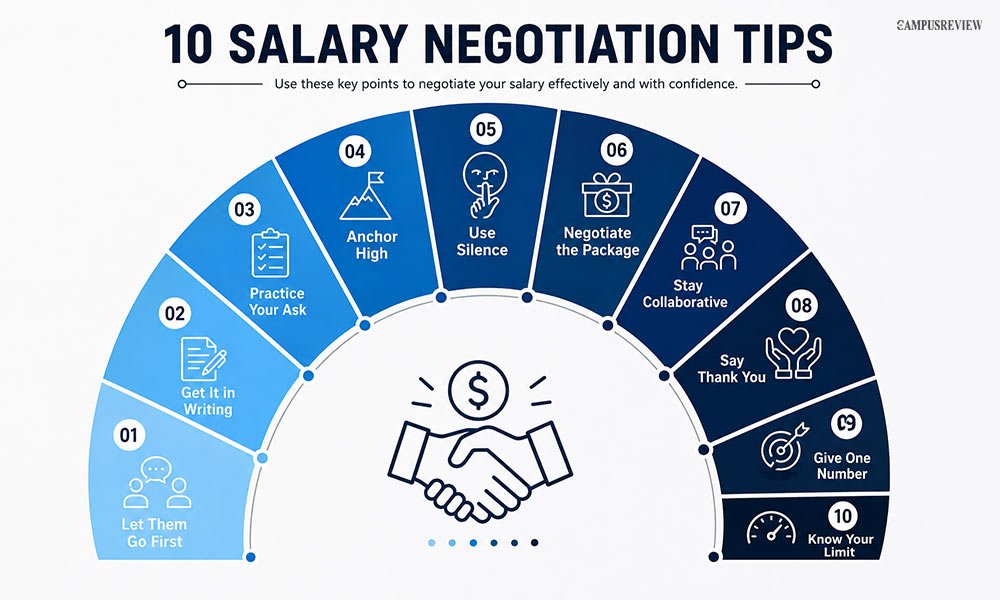
These tips will help you understand how to negotiate a salary professionally in almost any hiring situation.
- Let them go first. If you can avoid it, do not name a number before the employer does. Whoever states a number first sets the anchor for the rest of the conversation.
- Put your ask in writing. Even after a verbal conversation, follow up with an email that confirms the numbers you discussed.
- Practice out loud. Say your ask to a friend or in front of a mirror first. It sounds different out loud than it does in your head.
- Anchor slightly high. Open with your stretch number, not your target number, so you have room to settle in the middle.
- Use silence on purpose. State your number, then stop talking. Resist the urge to fill the pause or apologize for it.
- Negotiate the whole package. Base salary is just one line item. Bonus, equity, PTO, and benefits are all on the table too.
- Stay collaborative, not combative. Frame every ask as finding a fit that works for both sides, not as a demand.
- Say thank you either way. Whether the employer says yes or no, a gracious response protects the relationship.
- Give one clear number. A vague range invites a vague answer. Lead with a specific figure backed by research.
- Know your walk-away point. Decide the lowest offer you would accept before you start talking, so you never decide it under pressure.
What to Say When a Recruiter Asks Your Salary Expectations Early
Recruiters often ask for a number before you have even seen the role in detail. Do not give one yet. Deflect politely and turn the question back to them.
Recruiter: “What are your salary expectations for this role?”
You: “That’s a great question. I’m still learning about the day-to-day responsibilities and the full benefits package, so my expectations are flexible right now. I care most about finding a strong fit. Could you share the budgeted range for this position?”
How to Research Your Market Value Before You Negotiate
Research is the foundation of how to negotiate a salary successfully because it gives you evidence to support your request.
Employers respect numbers backed by research, not gut feeling.
| Platform | Best For | Keep in Mind |
| Glassdoor | Company-specific pay ranges | Numbers are self-reported and can be outdated |
| Levels.fyi | Tech roles with equity and bonuses | Skewed toward big tech firms and metro cities |
| LinkedIn Salary | Quick industry benchmarks | Ranges are broad, not company-specific |
| Government labour data | Verified, unbiased numbers by role and region | Updates slowly and skips equity or bonus data |
Check at least three sources before you settle on a number. Compare the same job title, the same experience level, and the same city each time.
Three Numbers Every Negotiation Needs
- Walk-away number: The lowest offer you would still accept.
- Target number: A fair figure backed by your research.
- Stretch number: Your opening ask, slightly above target, so there is room to meet in the middle.
How to Negotiate a Salary After a Job Offer: Step-by-Step
Once the offer lands in your inbox, follow this sequence. It works for freshers, career switchers, and internal promotions alike.
- Say thank you and buy time. Show enthusiasm, then ask for two to three days to review the full offer.
- Get everything in writing. Ask for base salary, bonus, equity, and benefits in one document.
- Research your number. Use the platforms above to build your target and stretch numbers.
- Build your case. List achievements, skills, and market data that support your ask.
- Make your ask. Use a script or email, and always propose one clear number, not a vague range.
- Handle pushback calmly. Listen to objections and pivot to other benefits if base salary is fixed.
Quick Comebacks for Common Employer Lines
| If the Employer Says… | You Can Respond… |
| “That’s our final offer.” | “Would you be open to discussing other benefits?” |
| “The budget is fixed.” | “Could we consider a signing bonus?” |
| “We’ll review salaries later.” | “Can we agree on a performance review in six months?” |
Quick tip: keep your counteroffer email under 200 words. A short, confident message reads better than a long explanation.
Salary Negotiation Scripts and Email Examples
Use these salary negotiation scripts and email templates as a starting point. Swap in your own numbers, company name, and achievements before you send anything.
Salary Negotiation Script for a Verbal Offer Call
Hiring Manager: “We’d like to offer you the position at a base salary of $95,000.”
You: “Thank you so much. I’m genuinely excited about this role and the team. Before I give you a final answer, could you send the complete offer in writing, including base pay, bonus, and benefits? I want to review it properly. Can I get back to you by Friday?”
Script for When Base Salary Is Fixed
You: “I appreciate the transparency around the base salary constraints. Since base pay is fixed, I would love to explore other ways to align the overall package with my market value. Would the team be open to a sign-on bonus, or an extra week of paid time off?”
| Benefit | Why It Helps |
| Sign-on bonus | One-time cash that bridges the gap |
| Extra paid time off | More time off without changing base pay |
| Early performance review | A faster path to your next raise |
| Remote or hybrid days | Saves commute time and cost |
| Learning budget | Funds courses and certifications |
Salary Negotiation Script for Freshers
You: “Thank you for the offer. I’m excited to start my career here. Based on my research and the certifications I completed in [skill area], I was hoping we could look at a base salary closer to $[Number]. I’m confident I can contribute from day one.”
As a fresher, lean on internships, projects, and certifications instead of years of experience. Numbers still matter more than feelings, so bring whatever data you have.
Your negotiation starts long before the offer call. A strong phone interview and a sharp cover letter build the confidence recruiters see in you.
Once you land the offer, a polished LinkedIn profile backs up every number you ask for, and a well-built resume for your first job gets you to the offer stage faster.
Email Templates:
If you’re wondering how to negotiate a salary over email, use these templates as a starting point.
Salary Negotiation Email Example (Standard Counteroffer)
Subject: Re: Offer
Hi [Name],
Thank you again for the written offer. I’m genuinely excited about the opportunity to join [Company] and help the team with [specific project discussed in interviews].
Based on my research of market rates for this role in [City], and my experience in [specific skill], I would like to propose a base salary of $[Number]. This aligns with current industry standards for this scope of work.
I understand budgets can be tight. If the base salary is firm, I am open to discussing a sign-on bonus or an accelerated six-month performance review instead.
I’m eager to move forward and confident we can find a package that works well for both of us.
Best regards,
[Your Name]
Salary Negotiation Email Example (With a Competing Offer)
Subject: Re: Offer
Hi [Name],
Thank you for putting the offer together. [Company] remains my first choice because of the team and the work.
To be transparent, I have received a competing offer with a higher total compensation package. I genuinely prefer this opportunity and believe I can make an immediate impact here.
Would it be possible to revisit the base salary and sign-on bonus? I would be glad to sign right away if we can close the gap.
Best regards,
[Your Name]
How to Handle Common Recruiter Objections
Understanding how to negotiate a salary also means preparing for common objections from recruiters. Here is what they usually mean, and how to respond.
| Objection | What to Say |
| “We don’t have budget for a higher base.” | “I understand base bands are fixed. Could we look at a sign-on bonus instead?” |
| “This is our standard offer for this level.” | “I respect that you use standard bands. Given my [skill or certification], is there room to place me higher within that band?” |
| “We have other candidates ready to accept.” | “I’m excited about this role and confident I can add value quickly. If we can align on the package, I’m ready to sign right away.” |
Mistakes to Avoid When You Negotiate a Salary Offer
Many candidates know how to negotiate a salary, but avoidable mistakes still weaken their position.
- Do not apologize for asking. You are not doing anything wrong.
- Do not lie about a competing offer. Recruiters can find out, and it damages trust.
- Do not negotiate over text message. Keep it to email or a call.
- Do not accept on the spot. Always ask for time to review the full offer.
- Do not make it personal. Base every ask on data and value, not personal expenses.
- Do not ask for changes one at a time. List all your requests together in one message.
Final Thoughts
Salary negotiation is a professional discussion, not a confrontation. Employers often expect candidates to ask thoughtful questions about compensation.
Once you know how to negotiate a salary, every future job offer becomes an opportunity to secure compensation that reflects your value.
Use the scripts and strategies in this guide. Tailor them to your situation. Approach your next offer with confidence.
FAQ
1. Can you negotiate salary more than once?
Yes, you can negotiate salary more than once if the employer presents a revised offer. Avoid repeated requests after both parties agree on the final compensation.
2. Can you negotiate salary if the job posting says the pay is fixed?
Yes, but the employer may not increase the base salary. Instead, negotiate benefits like a signing bonus, extra paid leave, or flexible work options.
3. Should you negotiate salary before or after accepting a job offer?
Negotiate your salary before accepting the job offer. Once you accept, employers are less likely to revise the compensation package.
4. What is the best way to respond to a low salary offer?
Thank the employer for the offer, then explain your expected salary using market research and your qualifications. Keep your response professional and respectful.